Understanding the Small Intestine: Anatomy, Function, and Digestive Health

Updated: 2 days ago
Medically reviewed by Dr. Baraa Alnahhal, MD · Last reviewed: October 17, 2026
Quick Answer
The small intestine is a coiled tube about 22 feet long between the stomach and the large intestine. [1] It uses digestive juices and enzymes to break food down, [1] then absorbs nutrients and water into the bloodstream. It is only about 2 centimeters wide, and more than 90% of the nutrients and water your body takes in are absorbed here. [1]
What the research says
About 1 in 120 people worldwide has biopsy-confirmed celiac disease, and many have no symptoms. A meta-analysis of 87 studies (394,274 participants) found a global seroprevalence of 1.5% (95% CI 1.3%–1.8%) and biopsy-confirmed prevalence of 0.8% (95% CI 0.6%–1.0%). About 41.4% of biopsy-confirmed patients were asymptomatic. (Karimzadhagh et al., Gastroenterology, 2026) [2]
Bacterial overgrowth in the small intestine is far more common in people with functional gut disorders. Across 81 studies, small intestinal bacterial overgrowth (SIBO) was found in 39.0% (95% CI 33.3%–44.8%) of patients with functional gastrointestinal disorders versus 11.5% (95% CI 8.7%–14.6%) of controls (odds ratio 5.27, 95% CI 3.91–7.10). (Lou et al., Zhonghua Yi Xue Za Zhi, 2026) [3]
SIBO is linked to irritable bowel syndrome, and rifaximin clears it in about 6 in 10 patients. A meta-analysis of 25 studies found IBS patients had higher odds of SIBO than healthy controls (OR 5.71, 95% CI 3.45–9.45), and rifaximin achieved a pooled eradication rate of 59% (95% CI 48%–68%). (Lu, Frontiers in Microbiology, 2026) [4]
The Vital Role of the Small Intestine
The small intestine is far more than a passageway for food. While the stomach begins breaking down solids, the small intestine finishes the job, turning semi-solid material into a liquid the body can use. [1] It extracts most of the vitamins, minerals and calories that fuel every biological process.
It is also a transport hub. Rhythmic muscle contractions called peristalsis continuously churn food and push it along, so every part of a meal contacts the absorbing lining before the remainder passes to the large intestine. These coordinated movements are part of gastrointestinal motility.
Anatomical Structure and Dimensions
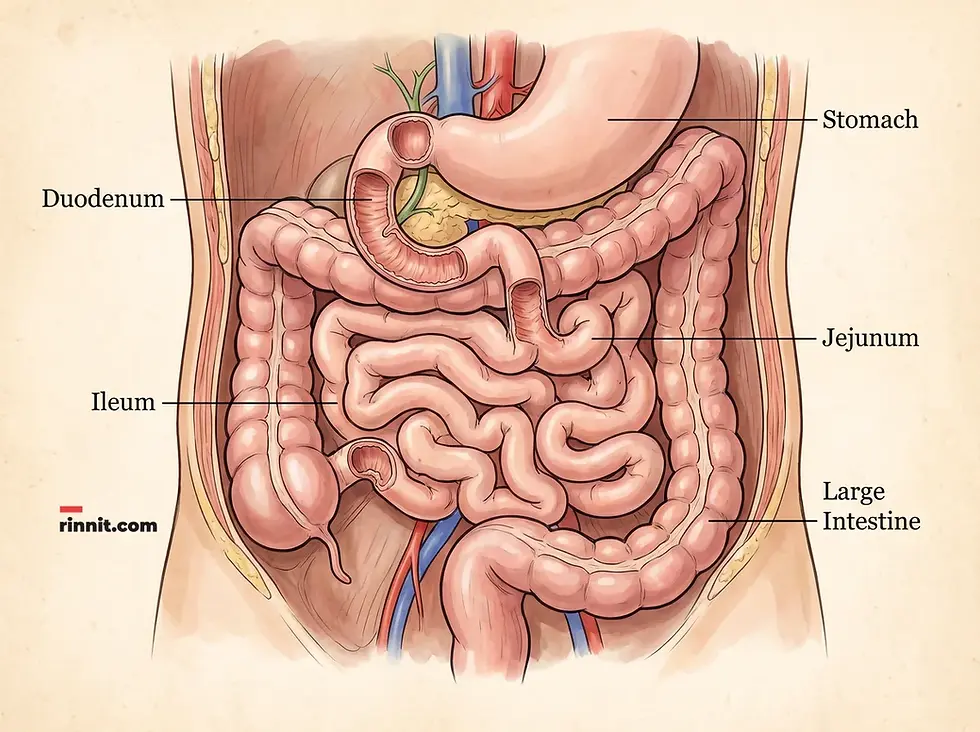
It is called “small” because of its narrow width, yet it is the longest part of the digestive tract. [1] Unfolded, its inner surface area would be about 30 square meters, roughly half a badminton court, made possible by millions of microscopic finger-like projections called villi and microvilli that greatly increase the contact area between food and the intestinal wall. [1] The small intestine is anchored in place by the mesentery, which carries its blood vessels and nerves.
Feature | Description |
Total length | Approximately 22 feet |
Diameter | About 2 centimeters (roughly index-finger width) |
Location | Central abdominal cavity, framed by the large intestine |
Surface area | About 30 square meters (roughly half a badminton court) when fully unfolded |
The Three Functional Segments
Duodenum: the first segment, about 10 inches long. [1] It receives partially digested food from the stomach, where bile from the gallbladder and enzymes from the pancreas are added to break down fats and proteins. Learn more in our guide to the duodenum.
Jejunum: the middle segment, about 8 feet long. Its muscular walls actively churn food to mix it with digestive juices. [1]
Ileum: the longest segment, where food spends the most time. [1] It completes absorption of vitamins, minerals and fats before waste moves on to the large intestine. [1]
Common Conditions Affecting the Small Bowel
Because of its complexity and central role, the small intestine can be affected by many conditions, from autoimmune reactions such as celiac disease to inflammatory disease such as Crohn’s disease. When the small bowel is compromised, the body may struggle to absorb nutrients, a state called malabsorption. [1]

Condition | Primary impact |
Celiac disease | Immune reaction to gluten that damages the intestinal lining |
Chronic inflammation that can affect any part of the GI tract | |
Small bowel obstruction | A physical blockage that prevents food and fluid from passing |
Excess bacterial growth in the small intestine that disrupts normal digestion | |
Abnormal growth of cells in the small bowel lining or wall | |
Poor absorption after a large part of the small intestine is lost or removed |
Other conditions that can involve the small intestine include enteritis, peptic ulcer disease, Meckel’s diverticulum, scleroderma, irritable bowel syndrome and gastrointestinal neuroendocrine tumors. [1] Symptoms often include abdominal pain, bloating, diarrhea or constipation, and nausea, [1] and untreated disease can lead to weight loss and nutritional deficiencies.
How Doctors Check the Small Intestine
Your provider chooses tests based on your symptoms. Options include:
Pillars of Intestinal Health
Caring for the small intestine comes down to everyday habits. Because it depends on a steady flow of nutrients and fluid, diet is the biggest lever, and a healthy gut community also matters (see our gut microbiome guide).

Nutrition: fruits, vegetables and whole grains supply fiber for smooth digestion.
Hydration: regular water and non-caffeinated fluids help liquefy food and move it along.
Sleep: good rest supports cellular repair and maintenance. [1]
Stress management: the gut and brain are closely linked, and lowering stress can reduce digestive disruption.
Physical activity: staying active supports healthy digestion and overall wellbeing.
Conclusion
The small intestine is the gateway for the body’s energy and nutrition. From its three segments to its microscopic villi, it is built for the complex work of digestion. Understanding its anatomy and what influences its health lets you take proactive steps to keep your digestive system a reliable foundation for overall wellness.
When to see a healthcare professional
If you have persistent bloating, abdominal pain, changes in bowel habits or unexplained weight loss, consult a healthcare professional. Early diagnosis of small intestine conditions can prevent long-term complications.
Frequently Asked Questions
1. What is the main function of the small intestine?
The small intestine breaks down food and absorbs more than 90% of the nutrients and water the body needs.
2. How long is the small intestine?
The small intestine is about 22 feet long, making it the longest part of the gastrointestinal tract.
3. What are the three parts of the small intestine?
The duodenum, the jejunum and the ileum.
4. Why is it called “small” if it is so long?
The name refers to its narrow width, only about 2 centimeters in diameter.
5. What happens in the duodenum?
The duodenum receives food from the stomach and mixes it with bile and pancreatic enzymes to begin chemical breakdown.
6. What is the role of the jejunum?
The jejunum's muscular contractions churn food and mix it with digestive juices for absorption.
7. What does the ileum do?
The ileum is the longest section and absorbs remaining nutrients such as vitamins, minerals and fats before waste moves on.
8. What are villi?
Tiny finger-like projections that increase the surface area of the intestinal lining for better absorption.
9. Can you live without a small intestine?
Large portions can be removed, but the body needs a functional section to absorb life-sustaining nutrients. Severe loss can cause short bowel syndrome.
10. What is celiac disease?
An autoimmune condition in which eating gluten causes the immune system to damage the small intestine lining.
11. What are common symptoms of a small bowel problem?
Abdominal pain, bloating, diarrhea, constipation and nausea.
12. How do doctors test the small intestine?
Common tests include blood and stool tests, CT scans, small bowel X-rays, endoscopy and capsule endoscopy.
13. What is a small bowel obstruction?
A physical blockage that prevents food or liquid from moving through the intestine.
14. How does hydration affect the small intestine?
Fluids help break down food and let it move smoothly through the long intestinal tube.
15. What is the best diet for small intestine health?
A balanced diet high in fiber from fruits, vegetables and whole grains, with plenty of fluids.
Related Reading
Small Bowel Resection: Surgery, Risks and Recovery explains small bowel resection surgery.
References
Cleveland Clinic. Small Intestine: Function, Parts, Length & Location. Cleveland Clinic. Last updated October 14, 2024. https://my.clevelandclinic.org/health/body/22135-small-intestine
Karimzadhagh S, Abbaspour E, Shamsi P, et al. Global prevalence of celiac disease and clinical characteristics in the general population: a systematic review and meta-analysis. Gastroenterology. 2026. PMID 42612883. https://doi.org/10.1053/j.gastro.2026.07.028
Lou MW, Zhang YQ, Wang YF, et al. Systematic review and meta-analysis of the prevalence of small intestinal bacterial overgrowth in patients with functional gastrointestinal disorders. Zhonghua Yi Xue Za Zhi. 2026;106(25):2622-2632. PMID 42402885. https://doi.org/10.3760/cma.j.cn112137-20251218-03348
Lu H. Relationship between small intestinal bacterial overgrowth and irritable bowel syndrome and the efficacy of rifaximin intervention: a systematic review and meta-analysis. Front Microbiol. 2026;17:1780567. PMID 41883799. https://doi.org/10.3389/fmicb.2026.1780567
Medical disclaimer
The information provided in this article is for educational purposes only and is not intended as medical advice. Always seek the guidance of a qualified healthcare professional regarding any medical condition or treatment.



Comments