Understanding the Duodenum: The Gateway to Effective Digestion

Updated: 3 days ago
Medically reviewed by Dr. Baraa Alnahhal, MD · Last reviewed: October 2026
TL;DR: The duodenum is the first and shortest part of the small intestine, about 10 inches long and C-shaped, just below the stomach. It makes acidic stomach contents less acidic and mixes them with bile and pancreatic enzymes so fats, proteins, and carbohydrates can be broken down and absorbed. [1] Ulcers, inflammation, celiac disease, Crohn's disease, and birth defects can affect it. [1] Blood in vomit or dark, tarry stool needs emergency care.
Get emergency care if you vomit blood (it may look like coffee grounds) or pass dark, tarry stool. These can mean a bleeding ulcer. An untreated ulcer can break through the duodenal wall and damage a nearby artery, causing severe bleeding.
Quick Answer
The duodenum is a C-shaped tube about 10 inches long that forms the first section of the small intestine, just below the stomach. [1] Its main job is to continue digestion: it makes acidic stomach contents less acidic and mixes them with bile and pancreatic enzymes that break down fats, proteins, and carbohydrates. It also begins nutrient absorption into the bloodstream. [1]
What the research says
Treating H. pylori helps duodenal ulcers stay healed. After surgical closure of a perforated duodenal ulcer, the pooled one-year ulcer recurrence rate was 5.2% with H. pylori eradication versus 35.2% without (pooled relative risk 0.15, 95% CI 0.06-0.37) (Tomtitchong et al., Helicobacter, 2012) [2].
Acid-reducing medicine lowers upper gut bleeding in high-risk people. In 6 observational studies and 1 randomized trial of people taking blood thinners, proton pump inhibitors were linked to a lower risk of upper gastrointestinal bleeding (pooled relative risk 0.67, 95% CI 0.61-0.74), with the largest benefit in those at higher risk, such as aspirin or NSAID users (Kurlander et al., Am J Med, 2022) [3].
Cancers near the duodenum are rare but serious. Ampullary carcinoma, which arises at the duodenal papilla, has an incidence of 0.5 to 0.9 per 100,000 people, with a 5-year survival of 41% to 45% when confined to the local area and 4% to 7% when metastatic (Walter et al., Dtsch Arztebl Int, 2023) [4].
Key takeaways
The duodenum is the shortest part of the small intestine, about 10 inches, yet much of the work of digestion and the start of absorption happens there.
Hormones from the duodenum (secretin and cholecystokinin) make chyme less acidic and call in bile and pancreatic enzymes. [1]
It has four segments and four wall layers, including Brunner's glands that help neutralize acid. [1]
H. pylori infection and NSAID overuse are the most common causes of duodenal ulcers. [1]
Fiber, water, limiting alcohol, tobacco, and NSAIDs, and prompt attention to symptoms help protect it.
Why is the duodenum called the gateway of the small intestine?
The duodenum is the first part of your small intestine. Despite the name, the small intestine is the longest part of the digestive tract, about 22 feet in all, and the duodenum is only about 10 inches of that. [1] "Duodenum" comes from the Latin for "12 fingers," because its length is about the width of 12 fingers side by side. [1] It is the first stop food makes as it leaves the stomach, and it sits before the jejunum (the middle part) and ileum (the last part).
Digestive juices from your liver, gallbladder, and pancreas empty into the duodenum. [1] The C-shaped curve wraps around the head of the pancreas [1], which makes the duodenum a collection point for secretions from several organs.
What role does the duodenum play in processing nutrients?
The duodenum continues the digestion that begins in the mouth and stomach and starts absorption. By the time food arrives, saliva and stomach acid have turned it into a slush called chyme, which is highly acidic. [1]
Making chyme less acidic. The duodenum releases the hormone secretin, which triggers the release of bicarbonate. This neutralizes acid, protects the intestine, and helps nutrient absorption. [1]
Transforming chyme into nutrients. It releases the hormone cholecystokinin, which triggers the pancreas, gallbladder, and liver to release substances. Bile breaks down fats, and the pancreas releases lipase (fats), amylase (carbohydrates), and protease (proteins). The bloodstream then absorbs the nutrients. [1]
Moving food along. It squeezes and relaxes in a wave-like motion called peristalsis, pushing unabsorbed material on to the jejunum. [1]
Function | Description | Key components |
Acid neutralization | Reduces the acidity of chyme to protect the intestinal lining | Secretin, bicarbonate, Brunner's glands |
Chemical digestion | Breaks down fats, proteins, and carbohydrates | Bile, lipase, amylase, protease |
Nutrient absorption | Begins moving nutrients into the blood | Microvilli of the mucosa |
Peristalsis | Moves food forward with wave-like contractions | Smooth muscle (muscularis) |
To read more about the hormone that coordinates this process, see our guide to cholecystokinin, and for the bile-carrying ducts, see the biliary tract.

What is the structure of the duodenum and its layers?
The duodenum starts just below the stomach and curves to the right and back, then down and to the left in a "C" or horseshoe shape. It slants slightly upward before joining the jejunum. [1] It has four segments, named for their position and shape: [1]
Segment | Length | Location and notes |
Superior | About 2 inches | Connects to the stomach at the pylorus. The part joined to the pylorus is the duodenal bulb, where most small intestine ulcers form. |
Descending | About 4 inches | Runs down in front of the right kidney. The pancreatic duct and common bile duct empty here. |
Horizontal (inferior) | About 4 inches | Extends right to left over major blood vessels, including the aorta and inferior vena cava. |
Ascending | Just under 1 inch | Rises slightly to the left of the aorta and joins the jejunum. |
The wall has four layers, from innermost to outermost:
Mucosa: contains glands and finger-like microvilli that increase the surface area for absorbing nutrients. [1]
Submucosa: blood vessels and connective tissue, including Brunner's glands, which release a substance that makes chyme less acidic. [1]
Muscularis: mostly smooth muscle that mixes the enzymes and bile with chyme and moves it along. [1]
Serosa: a protective barrier of squamous cells on the outside. [1]

What are common duodenum conditions and health concerns?
Because it sits right next to the stomach, the duodenum is especially vulnerable to damage from excess stomach acid. [1] Acid can cause open sores (peptic ulcers) in the stomach and duodenum, most often from H. pylori infection or overuse of NSAIDs such as aspirin and ibuprofen. [1] If an untreated ulcer breaks down the duodenum's protective barrier, its contents can leak out and damage the gastroduodenal artery behind it, causing severe bleeding that needs emergency care. [1] See our guides to H. pylori infection and duodenitis.
Condition | Description |
Peptic ulcers | Open sores, most often from H. pylori infection or NSAID overuse. |
Duodenitis | Inflammation of the duodenal lining. |
Celiac disease | A disorder in which eating gluten causes digestive problems and can damage the duodenum. |
Crohn's disease | An inflammatory bowel disease that causes irritation and inflammation. |
Brunner's gland adenomas | Benign (noncancerous) growths that start in Brunner's glands. |
Duodenal diverticulum | A small pouch pushing outside the duodenal wall. It usually causes no problems unless it becomes infected and inflamed. |
Duodenal atresia or stenosis | A baby is born with a closed duodenum (atresia) or a narrowed one (stenosis). See our guide to duodenal atresia. |
Duodenal cancer | Cancer that starts in the duodenum. |
Small bowel obstruction | A medical emergency in which part of the small intestine is blocked. |
To learn about the birth defect, read Duodenal Atresia: The Blocked First Part of a Newborn's Small Intestine. For the point where the bile and pancreatic ducts meet the duodenum, see the ampulla of Vater.
What symptoms of duodenum problems should prompt you to seek care?
Symptoms depend on the condition and often resemble other digestive problems: abdominal pain, bloating and gas, constipation, diarrhea, nausea and vomiting, and indigestion (stomach discomfort after eating). [1] Bloody vomit or dark, tarry stool is a sign of a bleeding ulcer and needs emergency care.
Tests that check the duodenum include breath tests for H. pylori, imaging (ultrasound, X-ray, CT, MRI) to look for growths and inflammation, scope procedures such as upper endoscopy and enteroscopy, and biopsies to check abnormal growths, including cancer. Treatment depends on the cause and may include antibiotics for infections, corticosteroids for severe inflammation, medicines that reduce stomach acid (proton pump inhibitors, H2 blockers, antacids), and surgery to correct structural problems or treat cancer, such as the Whipple procedure. [1]
How can you keep your duodenum healthy?
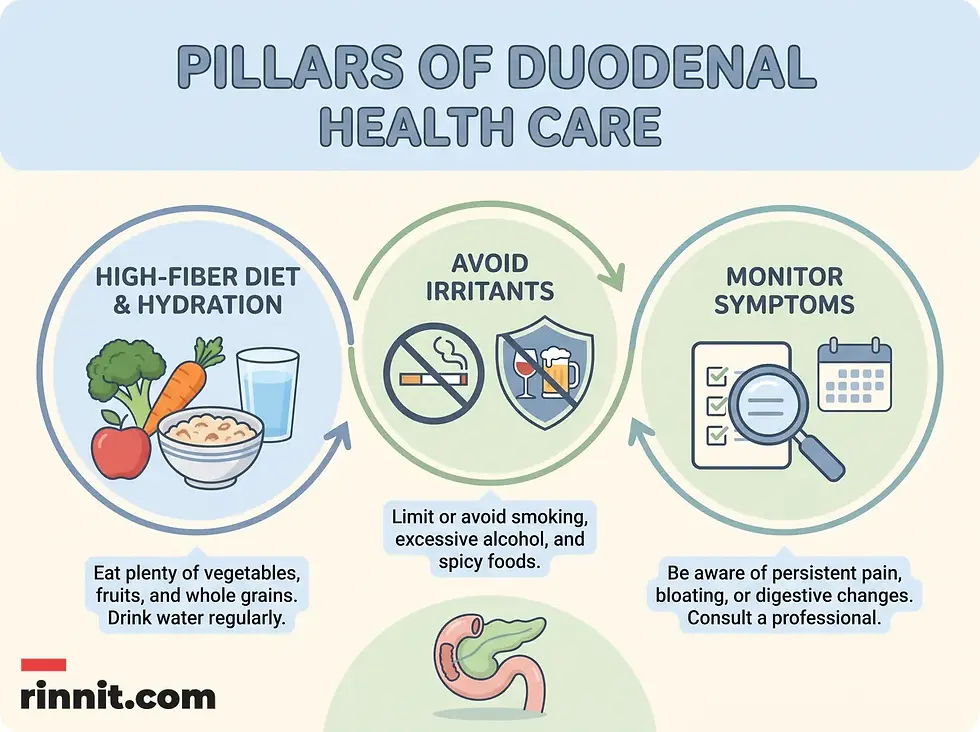
The duodenum stays healthy with the same habits that protect your whole digestive system: plenty of fiber and water, avoiding gut irritants and not ignoring symptoms.
Eat for digestion. Plenty of fiber and water support regular bowel movements so nothing backs up in the small intestine. Vegetables and nonacidic foods help keep a healthy acidity level in the gut. [1]
Avoid gut irritants. Smoking and drinking too much alcohol irritate the digestive organs [1], and taking too many NSAIDs can cause painful ulcers (see Understanding NSAIDs).
Do not ignore symptoms. Changes in bowel habits, an upset stomach, or indigestion can be temporary, but they can also signal that you need to change your lifestyle or see a provider.
When should you see a healthcare provider about your duodenum?
Talk to a provider about persistent abdominal pain, frequent bloating, nausea, or any lasting change in your bowel habits. Do not wait for symptoms to get worse. Seek emergency care for bloody vomit or dark, tarry stool.
Conclusion
The duodenum is the indispensable first responder of the small intestine. It turns acidic food into usable nutrients, with help from the liver, gallbladder, and pancreas. Understanding how it works, and adopting healthy habits, helps you protect your digestive health and avoid common complications.
Related reading
Duodenitis: Inflammation of the First Part of the Small Intestine
Duodenal Atresia: The Blocked First Part of a Newborn's Small Intestine
Understanding the Ampulla of Vater: Anatomy, Function, and Health
Understanding the Biliary Tract: Anatomy, Function, and Health
H. pylori Infection: The Stomach Germ Half the World Carries
Frequently Asked Questions
What is the main job of the duodenum?
The duodenum makes stomach contents less acidic and mixes them with bile and pancreatic enzymes to continue digestion and begin absorption.
How long is the duodenum?
About 10 inches, roughly the width of 12 fingers side by side. The name comes from the Latin for "12 fingers."
Why is it C-shaped?
The C curves around the head of the pancreas, which sits inside it.
What are the four parts of the duodenum?
The superior, descending, horizontal (inferior), and ascending segments.
What are the four layers of its wall?
The mucosa (innermost), submucosa, muscularis, and serosa (outermost).
What is chyme?
The highly acidic, partially digested food that moves from the stomach into the duodenum.
How does the duodenum make chyme less acidic?
The duodenum releases the hormone secretin, which triggers bicarbonate release, and Brunner's glands add an alkaline fluid.
What does cholecystokinin do?
Cholecystokinin triggers the pancreas, gallbladder, and liver to release substances that help turn chyme into nutrients.
What is the duodenal bulb?
The part of the superior segment that connects to the stomach. Most small intestine ulcers form here.
What are Brunner's glands?
Glands in the submucosa that release a substance that makes chyme less acidic.
What is peristalsis?
Wave-like muscle squeezing and relaxing that moves food forward through the digestive tract.
What causes duodenal ulcers?
The most common causes are H. pylori infection and overuse of NSAIDs such as aspirin and ibuprofen.
What are the symptoms of a bleeding ulcer?
Blood in vomit or dark, tarry stool. This needs emergency care.
What conditions can affect the duodenum?
Ulcers, duodenitis, celiac disease, Crohn's disease, Brunner's gland adenomas, diverticula, atresia or stenosis, cancer, and small bowel obstruction.
Can celiac disease affect the duodenum?
Yes. Eating gluten triggers an immune reaction that can damage and inflame the duodenal lining.
What is duodenal atresia?
A birth condition in which the duodenum is closed. Duodenal stenosis is a narrowed but open duodenum.
Is duodenal cancer common?
No. Cancer that starts in the duodenum is rare compared with other parts of the digestive system.
What tests check the duodenum?
Breath tests for H. pylori, imaging, upper endoscopy or enteroscopy, and biopsies.
How are duodenal conditions treated?
With antibiotics, corticosteroids, acid-reducing medicines, or surgery, depending on the cause.
How can I keep my duodenum healthy?
Eat fiber and vegetables, drink water, avoid smoking and excess alcohol, limit NSAIDs, and do not ignore digestive symptoms.
When should I see a doctor?
For persistent pain, bloating, nausea, or lasting changes in bowel habits. Seek emergency care for bloody vomit or tarry stool.
Sources
Cleveland Clinic. Duodenum. Cleveland Clinic. Last updated May 24, 2024. https://my.clevelandclinic.org/health/body/duodenum
Tomtitchong P, Siribumrungwong B, Vilaichone RK, et al. Systematic review and meta-analysis: Helicobacter pylori eradication therapy after simple closure of perforated duodenal ulcer. Helicobacter. 2012;17(2):148-152. PMID 22404446. https://doi.org/10.1111/j.1523-5378.2011.00928.x
Kurlander JE, Barnes GD, Fisher A, et al. Association of Antisecretory Drugs with Upper Gastrointestinal Bleeding in Patients Using Oral Anticoagulants: A Systematic Review and Meta-Analysis. Am J Med. 2022;135(10):1231-1243.e8. PMID 35679879. https://doi.org/10.1016/j.amjmed.2022.05.031
Walter D, Schnitzbauer AA, Schulze F, et al. The Diagnosis and Treatment of Ampullary Carcinoma. Dtsch Arztebl Int. 2023;120(43):729-735. PMID 37656482. https://doi.org/10.3238/arztebl.m2023.0195
Medical disclaimer
The information in this article is for educational purposes only and is not a substitute for professional medical advice, diagnosis, or treatment. Always seek the advice of your physician or another qualified health provider with any questions you may have about a medical condition. Never disregard professional medical advice or delay seeking it because of something you have read here. If you think you may have a medical emergency, call your doctor or your local emergency number immediately.



Comments