Understanding the Ampulla of Vater: Anatomy, Function, and Health

Updated: 3 days ago
Medically reviewed by Dr. Baraa Alnahhal, MD · Last reviewed: October 2026
Quick Answer: What is the ampulla of Vater?
The ampulla of Vater is the junction where the common bile duct and pancreatic duct join and empty into the duodenum, the first part of the small intestine. [1] It holds bile from the liver and enzymes from the pancreas and releases them through the major duodenal papilla to help digest food, with flow controlled by the sphincter of Oddi. [1]
What the research says
Endoscopic removal of ampullary adenomas works about as well as surgery. A meta-analysis of 39 studies (1,753 patients with benign sporadic ampullary adenomas) found similar recurrence after endoscopic and surgical ampullectomy at 1 year (13.0% vs 14.1%) and at 5 years (15.7% vs 17.6%), with no significant differences at any time point (Garg et al., Surg Endosc, 2023) [2].
A tight sphincter is not always the culprit, and cutting it is not always the answer. In long-term follow-up of the EPISOD trial, 103 patients with pain after gallbladder removal and little evidence of bile-duct blockage, who had been randomized to sphincterotomy or a sham procedure, were followed for up to 5 years. At a median of 58 months, success by the pain-score criterion was 40% vs 42%, and by the patient global impression criterion it was lower with sphincterotomy (37% vs 73%); the authors concluded ERCP could no longer be recommended for these patients (Cotton et al., Gastrointest Endosc, 2018) [3].
Anatomy guides how procedures are done. An anatomic review of the region notes that the site where the papilla enters the duodenum varies, that only the extramural zone of the sphincter of Oddi should be involved in sphincterotomy, and that wide excisions of the papilla risk bleeding and breaching the digestive barrier (Avisse et al., Surg Clin North Am, 2000) [4].
The Role and Function of the Ampulla of Vater
The main purpose of the ampulla of Vater is to connect the biliary tract with the gastrointestinal tract. It acts as a collection pouch where bile from the liver and enzymes from the pancreas merge before entering the duodenum, where they help break down food. [1] By regulating the release of these substances, the ampulla helps keep digestion in the small intestine coordinated.
The ampulla works automatically through a system of smooth muscles that respond to signals from the nervous system. These muscles, together called the sphincter of Oddi, open to let digestive juices into the duodenum and close again, which also helps keep food from entering the ampulla.

Anatomy and Microscopic Structure
The ampulla of Vater sits within the wall of the duodenum, halfway along its second (descending) part, about 4 inches in. [1] This is the transition point between the foregut, which breaks down food, and the midgut, where nutrients are mainly absorbed. [1]
The ampulla is traditionally described as bulbous and flask-like, with the neck of the flask where the two ducts feed into the wider reservoir. [1] But the anatomy varies. Cleveland Clinic notes that as often as 38% of the time, the bile and pancreatic ducts remain distinct and empty into the duodenum through a double-barreled opening. [1]
Component | Description | Primary Function |
|---|---|---|
Sphincter of Wirsung | The sphincter of the pancreatic duct. | Controls the flow of pancreatic enzymes into the ampulla. [1] |
Sphincters of the bile duct (choledochus) | A two-part system: a superior sphincter (sphincter of Boyden) and an inferior sphincter. | Work together to control the flow of bile into the duodenum. [1] |
Hepatopancreatic sphincter | The sphincter of the ampulla itself. | Controls the final release of bile and enzymes into the duodenum. [1] |
Papilla of Vater | The major duodenal papilla. | The external opening of the ampulla into the inside of the duodenum. [1] |

Conditions Affecting the Ampulla of Vater
Because the ampulla is a narrow junction, it can be affected by blockages and abnormal growths. A problem here can make digestive juices back up through the biliary system, causing pain and other symptoms.
Obstruction is one of the main issues, and gallstones are the most common cause, though scar tissue can sometimes be responsible. [1] Adenomas are abnormal growths that are not cancer but can develop into cancer. [1] Sphincter of Oddi dysfunction occurs when the sphincter does not open when it should. [1]
Condition | Description | Common Symptoms |
|---|---|---|
Obstruction | A blockage caused by gallstones or, sometimes, scar tissue. | Abdominal pain, biliary colic, jaundice, nausea and vomiting. [1] |
Adenoma | An abnormal growth that is not cancer but carries a risk of becoming cancer. | Usually none unless it grows and blocks the flow of bile and enzymes. [1] |
Ampullary cancer | A rare cancer that can develop from an adenoma and can grow and spread aggressively. | Symptoms from blockage, such as abdominal pain and jaundice; surgery is generally required. [1] |
Sphincter of Oddi dysfunction | The sphincter does not open when it should, so digestive juices back up in the biliary or pancreatic system. [1] | Biliary colic and abdominal pain. |
Diagnosis and Treatment
Healthcare providers can often examine and treat the ampulla of Vater with a procedure called endoscopic retrograde cholangiopancreatography (ERCP), without the need for surgery. A thin tube with a tiny camera (an endoscope) is passed down the throat and into the duodenum, which lets providers see the ampulla, remove tumors, and relieve obstructions with tools passed through the endoscope [1], and, as the illustration shows, place stents and remove stones.
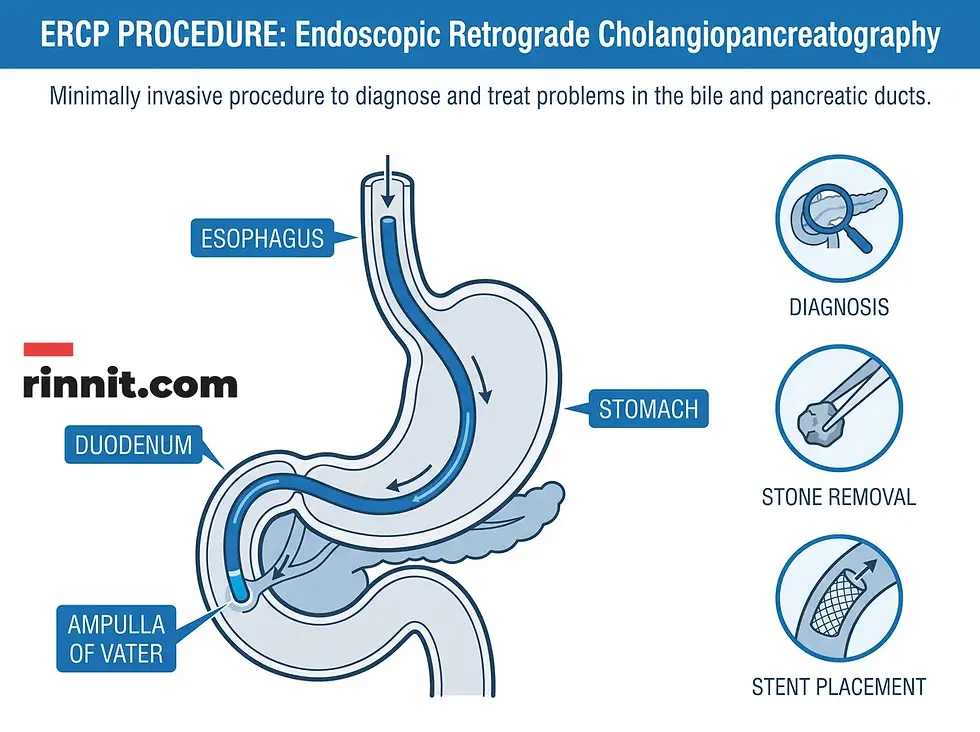
Whatever the cause of a blockage, it affects the whole biliary system, and the ampulla of Vater is just one place your provider will look. If a problem is found, it can often be treated when it is found.
Conclusion
The ampulla of Vater is a small landmark in the biliary system with surprising importance. It is where digestive juices enter the intestine and where providers can enter to examine the bile and pancreatic ducts. You might never hear about your ampulla until a provider finds a problem with it, and when they do, it can often be treated endoscopically.
Next Steps
If you have persistent abdominal pain, jaundice, or nausea and vomiting, talk to a healthcare provider. A prompt evaluation can find out whether a blockage or another problem in the biliary system is the cause and guide the right treatment.
Frequently Asked Questions
1. What is the ampulla of Vater?
The ampulla of Vater is the place where the common bile duct and the pancreatic duct merge and empty into the duodenum, the first part of the small intestine.
2. Where is it located?
The ampulla of Vater is within the wall of the duodenum, halfway along the second (descending) part, about 4 inches in.
3. What is its other name?
The ampulla of Vater is also called the hepatopancreatic ampulla or the biliopancreatic ampulla.
4. What does it look like?
Traditionally it has a bulbous, flask-like shape, but the anatomy can vary.
5. What is the sphincter of Oddi?
The sphincter of Oddi is the system of smooth muscles, made up of the sphincter of the pancreatic duct, the sphincters of the bile duct, and the sphincter of the ampulla, that controls the flow of digestive juices through the ampulla.
6. What is the papilla of Vater?
The papilla of Vater is the major duodenal papilla, the small opening where the ampulla empties into the inside of the duodenum.
7. What happens if the ampulla is blocked?
Bile and pancreatic enzymes can back up through the biliary system, causing symptoms such as abdominal pain, biliary colic, jaundice, and nausea and vomiting.
8. What is the most common cause of a blockage?
Gallstones are the most common cause of obstruction in the ampulla, although scar tissue can sometimes cause it.
9. Can cancer develop in the ampulla?
Yes. Ampullary cancer is rare, but it can grow and spread aggressively, so surgery is generally required to remove it.
10. What is an ampullary adenoma?
An ampullary adenoma is an abnormal growth that is not cancer but carries a risk of developing into cancer. It usually causes no symptoms unless it grows and blocks the flow of bile and enzymes.
11. How is a problem in the ampulla diagnosed and treated?
Providers can often examine and treat the ampulla with an endoscopic procedure called ERCP, without major surgery, using tools passed through the endoscope to remove tumors and relieve obstructions.
12. What are the symptoms of an ampulla problem?
Common signs include abdominal pain, biliary colic, jaundice (yellowing of the skin or eyes), and nausea and vomiting.
13. Is the ampulla part of the liver?
No. It is part of the biliary system, but it sits in the wall of the small intestine.
14. What is the "double-barreled" variation?
Cleveland Clinic notes that as often as 38% of the time, the bile and pancreatic ducts stay separate and empty into the duodenum through a double-barreled opening instead of merging into one reservoir.
15. Why is the ampulla called a "landmark"?
The ampulla marks the transition point between the foregut, which breaks down food, and the midgut, which absorbs it.
Trusted External Resources
Related Reading
Ampullary Cancer: Symptoms, Causes, Treatment & Complete Guide explains cancer that starts at the ampulla of Vater.
ERCP (Endoscopic Retrograde Cholangiopancreatography): Why It's Done, What Happens and Risks describes the scope procedure used to reach the bile and pancreatic ducts.
Bile Duct: The Essential Transport System of the Biliary Tree covers the ducts that carry bile to the ampulla.
Gallstone Pancreatitis: Causes, Symptoms, and Treatment explains pancreatitis caused by a gallstone blocking the ampulla.
References
Cleveland Clinic. Ampulla of Vater. Cleveland Clinic. Last updated July 8, 2025. https://my.clevelandclinic.org/health/body/24209-ampulla-of-vater
Garg R, Thind K, Bhalla J, et al. Long-term recurrence after endoscopic versus surgical ampullectomy of sporadic ampullary adenomas: a systematic review and meta-analysis. Surg Endosc. 2023;37(7):5022-5044. PMID 37221416. https://doi.org/10.1007/s00464-023-10083-0
Cotton PB, Pauls Q, Keith J, et al. The EPISOD study: long-term outcomes. Gastrointest Endosc. 2018;87(1):205-210. PMID 28455162. https://doi.org/10.1016/j.gie.2017.04.015
Avisse C, Flament JB, Delattre JF. Ampulla of Vater: anatomic, embryologic, and surgical aspects. Surg Clin North Am. 2000;80(1):201-212. PMID 10685149. https://doi.org/10.1016/s0039-6109(05)70402-3
Medical Disclaimer
This article is for informational purposes only and does not constitute medical advice. Always seek the advice of your physician or other qualified health provider with any questions you may have regarding a medical condition. Never disregard professional medical advice or delay in seeking it because of something you have read in this article. If you think you may have a medical emergency, call your doctor or emergency services immediately.



Comments