Bile Duct: The Essential Transport System of the Biliary Tree

Updated: 3 days ago
Medically reviewed by Dr. Baraa Alnahhal, MD · Last reviewed: October 2026
Quick Answer: What is the bile duct?
The bile duct is a tube-like structure that carries bile from the liver and gallbladder to the small intestine, transporting bile acids and enzymes that help break down fats and proteins. [4] The common bile duct, about 10 centimeters long, is the central trunk. [4] A blockage can cause bile to back up, leading to inflammation, jaundice and biliary colic. [4]
What the research says
Earlier drainage was linked to lower mortality in acute cholangitis. A meta-analysis of 14 observational studies covering 84,063 patients found lower in-hospital mortality when ERCP was performed within 24 hours rather than later (OR 0.81; 95% CI 0.73 to 0.90), within 48 hours (OR 0.57; 95% CI 0.51 to 0.63), and within 72 hours (OR 0.32; 95% CI 0.15 to 0.68). All of the data were observational, and the authors called for a randomized trial (PubMed: Du et al., Clin Transl Gastroenterol, 2020) [1].
Bile duct stones can come back after they are removed. A meta-analysis of 46 studies reported that common bile duct stones recur in about 4% to 24% of people after stone extraction, and it identified 14 risk or protective factors. Factors graded as strong included a dilated common bile duct (about 1.5 cm), sharp bile duct angulation, multiple ERCP sessions, air in the bile ducts after surgery (pneumobilia), a history of bile duct incision, and biliary stent placement (PubMed: Wen et al., Expert Rev Gastroenterol Hepatol, 2023) [2].
Single-stage treatment shortened hospital stays. A network meta-analysis of 41 studies (19,756 participants) for complications and 16 studies (8,644 participants) for hospital stay found that one-stage approaches (bile duct exploration or ERCP during gallbladder surgery) were linked to shorter stays than two-stage approaches. Bile duct exploration also carried a lower overall complication risk than ERCP before surgery, with no overall differences in the other comparisons (PubMed: Mohseni et al., J Trauma Acute Care Surg, 2022) [3].
What does the bile duct do?

The primary purpose of the bile duct is to ensure that bile moves safely from the liver to the small intestine. Bile contains powerful acids that help break down fats and proteins during the digestive process. [4] Because these acids can be damaging to tissues not designed to handle them, the bile ducts provide a protected pathway that prevents interference with other bodily processes. [4]
In addition to bile, these ducts also transport digestive enzymes from the pancreas. [4] Together, these fluids are essential for:
Fat Emulsification: Breaking down dietary fats into smaller particles for absorption.
Protein Digestion: Assisting in the breakdown of proteins in the small intestine. [4]
Waste Removal: Transporting certain waste products out of the liver.
How is the biliary tree of bile ducts structured?

The biliary system is a complex network of branching tubes that begins inside the liver and extends to the digestive tract. [4]
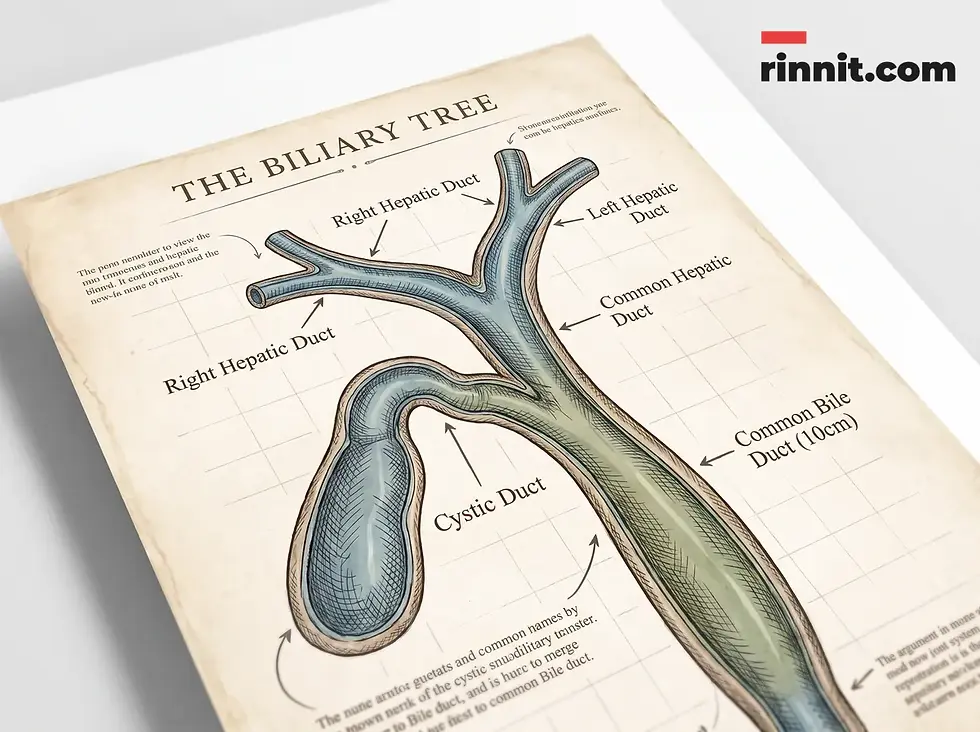
Duct Type | Location and Function |
Intrahepatic Ducts | Tiny branches inside the liver that collect bile as it is produced [4] |
Common Hepatic Duct | Formed by the union of the right and left hepatic ducts outside the liver [4] |
Cystic Duct | The pathway connecting the common hepatic duct to the gallbladder for storage [4] |
Common Bile Duct | The main 10 cm trunk that delivers bile to the small intestine [4] |
What conditions and disorders affect the bile ducts?
Bile duct conditions include obstructions such as gallstones, inflammation (cholangitis), strictures and cancer, all of which can disrupt the flow of bile. [4]
Obstructions: The most frequent cause of bile duct problems, often due to gallstones (choledocholithiasis) moving from the gallbladder into the common bile duct. [4]
Inflammation (Cholangitis): Acute inflammation can be caused by infections or blockages, while chronic inflammation often stems from autoimmune diseases like primary biliary cholangitis. [4]
Strictures: Narrowing of the ducts due to scar tissue from long-term inflammation or birth disorders like biliary atresia. [4]
Cancer: Cholangiocarcinoma can develop in both the extrahepatic and intrahepatic ducts. [4]
Consequences of a Blocked Bile Duct
When bile flow is stalled (cholestasis), it can back up into the liver, gallbladder, and pancreas, causing inflammation and damage. [4] This backup can lead to jaundice (yellowing of the skin and eyes), dark urine, pale stools and intense itching, and a blockage that lasts a long time can damage the liver. [4] Furthermore, without bile in the small intestine, the body may struggle with malabsorption, potentially leading to malnutrition. [4]
How are bile duct problems diagnosed, and how are bile ducts kept healthy?
Biliary colic—a steady, increasing abdominal pain often occurring after fatty meals—is a primary symptom of acute bile duct issues. [4] Healthcare providers use various diagnostic tools to locate and treat these problems, including Endoscopic Retrograde Cholangiopancreatography (ERCP), a non-surgical procedure used to remove blockages. [4]
Maintaining biliary health involves:
Managing underlying medical conditions that cause inflammation.
Seeking immediate medical attention for symptoms of jaundice or severe abdominal pain. Fever or chills together with yellow skin or eyes and pain in the upper right belly can mean an infected, blocked bile duct (cholangitis), which needs emergency care.
Following professional guidance for unblocking procedures if an obstruction is detected.
Conclusion
The bile ducts are indispensable for a functioning digestive system, acting as the vital link between the liver's production and the small intestine's absorption. While they are resilient, they are highly susceptible to obstructions and inflammation that can have systemic consequences. By understanding the signs of biliary distress and seeking timely diagnostic care, individuals can protect their biliary tree and ensure long-term digestive wellness.
Experiencing abdominal pain after meals or noticing skin changes? Don't ignore the signals from your biliary system. Consult a healthcare professional to check your bile duct health and prevent potential complications.
Frequently Asked Questions
1. What is a bile duct?
A bile duct is a tiny canal that carries bile between the liver, gallbladder, and small intestine.
2. What does the common bile duct do?
The common bile duct acts as the main trunk of the biliary tree, delivering bile to the small intestine to help digest fats.
3. What are the symptoms of a blocked bile duct?
Common symptoms include jaundice, nausea, itching, and abdominal pain known as biliary colic.
4. What is biliary colic?
Biliary colic is abdominal pain that often increases after a fatty meal, caused by pressure in the biliary system.
5. How long is the common bile duct?
The common bile duct is approximately 10 centimeters long.
6. What causes bile duct inflammation?
Inflammation, or cholangitis, can be caused by infections, blockages, or autoimmune diseases.
7. What are gallstones in the bile duct called?
When gallstones move into the common bile duct, the condition is known as choledocholithiasis.
8. What happens if bile backs up into the liver?
Bile backing up into the liver can cause inflammation and jaundice, and a long-lasting blockage can damage or scar the liver.
9. How do doctors unblock a bile duct?
Providers often use a non-surgical procedure called ERCP to locate and remove obstructions.
10. Can bile duct problems cause malnutrition?
Yes, a lack of bile in the small intestine can lead to the malabsorption of fats and fat-soluble vitamins.
Related Reading
What Is Bile Duct Obstruction? Symptoms, Causes, Diagnosis, and Treatment Explained explains what happens when bile flow is blocked and the warning signs.
Choledocholithiasis: What a Bile Duct Gallstone Is, How It's Found, and How It's Removed covers gallstones stuck in the bile duct and how they are removed.
ERCP (Endoscopic Retrograde Cholangiopancreatography): Why It's Done, What Happens and Risks explains the scope procedure used to see and treat bile ducts.
Cholangiocarcinoma (Bile Duct Cancer): Symptoms, Causes, and Treatment describes cancer of the bile ducts and its treatment options.
References
Du L, Cen M, Zheng X, et al. Timing of performing endoscopic retrograde cholangiopancreatography and inpatient mortality in acute cholangitis: a systematic review and meta-analysis. Clin Transl Gastroenterol. 2020;11(3):e00158. PMID 32352721. https://doi.org/10.14309/ctg.0000000000000158
Wen N, Wang Y, Cai Y, et al. Risk factors for recurrent common bile duct stones: a systematic review and meta-analysis. Expert Rev Gastroenterol Hepatol. 2023;17(9):937-947. PMID 37531090. https://doi.org/10.1080/17474124.2023.2242784
Mohseni S, Bass GA, Forssten MP, et al. Common bile duct stones management: a network meta-analysis. J Trauma Acute Care Surg. 2022;93(5):e155-e165. PMID 35939370. https://doi.org/10.1097/TA.0000000000003755
Cleveland Clinic. Bile Duct. Cleveland Clinic. Dec. 12, 2022. https://my.clevelandclinic.org/health/body/24523-bile-duct
Medical Disclaimer
This article is for informational purposes only and does not constitute medical advice. Always seek the advice of your physician or other qualified health provider with any questions you may have regarding a medical condition. Never disregard professional medical advice or delay in seeking it because of something you have read here.



Comments