Understanding the Biliary Tract: Anatomy, Function, and Health

Updated: 3 days ago
Medically reviewed by Dr. Baraa Alnahhal, MD · Last reviewed: October 2026
TL;DR: The biliary tract, or biliary tree, is the branching network of bile ducts and organs that makes, stores, and moves bile. The liver makes bile, the gallbladder stores it, and the ducts deliver it to the small intestine, where it helps digest fat and carries waste such as bilirubin out of the body. Gallstones, strictures, and cholestasis are common problems. Jaundice, upper belly pain, and pale greasy stools are warning signs. [1]
Medical emergency: Yellow skin or eyes together with fever, chills, or severe pain in the upper right belly can signal an infected, blocked bile duct (cholangitis), which needs urgent hospital care. Go to the nearest emergency department right away.
Quick Answer: What is the biliary tract?
The biliary tract, also called the biliary tree or system, is the network of organs and ducts that make, store and move bile, including the liver, bile ducts and gallbladder. [1] It helps digest fat and fat-soluble vitamins and removes waste such as bilirubin in stool. Because its parts are linked, a blocked duct can affect the liver, gallbladder and pancreas.
What the research says
Gallstones are common. A systematic review and meta-analysis of 115 studies with 32,610,568 participants found that 6.1% of people worldwide have gallstones (95% CI 5.6–6.5). Prevalence was higher in women than in men (7.6% versus 5.4%) and rose with age (Wang et al., Clin Gastroenterol Hepatol, 2024) [3].
Some modern medicines nudge gallstone risk up slightly. A meta-analysis of 55 randomized trials with 106,395 participants found that GLP-1 receptor agonists, drugs used for diabetes and weight loss, increased the risk of cholelithiasis (risk ratio 1.46, 95% CI 1.09–1.97, about 2 more cases per 1,000 people) but had little or no effect on other biliary events such as cholecystitis, cholangitis, or cholestasis (Chiang et al., Gastroenterology, 2025) [4].
Key takeaways
The biliary tree is a branching system of bile ducts joined to the liver, gallbladder, pancreas, and small intestine.
The liver makes bile, the gallbladder stores and concentrates it, and the ducts deliver it to the duodenum.
Bile breaks down fats, helps absorb fat-soluble vitamins, and removes waste such as bilirubin.
Gallstones, strictures, cholestasis, and infections are the most common problems.
Warning signs include jaundice, upper belly pain, biliary colic, and pale, greasy stools.
Blood tests and imaging, and sometimes ERCP, find and treat blockages.
What is the anatomy of the biliary tract?
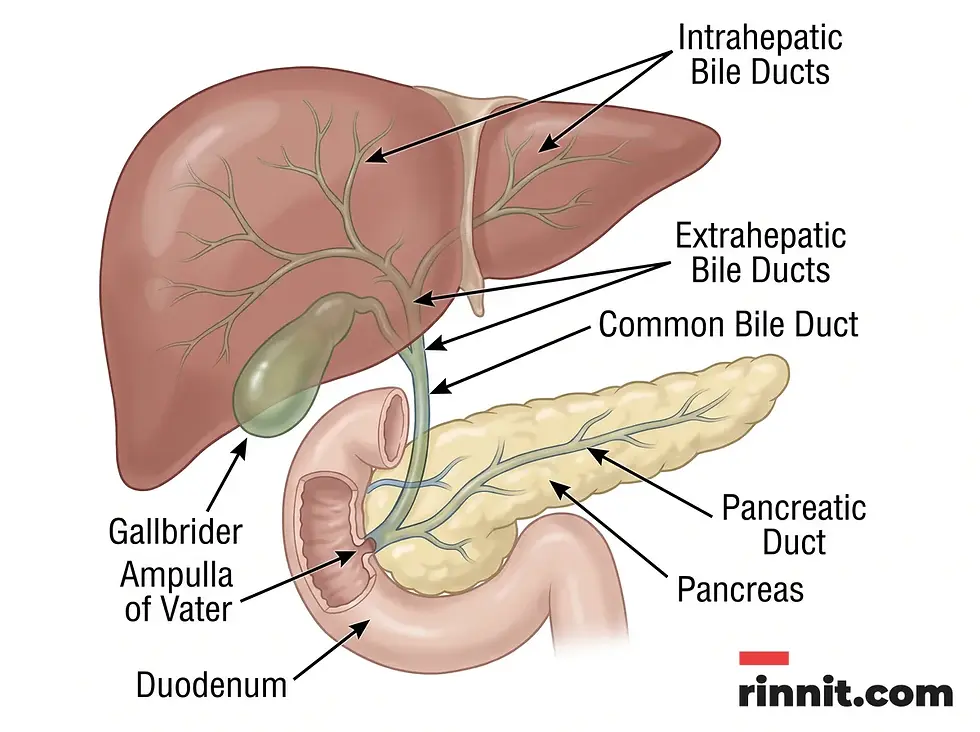
The biliary tract is called a "tree" because it branches. Its parts sit in the upper abdomen, between the ribs and the belly button. The liver is on the upper right, the gallbladder is tucked under the liver, the stomach sits in the middle, and the pancreas lies behind the stomach. [1]
Bile is made in the liver and collects in tiny channels called canaliculi. These drain into small ducts that join to form the right and left hepatic ducts. [2] Outside the liver, those ducts merge into the common hepatic duct, which meets the cystic duct from the gallbladder to form the common bile duct, the "trunk" of the tree. A healthy common bile duct is about 6 to 8 cm long and less than about 6 mm wide. [2] It joins the pancreatic duct at the ampulla of Vater and empties into the duodenum, the first part of the small intestine. [1] The flow is controlled by a ring of muscle called the sphincter of Oddi. [2]
Component | Primary role | Key characteristics |
Liver | Makes bile and filters the blood | Adds waste such as cholesterol and bilirubin to bile, and makes bile acids from cholesterol [1] |
Bile ducts | Carry bile | A branching network that joins into the common bile duct |
Gallbladder | Stores and concentrates bile | Sits under the liver and releases bile when food reaches the small intestine |
Pancreas | Releases digestive enzymes | Its duct joins the common bile duct before they empty into the duodenum [1] |
Ampulla of Vater | Junction point | Where the common bile duct and pancreatic duct enter the duodenum |
Small intestine | Uses the bile | Bile acids break down fats in the duodenum, and most are recycled back to the liver |
How does the biliary tract help digestion and waste removal?
The biliary system does two jobs. It helps digest fat, and it removes waste. Bile contains bile acids (bile salts) that the liver makes from cholesterol. [1] When you eat, the duodenum releases a hormone called cholecystokinin (CCK), which makes the gallbladder contract and squeeze stored bile into the common bile duct. [2] Bile and pancreatic enzymes then enter the duodenum together.
Process | What happens | Why it matters |
Bile production | The liver filters blood and makes bile acids from cholesterol | Needed for fat digestion and for clearing waste |
Bile storage | The gallbladder holds and concentrates bile until food arrives | Provides a concentrated supply when a meal is eaten |
Fat emulsification | Bile acids break large fat globules into tiny droplets | Allows absorption of fats and fat-soluble vitamins (A, D, E, and K) |
Waste removal | Bilirubin and other waste travel through the ducts and leave in the stool | Clears waste from the blood and gives stool its brown color |

What are common biliary tract conditions?
Because the ducts and organs are linked, infection, inflammation, and blockages can spread through the system or stop bile from flowing.
Condition | What it is |
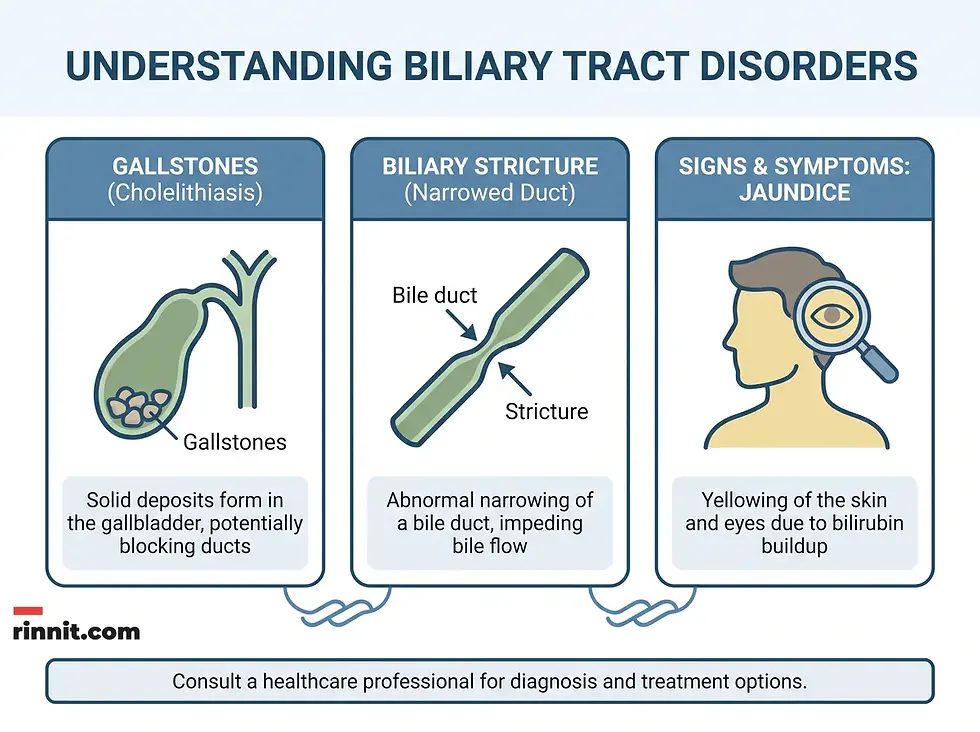
Gallstones | Hard deposits that form in the gallbladder and can block bile flow, cause pain, and lead to infection (see our guide to gallbladder disease) |
Cholestasis | Slow or stopped bile flow, often from problems making bile; it can occur during pregnancy [1] |
Biliary stricture | Scar tissue narrows a bile duct. Long-term inflammation, cancer, and autoimmune disease can cause it |
Cholangitis | Infection or inflammation of the bile ducts, including the autoimmune forms primary sclerosing cholangitis and primary biliary cholangitis |
Biliary dyskinesia | The gallbladder or sphincter does not move bile properly |
Cancers | Cancers of the bile ducts, gallbladder, liver, pancreas, or ampulla (see hilar cholangiocarcinoma) |
Warning signs of biliary disease
Jaundice: yellow skin and eyes caused by bile backing up into the blood. [1]
Upper abdominal pain: pain in the upper right or middle belly that may come from the liver, gallbladder, or bile ducts. [1]
Biliary colic: severe, on-and-off pain from a blockage, often with nausea and vomiting. [1]
Fatty stools (steatorrhea): pale, greasy stools that may float, a sign that fat is not being digested. [1]
Why blockages matter
A short-term blockage can cause fatty stools. A long-term one can lead to shortages of fat-soluble vitamins (A, D, E, and K). Bacteria can multiply above a blockage and cause ascending cholangitis, and an untreated chronic blockage can eventually cause portal hypertension (high pressure in the liver's blood vessels).
How are biliary tract problems diagnosed and treated?
Biliary tract problems are usually first checked with blood tests of liver and pancreas enzymes, followed by imaging and treatments such as ERCP or surgery. Imaging looks for blockages and swelling. Options include:
Ultrasound and CT scan
MRCP (magnetic resonance cholangiopancreatography), which shows the ducts without an endoscope
HIDA scan (hepatobiliary scintigraphy), which tracks bile flow
Endoscopic ultrasound (EUS)
ERCP (endoscopic retrograde cholangiopancreatography), which both shows the ducts and allows treatment
During an ERCP, a doctor can remove a stone, take a tissue sample, or place a stent to hold a narrowed duct open. [1] Other treatments include biliary drainage, in which a small tube drains extra bile from the ducts through the abdominal wall [1], and surgery. Removal of the gallbladder (cholecystectomy) is usually done by keyhole surgery [2] for symptomatic gallstones and gallbladder inflammation, and surgeons check the bile duct anatomy closely beforehand (see intraoperative cholangiogram).
How can you keep your biliary tract healthy?
Biliary disease can go unnoticed for a long time, so general healthy habits matter. The same habits that protect your liver help the biliary system: keep a healthy weight, eat a balanced diet, stay active, and limit alcohol. If you take a medicine that affects weight or digestion, ask your provider whether it changes your gallstone risk. Do not ignore symptoms such as jaundice or recurring upper belly pain.
When should you see a healthcare provider about biliary tract problems?
See a provider about biliary tract problems if you have yellowing skin or eyes, ongoing upper belly pain, pale or greasy stools, dark urine, or severe pain with vomiting.
Yellowing of the skin or eyes
Persistent or repeated pain in the upper belly
Pale, greasy, or floating stools, or dark urine
Episodes of severe pain with nausea and vomiting
Seek emergency care for jaundice with fever or chills, or for severe belly pain that does not ease.
Conclusion
The biliary tract does a quiet but essential job. It turns the liver's bile into a digestive tool and a waste-removal route, and it does so through a delicate branching network of ducts. Knowing how the liver, gallbladder, pancreas, and ducts fit together makes it easier to recognize the signs of trouble and to seek care early, when blockages are easiest to treat.
Related reading
Frequently Asked Questions
What is the biliary tract?
The biliary tract is the network of organs and ducts, including the liver, gallbladder, and bile ducts, that makes, stores, and moves bile. It works closely with the pancreas.
What does bile do?
Bile helps the small intestine digest fats and absorb fat-soluble vitamins, and it carries waste products out of the body.
Where is the biliary system located?
In the upper abdomen, between the ribs and the belly button. The liver is on the upper right and the gallbladder is tucked underneath it.
What is the biliary tree?
The biliary tree is another name for the biliary tract, named for its branching structure of bile ducts.
How does the liver contribute to the biliary system?
The liver makes bile and adds waste such as bilirubin and cholesterol that it has filtered from the blood.
What is the role of the gallbladder?
The gallbladder stores and concentrates bile and releases it into the bile duct when food reaches the small intestine.
What are gallstones?
Gallstones are hard deposits that form in the gallbladder and can block bile flow.
What is jaundice?
Jaundice is yellowing of the skin and eyes that happens when bile or bilirubin backs up into the bloodstream.
What causes biliary strictures?
Scar tissue narrows a bile duct. Causes include long-term inflammation, autoimmune disease, cancer, and conditions present from birth.
What is biliary colic?
Biliary colic is severe, on-and-off pain from a blockage in the biliary system, often with nausea and vomiting.
How is biliary disease diagnosed?
Providers use blood tests for liver and pancreas enzymes and imaging such as ultrasound, CT, MRCP, a HIDA scan, endoscopic ultrasound, or ERCP.
What is an ERCP?
An ERCP is a procedure that uses an endoscope and X-ray dye to see the bile and pancreatic ducts and to treat problems such as stones and strictures.
Can the biliary tract affect stool?
Yes. If bile cannot reach the intestine, stools can become pale, greasy, and float (steatorrhea).
What is cholestasis?
Cholestasis is slow or stopped bile flow. It can occur in the liver or ducts and can happen during pregnancy.
Are biliary cancers common?
Biliary cancers are much less common than gallstones, but cancer can occur in the bile ducts, gallbladder, liver, pancreas, or ampulla.
Sources
Cleveland Clinic. Biliary Tree. Cleveland Clinic. Last updated September 4, 2025. https://my.clevelandclinic.org/health/body/biliary-tract
Hundt M, Wu CY, Young M. Anatomy, Abdomen and Pelvis: Biliary Ducts. In: StatPearls [Internet]. Treasure Island (FL): StatPearls Publishing; last update July 15, 2023. PMID 29083810. https://pubmed.ncbi.nlm.nih.gov/29083810/
Wang X, Yu W, Jiang G, et al. Global epidemiology of gallstones in the 21st century: a systematic review and meta-analysis. Clin Gastroenterol Hepatol. 2024;22(8):1586-1595. PMID 38382725. https://doi.org/10.1016/j.cgh.2024.01.051
Chiang CH, Jaroenlapnopparat A, Colak SC, et al. Glucagon-like peptide-1 receptor agonists and gastrointestinal adverse events: a systematic review and meta-analysis. Gastroenterology. 2025;169(6):1268-1281. PMID 40499738. https://doi.org/10.1053/j.gastro.2025.06.003
Medical disclaimer
The information in this article is for educational purposes only and is not a substitute for professional medical advice, diagnosis, or treatment. Always seek the advice of your physician or another qualified health provider with any questions you may have about a medical condition. Never disregard professional medical advice or delay seeking it because of something you have read here. If you think you may have a medical emergency, call your doctor or your local emergency number immediately.



Comments