Short Bowel Syndrome in Children: Causes, Symptoms, and Management

Updated: 3 days ago
Medically reviewed by Dr. Baraa Alnahhal, MD · Last reviewed: October 2026
Quick Answer: What is short bowel syndrome in children?
Short bowel syndrome in children, also called short gut syndrome, is a condition in which a child's small intestine is too short or works too poorly to absorb essential nutrients and fluids. [1] It may be present at birth or follow surgery. [1] Symptoms include chronic diarrhea, poor growth and bloating. [1] Treatment focuses on IV or tube feeding and medicines. [1]
When to see a provider
See your child’s healthcare provider if you notice persistent watery diarrhea, poor weight gain, or signs of dehydration. It is especially important to get help right away if symptoms appear after bowel surgery.
What the research says
Teduglutide reduced the need for IV nutrition in children in a 24-week phase III study. Among 59 children with intestinal failure due to SBS, a 20% or greater reduction in parenteral support was reached by 54.2% on the lower dose and 69.2% on the higher dose of teduglutide, versus 11.1% on standard care; 2 and 3 children, respectively, reached full enteral autonomy (Kocoshis et al., JPEN, 2020) [2].
Bowel-lengthening surgery helps some children come off IV nutrition, but evidence is limited. A systematic review of 40 studies (782 children) found that 46% weaned off parenteral nutrition after serial transverse enteroplasty (STEP) and 52% after longitudinal intestinal lengthening and tailoring (LILT); mortality was 7% for STEP and 26% for LILT. The authors rated reporting quality as poor to fair and could not recommend which patients suit each procedure (Nagelkerke et al., European Journal of Pediatric Surgery, 2022) [3].
Data in infants are still small. In open-label phase 3 studies of 12 infants and 8 children, 57.1% of infants and 66.7% of children on teduglutide cut parenteral support by 20% or more after 24 weeks, versus 50.0% of infants on standard care; two children reached enteral autonomy (Chiba et al., Journal of Pediatric Gastroenterology and Nutrition, 2023) [4].
What Is Pediatric Short Bowel Syndrome?
Short bowel syndrome (SBS) is a complex condition in which the body cannot absorb enough fluids and nutrients from food. This happens because a significant portion of the small intestine is missing from birth, has been removed by surgery, or is not working as it should. [1] The small intestine is the main site where proteins, fats, carbohydrates, vitamins, and minerals are absorbed. [1] When it is too short, a child’s growth and overall health are at risk.
SBS is rare, affecting an estimated 10,000 to 20,000 people in the United States, including both children and adults. [1] Children are especially vulnerable because they need high levels of nutrition for physical and cognitive development. The effect depends on which section is affected: the duodenum, the jejunum, or the ileum. The ileum can often take over some of the roles of other sections if they are missing [1], which helps explain why outcomes vary so much between children.

What causes short bowel syndrome in children, and who is at risk?
SBS in children is either congenital or acquired. Congenital cases involve growth abnormalities during fetal development, such as a bowel that is too short, missing sections, or intestinal atresia (a narrow, non-functional bowel). [1] Acquired cases usually occur as a result of surgery needed to treat another serious intestinal condition. [1]
Common Conditions Requiring Surgery | Description of Impact on Intestines |
Necrotizing Enterocolitis (NEC) | Inflammation and loss of blood flow that causes tissue death. |
Gastroschisis | The intestines develop outside the body before birth. [1] |
Volvulus | A twisting of the intestines that cuts off blood supply. [1] |
Intussusception | One part of the intestine folds into another like a telescope and affects blood flow. [1] |
Crohn’s Disease | Chronic inflammation and irritation of the digestive tract. [1] |
The main risk factor for acquired SBS is having one of these underlying conditions. [1] The more bowel that is removed, the more severe the syndrome tends to be, because a shorter path for food means less time for nutrients to be broken down and absorbed. There is no known way to prevent SBS. [1]
What are the symptoms of short bowel syndrome in children?
The most common symptom in infants and children is chronic, watery diarrhea. [1] Because the intestine cannot process food efficiently, waste passes through quickly and can cause significant fluid loss. Parents may also notice that their child is not growing as expected or struggles to gain weight despite adequate feeding.
Other common symptoms include bloating, excessive gas, and foul-smelling stools. [1] Children may also feel unusually tired because vitamins and minerals are not reaching the bloodstream. Left untreated, these problems can lead to severe dehydration and malnutrition, which can be life-threatening in children. [1]

What malabsorption complications affect children with short bowel syndrome?
When the body cannot keep a healthy balance of fluids and electrolytes, other health problems can follow. Chronic diarrhea often causes severe diaper rash in infants because stools are frequent and acidic. [1] Over time, some children develop an aversion to eating or abnormal eating habits. [1]
Category | Potential Complications |
Nutritional | Vitamin and mineral deficiencies, electrolyte imbalances, dehydration, and weight loss. [1] |
Organ Health | Liver disease (often from long-term IV nutrition), kidney stones, and gallstones. [1] |
Digestive | Small intestinal bacterial overgrowth (SIBO) and food intolerances such as lactose intolerance. [1] |
Long-term use of total parenteral nutrition (TPN) can save a child’s life, but it carries its own risks, including liver disease. [1] Care teams monitor these children closely to balance their nutritional needs with the health of their organs.
How is short bowel syndrome diagnosed in children?
Short bowel syndrome (SBS) in children is diagnosed by reviewing medical and family history, doing a physical exam and ordering tests to find the cause of symptoms. [1] Tests may include:
How is short bowel syndrome in children treated and managed?
The goal of treatment is to make sure your child gets enough nutrients to grow while relieving symptoms. Plans are individualized and often combine nutrition support, medication, and sometimes surgery.
Nutritional support
Dietary changes: providers may recommend small, frequent, high-calorie meals that supply enough carbohydrates and protein, plus vitamin and mineral supplements. They may also advise avoiding foods high in fat, simple sugars, and fiber. [1]
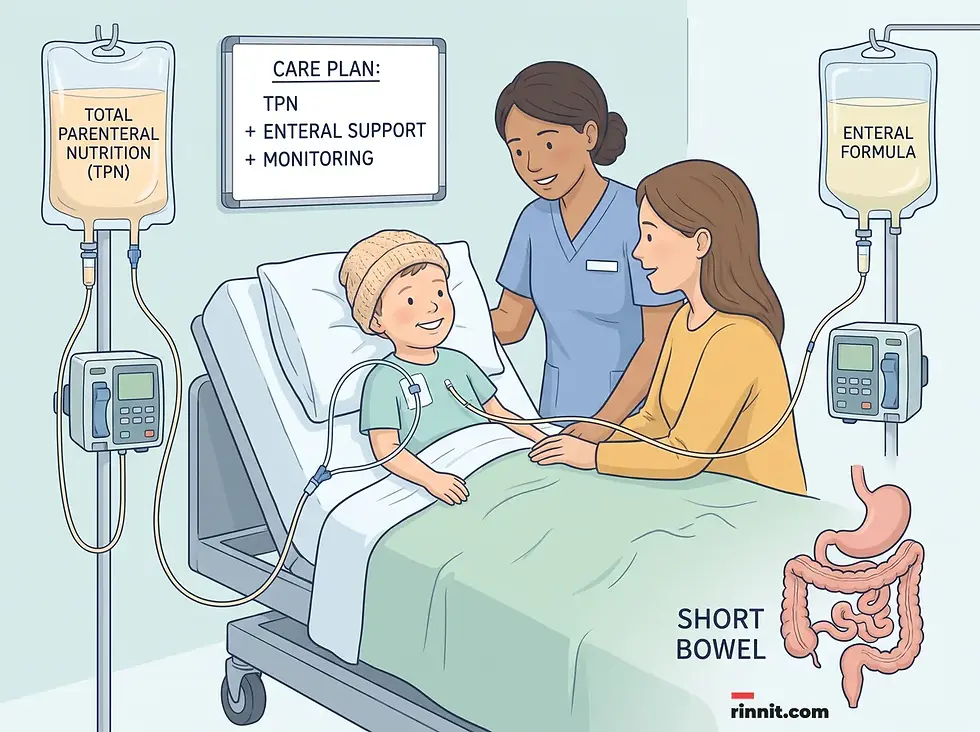
Total parenteral nutrition (TPN): a solution of fluids and nutrients given through a central line into a vein, bypassing the digestive system. [1] Read more in our guide to parenteral nutrition and intravenous feeding.
Enteral nutrition: tube feeding that delivers nutrients directly into the stomach or small intestine, either to supplement or to replace eating by mouth. [1]
Medications
Medicines can treat symptoms and complications. Antibiotics, sometimes given in cycles, help prevent or treat bacterial overgrowth. [1] Acid-reducing medicines, bile-salt binders, and medicines that slow the movement of food through the intestine may be used to ease symptoms and lessen diarrhea. [1] Newer treatments such as teduglutide, an injection given regularly, can improve intestinal adaptation and may help some children reduce or stop IV nutrition. [1] [2] [4]
Surgery
Some children need surgery to improve intestinal function. Operations can lengthen the small intestine, narrow its diameter to reduce bacterial overgrowth, prevent blockages, slow the movement of food, or place a feeding tube. [1] [3] In severe cases, intestinal and/or liver transplantation may be considered to prevent major or life-threatening complications. [1]
What is the outlook for children with short bowel syndrome?
SBS can be a lifelong condition or a short-term one. [1] In some children the remaining intestine adapts and grows, which improves nutrient absorption over time. Even then, lifelong follow-up is needed to monitor growth and nutritional deficiencies. [1] With better care and monitoring for complications, many infants and children have a good outlook and a normal life expectancy, although this depends on the length of the remaining intestine. [1]
Conclusion
Short bowel syndrome in children is a challenging, rare condition that needs specialized, long-term care. Although the symptoms and complications are serious, advances in nutrition support and surgical techniques have improved the outlook for many children. Early diagnosis and a multidisciplinary approach are essential to help these children grow and thrive despite their digestive challenges.
What are the next steps for a child with short bowel syndrome?
If you suspect your child has signs of malabsorption or chronic digestive problems, consult a pediatric specialist promptly to discuss a full evaluation and care plan.
Trusted resources: Cleveland Clinic: Short Bowel Syndrome in Children.
Frequently Asked Questions
What is the most common symptom of short bowel syndrome in children?
Chronic, watery diarrhea is the most common symptom in infants and children with this condition.
Can a child be born with short bowel syndrome?
Yes. It can be congenital, meaning the small intestine did not form completely or is too short at birth.
What is “short gut syndrome”?
Short gut syndrome is another name for short bowel syndrome.
How does the body absorb nutrients if the intestine is short?
Absorption is reduced, but sometimes the remaining intestine, particularly the ileum, adapts and takes on more of the absorption work over time.
What is TPN?
Total parenteral nutrition (TPN) delivers all needed nutrients directly into a vein, bypassing the digestive tract. Learn more about parenteral nutrition.
Is short bowel syndrome common?
No. It is rare, affecting an estimated 10,000 to 20,000 people in the United States, including children and adults.
Can surgery cause short bowel syndrome?
Yes. It often develops after surgery that removes a large part of the small intestine to treat another condition.
What are the three sections of the small intestine?
The duodenum, the jejunum, and the ileum.
Why do children with SBS have poor growth?
The shortened intestine cannot absorb enough calories, vitamins, and minerals to support normal development.
What is enteral nutrition?
Enteral nutrition is tube feeding that delivers nutrients directly into the stomach or small intestine.
Can short bowel syndrome lead to liver disease?
Yes. Liver disease is a possible complication, often linked to long-term use of intravenous nutrition (TPN).
Are there specific foods a child with SBS should avoid?
Providers often advise limiting foods high in fat, simple sugars, and fiber. Advice varies with severity, so follow your child’s care team’s plan.
What is intestinal atresia?
Intestinal atresia is a congenital condition in which part of the bowel is missing or closed off, which can lead to short bowel syndrome.
How is the condition diagnosed?
Diagnosis usually involves a physical exam, blood tests to check nutrient levels, a fecal fat test, and imaging such as X-rays or CT scans.
Is short bowel syndrome life-threatening?
Short bowel syndrome can be if left untreated because of the risk of severe malnutrition and dehydration, but with professional care it can be managed and many children do well.
References
Cleveland Clinic. Short Bowel Syndrome in Children. Cleveland Clinic Health Library. Last updated June 1, 2023. https://my.clevelandclinic.org/health/diseases/14725-short-bowel-syndrome-in-children
Kocoshis SA, Merritt RJ, Hill S, et al. Safety and efficacy of teduglutide in pediatric patients with intestinal failure due to short bowel syndrome: a 24-week, phase III study. JPEN J Parenter Enteral Nutr. 2020;44(4):621-631. PMID 31495952. https://doi.org/10.1002/jpen.1690
Nagelkerke SCJ, Poelgeest MYV, Wessel LM, et al. Bowel lengthening procedures in children with short bowel syndrome: a systematic review. Eur J Pediatr Surg. 2022;32(4):301-309. PMID 33663008. https://doi.org/10.1055/s-0041-1725187
Chiba M, Masumoto K, Kaji T, et al. Efficacy and safety of teduglutide in infants and children with short bowel syndrome dependent on parenteral support. J Pediatr Gastroenterol Nutr. 2023;77(3):339-346. PMID 37364133. https://doi.org/10.1097/MPG.0000000000003867
Medical Disclaimer
This article is for informational purposes only and does not constitute medical advice. Always seek the advice of your physician or other qualified health provider with any questions you may have regarding a medical condition.



Comments