The Mesentery: The Continuous Organ Supporting Your Digestive Health

Updated: 3 days ago
Medically reviewed by Dr. Baraa Alnahhal, MD | Last reviewed: October 7, 2026
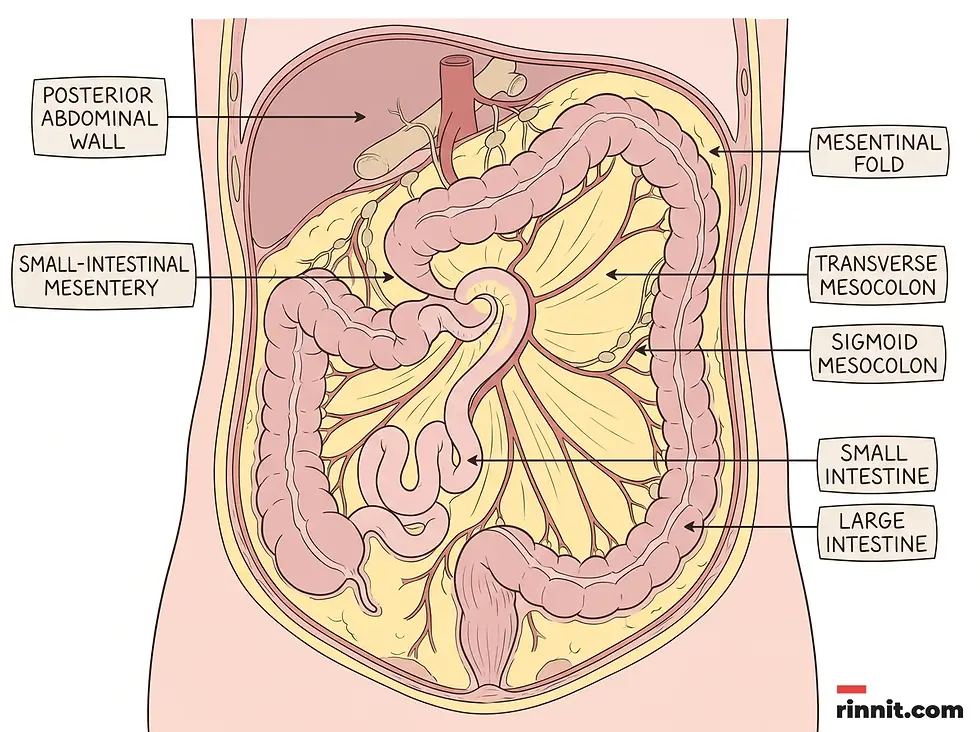
Quick Answer: What is the mesentery?
The mesentery is a continuous fold of tissue in the abdomen that connects the intestines to the back wall of the belly [1]. It keeps the intestines from collapsing or twisting, carries blood vessels, lymph vessels and nerves, and helps regulate inflammation [1]. Stretched out, the adult mesentery is about six feet long and is made mostly of fat and connective tissue [1].
What the research says
Visceral fat shows the strongest link to insulin resistance of any fat depot studied. A systematic review and meta-analysis of 40 observational studies found that visceral fat mass correlated more strongly with insulin resistance (HOMA-IR; r = 0.570, 95% CI 0.424–0.687) than total fat mass (r = 0.492), body mass index (r = 0.482) or waist circumference (r = 0.466) ([Zhang et al., Scientific Reports, 2015](https://doi.org/10.1038/srep18495) [2]).
Aerobic exercise measurably shrinks visceral fat. A dose-response meta-analysis of 116 randomized trials (6,880 adults with overweight or obesity) found that each additional 30 minutes per week of aerobic exercise was associated with a 1.60 cm² smaller visceral adipose tissue area (95% CI −2.12 to −1.07; 26 trials, high-certainty evidence), and that about 150 minutes per week at moderate to vigorous intensity produced clinically important reductions in waist circumference and body fat ([Jayedi et al., JAMA Network Open, 2024](https://doi.org/10.1001/jamanetworkopen.2024.52185) [3]).
Whether removing more mesentery during Crohn’s surgery lowers recurrence is still unsettled. One meta-analysis (5 studies, 4,358 patients) linked extended mesenteric resection to a lower surgical recurrence rate (OR 4.94, 95% CI 2.22–10.97) with comparable complication rates, while another (6 studies, 4,590 patients) found no significant difference in surgical recurrence (OR 0.3, 95% CI 0.02–3.73) or complications; both call for long-term randomized trials ([Vaghiri et al., International Journal of Colorectal Disease, 2025](https://doi.org/10.1007/s00384-025-04845-6) [4]; [Topala et al., Techniques in Coloproctology, 2025](https://doi.org/10.1007/s10151-025-03110-w) [5]).
What role does the mesentery play in the body?
The mesentery acts as the structural backbone of the abdominal cavity. By anchoring the small and large intestines to the back of the belly, it keeps these long, winding tubes in position without collapsing or twisting into dangerous blockages [1]. Scientists think its design may even help humans walk upright [1].
It also supports organ development. The mesentery forms before the other digestive organs [1], and the liver, spleen, and pancreas grow within it and stay connected to it for life [1]. Through shared blood vessels, nerves, and lymph nodes, organs can send signals to one another via the mesentery, and its lymph nodes help trap germs [1].
What is the anatomy of the mesentery, and why is it continuous?
Recent research has shifted the view of the mesentery from a set of separate tissue folds to a single, continuous organ [1]. It begins near the superior mesenteric artery at the back of the abdomen and extends in a spiral that covers the intestines [1]. This matters for surgery, because it lets surgeons see the abdomen as a unified system rather than a collection of separate pouches.
Section | Connection Point |
Small-intestinal mesentery | Connects to the small intestine [1] |
Right mesocolon | Secures the right side of the large intestine (colon) [1] |
Transverse mesocolon | Runs across the transverse colon [1] |
Left mesocolon | Secures the left side of the large intestine [1] |
Mesosigmoid | Connects the sigmoid colon [1] |
Mesorectum | Connects the rectum [1] |
What is the mesentery made of, and what are its protective layers?
The mesentery is mostly fat tissue, along with connective tissue, blood vessels, lymph tissue, and nerves [1]. A protective layer called the mesothelium surrounds it, and another tissue, Toldt’s fascia, connects it to the abdominal wall [1]. This network works like a communication highway, letting signals and nutrients pass between organs.
What disorders affect the mesentery, and why do they matter?
The health of the mesentery is closely tied to several systemic conditions. Most belly fat is stored here as visceral fat [1], and too much of it raises the risk of diabetes, high blood pressure, obesity, coronary artery disease, metabolic syndrome, and stroke [1]. Much research also links the mesentery to Crohn’s disease, and some studies suggest the disease may even start there [1]. Because the mesentery is tied to so many organs, many digestive diseases involve it [1].
Condition | Description |
Visceral fat accumulation | Excess fat stored in the mesentery, linked to diabetes, heart disease, and other metabolic conditions |
Crohn’s disease | Chronic inflammatory bowel disease; some studies suggest it may start in the mesentery [1] |
Volvulus | A dangerous twisting of the intestines and mesentery that creates a blockage [1] |
Sclerosing mesenteritis | Ongoing inflammation that leads to scarring and blocked blood flow [1] |
Mesenteric hernias | Loops of intestine slipping through an opening or weak spot in the mesentery (a type of internal hernia) [1] |
Tumors | Tumors can form in the mesentery or spread there from nearby organs [1] |

How can you care for your mesentery for long-term health?
The best way to look after the mesentery is to keep a healthy amount of visceral fat. These habits help:
Physical activity: Aim for at least 150 minutes of exercise each week [1].
Nutritional balance: Limit processed foods, sugar, trans fats, sodium, and alcohol [1].
Restorative sleep: Get at least seven hours of quality sleep each night [1].
Stress management: Managing stress helps control cortisol [1], a hormone linked to belly fat.

Conclusion
The mesentery is far more than a simple anchor for the intestines. It is a continuous structure that supports and nourishes the digestive organs, helps them communicate, and plays a role in the body’s inflammatory response. Understanding it, and adopting habits that keep visceral fat in check, can support long-term metabolic and digestive health.
Call to Action
Keep an eye on your waist measurement, stay physically active, and prioritize sleep and stress management. If you have persistent abdominal pain or lasting changes in digestion, see a healthcare professional for evaluation.
Frequently Asked Questions
What is the mesentery?
The mesentery is a continuous fold of tissue in the abdomen that anchors the intestines to the back wall of the belly and supports other digestive organs.
Is the mesentery considered an organ?
Many healthcare providers now see it as one continuous organ, because of its unified structure and clear purpose: to support, nourish and connect several digestive organs.
How long is the adult mesentery?
When stretched out, the adult mesentery is about six feet long.
What is the main function of the mesentery?
The mesentery secures the intestines in place, carries blood vessels, lymph vessels and nerves to digestive organs, and helps regulate inflammation.
Where is the mesentery located?
The mesentery begins at the back of the abdomen, near the superior mesenteric artery, and extends in a spiral that covers the intestines.
What is visceral fat?
Visceral fat is fat stored deep in the abdomen, and most of it is stored in the mesentery. Too much raises the risk of diabetes, high blood pressure, heart disease, and stroke.
How does the mesentery relate to Crohn’s disease?
Much research links the mesentery to Crohn’s disease, and some studies suggest the inflammation may even start there.
What is a volvulus?
A volvulus is a serious condition in which the intestines and mesentery twist, causing a dangerous blockage.
Can the mesentery be affected by cancer?
Yes. Tumors can form in the mesentery or spread there from nearby organs.
What is sclerosing mesenteritis?
Sclerosing mesenteritis is a condition of ongoing inflammation that leads to scarring and blocked blood flow in the mesentery.
Could the mesentery help humans walk upright?
Scientists think its design may help humans walk upright, because it keeps the intestines stable while still allowing some movement.
What tissue protects the mesentery?
A thin protective layer called the mesothelium surrounds it, and a tissue called Toldt’s fascia connects it to the abdominal wall.
How does the mesentery help organs communicate?
The mesentery carries shared blood vessels, nerves and lymph nodes that allow organs to send signals to one another.
What is C-reactive protein (CRP)?
CRP is a protein that helps regulate inflammation. The mesentery makes it, among other sources in the body.
How can I reduce visceral fat?
Exercise at least 150 minutes a week, limit processed foods, sugar, trans fats, sodium and alcohol, get enough quality sleep, and manage stress.
Related Reading
Sclerosing Mesenteritis: Complete Guide to Symptoms, Causes, Diagnosis, and Treatment explains inflammation and scarring of the mesentery and its treatment.
Understanding Mesenteric Ischemia: Causes, Symptoms, and Emergency Care covers blocked blood flow to the intestines and its warning signs.
Understanding Intestinal Malrotation: Causes, Symptoms, and Care explains how the bowel can twist when it forms abnormally.
Peritoneum: Anatomy, Function, Conditions and Care describes the lining of the belly that the mesentery is part of.
Sources
Cleveland Clinic. Mesentery. Cleveland Clinic. Last updated September 4, 2025. https://my.clevelandclinic.org/health/body/mesentery
Zhang M, Hu T, Zhang S, et al. Associations of different adipose tissue depots with insulin resistance: a systematic review and meta-analysis of observational studies. Sci Rep. 2015;5:18495. PMID: 26686961. DOI: 10.1038/srep18495
Jayedi A, Soltani S, Emadi A, et al. Aerobic exercise and weight loss in adults: a systematic review and dose-response meta-analysis. JAMA Netw Open. 2024;7(12):e2452185. PMID: 39724371. DOI: 10.1001/jamanetworkopen.2024.52185
Vaghiri S, Alipouriani A, Knoefel WT, et al. Extended mesenteric resection reduces the rate of surgical recurrence in Crohn’s disease: a systematic review and meta-analysis. Int J Colorectal Dis. 2025;40(1):51. PMID: 39998692. DOI: 10.1007/s00384-025-04845-6
Topala M, Martinekova P, Rancz A, et al. To cut or not to cut? Extended mesenteric excision during intestinal resection does not impact the postoperative recurrence nor the postoperative complications in Crohn’s disease: a systematic review and meta-analysis. Tech Coloproctol. 2025;29(1):79. PMID: 40057619. DOI: 10.1007/s10151-025-03110-w
Medical disclaimer
The information provided in this article is for educational purposes only and is not intended as medical advice. Always seek the guidance of a qualified healthcare provider regarding any medical condition or treatment.



Comments