Understanding Mesenteric Ischemia: Causes, Symptoms, and Emergency Care

Updated: 2 days ago
Medically reviewed by Dr. Baraa Alnahhal, MD · Last reviewed: October 2026
Mesenteric ischemia is an uncommon but serious and life-threatening condition in which parts of the digestive system do not get enough blood flow and oxygen, usually because a blood vessel supplying them is blocked or narrowed. It can be acute (sudden) or chronic (long-term), and because it is often fatal when treatment is delayed, rapid diagnosis and treatment are important [1].
Quick Answer: What is mesenteric ischemia?
Mesenteric ischemia is a condition in which the blood vessels of the mesentery cannot supply enough blood to the digestive organs. Acute mesenteric ischemia is a medical emergency, usually caused by a blood clot, and is often fatal without quick treatment. Belly pain after eating is the most common symptom. Seek immediate care for severe belly pain. [1]
What the research says
CT angiography is the method of choice for diagnosing acute mesenteric ischemia. A systematic review and meta-analysis that pooled 81 studies in 14 meta-analyses found that CT angiography (CTA) had a sensitivity of 92.0% and specificity of 98.8%, compared with 75.8% and 90.5% for other CT protocols. Absent or reduced bowel wall enhancement, the best non-vascular feature, had a sensitivity of 57.9% and specificity of 90.1% (Reintam Blaser et al., Sci Rep, 2025 [2]).
Symptoms and blood tests alone are not enough to diagnose it. A meta-analysis of 23 studies with 1,970 emergency department patients found that lactate had a pooled sensitivity of 86% but specificity of only 44%, and D-dimer had a sensitivity of 96% but specificity of 40%. CT had a sensitivity of 94% and specificity of 95%, and the pooled operative mortality rate was 47% (95% CI 40% to 54%). The authors concluded that only CT angiography had adequate accuracy to establish the diagnosis in place of laparotomy (Cudnik et al., Acad Emerg Med, 2013 [3]).
For chronic mesenteric ischemia, covered stents may work better than bare-metal stents. A meta-analysis of one randomized trial and five observational studies found that covered stents had higher primary patency (hazard ratio 0.40; 95% CI 0.23 to 0.68) and better freedom from reintervention (hazard ratio 0.30; 95% CI 0.13 to 0.71). The authors cautioned that the evidence came from few studies with moderate to serious risk of bias and called for higher-quality trials (Dias Miranda et al., Ann Vasc Surg, 2025 [4]).
What is mesenteric ischemia?
The mesentery is an organ in your abdomen that holds your small and large intestines and other organs in place, and a network of blood vessels in the mesentery supplies those organs. When blood flow drops, the affected organs and tissues do not get enough oxygen and cannot work right. If the blockage is severe enough, they may start to die, which is why the condition is often fatal and why rapid diagnosis and treatment matter [1].
What are the types of mesenteric ischemia?
Type | How it develops | Main cause | Severity |
Acute | Suddenly, with sudden and severe symptoms | Usually a blood clot that blocks a critical artery | Medical emergency |
Non-occlusive (NOMI), a subtype of acute | Usually takes longer to become severe than the clot-related type | Blood vessels tighten or spasm without a blockage | Dangerous and fatal in many cases |
Chronic | Gradually, over days or weeks, with symptoms that usually worsen over time | Mesenteric arteries slowly narrow | Can progress to the acute type |
Source: Cleveland Clinic [1].
What are the symptoms and signs of mesenteric ischemia?
Mesenteric ischemia symptoms, most commonly belly pain after eating, come on suddenly in the acute type of the condition. With chronic mesenteric ischemia, they can develop slowly and usually worsen over six months or more, and some people have no symptoms [1]. Belly pain is the most common symptom and usually occurs for up to four hours after eating. Other symptoms may include [1]:
Nausea and vomiting
Constipation
Diarrhea
Food fear (avoiding eating because of the pain) and weight loss
Fever
It is very common for the acute type to happen after you have had chronic symptoms. Early symptoms from narrowed blood vessels suddenly become severe when a new blood clot blocks the narrowed vessels [1].
When to get help right away: seek immediate medical care if you have severe belly pain or other symptoms of acute mesenteric ischemia, or if chronic symptoms suddenly change or get worse [1].
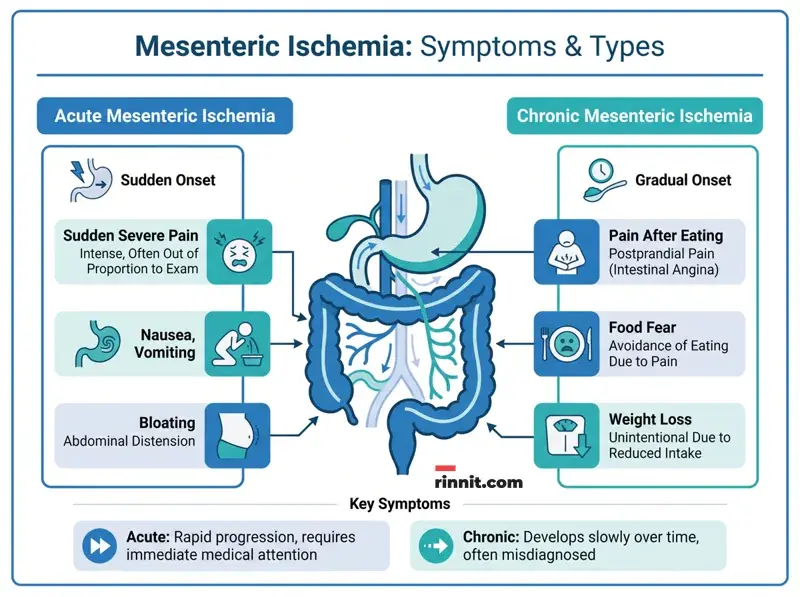
Acute mesenteric ischemia causes sudden symptoms, while chronic mesenteric ischemia develops gradually.
What causes mesenteric ischemia and who is at risk?
The different types of mesenteric ischemia have different causes [1]:
Acute mesenteric ischemia: plaque can build up inside your arteries, and if it breaks open, blood clots can form there or get stuck there after coming from elsewhere. A clot can also form in a nearby blood vessel, and a tear or bulge in the aorta is another cause.
Non-occlusive mesenteric ischemia (NOMI): this happens without a blockage, when blood vessels constrict or spasm because of certain medications, procedures or conditions such as shock.
Chronic mesenteric ischemia: this often happens because of diseases that make blood vessels narrower, such as atherosclerosis or blood clots, so blood flow to the mesentery drops over time.

Blood clots, arterial narrowing and cardiovascular risk factors can all reduce blood flow to the digestive organs.
Mesenteric ischemia is more common in females and as you age, and it usually happens along with heart and blood flow conditions, especially ones that can cause blood clots. Risk factors include [1]:
Atrial fibrillation (an abnormal heart rhythm)
Coronary artery disease
Diabetes
Heart failure
High blood pressure
High cholesterol
Disorders that make your blood clot too easily
Recent surgery
Peripheral vascular diseases, such as peripheral artery disease
Tobacco use (past or present)
What complications can mesenteric ischemia cause?
Mesenteric ischemia can cause the intestines to start dying from lack of oxygen, letting their bacteria spread to places they do not belong. This can cause dangerous infections that lead to sepsis, a life-threatening condition. Other complications depend on the type [1]:
Acute type: damage to your small bowel, weight loss, and tearing or rupture of your intestine or colon.
Chronic type: bowel ischemia, weight loss, malnutrition and progression to the acute type.
How is mesenteric ischemia diagnosed?
Healthcare providers diagnose mesenteric ischemia with a physical exam, lab tests and imaging that checks blood flow. It is usually hard to diagnose in its early stages because it shares symptoms with common illnesses [1]. Tests that can help include:
Test | What it does |
Lab tests | Check the amount of oxygen in your blood and how well your blood clots, and look for signs of infection or tissue damage. |
Ultrasound | Sound waves from a device held against the skin of your belly create an image. If providers get a good image, they can use it to find areas with low or no blood flow. |
CT angiogram | The best way to diagnose mesenteric ischemia. It shows partly or fully blocked vessels. |
Digital subtraction angiogram | Can help when noninvasive tests are not enough for a clear diagnosis. A computer removes bones and other structures from the image. |
Endoscopy | An endoscope is inserted into your digestive tract, through your throat or rectum, to look for signs of ischemia. |
Source: Cleveland Clinic [1].
How is mesenteric ischemia treated in an emergency?
Healthcare providers can treat and reverse mesenteric ischemia when they catch it early enough, and the condition becomes more dangerous over time. The first goal is always to restore blood flow as quickly as possible. The next goal is to remove damaged or dead tissue from your intestine or colon, which is the only way to fix the damage and prevent life-threatening complications. The likely treatments vary depending on the type of mesenteric ischemia and the location of its cause [1].
Acute and chronic mesenteric ischemia
Surgery to remove blood clots
Angioplasty to widen narrow blood vessels and place a stent to keep a blood vessel open
Bypass surgery using a section of blood vessel from another place in your body to reroute blood
Surgery to remove dead or damaged tissue and repair the area around it
Medications such as clot-busters (thrombolytics), antibiotics and blood thinners
Non-occlusive mesenteric ischemia (NOMI)
Because NOMI usually involves blood vessels that constrict, providers treat what causes that. Treatment may include stopping prescription medications that make blood vessels tighten, treating an illness to improve blood flow to the mesentery, performing an angioplasty to widen the affected blood vessel, and giving vasodilators to make your blood vessels expand [1].

Treatment moves from diagnosis and immediate care to surgical or endovascular intervention and long-term recovery.
What is the outlook for mesenteric ischemia, and can it be prevented?
Most people start to feel better when blood flow to the affected area improves, and others will likely feel better within days or weeks. Recovery from surgery takes longer, but an operation can give you years of relief [1].
When treatment does not happen quickly, acute mesenteric ischemia is often fatal, with between 6 and 8 out of 10 people dying from the acute type, but these odds improve when treatment happens quickly.
Without treatment for the chronic type, nearly all people do not survive five years.
Acute NOMI usually takes longer to become severe but is still dangerous and is fatal in many cases.
People with mesenteric ischemia have a much higher risk of other ischemia-related conditions, including heart attack, stroke and pulmonary embolism, and you may need to take blood thinners for the rest of your life.
Over time, a widened artery can narrow again, and you may need more treatment if this happens.
You can do several things to lower your risk of mesenteric ischemia [1]:
Get an annual checkup.
Avoid using tobacco products.
Take your medications.
Eat healthy foods.
Maintain a weight that is healthy for you.
Stay active.
Manage conditions that make blood clots more likely to form.
Manage and maintain your cholesterol levels.
If you have chronic mesenteric ischemia, care for it as your provider instructs, and keep your follow-up visits to avoid long-term problems and lower your risk of complications [1].
What is the bottom line on mesenteric ischemia?
Mesenteric ischemia is uncommon, but it can be life-threatening, especially when it happens suddenly. Severe belly pain, or chronic symptoms such as pain after eating that suddenly change or get worse, are reasons to seek medical care immediately. Modern medicine has made advances in diagnosing and treating it quickly, and the best things you can do are to know your risks and take steps to manage them with your healthcare provider [1].
Frequently Asked Questions
What is mesenteric ischemia?
Mesenteric ischemia is a serious condition in which parts of your digestive system do not get enough blood flow and oxygen, usually because of a blockage in the blood vessels that supply them. It can be acute (sudden) or chronic (long-term) [1].
Is mesenteric ischemia a medical emergency?
The acute type is. It usually involves a blood clot that blocks a critical artery, causes sudden and severe symptoms, and is often fatal when treatment is delayed [1].
What are the most common symptoms of an acute blockage?
Belly pain is the most common symptom. Other symptoms include nausea and vomiting, constipation, diarrhea and fever [1].
What causes mesenteric ischemia?
Acute cases usually involve a blood clot that forms in or travels to a mesenteric artery, often linked to plaque buildup. Non-occlusive cases happen when blood vessels constrict or spasm, and chronic cases usually result from gradual narrowing of the arteries, such as from atherosclerosis [1].
Who is most at risk for this condition?
Mesenteric ischemia is more common in females and as you age, particularly in people over 70, and in those with heart disease, atrial fibrillation, diabetes, high blood pressure, high cholesterol, clotting disorders, peripheral artery disease or a history of tobacco use [1].
Can chronic mesenteric ischemia lead to an acute emergency?
Yes. It is very common for the acute type to happen after chronic symptoms, when a new blood clot suddenly blocks vessels that were already narrowed [1].
What is food fear?
Food fear means avoiding eating because of the pain that follows meals. It is listed as a symptom of mesenteric ischemia, along with weight loss [1].
How is mesenteric ischemia diagnosed?
Providers use a physical exam, lab tests and imaging that checks blood flow, such as ultrasound, CT angiogram, digital subtraction angiogram or endoscopy. A CT angiogram is the best way to diagnose it [1]. In a pooled analysis, CT angiography had a sensitivity of 92.0% and specificity of 98.8% for acute mesenteric ischemia [2].
What are the complications of untreated mesenteric ischemia?
When intestinal tissue dies, bacteria can spread and cause dangerous infections that lead to sepsis. Acute cases can also damage the small bowel and cause tearing or rupture of the intestine or colon, and chronic cases can cause bowel ischemia, weight loss and malnutrition [1].
Can medications cause mesenteric ischemia?
Medications can contribute to the non-occlusive type. Non-occlusive mesenteric ischemia happens when blood vessels constrict or spasm, which can occur because of certain medications, procedures or conditions such as shock. Treatment may include stopping medications that make blood vessels tighten [1].
References
Cleveland Clinic. Mesenteric Ischemia. Cleveland Clinic. August 14, 2026. https://my.clevelandclinic.org/health/diseases/23246-mesenteric-ischemia
Reintam Blaser A, Koitmäe M, Laisaar KT, et al. Radiological diagnosis of acute mesenteric ischemia in adult patients: a systematic review and meta-analysis. Sci Rep. 2025;15(1):9875. PMID 40119151. https://doi.org/10.1038/s41598-025-94846-w
Cudnik MT, Darbha S, Jones J, et al. The diagnosis of acute mesenteric ischemia: a systematic review and meta-analysis. Acad Emerg Med. 2013;20(11):1087-1100. PMID 24238311. https://doi.org/10.1111/acem.12254
Dias Miranda NC, Marimpietri FS, Marcolin Miranda L, et al. Covered versus bare-metal stents in chronic mesenteric ischemia treatment: a systematic review and meta-analysis. Ann Vasc Surg. 2025;113:214-220. PMID 39864517. https://doi.org/10.1016/j.avsg.2024.12.071
Medical disclaimer
This article is for informational purposes only and is not a substitute for professional medical advice, diagnosis, or treatment. The clinical information in this guide reflects source material last reviewed in August 2026.



Comments