Small Intestinal Bacterial Overgrowth (SIBO) Guide: Symptoms, Causes, Diagnosis, and Treatment

Updated: 2 days ago
Medically reviewed by Dr. Baraa Alnahhal, MD · Last reviewed: September 2026
TL;DR
Small intestinal bacterial overgrowth (SIBO) — sometimes called blind loop syndrome — occurs when the small intestine develops an abnormal increase in its bacterial population, especially types of bacteria not commonly found there. It typically develops when surgery or disease slows the passage of food and waste, letting stagnant contents become a breeding ground for bacteria. The result: diarrhea, bloating, abdominal pain, weight loss, and malnutrition, plus vitamin, bone, and kidney complications. Diagnosis runs through a breath test (measuring hydrogen or methane after a glucose-water drink) plus blood, stool, and imaging checks. Treatment starts with antibiotics — with surgery to fix the underlying problem whenever possible and nutritional support to repair the damage [1] [2].
Quick Answer
What is SIBO? An abnormal increase in the bacterial population of the small intestine — particularly bacteria not normally found there — that causes diarrhea, weight loss, and malnutrition. It is sometimes called blind loop syndrome.
How does it start? A circumstance such as surgery or disease slows the passage of food and waste through the digestive tract, creating a breeding ground for bacteria.
What are the symptoms? Loss of appetite, abdominal pain, nausea, bloating, uncomfortable fullness after eating, diarrhea, unintentional weight loss, and malnutrition.
Who is at higher risk? People with prior abdominal or gastric surgery, structural defects or injuries of the small intestine, fistulas, Crohn's disease, scleroderma, abdominal radiation history, diabetes, or small intestine diverticulosis.
How is it treated? Antibiotics are the first treatment for most people — often started even before or without testing — plus surgery to fix the underlying problem when possible, and nutritional support (B-12, vitamins, calcium, iron, and sometimes a lactose-free diet).
What This Guide Is Based On
This guide is built entirely from specialist-reviewed clinical guidance updated November 2024, alongside the NIDDK guide to SIBO, UpToDate overviews of small intestinal bacterial overgrowth and the hydrogen/methane breath test, the AGA and ACG motility and SIBO guidance, and the peer-reviewed reviews of SIBO management in Clinical and Translational Gastroenterology (2019) and Gastroenterological Clinics of North America (2018). These peer-reviewed and institution-backed references are cited inline throughout, with the full list at the end of this guide [1] [2].
What Is SIBO?
Small intestinal bacterial overgrowth occurs when there is an abnormal increase in the overall bacterial population in the small intestine — particularly types of bacteria not commonly found in that part of the digestive tract. The condition is sometimes called blind loop syndrome [1].
Your small intestine is the longest section of your digestive tract, measuring about 20 feet (6.1 meters). It is where food mixes with digestive juices and where nutrients are absorbed into your bloodstream [1].
Here is what makes the small intestine special: unlike your large intestine (colon), it normally has relatively few bacteria — thanks to the rapid flow of contents and the presence of bile. When something slows that flow, the balance breaks. Excess bacteria can produce toxins, interfere with nutrient absorption, and trigger diarrhea through the breakdown products of digested food [1].

What Are the Signs and Symptoms?
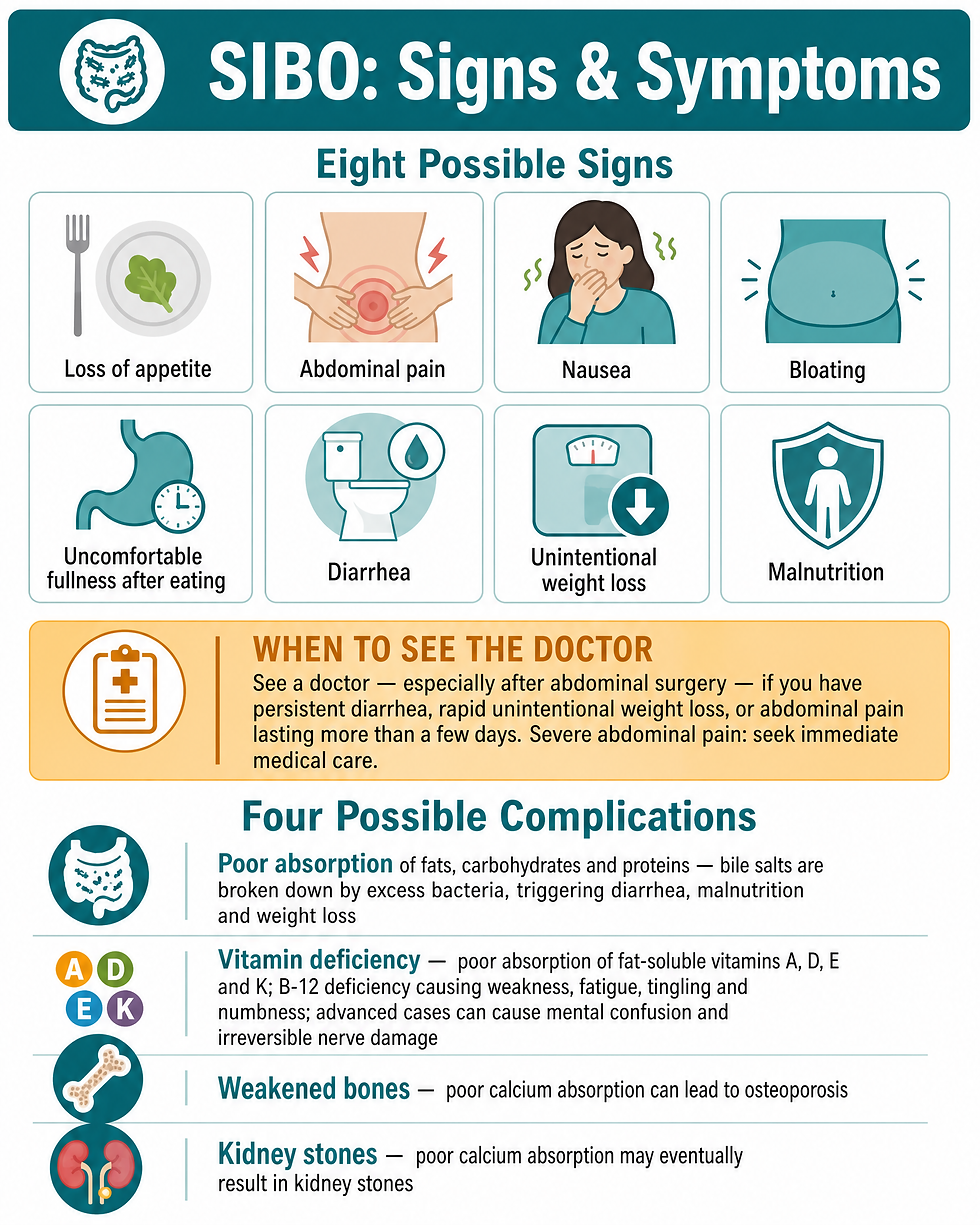
Eight signs and symptoms commonly point to SIBO:
Possible sign or symptom | What it means |
Loss of appetite | Reduced desire to eat |
Abdominal pain | Pain in the belly area |
Nausea | Feeling sick to your stomach |
Bloating | A swollen, uncomfortable feeling in the abdomen |
An uncomfortable feeling of fullness after eating | Fullness beyond what the meal warrants |
Diarrhea | Loose or watery stools |
Unintentional weight loss | Weight loss without trying |
Malnutrition | The body not getting enough nutrients |
When Should You See a Doctor?
Bloating, nausea, and diarrhea are signs of many intestinal problems — not just SIBO. See your doctor for a full evaluation if you have persistent diarrhea, rapid, unintentional weight loss, or abdominal pain lasting more than a few days — especially if you've had abdominal surgery. If you have severe abdominal pain, seek immediate medical care [1].
What Causes SIBO?
SIBO develops when something slows the passage of food and waste products through the digestive tract, turning the small intestine into a breeding ground for bacteria. Three situations commonly cause it [1]:
Complications of abdominal surgery are the most familiar trigger — including gastric bypass for obesity and gastrectomy (stomach removal) done to treat peptic ulcers or stomach cancer.
Structural problems in and around the small intestine can also block normal flow. These include scar tissue (intestinal adhesions) that wraps around the outside of the small bowel, and intestinal diverticulosis — bulging pouches of tissue that protrude through the wall of the small intestine.
Certain medical conditions can slow the movement (motility) of food and waste through the small intestine — including Crohn's disease, radiation enteritis, scleroderma, celiac disease, and diabetes [1].
Who Is at Higher Risk?
Nine factors raise the risk of developing SIBO:
Risk factor | Why it matters |
Gastric surgery for obesity or ulcers | Changes stomach anatomy and flow |
A structural defect in the small intestine | Creates pockets where contents stagnate |
An injury to the small intestine | Damages normal flow and structure |
An abnormal passageway (fistula) between two segments of bowel | Lets contents bypass normal transit |
Crohn's disease, intestinal lymphoma, or scleroderma involving the small intestine | Diseases that slow intestinal motility |
History of radiation therapy to the abdomen | Can damage intestinal structure and movement |
Diabetes | Can slow the movement of food and waste through the small intestine |
Diverticulosis of the small intestine | Bulging pouches where bacteria collect |
Adhesions caused by previous abdominal surgery | Scar tissue that wraps the small bowel |
What Are the Complications?
Untreated or poorly controlled SIBO can cause escalating problems. The key ones to understand:
Complication | How it happens |
Poor absorption of fats, carbohydrates, and proteins | Bile salts — needed to digest fats — are broken down by excess bacteria, causing incomplete fat digestion and diarrhea; bacterial products can harm the intestinal lining, cutting absorption of carbohydrates and proteins; bacteria also compete for available food. Together these effects cause diarrhea, malnutrition, and weight loss |
Vitamin deficiency | Incomplete fat absorption means the body cannot fully absorb fat-soluble vitamins A, D, E, and K. Bacteria in the small intestine also use vitamin B-12 — essential for the nervous system, blood cell production, and DNA — leading to B-12 deficiency with weakness, fatigue, tingling, and numbness in the hands and feet; advanced cases can cause mental confusion, and the nerve damage may be irreversible |
Weakened bones (osteoporosis) | Intestinal damage causes poor calcium absorption, which over time can lead to osteoporosis |
Kidney stones | Poor calcium absorption may eventually result in kidney stones |
How Is SIBO Diagnosed?
To diagnose SIBO, you may have tests to check for bacterial overgrowth, poor fat absorption, or other problems that may be causing or contributing to your symptoms [2]:
Diagnostic step | What it does |
Breath testing | A noninvasive test that measures the amount of hydrogen or methane you breathe out after drinking a mixture of glucose and water. A rapid rise in exhaled hydrogen or methane may indicate bacterial overgrowth. Widely available — but less specific than other tests |
Small intestine aspirate and fluid culture | Removes and tests fluid from the small intestine. This used to be considered a good diagnostic method, but experts no longer recommend it — contamination from bacteria in the mouth can produce a false diagnosis |
Blood testing | Looks for vitamin deficiency, particularly B-12 |
Stool evaluation | Tests for fat malabsorption |
Imaging tests | X-rays, CT scans, or MRI to look for structural abnormalities of the intestine |
How Is SIBO Treated?
Whenever possible, doctors treat SIBO by dealing with the underlying problem — for example, by surgically repairing a postoperative loop, stricture, or fistula. But a loop can't always be reversed. In that case, treatment focuses on correcting nutritional deficiencies and eliminating the bacterial overgrowth [2].
Antibiotic Therapy
For most people, the initial treatment is antibiotics. Notably, doctors may start antibiotics if your symptoms and medical history strongly suggest SIBO — even when test results are inconclusive or without any testing at all. Testing may follow if antibiotic treatment isn't effective [2].
Two practical realities shape how antibiotics are used:
A short course of antibiotics often significantly reduces the abnormal bacteria. But bacteria can return when the antibiotic is discontinued, so treatment may need to be long term. Some people with a small intestine loop may go for long periods without needing antibiotics; others may need them regularly [2].
Doctors may also switch among different antibiotics to help prevent bacterial resistance. This matters because antibiotics wipe out most intestinal bacteria — both normal and abnormal — and can therefore cause some of the very problems they're trying to cure, including diarrhea. Switching among drugs helps avoid that problem [2].
Nutritional Support
Correcting nutritional deficiencies is a crucial part of treatment, particularly for people with severe weight loss. One important caution: malnutrition can be treated, but the damage it causes can't always be reversed [2].
Nutritional measure | What it involves |
Nutritional supplements | Intramuscular injections of vitamin B-12, plus oral vitamins, calcium, and iron supplements |
Lactose-free diet | Damage to the small intestine may cause you to lose the ability to digest milk sugar (lactose); avoid most lactose-containing products or use lactase preparations that help digest milk sugar. Some affected people may tolerate yogurt, because the bacteria used in the culturing process naturally break down lactose |

How Should You Prepare for Your Appointment?
If you have signs and symptoms common to SIBO, make an appointment with your doctor. After an initial evaluation, you may be referred to a gastroenterologist — a doctor who specializes in digestive disorders. Being prepared makes the visit count [2]:
What to bring | Details |
Your symptoms | Including when they started and how they may have changed or worsened over time |
Your medical records | Especially if you have had surgery on your stomach or intestines, have any known bowel condition, or have received radiation to the abdomen or pelvis |
A list of all your medications | Including vitamins and supplements |
Key medical information | Other conditions with which you've been diagnosed — be sure to mention any abdominal surgery |
Key personal information | Any recent changes or stressors in your life, which can be connected to digestive symptoms |
A family member or friend | If possible; it can be difficult to remember everything said during an appointment |
Questions to ask | Creating your list in advance helps you make the most of your time |
Useful questions include: What is the most likely cause of my condition? What treatment approach do you recommend? Are there side effects associated with the medications? Will I need medications long term? How often will you see me to monitor my progress? Should I take any nutritional supplements? Do I have any vitamin deficiencies? Are there lifestyle or dietary changes that can reduce my symptoms?
Expect your doctor to ask about abdominal surgery, when symptoms began, whether they come and go, weight loss, stool changes, vomiting, fever, your typical daily diet, lactose tolerance, and any history of radiation, kidney stones, pancreas problems, or Crohn's disease [2].
Conclusion
SIBO is a condition of imbalance — a small intestine that normally keeps bacteria in check through rapid flow and bile slowly accumulates an abnormal population once surgery, structural problems, or disease slows the passage of food and waste. The pattern to watch for is the combination of bloating, diarrhea, and unintentional weight loss — especially in anyone with a history of abdominal surgery. The diagnostic route is straightforward (a breath test plus blood, stool, and imaging checks), and the treatment path is proven: fix the underlying problem when possible, use antibiotics to clear the bacteria, and support nutrition — including B-12, fat-soluble vitamins, and calcium — before the deficiency damage becomes hard to reverse. If you've had abdominal surgery and new digestive symptoms won't let up, make the appointment.
This guide is for general information only and is not a substitute for professional medical advice. Always consult a qualified healthcare provider for diagnosis and treatment.
Frequently Asked Questions
What exactly is SIBO?
Small intestinal bacterial overgrowth is a condition in which the small intestine develops an abnormal increase in its bacterial population — particularly types of bacteria not commonly found in that part of the digestive tract. It is sometimes called blind loop syndrome.
What are the symptoms of SIBO?
Loss of appetite, abdominal pain, nausea, bloating, an uncomfortable feeling of fullness after eating, diarrhea, unintentional weight loss, and malnutrition.
Why does SIBO develop?
The small intestine normally has few bacteria because contents flow rapidly and bile suppresses bacterial growth. When surgery or disease slows the passage of food and waste, stagnant contents become a breeding ground — the bacteria multiply, may produce toxins, interfere with nutrient absorption, and trigger diarrhea.
Who is at higher risk of SIBO?
People who have had gastric surgery (such as gastric bypass or gastrectomy), have structural defects or injuries of the small intestine, have a fistula between bowel segments, have Crohn's disease, intestinal lymphoma, or scleroderma involving the small intestine, have had abdominal radiation therapy, have diabetes, have small intestine diverticulosis, or have adhesions from previous abdominal surgery.
How is SIBO diagnosed?
Most commonly with a noninvasive breath test that measures hydrogen or methane breathed out after drinking a glucose-and-water mixture — a rapid rise suggests overgrowth. The older method, small intestine aspirate and fluid culture, is no longer recommended because mouth bacteria can contaminate the sample and cause an incorrect diagnosis. Blood tests (vitamin deficiency), stool evaluation (fat malabsorption), and imaging (X-ray, CT, MRI) may also be used.
What is the first-line treatment for SIBO?
Antibiotics. A short course often significantly reduces the abnormal bacteria, but bacteria can return when antibiotics are discontinued, so treatment may need to be long term. Doctors may also switch among different antibiotics to prevent resistance — since antibiotics can cause diarrhea, the very problem they are meant to cure.
Can antibiotics alone cure SIBO?
Whenever possible, doctors first address the underlying problem — such as surgically repairing a postoperative loop, stricture, or fistula. When that is not reversible, treatment focuses on clearing the bacteria with antibiotics and correcting nutritional deficiencies.
What happens if SIBO is left untreated?
Ongoing complications include poor absorption of fats, carbohydrates, and proteins (causing diarrhea, malnutrition, and weight loss), deficiency of fat-soluble vitamins A, D, E, and K, and B-12 deficiency with weakness, fatigue, tingling, and numbness — in advanced cases mental confusion, and the nerve damage may be irreversible — plus weakened bones (osteoporosis) and kidney stones from poor calcium absorption.
References
Additional references consulted:
Rao SS, et al. "Small intestinal bacterial overgrowth: Clinical features and therapeutic management." Clinical and Translational Gastroenterology, 2019.
Adike A, et al. "Small intestinal bacterial overgrowth: Nutritional implications, diagnosis, and management." Gastroenterological Clinics of North America, 2018.
Rodriguez DA, et al. "Small intestinal bacterial overgrowth in children: A state-of-the-art review." Frontiers in Pediatrics, 2019.
Ferri FF. "Small bowel bacterial overgrowth (SIBO)." Ferri's Clinical Advisor 2020. Elsevier, 2020.
Source references:
Small intestinal bacterial overgrowth (SIBO) — Symptoms & causes (updated November 11, 2024)
Small intestinal bacterial overgrowth (SIBO) — Diagnosis & treatment (updated November 11, 2024)
Comments