TURBT (Transurethral Resection of Bladder Tumor): Procedure, Risks and Recovery

Updated: 3 days ago
Medically reviewed by Dr. Baraa Alnahhal, MD · Last reviewed: October 2026
Quick Answer: What is TURBT?
TURBT (transurethral resection of bladder tumor) is a procedure that biopsies and removes a bladder tumor through the urethra without an external incision, allowing diagnosis and treatment at once. The tissue is analyzed to determine stage and grade. Full recovery can take up to six weeks. Contact the care team for fever, severe pain, excessive blood or large clots.
What the research says
A repeat TURBT often finds residual tumor. In a single-center series of 87 patients with Ta–T1 bladder tumors who had routine repeat resection 4–6 weeks after the first, the second specimen showed no tumor in 47 patients (54.0%) and residual cancer in 40 patients (46.0%). The authors describe second-look TURBT as a valuable procedure for accurate staging of non-muscle-invasive bladder cancer; 15 patients had a recurrence during the first year of follow-up (Maltagliati et al., Acta Biomed, 2020).
A single dose of chemotherapy right after resection can lower recurrence risk. A network meta-analysis of 13 randomized trials in non-muscle-invasive bladder cancer found that a single, immediate instillation of pirarubicin (hazard ratio 0.31), mitomycin C (0.44) or epirubicin (0.60) was associated with longer recurrence-free survival after TURBT; only pirarubicin also reduced disease progression (Kang et al., Oncotarget, 2016).

What is TURBT?
TURBT stands for transurethral resection of bladder tumor. It is a procedure used to diagnose and treat bladder cancer at the same time.
During TURBT, a provider uses a long, thin cystoscope with a camera to look inside the bladder, find the tumor and cut it out. The removed tissue is sent to a pathology laboratory. A pathologist examines the tissue to help determine its stage, meaning how far it has grown into the bladder wall, and its grade, meaning how different the cells look from normal cells.
TURBT is performed through the urethra, so the provider does not need to make an external incision to reach the bladder.
Why is TURBT done?
Providers perform TURBT when a tumor in the bladder needs a biopsy, removal or both. The procedure allows tissue sampling and tumor removal during one procedure. The pathology examination is important because the tissue helps the care team determine the tumor's stage and grade.
TURBT purpose | What it involves |
Locate the tumor | A camera-equipped cystoscope is used to see inside the bladder. |
Remove the tumor | A small cutting device is used to resect the tumor. |
Biopsy the tumor | Removed tissue is sent to a pathology laboratory for examination. |
Support staging and grading | Pathology helps determine how far the tumor has grown and how different the cells look from normal cells. |
Combine steps | TURBT can biopsy and treat a tumor during one procedure. |
TURBT can diagnose and treat a bladder tumor, but the pathology findings and clinical assessment determine what happens next. This article cannot interpret an individual pathology report or recommend a treatment plan.
How should you prepare for TURBT?
The treating provider will give specific preparation instructions. Following those directions closely can reduce the risk of complications. Tell the care team about all prescription medicines, over-the-counter medicines and herbal supplements. Wear comfortable clothing because you will change into a gown before the procedure.
Preparation topic | Guidance |
Fasting | Do not eat for eight hours before the procedure if instructed. |
Medication | Stop or take medicines only as directed; do not stop a medicine unless the provider tells you to. |
Transportation | Arrange for someone to drive you home afterward. |
Bathing | Take a bath or shower before arriving. |
Skin products | Do not use lotions, perfumes or deodorants that day. |
Medication list | Report all prescription, over-the-counter and herbal medicines or supplements. |
Clothing | Wear comfortable clothing; you will change into a gown. |
Do not change a prescribed medicine or supplement schedule based on this article. Follow the instructions given for your procedure.
What happens during a TURBT procedure?
Just before TURBT, the provider may use general anesthesia, which means you are asleep, or regional or spinal anesthesia, which means you are awake while the lower half of your body is numb.
In some cases, a catheter releases a special dye into the bladder about an hour before surgery. During the procedure, a special light illuminates the dye so the tumor is easier to see. The dye and special light are used only in some cases.
The main procedure steps
The provider inserts the scope into the bladder through the urethra.
The provider locates the tumor and removes it with a small cutting device.
The removed tissue is sent to a pathology laboratory for examination.
Heat is applied to the resection area to stop bleeding.
The scope is removed.
A catheter may be inserted to drain urine and other fluids, help prevent blood clots and, when needed, flush the bladder with sterile saline. Some people do not need a catheter.

Is TURBT painful?
You should not experience pain during the TURBT procedure because anesthesia is used. Afterward, pain or discomfort may occur, especially while urinating, for one to two weeks.
The treating provider can explain how to manage discomfort and which symptoms should prompt a call. Unexpected or severe pain should be reported to the care team.
Is chemotherapy needed after TURBT?
Some people may need chemotherapy after TURBT. The next step depends on the tumor and the clinical assessment; this article cannot determine whether chemotherapy is appropriate for an individual.
When a tumor has not spread outside the bladder, the provider may recommend intravesical chemotherapy, which means medicine is delivered directly into the bladder through a catheter. The first dose may be given during the TURBT procedure after the tumor is removed, with additional treatment beginning in the following weeks. If cancer has spread, chemotherapy may be given through an IV so it can treat the entire body.
Treatment route | When it may be considered |
Intravesical chemotherapy | May be recommended when the tumor has not spread outside the bladder; medicine is delivered directly into the bladder through a catheter. |
IV chemotherapy | May be used when cancer has spread, so treatment can reach the entire body. |
Ask the treating team what the pathology results mean, whether additional treatment is being discussed and how treatment decisions will be made. Do not infer a treatment plan from a general article.
Do you stay in the hospital after TURBT?
After TURBT, providers monitor you at the hospital for a few hours. If a catheter was used, it may be removed before you go home or may stay in place for a few days. The decision can depend on how large the tumor was and how bloody the urine is. Some people do not need a catheter.
After going home, drink plenty of fluids as recommended by the provider. You can otherwise eat and drink normally unless the care team gives different instructions. You will have a follow-up appointment or be contacted with the biopsy results, so ask when to expect them and how you will receive them.
What are the advantages of TURBT?
The main advantage is that TURBT can biopsy and treat tumors that have not spread outside the bladder. Combining the steps can reduce the number of procedures and the risks that come with additional procedures.
Potential advantage | Explanation |
Diagnosis and treatment together | TURBT can remove the tumor and provide tissue for biopsy during one procedure. |
No external incision | The scope reaches the bladder through the urethra. |
Pathology information | Examination helps determine stage and grade. |
Possible reduction in procedures | Combining biopsy and treatment may reduce the number of procedures needed for tumors that have not spread outside the bladder. |
These are general features of the procedure, not a prediction of an individual outcome. Ask the treating team how they apply to your situation.
What are the risks and complications of TURBT?
Bladder tumor biopsy and resection is described as a very safe procedure, but like any surgery it has risks. Listed risks include anesthesia-related problems, urinary tract infections, excessive or prolonged bleeding and bladder injuries.
Potential risk | Description |
Anesthesia-related risks | These may include allergic reactions and breathing problems. |
Urinary tract infection | A UTI is a possible complication. |
Excessive or prolonged bleeding | Bleeding may be heavier than expected or continue for a long time. |
Bladder injury | Injury to the bladder is a possible complication. |
Ask the treating team which risks are most relevant to the planned procedure and what symptoms require prompt contact.
What is recovery like after TURBT?
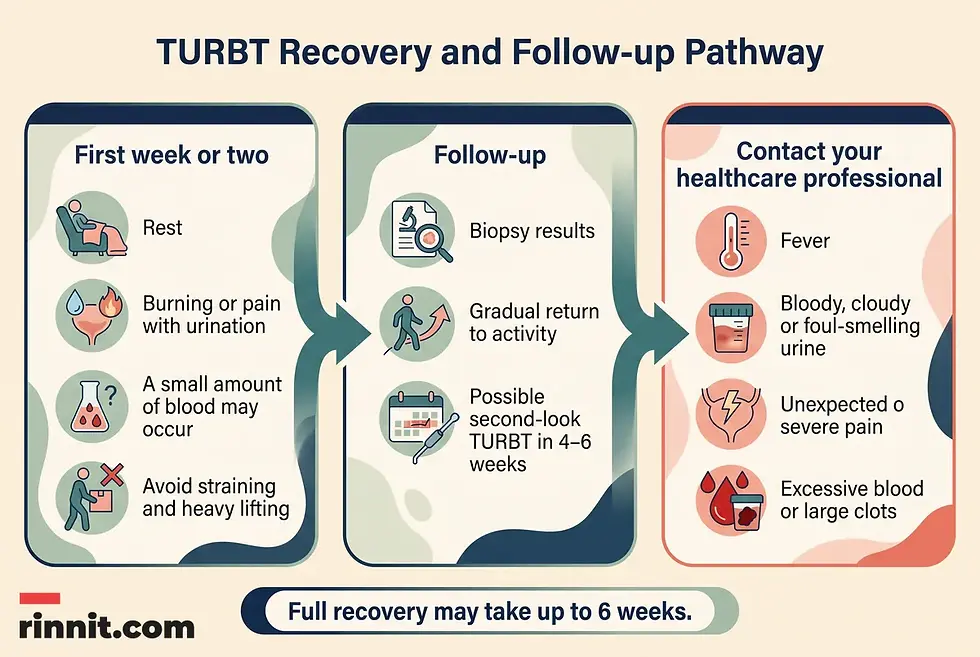
Recovery after a TURBT is gradual, and it can take up to six weeks to feel fully recovered. During the first week or two, you should get plenty of rest. Burning or pain while urinating may occur, and a small amount of blood in the urine may be normal. Let the provider know if there is more blood than expected.
The care team may advise you to avoid straining or lifting heavy objects and may recommend avoiding driving. Providers usually recommend waiting at least two weeks before gradually returning to typical activities, but the treating provider determines when your normal activity level is appropriate.
Recovery period | What to expect |
First week or two | Rest; burning or pain with urination may occur; a small amount of blood in urine may occur. |
At least two weeks | Providers usually recommend waiting at least this long before gradually returning to typical activities. |
Up to six weeks | Full recovery may take this long. |
Follow-up period | Biopsy results are shared during a follow-up appointment or by contact from the care team. |
What about a second-look TURBT?
Some people may need a second TURBT, also called a second-look TURBT. It may be used to reduce the risk of cancer spreading outside the bladder and to check that all the tumor was removed during the first procedure. It usually happens four to six weeks after the first procedure.
A second-look procedure is not a conclusion about any one person's condition. Ask the treating team whether it is being considered and what question it is intended to answer.
When should you call a healthcare professional?
Contact the treating provider if you have questions before or after TURBT. Let the care team know right away if you have a fever, bloody, cloudy or foul-smelling urine, unexpected or severe pain, excessive blood in the urine or large blood clots in the urine.
Warning sign after TURBT | Action |
Fever | Contact the provider. |
Bloody, cloudy or foul-smelling urine | Contact the provider. |
Unexpected or severe pain | Contact the provider. |
Excessive blood in urine | Contact the provider right away. |
Large blood clots in urine | Contact the provider right away. |
If symptoms feel severe or rapidly worsen, follow the care team's instructions for urgent assessment. This article cannot determine the cause or severity of an individual symptom.
TURBT vs. cystoscopy: what is the difference?
Cystoscopy is a procedure that allows a provider to look inside the bladder and urethra. It is a broader procedure that can be used for many conditions. TURBT is used specifically to biopsy and remove bladder cancer.
Feature | Cystoscopy | TURBT |
Main role | Allows the provider to look inside the bladder and urethra. | Biopsies and removes a bladder tumor. |
Scope route | Uses an instrument through the urethra. | Uses a scope through the urethra. |
Uses | Can be used for many conditions. | Specifically used to biopsy and remove bladder cancer. |
Tissue removal | Looking alone does not necessarily mean a tumor is removed. | A small cutting device is used to remove the tumor. |
The treating team can explain which procedure is planned and why.
What questions should you ask before a TURBT?
Writing down questions can make a procedure discussion easier.
Topic | Example question |
Purpose | Is TURBT being used for biopsy, removal or both? |
Pathology | When will the tissue report be available, and how will I receive it? |
Anesthesia | Will general or regional/spinal anesthesia be used? |
Catheter | Will I need a catheter, and if so, when might it be removed? |
Recovery | How much rest, lifting restriction and driving restriction should I expect? |
Additional treatment | Could intravesical or IV chemotherapy be discussed after pathology review? |
Second look | Could another TURBT be considered four to six weeks later? |
Warning signs | Who should I call for fever, urine changes, pain, blood or clots? |
Conclusion: Know what the procedure can and cannot tell you
TURBT is a transurethral procedure that can diagnose and treat a bladder tumor during the same procedure. A camera-equipped cystoscope travels through the urethra, the tumor is removed, and tissue is sent for pathology review to help determine stage and grade.
Preparation may include fasting, medication instructions, transportation, bathing and a complete medicine and supplement list. Afterward, a catheter may be used temporarily, pain or burning with urination may last one to two weeks, and full recovery can take up to six weeks.
If TURBT has been planned, ask the treating team about anesthesia, catheter use, pathology timing, possible additional treatment, activity restrictions and whether a second-look procedure may be considered. Contact the care team for fever, bloody, cloudy or foul-smelling urine, unexpected or severe pain, excessive blood in the urine or large blood clots.
Frequently Asked Questions
Does TURBT require an external incision?
No. The scope reaches the bladder through the urethra, so an external incision is not needed to perform TURBT.
Is TURBT a biopsy or a treatment?
TURBT can be both. TURBT can remove the tumor and provide tissue samples for pathology examination during one procedure.
What happens to the tumor after it is removed?
The tissue is sent to a pathology laboratory, where a pathologist examines it to help determine the tumor's stage and grade.
What anesthesia is used for TURBT?
General anesthesia may be used, which means you are asleep. Regional or spinal anesthesia may also be used, which means you are awake while the lower half of the body is numb.
Will I need a catheter after TURBT?
Some people need a catheter and some do not. If used, it may be removed before going home or stay in place for a few days.
How painful is TURBT?
Pain should not occur during the procedure because anesthesia is used. Pain or discomfort, especially while urinating, may occur for one to two weeks afterward.
How long does TURBT recovery take?
Full recovery can take up to six weeks. Providers usually recommend waiting at least two weeks before gradually returning to typical activities.
Is blood in the urine normal after TURBT?
A small amount may occur during the first week or two. More blood than expected, excessive blood or large clots should be reported to the care team.
Is chemotherapy always needed after TURBT?
No. Some people may need chemotherapy. Intravesical chemotherapy may be considered when the tumor has not spread outside the bladder, while IV chemotherapy may be used when cancer has spread.
What is a second-look TURBT?
A second-look TURBT is another TURBT, usually four to six weeks after the first, that may help check whether all of the tumor was removed and reduce the risk of spread outside the bladder.
How is TURBT different from cystoscopy?
Cystoscopy lets a provider look inside the bladder and urethra for many conditions. TURBT is used specifically to biopsy and remove bladder cancer.
How do I prepare for TURBT?
Don't eat for eight hours before the procedure, and tell your provider about all medicines, including over-the-counter drugs and herbal supplements; stop them only if told to, or take them with a sip of water. [1] Bathe or shower beforehand, skip lotions, perfumes and deodorants that day, wear comfortable clothing, and arrange for someone to drive you home. [1]
When should I call after TURBT?
Contact the care team for fever, bloody, cloudy or foul-smelling urine, unexpected or severe pain, excessive blood in the urine or large blood clots.
Related guides
Related Reading
BCG Treatment for Bladder Cancer: Procedure, Schedule and Side Effects explains BCG treatment for bladder cancer.
References
Cleveland Clinic. TURBT: Transurethral Resection of Bladder Tumor. Cleveland Clinic. Last updated November 27, 2023. https://my.clevelandclinic.org/health/procedures/turbt
Maltagliati M, Varca V, Milandri R, et al. Second-look TURBT: evaluation of anatomopatological and oncologic results in a single center. Acta Biomed. 2020;91(2):322-325. PMID 32420968. https://doi.org/10.23750/abm.v91i2.8618
Kang M, Jeong CW, Kwak C, et al. Single, immediate postoperative instillation of chemotherapy in non-muscle invasive bladder cancer: a systematic review and network meta-analysis of randomized clinical trials using different drugs. Oncotarget. 2016;7(29):45479-45488. PMID 27323781. https://doi.org/10.18632/oncotarget.9991
Disclaimer
This article is for general educational purposes and is not a substitute for professional medical advice, diagnosis or treatment. Always seek the advice of a qualified healthcare professional with any questions about a medical condition or treatment.



Comments