Pelvic Exenteration: Types, Surgery and Recovery

Updated: 2 days ago
Written and medically reviewed by Dr. Baraa Alnahhal, MD · Last reviewed: November 2026 · How we review
Quick Answer
Pelvic exenteration is a major surgery that removes organs in the pelvis to treat advanced or recurrent cancer, most often gynecologic cancers such as cervical cancer. You may need a urostomy or colostomy afterward. Full recovery may take six months to a year. It's usually a last-resort option when cure is still possible.
What the research says
Early deaths after surgery were uncommon and falling: in a review of 46 studies with 4,417 people with gynecologic cancers, 30-day mortality after pelvic exenteration was 5.1%, with sepsis the leading cause, and early deaths fell 2.6% per publication year (Di Donato V et al., International Journal of Gynecological Cancer, 2025) [2]
Quality of life often recovered within a year: a review of 25 studies with 5,489 people with advanced or recurrent rectal cancer found complication rates of 17.8% to 87.0%, but quality-of-life scores often returned to baseline by 12 months (Maudsley J et al., Annals of the Royal College of Surgeons of England, 2025) [3]
Key takeaways
Pelvic exenteration removes pelvic organs to treat advanced or recurrent cancer.
It's used for cervical, colorectal, anal and bladder cancers.
Surgery takes about 12 hours.
You may need a urostomy, colostomy or vaginal reconstruction.
It cures up to 63% of people.
What is pelvic exenteration?
It treats cancer that has come back or advanced but hasn't spread beyond the pelvis. It can also ease cancer pain. Because it's rare and complex, choose a high-volume center. Sources: [1]
Why it's done

It's a last-resort option when cure is still possible.
Cervical cancer and other gynecologic cancers.
Rectal and colon cancer.
Anal cancer.
Bladder cancer. Sources: [1]
Types of pelvic exenteration
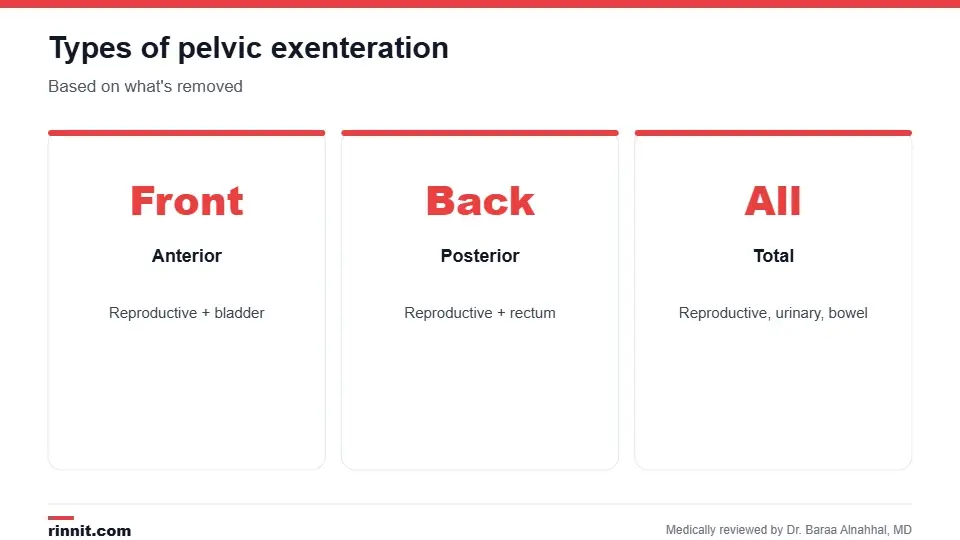
In males, total exenteration also removes the prostate and seminal vesicles.
Type | What's removed |
Anterior (front) | Uterus, ovaries, cervix, vagina, bladder and urethra |
Posterior (back) | Reproductive organs, rectum, anus and part of the colon |
Total | Reproductive, urinary and affected digestive organs; in males, also prostate and seminal vesicles |
Sources: [1]
How to prepare
Avoid alcohol and tobacco.
Stop certain medicines, such as blood thinners, as directed.
Follow eating and drinking instructions.
Choose a caregiver to help during recovery.
Plan time off work. Sources: [1]
What happens during surgery
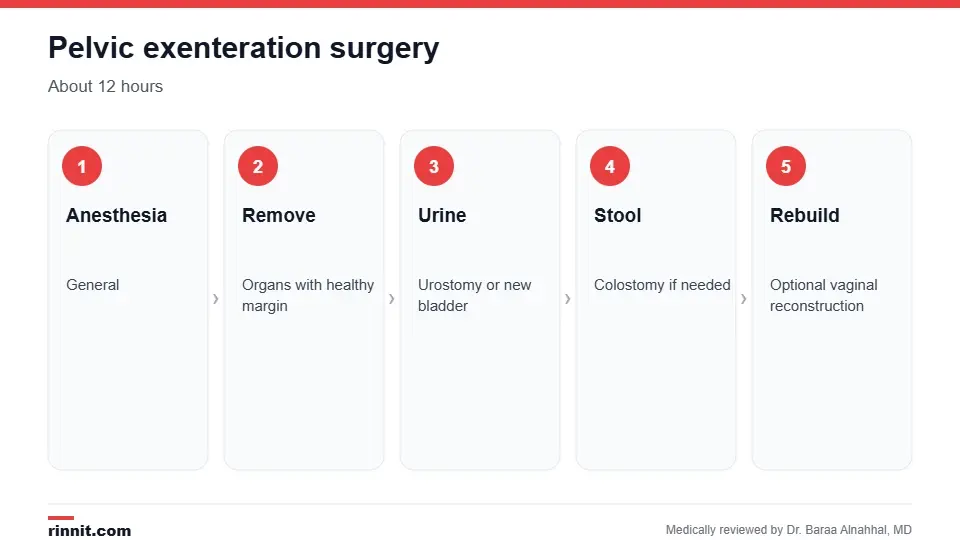
Surgery usually takes around 12 hours.
You get general anesthesia.
Most people have open surgery through a large incision; some have laparoscopic surgery.
The surgeon removes affected tissue with a margin of healthy tissue.
If the bladder is removed, urine is rerouted through a urostomy or a new bladder made from intestine.
If the rectum and anus are removed, a colostomy is created.
Vaginal reconstruction may be done. Sources: [1]
Risks
Pelvic exenteration is a complex surgery with real risks and a challenging recovery. In studies, complications were common, and sepsis was the leading cause of early death. Your team will discuss your specific risks. Sources: [1, 2, 3]
Recovery
You'll stay in the hospital for several days or weeks.
You'll learn how to care for your ostomies and spot infection.
Rest for several weeks and get help with bathing and dressing if needed.
Move regularly to prevent blood clots and constipation.
You may avoid sitting for up to eight weeks.
Core physical therapy may help with sitting upright. Sources: [1]
Full recovery may take six months to a year. Counseling and support groups can help, and quality of life generally improves over time. Sources: [1, 3]
Outlook
Pelvic exenteration cures up to 63% of people. Five-year survival is about 50% for rectal cancer and 30% to 70% for gynecologic cancers. Sources: [1, 2]
When to call your provider
Bleeding or swelling in your belly.
Fever, redness or swelling near the incision.
Severe belly pain.
Constipation or problems with your ostomies.
Nausea and vomiting. Sources: [1]
Conclusion
Pelvic exenteration is a demanding surgery, but it offers a real chance of cure for advanced pelvic cancers. An experienced team and strong support make recovery easier.
Keep learning: read about ostomy surgery and cervical cancer.
Frequently asked questions
What is pelvic exenteration?
Surgery that removes pelvic organs to treat advanced or recurrent cancer.
What cancers does it treat?
Cervical and other gynecologic, colorectal, anal and bladder cancers.
What are the types?
Anterior, posterior and total.
How long does surgery take?
Around 12 hours.
Will I need an ostomy?
Often, a urostomy, colostomy or both, depending on what's removed.
Can the vagina be reconstructed?
Yes, vaginal reconstruction is an option.
How long is the hospital stay?
Several days to several weeks.
How long is full recovery?
Six months to a year.
Can it cure cancer?
It cures up to 63% of people.
Why choose a high-volume center?
The surgery is rare and complex, so experience matters.
Related Reading
Ostomy Surgery: Types, Procedure, and Recovery living with an ostomy.
Urostomy: A Comprehensive Guide to Urinary Diversion Surgery rerouting urine after bladder removal.
Colostomy: Procedure, Types, and Recovery a stool diversion.
Cervical Cancer: Symptoms, Screening, Diagnosis, Treatment and Support a cancer it treats.
Cystectomy (Bladder Removal Surgery): Types, Procedure, Risks and Recovery bladder removal surgery.
References
Cleveland Clinic. Pelvic Exenteration: What It Is & Recovery. Cleveland Clinic. Last updated June 11, 2026. https://my.clevelandclinic.org/health/treatments/22455-pelvic-exenteration
Di Donato V, Kontopantelis E, De Angelis E, et al. Evaluation of survival and mortality in pelvic exenteration for gynecologic malignancies: a systematic review, meta-analyses, and meta-regression study. International Journal of Gynecological Cancer. 2025;35(6):101829. PMID 40373347. https://doi.org/10.1016/j.ijgc.2025.101829
Maudsley J, Clifford RE, Aziz O, et al. A systematic review of oncosurgical and quality of life outcomes following pelvic exenteration for locally advanced and recurrent rectal cancer. Annals of the Royal College of Surgeons of England. 2025;107(1):2-11. PMID 38362800. https://doi.org/10.1308/rcsann.2023.0031
Medical disclaimer
This article is for general education only and does not replace advice from a qualified healthcare professional. Talk to your doctor about your own diagnosis and treatment, and seek emergency care right away for severe or sudden symptoms.



Comments