What Is Rectal Cancer? A Plain-Language Guide to the Signs, Causes, and Treatment

Updated: 3 days ago
Medically reviewed by Dr. Baraa Alnahhal, MD · Last reviewed: October 2026
Quick Answer: Rectal Cancer at a Glance
Rectal cancer is a cancer that starts as a growth of cells in the rectum, the last several inches of the large intestine, usually as an adenocarcinoma [1]. Warning signs include bowel changes, rectal bleeding and weight loss [1]. Colonoscopy and biopsy diagnose it [2]. It is often curable when found early, usually with surgery, chemotherapy and radiation [2].
Feature | Details |
What it is | A cancer that starts as a growth of cells in the rectum, the last several inches of the large intestine [1]. |
Why it happens | DNA changes make cells grow too fast and keep living when healthy cells would die, forming a tumor. Most are adenocarcinomas [1]. |
Warning signs | Bowel habit changes, rectal bleeding, narrow stool, incomplete emptying, abdominal pain, unexplained weight loss, weakness or fatigue, and a lump in the rectum [1]. |
How it's diagnosed | Colonoscopy and biopsy, then staging tests such as blood tests, CEA, CT scans, and a pelvic MRI [2]. |
How it's treated | Often curable, especially when found early. Usually surgery combined with chemotherapy and radiation. Targeted therapy and immunotherapy are other options [2]. |
Prevention | Screening starting around age 45, a diet rich in fruits and vegetables, regular exercise, a healthy weight, moderate or no alcohol, and not smoking [1]. |
What the research says
Screening with a scope lowers colorectal cancer cases and deaths. A meta-analysis of 7 randomized trials (663,319 people at average risk) found that screening with colonoscopy or sigmoidoscopy, compared with standard care, was associated with a 20% lower rate of colorectal cancer (risk ratio 0.80, 95% CI 0.77 to 0.83) and a 26% lower rate of colorectal cancer death (risk ratio 0.74, 95% CI 0.69 to 0.80). Deaths from all causes did not change significantly. (Han et al., Front Oncol, 2024) [3]
Giving chemotherapy before surgery can raise the chance of a complete response. A network meta-analysis of 27 randomized trials (13,413 adults with locally advanced rectal cancer) compared "total neoadjuvant therapy" protocols, which add chemotherapy before surgery, with standard chemoradiotherapy. Three protocols had higher rates of pathological complete response, meaning no cancer found in the removed tissue (relative risks 1.57 to 1.96). Two of them also improved 3-year disease-free survival. One protocol, short-course radiotherapy plus chemotherapy, had a higher 5-year rate of the cancer coming back in the pelvis. The best plan depends on the individual cancer and is chosen by your care team. (Turri et al., JAMA Netw Open, 2024) [4]
What Is Rectal Cancer?
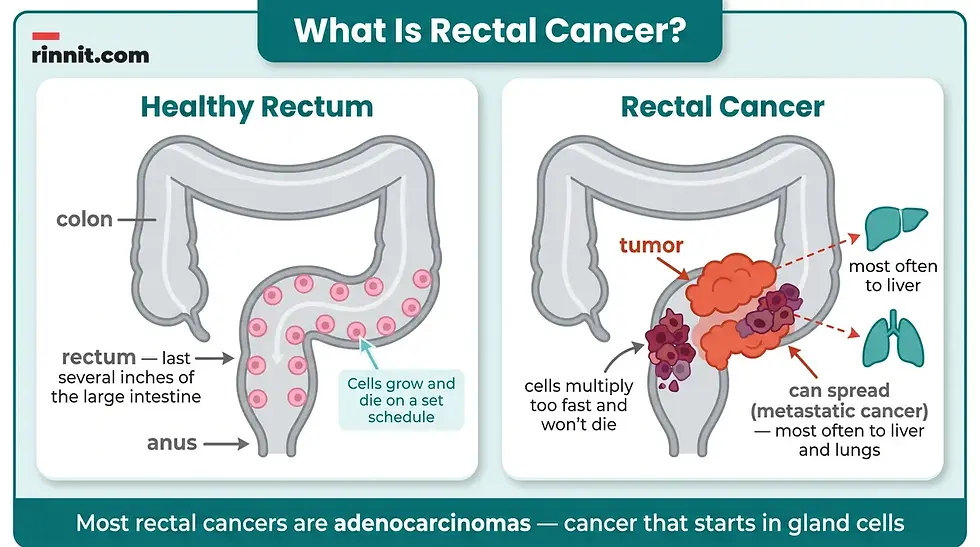
Rectal cancer is a kind of cancer that starts as a growth of cells in the rectum. The rectum is the last several inches of the large intestine [1]. It starts at the end of the final segment of the colon and ends at the short, narrow passage known as the anus [1]. Cancer in the rectum and cancer in the colon are often referred to together as colorectal cancer [1].
Rectal and colon cancers are similar in many ways, but their treatments are quite different. This is mainly because the rectum is barely separated from other organs and structures [1]. It sits in a tight space, which can make surgery to remove rectal cancer complex.
What Are the Signs of Rectal Cancer?
Rectal cancer may not cause any symptoms early on, and its signs are similar in both men and women. Symptoms usually appear when the disease is advanced [1]. In both men and women, they include:
Symptom | What to notice |
Change in bowel habits | Diarrhea, constipation, or a more frequent need to pass stool. |
Incomplete emptying | A feeling that the bowel does not empty completely. |
Abdominal pain | Pain in the belly area. |
Rectal bleeding | Stool that looks dark maroon or bright red [1]. |
Narrow stool | Stool that is noticeably thinner than usual. |
Unexplained weight loss | Weight loss that happens without trying. |
Weakness or fatigue | Ongoing tiredness or low energy. |
Lump in the rectum | May be found during a medical exam [1]. |
Is Bleeding Always Cancer?
No. Rectal bleeding is often due to other causes, such as swollen veins in the rectum called hemorrhoids. Bleeding from hemorrhoids is generally bright red and happens during or after bowel movements [1]. Bleeding related to cancer may be dark or bright red and can happen at any time [1]. It is difficult to tell the difference, so if you notice bleeding, see a healthcare professional and get checked [1].
When Should I See a Doctor?
Make an appointment with your doctor or another healthcare professional if you have any symptoms that worry you [1].
What Causes Rectal Cancer?
The exact cause of most rectal cancers is not known [1]. Rectal cancer happens when cells in the rectum develop changes in their DNA. A cell's DNA holds the instructions that tell the cell what to do. In healthy cells, the DNA tells the cell to grow and multiply at a set rate and to die at a set time. In cancer cells, the DNA changes give different instructions: make many more cells quickly, and keep living when healthy cells would die. This causes too many cells.
The cancer cells might form a mass called a tumor. The tumor can grow to invade and destroy healthy body tissue. In time, cancer cells can break away and spread to other parts of the body, which is called metastatic cancer. Rectal cancer can spread to almost any organ, but the liver and lungs are most commonly affected [1].
Most rectal cancers are adenocarcinomas, which are cancers that start in gland cells [1]. Gland cells are found all over the body, including in the rectum.

What Raises My Risk of Rectal Cancer?
The factors that may increase the risk of rectal cancer are the same as those for colon cancer [1].
Risk factor | What it means for your risk |
Personal history of colorectal cancer or polyps | Higher risk if you have had rectal cancer, colon cancer, or adenomatous polyps. |
Black race | Black people in the United States have a greater risk of colorectal cancer than people of other races [1]. |
Type 2 diabetes | May increase the risk. |
Heavy drinking | Increases the risk. |
Diet low in vegetables | Colorectal cancer may be related to a diet low in vegetables and high in red meat [1]. |
Family history | A parent, sibling, or child with colon or rectal cancer raises your risk. |
Inflammatory bowel disease | Ulcerative colitis and Crohn's disease increase the risk. |
Inherited syndromes | Familial adenomatous polyposis (FAP) and Lynch syndrome. They are involved in only a small percentage of rectal cancers, and genetic testing can detect them [1]. |
Excess weight | People with obesity have a higher risk than people at a healthy weight. |
Older age | Most people diagnosed are older than 50. Rates in people under 50 have been rising, and healthcare professionals are not sure why [1]. |
Radiation for a previous cancer | Radiation directed at the abdomen may increase the risk. |
Smoking | May increase the risk. |
Too little exercise | Inactive people are more likely to develop colorectal cancer. Regular physical activity may reduce the risk [1]. |

What Complications Can Rectal Cancer Cause?
Rectal cancer can cause complications such as bleeding in the rectum, intestinal obstruction that blocks stool and intestinal perforation, which typically requires surgery [1].
Bleeding in the rectum. Rectal cancer often causes bleeding. Sometimes the amount of blood is worrying, and treatment might be needed to stop it right away [1].
Intestinal obstruction. The cancer can grow to block the intestines, which prevents stool from leaving the body. Surgery to remove the cancer often relieves an obstruction. If you cannot have surgery right away, other treatments can ease the blockage [1].
Intestinal perforation. Rectal cancer may cause a tear in the intestines. Perforation typically requires surgery [1].
How Can I Reduce My Risk?
Rectal cancer cannot be prevented with certainty, but screening, limiting alcohol, eating more fruits and vegetables and exercising most days can reduce your risk [1].
Ask about screening. Colorectal cancer screening reduces the risk of cancer by finding precancerous polyps in the colon and rectum that could turn into cancer [1]. Most medical organizations recommend starting around age 45, and you may be screened earlier if you have risk factors [1]. Several screening options exist, so talk with your healthcare professional about which tests are right for you.
Drink alcohol in moderation, if at all. For healthy adults, that means up to one drink a day for women and up to two drinks a day for men [1].
Eat more fruits and vegetables. Choose a healthy diet with a variety of them. Food sources of vitamins and nutrients are best, and large doses of vitamins in pill form may be harmful [1].
Exercise most days of the week. Aim for at least 30 minutes on most days [1]. If you have not been active lately, ask your healthcare professional whether it is OK and start slowly.
Maintain a healthy weight. If you need to lose weight, ask a healthcare professional about healthy ways to do it: eat fewer calories and slowly increase exercise [1].
Stop smoking. Options include nicotine replacement products, medicines, and support groups [1]. If you have never smoked, do not start.
How Is Rectal Cancer Diagnosed?
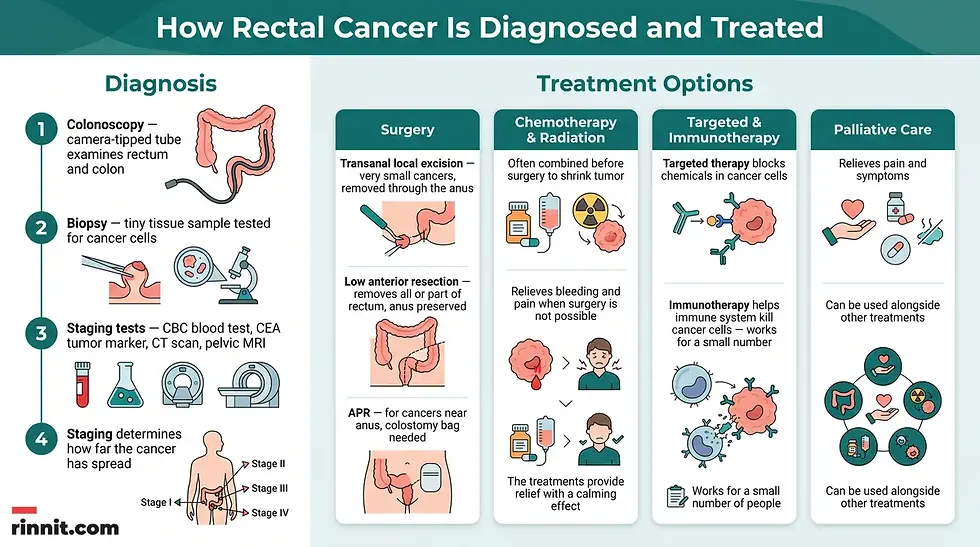
Rectal cancer diagnosis often begins with an imaging test to look at the rectum [2]. A thin, flexible tube with a camera may be passed into the rectum and colon, and a sample of tissue may be taken for lab testing. Rectal cancer can be found during a screening test for colorectal cancer, or it may be suspected based on your symptoms [2].
Colonoscopy
Colonoscopy is a test to look at the colon and rectum. It uses a long, flexible tube with a camera at the end, called a colonoscope [2]. Your healthcare professional looks for signs of cancer. Medicines are given before and during the procedure to keep you comfortable [2].
Biopsy
A biopsy removes a sample of tissue for testing in a lab. A healthcare professional passes special cutting tools through the colonoscope to remove a very small sample of tissue from inside the rectum [2]. The sample is sent to a lab to look for cancer cells. Other special tests give more details about the cancer cells, and your team uses this information to make a treatment plan [2].
How Do Doctors Stage Rectal Cancer?
If you are diagnosed with rectal cancer, the next step is to determine the cancer's extent, called the stage. The staging test results help your healthcare team create your treatment plan.
Staging test | What it does |
Complete blood count (CBC) | |
Blood tests for organ function | A chemistry panel measures chemicals in the blood. Worrying levels of some may suggest the cancer has spread to the liver, and high levels of others could mean problems with organs such as the kidneys and liver [2]. |
Carcinoembryonic antigen (CEA) | A tumor marker that may be higher than usual in people with colorectal cancer. CEA testing can help monitor your response to treatment [2]. |
CT scan of chest, abdomen, and pelvis | Helps determine whether the cancer has spread to other organs, such as the liver or lungs [2]. |
MRI of the pelvis | Gives a detailed image of the muscles, organs, and tissues around the cancer, and shows nearby lymph nodes and the layers of the rectal wall more clearly than a CT [2]. |
Surgery | Sometimes used to confirm how far the cancer has spread, especially after radiation or chemotherapy. Examining the tumor and nearby lymph nodes removed during surgery determines the exact stage [2]. |
How Is Rectal Cancer Treated?
Rectal cancer is often curable, especially when found early [2]. Even some cancers that have spread may be curable with the right treatment approach [2]. Treatment may begin with surgery to remove the cancer. If the cancer grows larger or spreads to other parts of the body, treatment might start with medicine and radiation instead [2]. Your healthcare team considers your overall health, the type and stage of your cancer, and your preferences [2].
Surgery
Surgery can be used alone or together with other treatments [2].
Surgery | When it's used | Key detail |
Transanal local excision | Very small cancers that are not likely to spread to nearby lymph nodes. | The cancer and some healthy tissue around it are cut away through a scope inserted through the anus. If lab results show aggressive cells, more surgery may be needed [2]. |
Low anterior resection | Larger cancers far enough from the anus. | All or part of the rectum, nearby tissue, and lymph nodes are removed. The anus is preserved, so waste leaves the body as usual [2]. |
Abdominoperineal resection (APR) | Cancers near the anus that cannot be removed without harming the muscles that control bowel movements. | The rectum, anus, and some colon are removed. A colostomy sends waste out through an opening in the abdomen into a bag [2]. |
In a low anterior resection, how the colon is reconnected depends on the cancer's location. If the cancer is in the upper rectum, that part is removed and the colon is attached to the remaining rectum (a colorectal anastomosis). If it is in the lower rectum, all of the rectum may be removed, and the colon is shaped into a pouch and attached to the anus (a coloanal anastomosis) [2].
Chemotherapy and Radiation
Chemotherapy treats cancer with strong medicines. In rectal cancer, it is typically used before or after surgery [2]. It is often combined with radiation therapy before an operation to shrink a large cancer so that it is easier to remove [2]. In advanced cancer that has spread beyond the rectum, chemotherapy slows the growth of the cancer, which extends survival and relieves symptoms [2].
Radiation therapy treats cancer with powerful energy beams. For rectal cancer, it is most often done as external beam radiation: you lie on a table while a machine moves around you and directs radiation to precise points on your body [2]. It is often combined with chemotherapy and usually used before surgery to shrink the cancer. When surgery is not an option, radiation can relieve symptoms such as bleeding and pain [2]. Combining chemotherapy and radiation may enhance the effect of each, and it can be your only treatment or be used before surgery, but it may also increase side effects [2].
Targeted Therapy and Immunotherapy
Targeted therapy uses medicines that attack specific chemicals in cancer cells [2]. For rectal cancer, it may be combined with chemotherapy for advanced cancers that cannot be removed with surgery or for cancers that come back after treatment. Some targeted therapies only work in people whose cancer cells have certain DNA changes, so your cancer cells may be tested in a lab [2].
Immunotherapy uses medicine that helps the body's immune system find and kill cancer cells. For rectal cancer, it is sometimes used before or after surgery and may also be used for advanced cancers that have spread [2]. It only works for a small number of people with rectal cancer, and special testing can show whether it might work for you [2].
Palliative Care
Palliative care is a type of healthcare that helps you feel better when you have a serious illness. It can relieve pain and other symptoms, and its goal is to improve quality of life for you and your family. You can have palliative care at the same time as strong cancer treatments such as surgery, chemotherapy, or radiation. Using it with other proper treatments can help people with cancer feel better and live longer [2].
How Can I Cope With a Rectal Cancer Diagnosis?
Coping with a rectal cancer diagnosis is easier when you learn enough to make care decisions, keep friends and family close and find someone to talk with.
Learn enough about rectal cancer to make decisions about your care. Ask your team about your test results, treatment options, and, if you like, your prognosis [2].
Keep friends and family close. They can provide practical help, such as taking care of your home if you are in the hospital, and emotional support when you feel overwhelmed [2].
Find someone to talk with. This may be a friend or family member, or a counselor, medical social worker, clergy member, or cancer support group. Other sources of information include the U.S. National Cancer Institute and the American Cancer Society [2].
How Should I Prepare for My Appointment?
If rectal cancer is suspected, you may be referred to a gastroenterologist, a doctor who treats digestive diseases, so it helps to prepare your symptoms, medicines and questions. If cancer is diagnosed, you may also be referred to an oncologist, a doctor who treats cancer [2]. To prepare:
Ask about pre-appointment restrictions, such as restricting your diet.
Write down your symptoms, including any that may not seem related, and key personal information such as major stresses or recent life changes.
List all medicines, vitamins, and supplements you take, with doses.
Take a family member or friend along. They may remember something you missed.
Write down your questions, from most to least important. Examples: In what part of the rectum is my cancer? What is its stage? Has it spread? Will I need more tests? What are my treatment options, how much does each increase my chances of a cure, and what are the side effects? How will treatment affect my daily life? Should I see a specialist? What will determine whether I need a follow-up visit [2]?
Your doctor is likely to ask when your symptoms began, whether they are continuous or occasional, how severe they are, and what seems to improve or worsen them [2].
What is the bottom line on rectal cancer?
Rectal cancer starts as a growth of cells in the last stretch of the large intestine, and it may cause no symptoms early on. When symptoms appear, any rectal bleeding or lasting change in bowel habits deserves a check, because cancer-related bleeding can look like bleeding from harmless hemorrhoids [1]. The disease can spread, most commonly to the liver and lungs [1], but it is often curable, especially when found early [2]. Treatment usually combines surgery with chemotherapy and radiation [2]. Screening starting around age 45, a healthy lifestyle, and acting quickly on warning signs are the best ways to protect yourself.
Want more digestive health guides? Explore more plain-language health information at Rinnit.com.
Frequently Asked Questions
What is rectal cancer?
Rectal cancer is a cancer that starts as a growth of cells in the rectum, the last several inches of the large intestine [1]. Rectal and colon cancer are often called colorectal cancer, but their treatments differ because the rectum sits in a tight space close to other organs, which makes surgery more complex [1].
What causes rectal cancer?
The exact cause of most rectal cancers is not known [1]. It happens when rectum cells develop DNA changes that tell them to grow too fast and keep living when healthy cells would die. The extra cells can form a tumor that invades healthy tissue and can spread, most commonly to the liver and lungs [1]. Most rectal cancers are adenocarcinomas [1].
What are the symptoms of rectal cancer?
Symptoms usually appear when the disease is advanced [1]. They include a change in bowel habits, a feeling that the bowel does not empty completely, abdominal pain, rectal bleeding, narrow stool, unexplained weight loss, weakness or fatigue, and a lump in the rectum [1].
Is rectal bleeding always a sign of cancer?
No. It is often caused by hemorrhoids, which are swollen veins in the rectum. Hemorrhoid bleeding is generally bright red and happens during or after bowel movements, while cancer-related bleeding may be dark or bright red and can happen at any time [1]. Because it is hard to tell the difference, any rectal bleeding should be checked by a healthcare professional [1].
Who is at higher risk of rectal cancer?
People with a personal or family history of colorectal cancer or polyps, Black people in the United States, people with type 2 diabetes, heavy drinkers, people with a diet low in vegetables and high in red meat, people with inflammatory bowel disease or inherited syndromes such as FAP and Lynch syndrome, people with obesity, smokers, people who had abdominal radiation for a previous cancer, and inactive people. Most people diagnosed are older than 50, though rates under 50 have been rising [1].
How is rectal cancer diagnosed?
Diagnosis often begins with a colonoscopy and a biopsy, in which a tiny tissue sample is tested in a lab for cancer cells. Staging tests then show how far the cancer has spread, including blood tests, the CEA tumor marker, CT scans of the chest, abdomen, and pelvis, and an MRI of the pelvis [2].
How is rectal cancer treated?
Rectal cancer is often curable, especially when found early [2]. Treatment usually involves surgery: transanal local excision for very small cancers, low anterior resection for larger cancers far enough from the anus, or abdominoperineal resection (APR), which needs a colostomy, for cancers near the anus [2]. Chemotherapy and radiation are often combined and used before surgery to shrink the cancer [2]. Targeted therapy, immunotherapy, and palliative care are other options.
Can I lower my risk of rectal cancer?
There is no sure way to prevent it, but you can reduce your risk by starting screening around age 45 (earlier if you have risk factors), drinking alcohol in moderation, eating more fruits and vegetables, exercising at least 30 minutes on most days, keeping a healthy weight, and not smoking. Avoid large doses of vitamins in pill form [1].
Related Reading
Learn more in our guide to Low Anterior Resection (LAR): Rectal Cancer Surgery, Risks and Recovery.
Learn more in our guide to Colorectal Cancer Screening: When to Start, Test Options and What Results Mean.
CEA Test (Carcinoembryonic Antigen): Normal Levels, High Results and Limits explains the tumor marker blood test used to monitor this cancer.
Digital Rectal Exam (DRE): Why It's Done, Positions and What to Expect explains the gloved finger exam of the rectum, anus and prostate.
References
Mayo Clinic Staff. Rectal cancer - Symptoms and causes. Mayo Clinic. Published September 12, 2025. https://www.mayoclinic.org/diseases-conditions/rectal-cancer/symptoms-causes/syc-20352884
Mayo Clinic Staff. Rectal cancer - Diagnosis and treatment. Mayo Clinic. Published September 12, 2025. https://www.mayoclinic.org/diseases-conditions/rectal-cancer/diagnosis-treatment/drc-20352889
Han C, et al. Effectiveness of sigmoidoscopy or colonoscopy screening on colorectal cancer incidence and mortality: a systematic review and meta-analysis of randomized controlled trial. Front Oncol. 2024;14:1364923. PMID 38549924. https://doi.org/10.3389/fonc.2024.1364923
Turri G, et al. Treatment of Locally Advanced Rectal Cancer in the Era of Total Neoadjuvant Therapy: A Systematic Review and Network Meta-Analysis. JAMA Netw Open. 2024;7(6):e2414702. PMID 38833249. https://doi.org/10.1001/jamanetworkopen.2024.14702
Medical disclaimer
This article is for general informational purposes only and does not constitute medical advice. Always consult a qualified healthcare professional for diagnosis and treatment decisions. See a healthcare professional promptly if you notice rectal bleeding, a lasting change in your bowel habits, or any other symptom that worries you.



Comments