Low Anterior Resection (LAR): Rectal Cancer Surgery, Risks and Recovery

Updated: 3 days ago
Written and medically reviewed by Dr. Baraa Alnahhal, MD · Last reviewed: November 2026 · How we review
Quick Answer: What is a low anterior resection?
A low anterior resection (LAR) is surgery to treat rectal cancer that removes the cancerous part of the rectum and then reconnects the bowel so the anus stays in place. A temporary ostomy is sometimes made while the join heals. The main trade-off is low anterior resection syndrome (LARS), bowel changes such as frequent or urgent bowel movements. [1]
What the research says
About 4 in 10 people develop major bowel symptoms after rectal cancer surgery. A meta-analysis of 11 studies using the LARS score found that major low anterior resection syndrome affected about 41% of patients at least a year after surgery. A low join (anastomosis) and previous radiotherapy were the most consistent risk factors. (Croese et al., International Journal of Surgery, 2018) [2]
Removing less of the fatty tissue around the rectum, when safe, protects bowel function. In 27 studies with 12,325 patients, partial mesorectal excision for higher tumors had similar cancer control to total mesorectal excision but a lower risk of a leak at the join (OR 0.42) and of major LARS (OR 0.34). (Carbone et al., European Journal of Surgical Oncology, 2023) [3]
Treatment before surgery raises the risk of bowel problems. Across 33 studies with 17,917 patients, radiation or chemotherapy before surgery was linked to a higher rate of major LARS than going straight to surgery (OR 3.09), as well as more urinary incontinence and erectile dysfunction. (Li et al., Clinical Oncology, 2023) [4]
Key takeaways
LAR removes the cancerous part of the rectum and reconnects the bowel, keeping the anus intact. [1]
It is only an option when the tumor is high enough in the rectum to remove without damaging the anus. [1]
Most LARs are laparoscopic, and a temporary ostomy may protect the join while it heals. [1]
Most people stay in the hospital a few days and return to work after about one month. [1]
Low anterior resection syndrome (LARS) can cause frequent, urgent bowel movements that may improve slowly. [1]
What is a low anterior resection?
A low anterior resection is a type of proctectomy, which is surgery to remove part or all of the rectum. It is used to treat rectal cancer. The surgeon removes the part of the rectum that contains the cancer, along with some healthy tissue around it, and sometimes part of the colon as well. [1]
Because the anus stays intact and the remaining bowel is reconnected, your bowel can work much as it did before. That is why LAR is also called restorative proctectomy or sphincter-sparing surgery. It is only an option if the tumor is high enough in the rectum to be removed without damaging the anus. [1]
How do you prepare for a low anterior resection?
Whether and when you have LAR depends on the tumor's location, size and spread. Your care team may order: [1]
Your team may recommend radiation therapy or chemotherapy before or after surgery. Before the operation you will get instructions about your medicines, what to eat and drink, and how to clear your bowel with an enema or bowel prep. [1]
What happens during a low anterior resection?
You lie on the operating table with your head tilted lower than your feet (the Trendelenburg position) and receive general anesthesia. You will have an IV, a breathing tube and tubes to drain stomach fluid and urine. [1]
Most LARs are laparoscopic: the surgeon makes a small keyhole incision for a camera and four or five more small incisions for tools. Open surgery uses one long incision in the belly. The approach depends on what is safest for you. [1]
Will I need an ostomy after LAR?
Sometimes. A temporary ostomy may be created to send stool away from the new join while it heals. The surgeon brings part of the bowel to an opening on your belly called a stoma, and stool collects in a bag. A colostomy uses the colon and an ileostomy uses the small intestine; temporary versions are called a loop colostomy or loop ileostomy. A temporary ostomy can be reversed after cancer treatment, once your body is strong enough. [1]

Low anterior resection at a glance
Item | Typical detail |
Main use | Rectal cancer |
Anesthesia | General (you are asleep) |
Usual approach | Laparoscopic (keyhole); open surgery when safer |
Ostomy | Sometimes temporary, reversed later |
Hospital stay | A few days |
Back to work | About one month for most people |
Sources: [1]
What are the risks of a low anterior resection?
Risk | What it means |
Bleeding | Blood loss during or after surgery |
Infection | Infection at the incision or inside the belly |
Anastomotic leak | Leakage where the two ends of bowel were joined |
Nerve damage | Effects on bladder control or sexual function |
Most of these problems are short term and treatable, but nerve damage can sometimes last. [1]
What is low anterior resection syndrome (LARS)?
The main advantage of LAR over abdominoperineal resection is that you can avoid a permanent ostomy. The trade-off is low anterior resection syndrome, or LARS. [1]
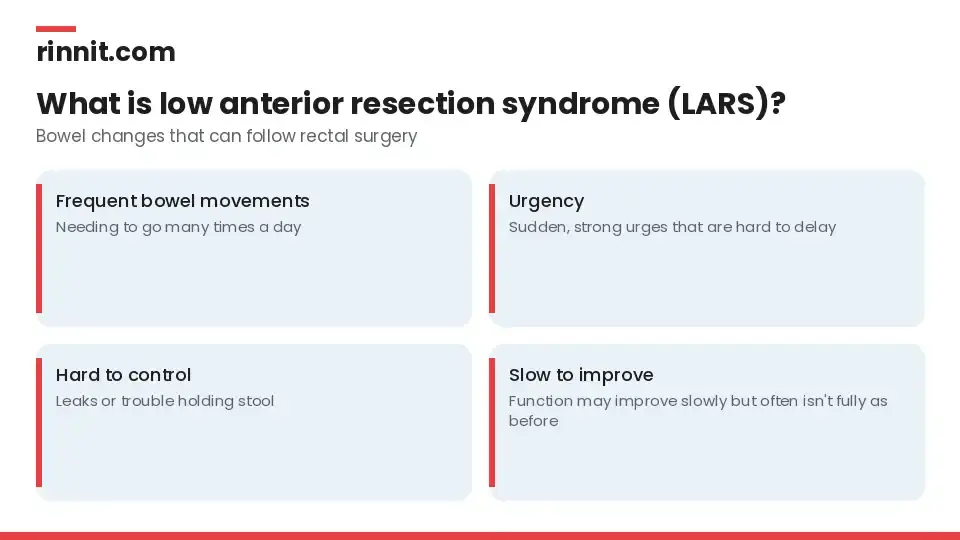
LARS describes bowel changes that can follow rectal surgery.
These symptoms may improve slowly, but bowel function often never returns fully to what it was before surgery, which can lower quality of life. LARS can be addressed after cancer treatment. [1]
What is recovery like after a low anterior resection?
You will usually stay in the hospital for a few days. During this time you get pain medicine and antibiotics and start on a liquid diet. A urinary catheter may be used, because nerves near the bladder can be affected for a while. If you have an ostomy, a wound ostomy continence nurse will teach you how to care for it. [1]
You can usually go home when: [1]
Recovery at home
Time after surgery | What to expect |
Hospital stay | A few days: pain medicine, antibiotics, liquid diet |
First few days | Pain medicine moves from opioids to over-the-counter relievers |
First few weeks | Rest at home with help for meals, housework or childcare |
After a few weeks | Follow-up visit; further cancer treatment may begin |
About one month | Most people return to work |
After cancer treatment | A temporary ostomy can be reversed |
Sources: [1]

When should you call your doctor after a low anterior resection?
Contact your care team if you notice any of these: [1]
Conclusion
A low anterior resection removes rectal cancer while keeping the anus, so most people can avoid a permanent ostomy. Most operations are keyhole surgery, recovery takes a few weeks at home, and most people are back at work in about a month. Bowel function may not return to normal right away, and LARS is common, but removing the cancer usually outweighs these side effects, and LARS can be treated after cancer care. [1]
If you have been told you need rectal cancer surgery, ask your surgeon whether LAR is an option for you, whether you will need a temporary ostomy and how to prepare for bowel changes afterward.
Keep learning: Read our guides to rectal cancer, hemicolectomy and ostomy reversal surgery. For more on treatment options, see the American Cancer Society's guide to rectal cancer surgery.
FAQ
What is a low anterior resection?
It is rectal cancer surgery that removes the cancerous part of the rectum and reconnects the bowel, keeping the anus in place.
Who can have a low anterior resection?
It is an option when the tumor is high enough in the rectum to be removed without damaging the anus.
Is low anterior resection major surgery?
Yes. It is done under general anesthesia, usually laparoscopically, and needs a hospital stay of a few days.
Will I need a colostomy or ileostomy after LAR?
Sometimes. A temporary ostomy may protect the new join while it heals and can be reversed after cancer treatment.
How long is the hospital stay after LAR?
Most people stay a few days, until they are eating solid food and their bowels and bladder are working.
How long is recovery after a low anterior resection?
Expect at least a few weeks at home; most people return to work after about one month.
What is low anterior resection syndrome?
LARS is a set of bowel changes after rectal surgery, such as frequent, urgent or hard-to-control bowel movements.
Does bowel function go back to normal after LAR?
Symptoms may improve slowly, but bowel function often does not return fully to how it was before surgery.
What are the risks of a low anterior resection?
Risks include bleeding, infection, a leak where the bowel was joined, and nerve damage affecting bladder control or sexual function.
When should I call my doctor after LAR?
Call for worsening or ongoing pain, a red or swollen stoma, fever, a swollen belly, or heavy ostomy output with dehydration.
How do I prepare for a low anterior resection?
Your care team may order blood tests, a flexible sigmoidoscopy, a CT scan of the upper body and an MRI of the lower body, and may recommend radiation or chemotherapy before or after surgery [1]. Before the operation you get instructions about your medicines, what to eat and drink, and how to clear your bowel with an enema or bowel prep [1].
Does a low anterior resection hurt, and what anesthesia is used?
You receive general anesthesia, so you're asleep during the operation [1]. In the hospital you get pain medicine, moving from opioids to over-the-counter relievers over the first few days, and you go home once pain pills by mouth control your pain [1].
Related Reading
Learn more in our guide to What Is Rectal Cancer? A Plain-Language Guide to the Signs, Causes, and Treatment.
Learn more in our guide to Colon Cancer: Symptoms, Screening, Diagnosis, Treatment and Support.
References
Cleveland Clinic. Low Anterior Resection: Surgery, Recovery & Outlook. Cleveland Clinic. Last updated July 1, 2025. https://my.clevelandclinic.org/health/procedures/low-anterior-resection
Croese AD, Lonie JM, Trollope AF, et al. A meta-analysis of the prevalence of Low Anterior Resection Syndrome and systematic review of risk factors. Int J Surg. 2018;56:234-241. PMID 29936195. https://doi.org/10.1016/j.ijsu.2018.06.031
Carbone F, Petz W, Borin S, et al. Tumour-specific mesorectal excision for rectal cancer: Systematic review and meta-analysis of oncological and functional outcomes. Eur J Surg Oncol. 2023;49(11):107069. PMID 37708660. https://doi.org/10.1016/j.ejso.2023.107069
Li X, Fu R, Ni H, et al. Effect of Neoadjuvant Therapy on the Functional Outcome of Patients With Rectal Cancer: A Systematic Review and Meta-Analysis. Clin Oncol (R Coll Radiol). 2023;35(2):e121-e134. PMID 35940977. https://doi.org/10.1016/j.clon.2022.07.003
Medical disclaimer
This article is for general education only and does not replace advice from a qualified healthcare professional. Talk to your doctor about your own diagnosis and treatment, and seek emergency care right away for severe or sudden symptoms.


Comments