Hemicolectomy: Right vs. Left Colon Surgery, Procedure, Risks and Recovery

Updated: 2 days ago
Written and medically reviewed by Dr. Baraa Alnahhal, MD · Last reviewed: November 2026 · How we review
Quick Answer: What is a hemicolectomy?
A hemicolectomy is surgery that removes one side of the colon, right or left. It's most often done for colon cancer, precancerous polyps, severe Crohn's disease or ulcerative colitis, a blocked bowel or a hole in the colon. Most operations need a three- to four-day hospital stay. Most people resume usual routines in one to two weeks. [1]
What the research says
Keyhole surgery shortens the hospital stay without raising complications. In a pooled analysis of 26 studies with 3,410 people treated for right-sided colon cancer, laparoscopic surgery cut the hospital stay by about 3 days and lowered wound infections (RR 0.65), with similar rates of anastomotic leak, blood clots and repeat surgery. Open surgery was about 49 minutes faster. (Li et al., Medicine, 2020) [2]
Joining the bowel inside the abdomen may ease recovery. Four randomized trials with 399 patients found that making the bowel connection inside the body during laparoscopic right hemicolectomy meant a shorter incision (about 1.8 cm), less pain on days 2 to 5 and a slightly shorter stay, with the same overall complication rate. (Hajibandeh et al., Updates in Surgery, 2021) [3]
Right and left robotic operations differ slightly. In 13,514 patients with colon tumors, robotic right colectomy took about 23 minutes less than robotic left colectomy but had a higher rate of temporary bowel slowdown (ileus, 10% vs 7%), with no difference in leaks, infections or length of stay. (Solis-Pazmino et al., Journal of Robotic Surgery, 2023) [4]
Key takeaways
A hemicolectomy removes either the right side (ascending colon) or the left side (descending colon) of the large intestine. [1]
It is a major operation because it removes part of an organ, needs general anesthesia and requires a hospital stay of several days. [1]
Your surgeon usually reconnects the healthy ends of the bowel, but some people need a temporary or permanent ostomy. [1]
Most people resume normal routines in about one to two weeks. [1]
What is a hemicolectomy?
A hemicolectomy is a type of colectomy (colon resection) that removes one side of the colon, the largest part of the large intestine. The surgeon takes out the diseased section with a small margin of healthy colon on each side and then joins the remaining ends. [1]
For a full overview of all colon removal operations, see our guide to colectomy types, procedure, risks and recovery.
Right vs. left hemicolectomy: what is the difference?
The two types differ in which part of the colon is removed and where the bowel is reconnected. [1]
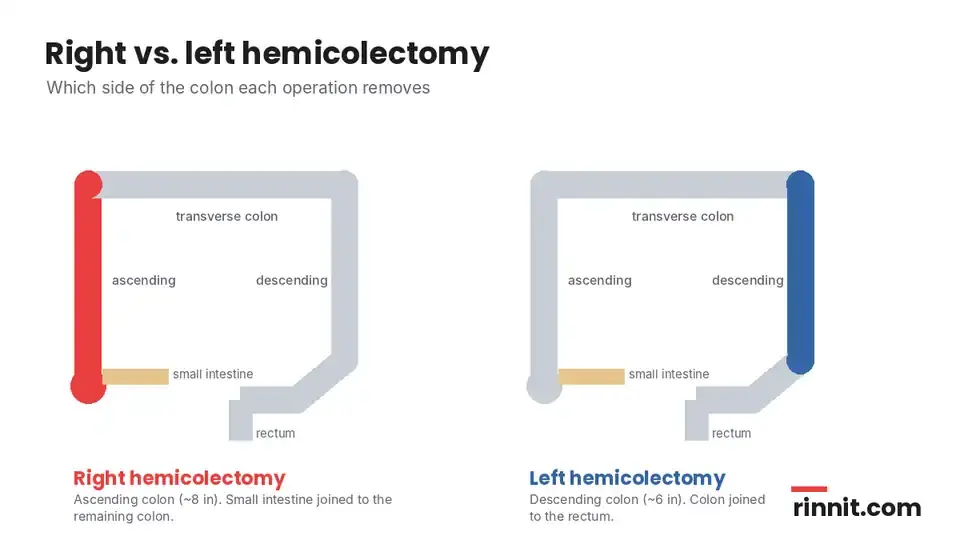
A right hemicolectomy removes the ascending colon; a left hemicolectomy removes the descending colon.
Feature | Right hemicolectomy | Left hemicolectomy |
Section removed | Ascending colon, about 8 inches (20 cm) long | Descending colon, about 6 inches (15 cm) long |
What that section does | Carries waste from the small intestine toward the transverse colon | Finishes turning digested food into stool |
Reconnected to | The end of the small intestine | The rectum |
Sources: [1]
An extended right hemicolectomy removes the whole right colon plus some or all of the transverse colon, the part that runs across the top of the abdomen. It is often used for cancer at the splenic flexure, a small bend in the colon. [1]
Why is a hemicolectomy done?
A hemicolectomy treats disease that affects one side of the colon. Common reasons include: [1]
Precancerous polyps
An inherited condition that raises cancer risk, such as Lynch syndrome
A bowel obstruction (blockage)
Severe inflammatory bowel disease, such as Crohn's disease or ulcerative colitis
A perforation (hole) in the colon
For colon cancer, surgery can lower the risk of the cancer spreading. For severe digestive disease, the main goal is to relieve symptoms. [1]
How do you prepare for a hemicolectomy?
Your surgical team will give you detailed instructions. General steps include: [1]
Stop smoking. Smoking slows healing.
Review your medicines. Tell your surgeon about every prescription, over-the-counter medicine and supplement, and stop any only as instructed.
Plan for a hospital stay. Expect to be in the hospital for several days, up to a week.
Complete a bowel prep. This is done the day before surgery to empty the colon.
Follow fasting rules. Stop eating at least four hours before surgery. Clear liquids are usually allowed until two hours before.
What happens during a hemicolectomy?
Most hemicolectomies are minimally invasive, done laparoscopically or with robotic assistance. A laparoscopic hemicolectomy usually takes two to three hours. [1]
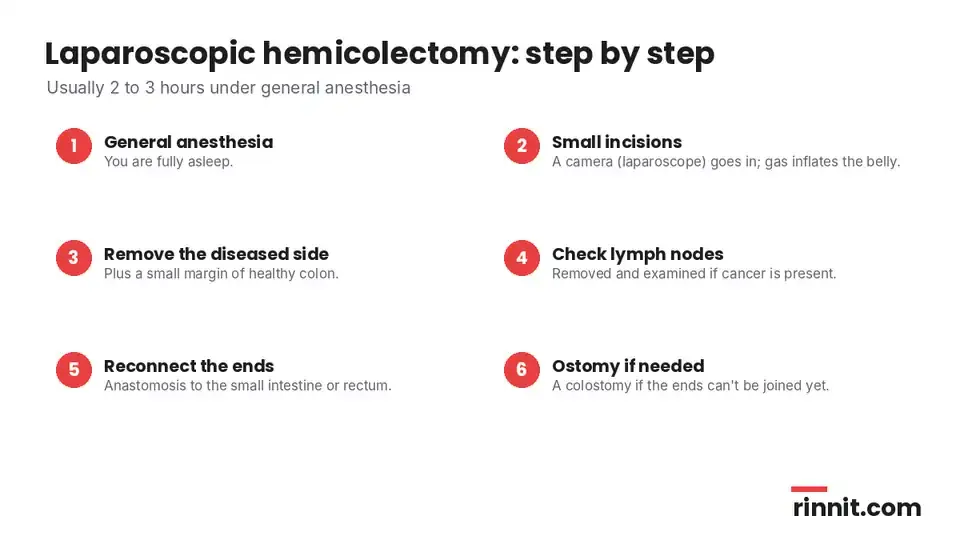
A laparoscopic hemicolectomy usually takes two to three hours.
General anesthesia puts you fully to sleep.
A small incision is made, and a camera (laparoscope) is inserted.
Gas inflates the abdomen so the surgeon can see clearly. A few more small incisions may be added for instruments.
The diseased section is removed along with a small margin of healthy colon on each side.
Nearby lymph nodes are removed and sent to a pathologist if cancer is present.
The healthy ends are reconnected (anastomosis). After a right hemicolectomy, the colon is joined to the end of the small intestine; after a left hemicolectomy, it is joined to the rectum.
Sources: [1]
If the ends cannot be joined, or the colon needs time to heal, the surgeon may create a colostomy, an opening in the abdominal wall that drains stool into a bag. It may be temporary or permanent. [1] Our guides to loop colostomy and colostomy irrigation explain what living with a stoma involves.
Hemicolectomy at a glance
Item | Typical detail |
Anesthesia | General (you are asleep) |
Usual approach | Laparoscopic or robotic |
Operating time | 2–3 hours (laparoscopic) |
Hospital stay | 3–4 days |
Back to normal routines | About 1–2 weeks |
Sources: [1]
What happens after a hemicolectomy?
You usually stay in the hospital for three to four days. During this time your care team will: [1]
Give pain medicine as needed and lower the dose before you go home
Start you on a liquid or soft diet until your bowels work again, which you notice when you pass gas and stool
Get you walking early, often on the day of surgery
Teach you how to care for yourself at home, including colostomy care if you have one
Digestion may be temporarily affected while your bowel recovers. [1]
How long does recovery from a hemicolectomy take?
Most people can return to their normal routines in about one to two weeks. Milestones include climbing stairs, showering, driving and going back to work, and your surgeon will tell you when each is safe. [1]
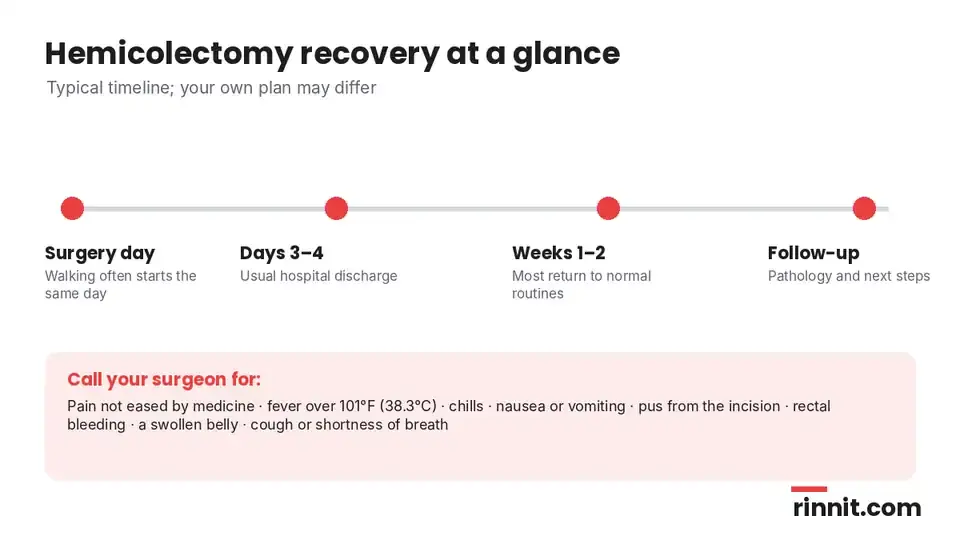
Most people are back to their usual routines in one to two weeks.
Because a hemicolectomy can change bowel habits, and sometimes involves an ostomy, your daily routines may change. Talk with your care team about any worries you have about life after surgery. [1]
What are the benefits and risks of a hemicolectomy?
Removing a cancerous tumor can lower the chance of the cancer spreading and, in many cases, can cure the cancer on its own. For inflammatory bowel disease and other non-cancer conditions, the main benefit is symptom relief. [1]
Possible complications include: [1]
Complication | What it means |
Anastomotic leak | Leakage where the two sections of bowel were joined |
Bleeding | Blood loss during or after surgery |
Blood clots | Clots in the deep leg veins that can travel to the lungs |
Organ injury | Damage to nearby organs, such as the small intestine |
Surgical site infection | Infection at or under the incision |
When should you call your surgeon after a hemicolectomy?
Contact your surgeon if you have any of these signs: [1]
Belly pain that your prescribed medicine does not relieve
Chills
Cough or shortness of breath
A fever above 101°F (38.3°C) that does not go away
Nausea and vomiting
Pus from the incision
Rectal bleeding
A swollen belly
Conclusion
A hemicolectomy removes the right or left side of the colon to treat cancer, precancerous polyps, severe inflammatory bowel disease, blockages or a hole in the bowel. Most operations are done through small incisions, the hospital stay is short, and most people are back to their routines within a couple of weeks. [1]
The best results come from careful preparation, early walking, following your diet plan and reporting warning signs quickly. If you are facing this surgery, write down your questions about bowel changes, ostomy care and recovery and bring them to your surgeon.
Keep learning: Read our guides to colon cancer, proctocolectomy and surgery for ulcerative colitis. For more on colon cancer operations, see the American Cancer Society's guide to colon cancer surgery.
FAQ
What is a hemicolectomy?
A hemicolectomy is surgery that removes either the right or the left side of the colon, usually through small incisions, and then reconnects the healthy ends of the bowel.
What is the difference between a right and a left hemicolectomy?
A right hemicolectomy removes the ascending colon and joins the colon to the small intestine. A left hemicolectomy removes the descending colon and joins the colon to the rectum.
Why would someone need a hemicolectomy?
Common reasons are colon cancer, precancerous polyps, Lynch syndrome, a bowel blockage, severe Crohn's disease or ulcerative colitis, and a hole in the colon.
Is a hemicolectomy major surgery?
Yes. It removes part of an organ, needs general anesthesia and requires a hospital stay of several days, even when done through small incisions.
How long does a hemicolectomy take?
A laparoscopic hemicolectomy usually takes two to three hours.
How long will I stay in the hospital after a hemicolectomy?
Most people stay in the hospital for three to four days after a hemicolectomy.
How long is recovery after a hemicolectomy?
Most people return to their normal routines in about one to two weeks.
Will I need a colostomy bag after a hemicolectomy?
Not always. A colostomy is made only if the bowel ends cannot be joined or the colon needs time to heal, and it may be temporary or permanent.
What are the risks of a hemicolectomy?
Risks include a leak where the bowel was joined, bleeding, blood clots in the legs or lungs, injury to nearby organs and infection at the surgical site.
How do I prepare for a hemicolectomy?
Quit smoking, because it makes healing harder, and tell your surgeon about all medicines and supplements so they can say if and when to stop any. [1] You do a bowel prep the day before, stop eating at least four hours before surgery (clear liquids are allowed up to two hours before), and plan for a hospital stay of several days up to a week. [1]
Does a hemicolectomy hurt, and what anesthesia is used?
A hemicolectomy is done under general anesthesia, so you are asleep during surgery. [1] Afterward you receive pain medicine as needed, and the dose is gradually lowered before you go home. [1]
When should I call my doctor after a hemicolectomy?
Call your surgeon for pain not eased by medicine, fever above 101°F, chills, vomiting, pus from the incision, rectal bleeding, a swollen belly, or cough or shortness of breath.
Related Reading
Learn more in our guide to Colon Cancer: Symptoms, Screening, Diagnosis, Treatment and Support.
Learn more in our guide to Crohn's Disease: Symptoms, Causes, Flares vs. Remission and Treatment — What You Need to Know.
Learn more in our guide to Ulcerative Colitis: Symptoms, Causes, Diagnosis, and Treatment Explained.
References
Cleveland Clinic. Hemicolectomy: What It Is, Types, Surgery & Recovery. Cleveland Clinic. Last updated June 29, 2025. https://my.clevelandclinic.org/health/procedures/hemicolectomy
Li YS, Meng FC, Lin JK. Procedural and post-operative complications associated with laparoscopic versus open abdominal surgery for right-sided colonic cancer resection: A systematic review and meta-analysis. Medicine (Baltimore). 2020;99(40):e22431. PMID: 33019422. https://doi.org/10.1097/MD.0000000000022431
Hajibandeh S, Hajibandeh S, Mankotia R, et al. Meta-analysis of randomised controlled trials comparing intracorporeal versus extracorporeal anastomosis in laparoscopic right hemicolectomy: upgrading the level of evidence. Updates Surg. 2021;73(1):23-33. PMID: 33534124. https://doi.org/10.1007/s13304-020-00948-7
Solis-Pazmino P, Oka K, La K, et al. Robotic right versus left colectomy for colorectal neoplasia: a systemic review and meta-analysis. J Robot Surg. 2023;17(5):1907-1915. PMID: 37310528. https://doi.org/10.1007/s11701-023-01649-0
Medical disclaimer
This article is for general education only and does not replace advice from a qualified healthcare professional. Talk to your doctor about your own diagnosis and treatment, and seek emergency care right away for severe or sudden symptoms.



Comments