Colostomy Irrigation: What It Is, Who It's For, and How It Works

Updated: Nov 5
Written and medically reviewed by Dr. Baraa Alnahhal, MD · Last reviewed: October 2026 · How we review
Quick Answer: What is colostomy irrigation?
Colostomy irrigation is a way to empty the colon by flushing warm water into it through the stoma, much like an enema, at a set time each day or every other day. It suits people with a descending or sigmoid colostomy, can take up to an hour, and may let them skip wearing a pouch. [1][2]
What the research says
Irrigation means fewer bowel movements and less gas and odor. A systematic review screened 499 articles and found 4 qualifying studies: irrigating cut the number of bowel movements, often gave 24 hours or more with no output, reduced pouch use, and lowered gas and odor. One study found better digestive-specific quality of life, though a general quality-of-life survey showed no difference. (Kent et al., J Wound Ostomy Continence Nurs, 2015)
Most people who irrigate say it gives them security. In interviews with 39 people who irrigate regularly, 97% described positive effects, mainly feeling secure and having an empty pouch. 87% had adjusted their routine over the years. (Carlsson et al., J Wound Ostomy Continence Nurs, 2010)
Many patients are never offered it. In a survey of 985 ostomy nurses, 59% considered irrigation evidence-based, yet about half said they do not routinely teach it. (Cobb et al., J Wound Ostomy Continence Nurs, 2015)
Key takeaways
Colostomy irrigation flushes stool out of the colon with warm water through the stoma.
It is usually only an option for a descending or sigmoid colostomy, where stool is firmer.
A session can take up to an hour; most bowels settle into a pattern within 6–8 weeks.
Between sessions, a small cap covers the stoma instead of a full pouch.
Call your doctor for stoma changes, severe cramps, heavy bleeding, or a sharp drop in output.
What is a colostomy?
A colostomy is surgery that connects part of the large intestine (colon) to an opening in the belly wall called a stoma. Stool then leaves the body through the stoma instead of the rectum.
Most people wear a bag (pouch) over the stoma to collect stool and empty it several times a day.
Some colostomies are temporary. The bowel heals, and a surgeon reconnects it and closes the stoma. Others are permanent.
A colostomy is not the same as an ileostomy. An ileostomy connects the small intestine (ileum) to the belly wall, not the colon. Learn more in our colostomy guide.
What is colostomy irrigation?
Colostomy irrigation is a method of emptying the colon on a schedule by washing it out with water through the stoma. It works much like an enema.
You do it at the same time every day, or every other day, depending on your needs. The goal is to remove stool in one planned session, so you don't need to wear a colostomy bag all the time.
Who needs a colostomy in the first place?
People with certain disorders of the colon and rectum may need a colostomy. Common reasons include:
Category | Examples |
Cancers | Anal cancer, colorectal (colon) cancer, cervical cancer, vaginal cancer |
Inflammation | |
Bowel control problems | Fecal incontinence |
Birth conditions | Hirschsprung disease |
Injury or blockage | Intestinal injury or trauma, large bowel obstruction |
Having one of these conditions doesn't mean irrigation is right for you. That depends on where your colostomy is.
Who is a good candidate for colostomy irrigation?
Colostomy irrigation is usually only an option for people with a descending or sigmoid colostomy, because stool is firmer in these parts of the colon. Irrigation works best when stool is firm.
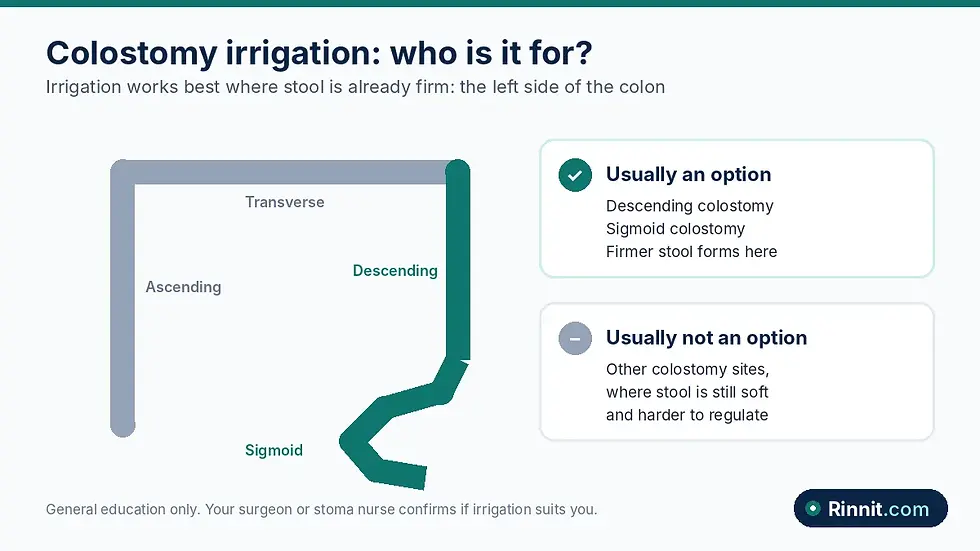
The descending and sigmoid colon, on the left side of the belly, are where solid stool forms.
Colostomy type | Where it is | Is irrigation usually an option? |
Descending | The colon running down the left side of the belly | ✅ Yes — solid stool starts to form here |
Sigmoid | The last part of the colon, just before the rectum | ✅ Yes — it moves solid waste toward the rectum |
Other sites | Higher up the colon | ❌ Usually not — stool is still soft |
Your surgeon or stoma nurse will confirm whether irrigation suits you.
What supplies do you need for colostomy irrigation?
You can get colostomy irrigation supplies from your healthcare provider, a pharmacy, or a medical supply store.
Supply | What it's for |
Irrigation sleeve and system | A container and tubing that deliver water into the stoma; the sleeve directs stool into the toilet |
Warm water | 500 to 1,000 mL (½ to 1 quart) per session |
Water-based lubricant | Makes insertion through the stoma easier |
Adjustable belt | Holds the sleeve in place |
Closure clips | Seal the sleeve |
Stoma cap | Covers the stoma between irrigations |
How is colostomy irrigation done?
Colostomy irrigation is a skill your healthcare provider teaches you hands-on before you try it alone. Here's what to expect once you start:
Timing: Irrigate at the same time each day. Many people choose the time they used to have a bowel movement before surgery.
Easier moments: Irrigating after a meal or a hot drink may make it easier.
Session length: A session can take up to one hour. It gets easier with practice.
Comfort check: Belly pain or nausea during irrigation can mean the water is flowing too fast or is too cold.
Adjustment period: In 6 to 8 weeks, your bowels usually adjust and bowel movements become regular.
Between sessions: A small cap covers the stoma.
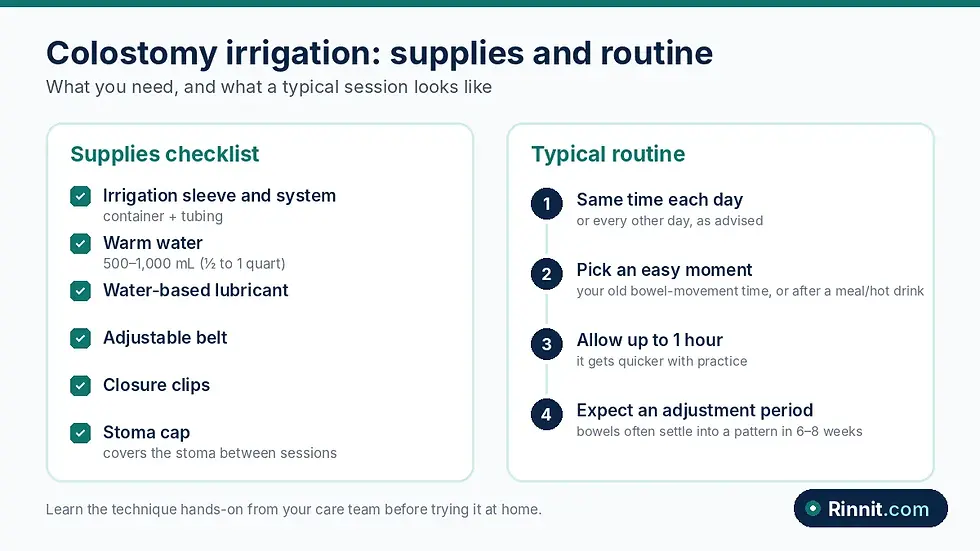
Supplies and routine at a glance: same time daily, up to an hour per session, and a 6–8 week adjustment period.
Colostomy irrigation vs. wearing a pouch at a glance
Colostomy irrigation | Pouch only | |
How stool leaves | In one planned session | Throughout the day |
What you wear | A small cap over the stoma | A pouch at all times |
Time needed | Up to 1 hour daily or every other day | Emptying several times a day |
Who it suits | Descending or sigmoid colostomy | Any colostomy |
Learning curve | Needs training; 6–8 weeks to settle | Simpler to start |
What are the risks of colostomy irrigation?
The main risks of colostomy irrigation are skin irritation around the stoma and some stool leakage between sessions.
Skin irritation: Call your provider if you notice signs of infection, such as burning, itching, or watery discharge.
Light bleeding: A small amount of blood at the stoma is normal.
Constipation or diarrhea: A colostomy can make both more likely. Eating enough fiber and drinking plenty of water helps prevent them.
Leakage: Some people have a small amount of stool leakage between irrigations.
How can a colostomy affect your emotions and body image?
A colostomy can change how you feel about yourself and your body. Gas and odors are not always easy to control.
If you start to feel anxious or depressed, talk to your healthcare provider. Support is available, and these feelings are common.
How effective is colostomy irrigation?
Colostomy irrigation can be an effective way to remove stool if not wearing a bag matters to you. Studies show it reduces how often stool passes, cuts down on gas and odor, and lets some people stop wearing a pouch.
When should you call a doctor about colostomy irrigation?
Call your healthcare provider if you have any of these signs while irrigating:

What's usually expected versus when to call your doctor.
Usually expected | Call your doctor |
A small amount of blood at the stoma | Change in stoma size or appearance |
Belly pain or nausea that eases when you slow the flow or warm the water | Long-lasting skin irritation or signs of skin infection |
A little stool leakage between sessions | Extreme nausea and vomiting |
A large drop in gas or stool from the stoma | |
Severe stomach cramps lasting more than a few hours | |
Unusual odor, heavy bleeding, or watery discharge from the stoma |
Conclusion
Colostomy irrigation gives people with a descending or sigmoid colostomy a way to control when stool leaves the body, often without wearing a pouch full time. It takes training, up to an hour per session, and a few weeks of patience while the bowel adjusts. Over time, most people find it gets easier.
Whether you irrigate or wear a pouch, a colostomy doesn't have to stop you from doing the things you love.
Thinking about irrigation? Save or print this guide and bring it to your next appointment. Ask your surgeon or stoma nurse: "Is my colostomy suitable for irrigation, and can you train me?" For more plain-language guides, read our full colostomy guide.
FAQ
Can everyone with a colostomy do irrigation?
No. Colostomy irrigation is usually only an option for people with a descending or sigmoid colostomy, where stool is firm enough to clear in one session.
How much water is used for colostomy irrigation?
Colostomy irrigation usually uses 500 to 1,000 mL (½ to 1 quart) of warm water per session.
How long does colostomy irrigation take?
A colostomy irrigation session can take up to one hour. It usually gets faster with practice.
How often should you irrigate a colostomy?
Most people irrigate at the same time every day, or every other day, depending on their needs and their care team's advice.
Do you still need a colostomy bag if you irrigate?
Many people who irrigate don't need a full bag. A small cap covers the stoma between sessions, though some people have a little leakage.
How long until colostomy irrigation works regularly?
Bowels usually adjust within 6 to 8 weeks, and bowel movements become regular.
Why do I get cramps during colostomy irrigation?
Belly pain or nausea during colostomy irrigation can mean the water is too cold or flowing too fast. Severe cramps lasting more than a few hours need a call to your doctor.
Is bleeding normal after colostomy irrigation?
A small amount of blood at the stoma is normal. Heavy bleeding is not, so call your healthcare provider.
How do I prepare for colostomy irrigation?
Gather an irrigation sleeve and system, an adjustable belt, closure clips, a water-based lubricant and one-half to 1 quart (500 to 1,000 cc) of warm water. [1] Plan to irrigate at the same time each day or every other day, such as the time you used to have a bowel movement or after a meal or hot drink, and allow up to an hour. [1]
When should I call my doctor about colostomy irrigation?
Call your provider for a change in stoma size or appearance, long-lasting skin irritation or signs of infection, extreme nausea and vomiting, a significant drop in gas or stool, severe stomach cramps lasting more than a few hours, or unusual odor, severe bleeding or watery discharge from the stoma. [1]
Related Reading
References
Cleveland Clinic. Colostomy Irrigation: Treatment, Definition & Causes. Cleveland Clinic. Last updated May 11, 2021. https://my.clevelandclinic.org/health/treatments/10747-colostomy-irrigation
American Cancer Society. Colostomy Care. American Cancer Society. Last updated July 1, 2025. https://www.cancer.org/cancer/supportive-care/ostomies/colostomy/management.html
NHS. Living with a colostomy — Colostomy irrigation. NHS. Page last reviewed September 16, 2020. https://www.nhs.uk/conditions/colostomy/living-with/
United Ostomy Associations of America. Living with a Colostomy. United Ostomy Associations of America. Last updated November 2024. https://www.ostomy.org/wp-content/uploads/2024/11/UOAA_Living_with_a_Colostomy_Guide-2024-11.pdf
Kent DJ, Long MA, Bauer C. Does colostomy irrigation affect functional outcomes and quality of life in persons with a colostomy? J Wound Ostomy Continence Nurs. 2015;42(2):155-161. PMID 25734458. https://doi.org/10.1097/WON.0000000000000121
Carlsson E, Gylin M, Nilsson L, et al. Positive and negative aspects of colostomy irrigation: a patient and WOC nurse perspective. J Wound Ostomy Continence Nurs. 2010;37(5):511-516. PMID 20838315. https://doi.org/10.1097/WON.0b013e3181edaf84
Cobb MD, Grant M, Tallman NJ, et al. Colostomy irrigation: current knowledge and practice of WOC nurses. J Wound Ostomy Continence Nurs. 2015;42(1):65-70. PMID 25325284. https://doi.org/10.1097/WON.0000000000000075
Medical disclaimer
This article is for general education and does not replace advice from your doctor, surgeon, or stoma nurse. Always learn colostomy irrigation from your care team before trying it at home. In an emergency, seek urgent medical care.



Comments