Colectomy: Types, Procedure, Risks and Recovery Explained

Updated: 6 days ago
Written and medically reviewed by Dr. Baraa Alnahhal, MD · Last reviewed: October 2026 · How we review
Quick Answer: What is a colectomy?
A colectomy is surgery to remove part or all of the colon (large intestine). It treats conditions such as colon cancer, diverticulitis, bowel obstruction, gastrointestinal bleeding and severe inflammatory bowel disease. Surgeons use open, laparoscopic or robotic methods, then reconnect the bowel or create an ostomy. Most home recovery takes up to six weeks. [1]
What the research says
Keyhole surgery shortens the hospital stay. A meta-analysis of 13 trials found that laparoscopic surgery for colon cancer led to shorter hospital stays, less blood loss and fewer wound infections (odds ratio 0.30) than open surgery, with no difference in overall complications, although the operation took longer. (Sun and Xing, Mathematical Biosciences and Engineering, 2019)
Robotic and laparoscopic results are similar. Across 7 studies and 733 patients having a right colectomy for cancer, robotic and laparoscopic surgery had similar complication rates, hospital stays and survival; the robotic operation took about 46 minutes longer. (Chaouch et al., BMC Surgery, 2025)
Enhanced recovery programs cut time in hospital. In 15 studies of 4,225 people with inflammatory bowel disease having colorectal surgery, enhanced recovery after surgery (ERAS) care shortened the hospital stay by 1.62 days without raising 30-day readmissions. (Johnson et al., Colorectal Disease, 2026)
Key takeaways
A colectomy removes the damaged part of the colon, the whole colon, or the colon and rectum.
It treats colon cancer, diverticulitis, bowel obstruction, GI bleeding and severe inflammatory bowel disease, and may be done to prevent cancer in some inherited conditions.
The surgery takes about one to four hours under general anesthesia.
Most people stay in hospital for a few days up to a week.
Not everyone needs an ostomy bag; it is only needed when the bowel can't be reconnected.
Many people return to most routines within two weeks, and home recovery can take up to six weeks.
What is a colectomy?
A colectomy is an operation that removes part or all of your colon, the large intestine that turns digested food into stool. It is also called colon resection or bowel resection surgery.
Doctors recommend it when a condition damages the colon so badly that your digestive tract can't work as it should.
The surgery may remove one specific section, the entire colon, or the colon together with the rectum.
Why would you need a colectomy?
You may need a colectomy if a disease has damaged your colon or puts you at high risk of colon cancer. The most common reasons are:
Can a colectomy prevent colon cancer?
A colectomy can be done as a preventive step for people with inherited conditions that raise colon cancer risk.
Two examples are Lynch syndrome and familial adenomatous polyposis (FAP). For people with these conditions, removing the colon early may reduce the chance of developing cancer.
What are the types of colectomy?
Colectomy types differ by how much of the colon, and sometimes the rectum, the surgeon removes. A total colectomy removes the entire colon, while a partial colectomy removes only certain sections.

Type | What is removed |
Total colectomy | The entire colon |
Partial colectomy | Only the damaged section(s) of the colon |
Hemicolectomy | One side of the colon (right or left) |
Sigmoid colectomy (sigmoidectomy) | The sigmoid colon, the last part of the colon |
Proctosigmoidectomy | The sigmoid colon, sometimes with part of the rectum |
Proctocolectomy | The colon and the rectum |
Your surgeon chooses the type based on where the disease is and how much of the colon it affects.
How do you prepare for a colectomy?
Preparing for a colectomy starts with a meeting with your gastrointestinal surgeon, who explains which type of colectomy you will have and which surgical method they will use.
Tests before surgery
Your healthcare team runs tests to make sure you are ready for surgery. These may include:
Blood tests
Colonoscopy
Electrocardiogram (EKG) to check your heart
Imaging tests, such as CT or MRI scans
The days before surgery
Your team will give you instructions for the last few days. General steps include:
Arrange for someone to drive you home from the hospital.
Start a clear liquid diet a few days before surgery.
Use a bowel prep to empty your intestines.
Stop eating and drinking after midnight on the day of surgery.
What happens during a colectomy?
During a colectomy, you are asleep under general anesthesia while the surgeon removes the diseased part of the colon and then reconnects the bowel or creates an ostomy. The operation usually takes between one and four hours.
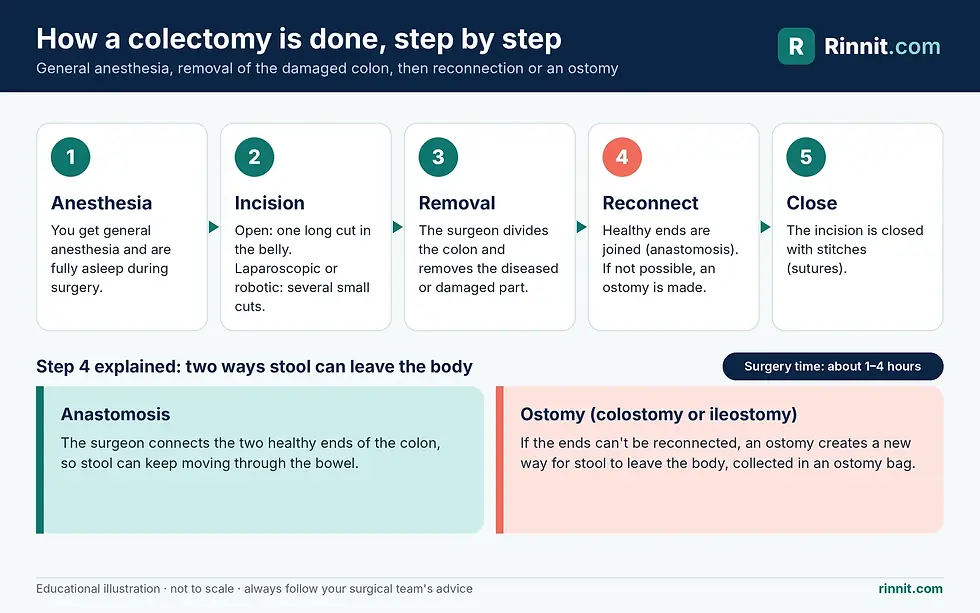
Here is what happens, step by step:
Anesthesia. An anesthesiologist gives you general anesthesia, so you are fully asleep.
Incision. The surgeon makes one long cut in your belly (open colectomy) or several small cuts (laparoscopic or robotic colectomy).
Removal. The surgeon divides the colon and removes the diseased or damaged part.
Reconnection. The healthy ends of the colon are joined together. If that isn't possible, the surgeon creates a colostomy or ileostomy.
Closing. The incision is closed with stitches (sutures).
Open, laparoscopic and robotic colectomy compared
Approach | Incision | What studies show |
Open | One long cut in the belly | Longer hospital stay than laparoscopic surgery in trials |
Laparoscopic | Several small cuts | Shorter stay, less blood loss and fewer wound infections than open surgery |
Robotic | Several small cuts | Results similar to laparoscopic surgery; operation takes longer |
Table findings come from the studies in "What the research says" above.
For a deeper look at surgical techniques, see this patient guide to colon resection surgery and this overview of types of colon cancer surgery.
What is the difference between anastomosis and an ostomy after colectomy?
Anastomosis reconnects the two healthy ends of the colon so stool keeps moving through the bowel, while an ostomy creates a new way for stool to leave the body when the ends can't be reconnected.
Normally, digested food passes through your colon on its way to becoming stool. Removing part of the colon splits it into two sections, which can disrupt that path.
Anastomosis | Ostomy (colostomy or ileostomy) | |
What it means | The two healthy ends are connected | A new opening lets stool leave the body |
How stool leaves | Through the bowel, as before | Into an ostomy bag |
When it's used | When the ends can be safely joined | When reconnection isn't possible |
If you need an ostomy, your care team will teach you how to look after it and adjust to life with an ostomy bag. Learn more in our guide to colostomy types, procedure and recovery.
What are the risks of a colectomy?
A colectomy is major surgery, and like all major operations it carries a risk of complications. Possible complications include:
Anastomotic leak, where the reconnected bowel leaks
Excessive bleeding
Infection
Injury to nearby organs
Your surgeon will talk with you about your personal risks before the operation.
How long is recovery after a colectomy?
Recovery after a colectomy usually means a hospital stay of a few days up to a week, followed by up to six weeks of recovery at home. Many people return to most of their usual routines within about two weeks.

Stage | What to expect |
In hospital (a few days to 1 week) | Liquid or soft diet at first; the team checks the surgery site |
Before going home | You learn incision care, ostomy care if needed, what to eat and which activities to do, such as walking |
About 2 weeks | Many people are back to most usual routines |
First month | Low-fiber diet while the colon heals |
Up to 6 weeks | Most home recovery is complete |
Tips for a smoother recovery
Bring a support person. There is a lot of information to take in after surgery, so ask a family member or friend to join the conversations with your care team.
Go gently. Resist the urge to rush back into your routine, even if you feel well.
Stay active as advised. Your team may suggest light activity, such as walking, once you get home.
What can you eat after a colectomy?
After a colectomy, you should eat mainly low-fiber foods for the first month, because they are easier for your healing colon to process.
Right after surgery, your intestines can't process regular food, so you will start on a liquid or soft diet for a few days. Your healthcare team will tell you when and how to move on to other foods.
When should you call your doctor after a colectomy?
You should call your surgeon after a colectomy if you have pain, signs of infection or problems passing stool. Contact them if you notice:
Belly pain that gets worse over time
Fever
Redness, pain or pus at the incision site
Trouble passing stool, or no bowel movement at all
What is life expectancy after a colectomy?
Life expectancy after a colectomy depends mainly on the condition that led to the surgery, not on the colectomy itself.
Some conditions, such as colon cancer, can affect how long you live. Others, such as diverticulitis, cause painful symptoms but are not life-threatening. A colectomy may also be just one part of your overall treatment.
Because every situation is different, your own healthcare provider is the best person to discuss your outlook.
Colectomy at a glance
Question | Short answer |
What is removed? | Part or all of the colon, sometimes with the rectum |
Main reasons | Colon cancer, diverticulitis, GI bleeding, bowel obstruction, severe IBD |
Anesthesia | General (you are asleep) |
Surgery methods | Open, laparoscopic or robotic |
Surgery time | About 1–4 hours |
Hospital stay | A few days to a week |
Ostomy needed? | Only if the bowel can't be reconnected |
Diet first month | Low-fiber foods |
Full recovery | Up to 6 weeks at home |
Conclusion
A colectomy can ease painful bowel symptoms, treat or even cure some conditions, and help people with colon cancer live longer. For some people it also means adjusting to an ostomy, which can feel like a big change.
Knowing what to expect, from preparation to the first weeks at home, makes the process less overwhelming. Your surgical team understands this is a major step and can point you to resources for every change the surgery brings.
Next step: Write down your questions and bring this guide to your next appointment. To understand the condition behind your surgery, explore our guides to colon cancer, colon polyps and diverticulitis.
FAQ
Is a colectomy major surgery?
Yes. A colectomy is major surgery done under general anesthesia, and it needs careful preparation, including tests, a clear liquid diet and a bowel prep.
How long does a colectomy take?
A colectomy usually takes between one and four hours, depending on the type of surgery and the method used.
How long will I stay in the hospital after a colectomy?
Most people stay in the hospital for a few days up to a week after a colectomy.
Will I need a colostomy bag after a colectomy?
Not always. You only need an ostomy bag if the surgeon can't reconnect the healthy ends of your colon.
When can I go back to normal activities after a colectomy?
Many people return to most of their usual routines within two weeks, and full recovery at home can take up to six weeks.
What should I eat after a colectomy?
Start with a liquid or soft diet in the hospital, then eat mostly low-fiber foods for the first month after surgery.
Can you live a normal life after a colectomy?
Yes. Most people return to their usual activities after they recover. Your body can work well without part, or sometimes all, of the colon.
Will my bowel habits change after a colectomy?
Bowel movements may be looser or more frequent at first. For many people, this improves over the following weeks to months as the bowel adjusts.
Can an ostomy be reversed after a colectomy?
A temporary ostomy can often be reversed in a later surgery once the bowel has healed. Some ostomies are permanent, and your surgeon will explain which type you have.
When should I call my doctor after a colectomy?
Call for fever, worsening belly pain, vomiting, redness or pus at the incision, or no bowel movement or gas. Get emergency care for severe pain, trouble breathing or a swollen, painful leg.
Related Reading
Small Bowel Resection: Surgery, Risks and Recovery explains small bowel resection surgery.
When diverticulitis needs an operation: Diverticulitis Surgery: Types, Procedure, Recovery and Risks
References
Cleveland Clinic. Colectomy (Colon Resection Surgery): What It Is & Types. Cleveland Clinic. Last updated May 14, 2025. https://my.clevelandclinic.org/health/treatments/4671-colectomy-bowel-resection-surgery
American Cancer Society. Surgery for Colon Cancer. American Cancer Society. Last revised January 29, 2024. https://www.cancer.org/cancer/types/colon-rectal-cancer/treating/colon-surgery.html
Society of American Gastrointestinal and Endoscopic Surgeons. Colon Resection Surgery: Patient Information. SAGES. Revised May 6, 2026. https://www.sages.org/publications/patient-information/patient-information-for-laparoscopic-colon-resection-from-sages/
Sun JL, Xing SY. Short-term outcome of laparoscopic surgery versus open surgery on colon carcinoma: a meta-analysis. Mathematical Biosciences and Engineering. 2019;16(5):4645-4659. PMID 31499682. https://doi.org/10.3934/mbe.2019233
Chaouch MA, Gouader A, Krimi B, et al. Robotic versus laparoscopic right colectomy with complete mesocolon excision for right-sided colon cancer: a systematic review and meta-analysis. BMC Surgery. 2025;25(1):577. PMID 41316150. https://doi.org/10.1186/s12893-025-03340-7
Johnson G, Theodosopoulos E, Vernon J, et al. Enhanced recovery after colorectal surgery in patients with inflammatory bowel disease to reduce hospital length of stay: a systematic review and meta-analysis. Colorectal Disease. 2026;28(10):e70642. PMID 42811387. https://doi.org/10.1111/codi.70642
Disclaimer
This article is for general education only and does not replace advice from your doctor or surgeon. Always follow the instructions of your own healthcare team before and after surgery.



Comments