Familial Adenomatous Polyposis (FAP): Symptoms, Causes, Types, Diagnosis, Treatment and Outlook — What You Need to Know

Updated: 2 days ago
Medically reviewed by Dr. Baraa Alnahhal, MD · Last reviewed: September 2026
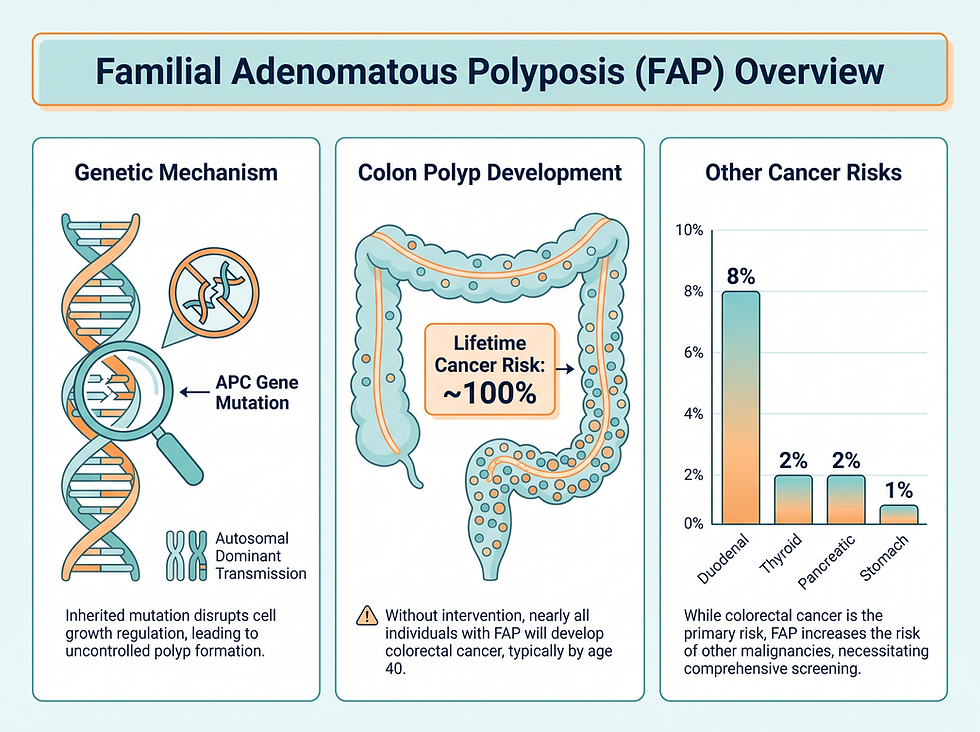
Quick Answer: Familial Adenomatous Polyposis (FAP) is a rare hereditary syndrome caused by a mutation in the APC gene, which leads to the development of hundreds or thousands of precancerous polyps in the colon and rectum. Without intervention, the lifetime risk of developing colorectal cancer is nearly 100%, often occurring by middle age. Polyps typically begin appearing in the teenage years, with an average onset age of 16. To manage this extreme cancer risk, most individuals with FAP undergo surgery to remove the entire colon (colectomy) early in life. Ongoing screening is required to monitor for other potential tumors in the stomach, small intestine, thyroid, and other organs.
TL;DR: Hereditary Polyposis at a Glance
Familial Adenomatous Polyposis is a genetic disorder that predisposes individuals to develop a vast number of adenomatous colon polyps. While these polyps are not initially cancerous, their sheer number and rapid growth make colorectal cancer almost inevitable without proactive surgical treatment.
FAP is rare, affecting approximately 1 in 8,000 people and accounting for about 0.5% of all colorectal cancer cases. It is primarily an inherited condition, though about 30% of cases result from original mutations in individuals without a family history. Beyond the colon, the syndrome can cause abnormal growths in the skin, bones, teeth, and other organs.
Early detection through genetic testing and regular colonoscopy screenings—often starting as early as age 10—is critical for managing cancer risk and improving long-term outcomes.
Limitation statement: The referenced clinical source provides specific cancer risk percentages for colorectal, duodenal, thyroid, and other cancers associated with FAP. It also estimates the prevalence of the condition and its subtypes. No statistics are invented in this article.
Cancer Type with FAP | Estimated Lifetime Risk |
Colorectal Cancer | Close to 100% (without treatment) |
Duodenal Cancer | 8% |
Papillary Thyroid Cancer | 2% |
Pancreatic Cancer | 2% |
Hepatoblastoma | 1.5% |
Stomach Cancer | 1% |
Brain and Spinal Tumors | < 1% |
What Are the Different Types of FAP?
Familial adenomatous polyposis presents in a "classic" form and several less common subtypes, each characterized by the number of polyps and the presence of other types of tumors.
FAP Type | Key Characteristics |
Classic FAP | More than 100 adenomatous polyps in the colon. |
Attenuated FAP (AFAP) | Less severe; between 20 and 100 colon polyps; later onset. |
Gardner Syndrome | Over 100 polyps plus tumors in skin, soft tissues, teeth, and bones. |
Turcot Syndrome | Multiple colon polyps accompanied by a cancerous brain tumor. |
FAP vs. Lynch Syndrome
It is important to distinguish FAP from Lynch syndrome (HNPCC), another hereditary condition that raises colorectal cancer risk. While FAP is defined by hundreds of polyps, Lynch syndrome may cause cancer with only a few polyps, which typically develop later in life.
Feature | Familial Adenomatous Polyposis (FAP) | Lynch Syndrome (HNPCC) |
Number of Polyps | Hundreds to thousands (Classic) | One or a few |
Age of Onset | Teenage years (avg. 16) | Later than FAP |
Cancer Risk | Nearly 100% | High, but lower than FAP |
Genetic Cause | APC gene mutation | Different gene mutations |
What Are the Symptoms and Causes of FAP?
Colon polyps in FAP often begin appearing during the teenage years but usually do not cause noticeable symptoms until they grow large or become dangerous. Regular screening is the only reliable way to find them early.
Signs of FAP
While the polyps themselves may be silent, some individuals experience rectal bleeding, diarrhea, or chronic abdominal pain. FAP can also cause visible lesions in other parts of the body.
Extra-Colonic Sign | Description |
Dermatofibromas | Fibrous, scar-like lumps just under the skin. |
Epidermal cysts | Keratin-filled, dome-shaped lumps under the skin. |
Osteomas | Benign bone tumors, often on the jaw or skull. |
Dental issues | Extra teeth or impacted teeth visible on X-rays. |
Retinal lesions (CHRPE) | Pigmented spots on the eye's retina; usually don't affect vision. |
The Genetic Cause
FAP is caused by a germline mutation in the APC gene, a tumor suppressor gene responsible for preventing uncontrolled cell growth. This mutation is present from conception. If one parent carries the mutation, their child has a 50% chance of inheriting it. However, 30% of diagnoses occur in people with no family history, representing new (original) mutations.

What Are the Complications of FAP?
Colorectal cancer is the primary complication, but the APC mutation affects every cell in the body, leading to other potential tumors.
Potential Complication | Description |
Desmoid Tumors | Locally invasive, non-cancerous tumors in the abdomen or limbs. |
Duodenal Polyps | Occur in nearly everyone with FAP; risk of duodenal/ampullary cancer. |
Adrenal/Pancreatic Tumors | Increased risk of growths in these organs. |
Post-Surgery Changes | Living without a colon changes bowel habits and requires a pouch system. |
How Is FAP Diagnosed and Treated?
Diagnosis relies on identifying the characteristic number of polyps and confirming the genetic mutation.
Diagnostic Test | Purpose |
Colonoscopy | Visual exam to count polyps; starts at age 10 for high-risk families. |
Genetic Testing | Blood test to identify the APC gene mutation. |
Physical Exam | Checking for skin lumps or bone growths (osteomas). |
Eye Exam | Checking for pigmented retinal lesions (CHRPE). |
Treatment and Management
Because polyps appear too frequently to be removed individually, surgical removal of the colon is the standard treatment to prevent cancer. People who have an internal pouch may also want to read about pouchitis and care after J-pouch surgery.
Treatment Option | Description |
Total Colectomy | Removal of the whole colon; connected to an ileostomy or ileal pouch. |
Proctocolectomy | Removal of both the colon and the rectum. |
Ileostomy Pouch | An external bag to collect waste. |
Ileal Pouch (J-Pouch) | An internal reservoir made from the small intestine. |
A note from the source (verbatim): "It’s certainly upsetting to learn you have a genetic disease that’ll require lifelong care. But once you know, you can take the necessary steps to manage your cancer risk. While surgery is almost certainly in your future, healthcare providers try to cause as little disruption to your life as possible."

Conclusion: Managing a Lifelong Genetic Risk
Familial Adenomatous Polyposis is a challenging diagnosis that requires significant medical intervention, yet it is also a condition where knowledge truly is power. By identifying the APC mutation early, individuals and their healthcare teams can take definitive action to prevent colorectal cancer before it starts.
Modern surgical techniques, including laparoscopic colectomy, have made recovery faster and less invasive. While life without a colon involves adjustments, many people successfully manage their condition and maintain a high quality of life through consistent screening and expert care.
Take these three steps:
Genetic Counseling — if FAP runs in your family, speak with a genetic counselor to understand your risk and the benefits of testing.
Early Screening — ensure that children at risk begin yearly colonoscopies by age 10 to monitor polyp development.
Specialized Care — work with a multidisciplinary team experienced in hereditary polyposis to manage both colonic and extra-colonic risks.
This article provides general information and is not a substitute for professional medical advice. Always consult a qualified healthcare provider for diagnosis and treatment.
Frequently Asked Questions
What is Familial Adenomatous Polyposis (FAP)?
It is a rare hereditary syndrome that causes hundreds to thousands of precancerous polyps to grow in the colon and rectum.
Is FAP cancerous?
The polyps themselves are initially benign (adenomas), but they have a nearly 100% chance of becoming cancerous if not treated.
What is the lifetime risk of colon cancer with FAP?
Without surgical intervention, the lifetime risk is close to 100%.
How common is FAP?
It is rare, affecting approximately 1 in 8,000 people worldwide.
What causes FAP?
It is caused by a mutation in the APC gene, which normally acts as a tumor suppressor.
Is FAP always inherited?
No. While it is usually inherited (50% chance from an affected parent), about 30% of cases are new mutations with no family history.
What is "Classic" FAP?
The form of the disease characterized by more than 100 adenomatous polyps in the colon.
What is Attenuated FAP (AFAP)?
A less severe subtype where the patient has between 20 and 100 colon polyps, often with a later onset.
What is Gardner Syndrome?
A subtype of FAP that includes colon polyps plus tumors in other areas like the skin, bones, and teeth.
What is Turcot Syndrome?
A rare subtype involving colon polyps and a cancerous brain tumor.
At what age do polyps start appearing?
Polyps typically begin to appear during the teenage years, with an average onset age of 16.
When should screening begin?
For children in known FAP families, yearly colonoscopy screenings usually begin at age 10.
What are the symptoms of FAP?
Symptoms are rare early on but can include rectal bleeding, diarrhea, and chronic abdominal pain as polyps grow.
What are extra-colonic signs of FAP?
These include skin lumps (dermatofibromas), bone tumors (osteomas), extra teeth, and pigmented retinal spots (CHRPE).
What is CHRPE?
It stands for Congenital Hypertrophy of the Retinal Pigment Epithelium—pigmented spots on the retina that are a common sign of FAP.
How is FAP different from Lynch syndrome?
Lynch syndrome causes fewer polyps, has a later onset, and is caused by different gene mutations.
What is a colectomy?
A surgical procedure to remove the entire colon, which is the primary treatment for FAP.
What is a proctocolectomy?
Surgery to remove both the colon and the rectum.
What is an ileal pouch (J-pouch)?
An internal reservoir created from the small intestine to replace the function of the rectum after surgery.
What is an ileostomy?
A procedure where the small intestine is diverted through an opening in the abdomen into an external pouch.
Can polyps grow in other organs?
Yes, people with FAP commonly develop polyps in the stomach and the duodenum (the first part of the small intestine).
What is the risk of duodenal cancer?
Individuals with FAP have an estimated 8% lifetime risk of developing duodenal cancer.
Are there other cancer risks?
Yes, including increased risks for thyroid, pancreatic, stomach, and liver (hepatoblastoma) cancers.
What are desmoid tumors?
Locally invasive, non-cancerous tumors that can occur in the abdomen or limbs of people with FAP.
How is FAP diagnosed?
Through colonoscopy to count polyps, genetic testing for the APC mutation, and physical/eye exams.
Is genetic counseling recommended?
Yes, it is essential for families affected by FAP to understand inheritance patterns and testing options.
Can laparoscopic surgery be used?
Yes, many colectomies can be performed using minimally invasive laparoscopic techniques for faster recovery.
Will I need lifelong screening after surgery?
Yes, ongoing screening is required to monitor for tumors in the remaining rectum (if present), stomach, and small intestine.
Does FAP affect vision?
While CHRPE (retinal spots) is common, it usually does not cause vision problems.
What is the outlook for someone with FAP?
With early diagnosis and proactive surgery, the risk of colorectal cancer is drastically reduced, leading to a much better prognosis.
Related Reading on Rinnit
Additional Resources
For further reading, these authoritative external references support the information above:
Content reviewed and produced following the Rinnit editorial framework. Last updated: September 28, 2026.
Comments