Colon Cancer: Symptoms, Causes, Diagnosis, Staging and Treatment — What You Need to Know

Updated: 2 days ago
Medically reviewed by Dr. Baraa Alnahhal, MD · Last reviewed: September 2026
Quick Answer
Colon cancer is a growth of cells that begins in the colon, the first and longest part of the large intestine. It usually starts as small, generally non-cancerous clumps of cells called polyps, some of which can turn into cancer over time. It most often affects adults over 50, though rates in people under 50 are growing.
Because polyps rarely cause symptoms, regular screening — typically starting around age 45 for people at average risk — is the key to prevention: finding and removing polyps helps prevent colon cancer. If cancer develops, treatment usually centers on surgery to remove it, often combined with chemotherapy, radiation therapy, targeted therapy, or immunotherapy depending on the cancer’s location and stage.
TL;DR
Colon cancer is a growth of abnormal cells in the colon that usually begins as a polyp. Many people have no symptoms at first; when symptoms appear they include changes in bowel habits, rectal bleeding, abdominal discomfort, a feeling of incomplete emptying, unexplained tiredness, and unintended weight loss. Because polyps often cause no symptoms, screening (usually from around age 45) is the main prevention tool. Diagnosis involves colonoscopy, biopsy, and blood tests; staging runs from 0 to 4. Treatment usually involves surgery, with chemotherapy, radiation, targeted therapy, and immunotherapy added based on stage, plus palliative care for symptom relief. Risk factors include age, family history, inherited syndromes (Lynch syndrome, familial adenomatous polyposis), inflammatory bowel disease, and lifestyle factors.
This article is based on two expert-reviewed clinical overviews dated December 19, 2024. The sources provide no incidence, survival-rate, or cure-rate statistics, and none are presented here. Treatment options described reflect what the sources state; suitability depends on individual circumstances and a specialist team’s judgment.
When Should You See a Doctor?
Colon cancer is most treatable when found early, and symptoms often appear gradually. Make an appointment with a health care professional if you notice lasting symptoms that worry you — especially any of the following:
What you notice | Why it matters |
Rectal bleeding or blood in the stool | Blood loss is a common sign of colon cancer |
A change in bowel habits (more frequent diarrhea or constipation) | Can reflect a tumor affecting the bowel |
Ongoing belly discomfort — cramps, gas, or pain | Tumor-related irritation of the colon |
A feeling that the bowel doesn’t empty all the way | Suggests the bowel is partially blocked or irritated |
Weakness or tiredness | May indicate slow blood loss and anemia |
Losing weight without trying | Unintended weight loss can signal cancer |
If symptoms persist rather than come and go, do not wait them out. Lasting symptoms are the signal to get checked.
“Colon cancer typically affects older adults, though it can happen at any age. It usually begins as small clumps of cells called polyps that form inside the colon.” — Mayo Clinic [1]
What Exactly Is Colon Cancer?
Colon cancer is a growth of cells that begins in a part of the large intestine called the colon. The colon is the first and longest part of the large intestine, and the large intestine is the last part of the digestive system. The digestive system breaks down food for the body to use.
Colon cancer can happen in any part of the colon. It typically affects older adults, though it can happen at any age.
The disease usually begins as small clumps of cells called polyps that form inside the colon. Polyps generally aren’t cancerous, but some can turn into colon cancers over time. Polyps often don’t cause symptoms. For this reason, doctors recommend regular screening tests to look for polyps in the colon. Finding and removing polyps helps prevent colon cancer. For a deeper look at polyps, see our colon polyps complete guide.
If colon cancer develops, many treatments can help control it. Treatments include surgery, radiation therapy and medicines, such as chemotherapy, targeted therapy and immunotherapy.
Colon cancer is sometimes called colorectal cancer. This term combines colon cancer and rectal cancer, which begins in the rectum.

What Are the Signs and Symptoms of Colon Cancer?
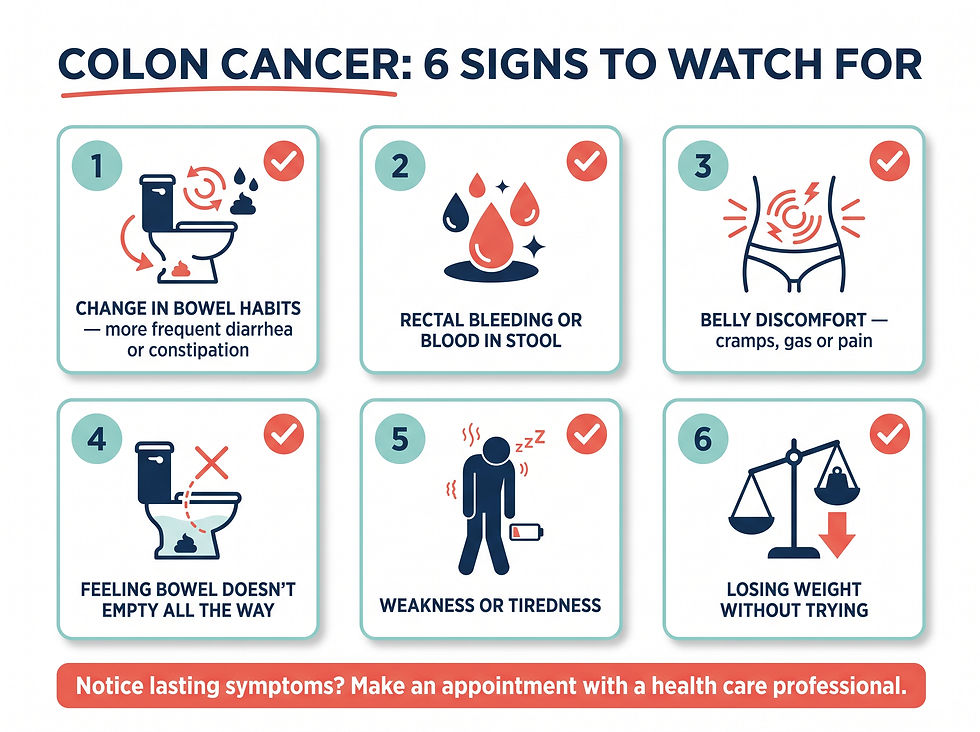
Many people with colon cancer don’t have symptoms at first. When symptoms appear, they’ll likely depend on the cancer’s size and where it is in the large intestine. Symptoms of colon cancer can include:
Symptom | What it looks like |
Change in bowel habits | More frequent diarrhea or constipation |
Rectal bleeding or blood in the stool | Visible blood from the bowel |
Ongoing belly discomfort | Cramps, gas or pain in the belly area |
Incomplete emptying | A feeling that the bowel doesn’t empty all the way during a bowel movement |
Weakness or tiredness | Often from slow blood loss |
Unintended weight loss | Losing weight without trying |
What Causes Colon Cancer?
Doctors aren’t certain what causes most colon cancers. What is known is the mechanism at the cell level. Colon cancer happens when cells in the colon develop changes in their DNA. A cell’s DNA holds the instructions that tell the cell what to do. The changes tell the cells to multiply quickly. The changes let the cells continue living when healthy cells die as part of their natural lifecycle.
This causes too many cells. The cells might form a mass called a tumor. The cells can invade and destroy healthy body tissue. In time, the cells can break away and spread to other parts of the body. When cancer spreads, it’s called metastatic cancer.
Who Is at Risk for Colon Cancer?
Risk factors range from age and genetics to diet and lifestyle. The sources identify the following:
Risk factor | Detail |
Older age | Most people with colon cancer are older than 50; the number of people younger than 50 who have colon cancer has been growing, and doctors don’t know why |
Black race | Black people in the United States have a greater risk of colon cancer than people of other races |
Personal history | Having had colon cancer or colon polyps increases the risk |
Inflammatory bowel diseases | Conditions that cause pain and swelling of the intestines — ulcerative colitis and Crohn’s disease — can increase the risk |
Inherited syndromes | Some DNA changes run in families; the most common inherited syndromes are familial adenomatous polyposis and Lynch syndrome |
Family history | A blood relative with colon cancer increases the risk; more than one family member with colon or rectal cancer increases the risk more |
Diet | A low-fiber, high-fat diet (typical Western diet) might be linked with colon cancer; research has had mixed results; some studies found increased risk in people who eat a lot of red meat and processed meat |
Physical inactivity | People who are not active are more likely to develop colon cancer; regular activity might help lower the risk |
Diabetes | People with diabetes or insulin resistance have an increased risk |
Obesity | People who are obese have an increased risk; obesity also increases the risk of dying of colon cancer |
Smoking | People who smoke can have an increased risk |
Alcohol | Drinking too much alcohol can increase the risk |
Radiation therapy for previous cancer | Radiation directed at the abdomen increases the risk |
Inherited conditions have their own guides: read more about familial adenomatous polyposis (FAP).

Can Colon Cancer Be Prevented?
Prevention rests on two pillars: screening and lifestyle.
Why Screening Is the Key
Doctors recommend that people with an average risk of colon cancer consider starting colon cancer screening around age 45. But people with an increased risk — including those with a family history of colon cancer — should think about starting screening sooner. There are several different tests that are used for colon cancer screening; talk about your options with your health care team.
The power of screening lies in the polyp-to-cancer pathway. Because polyps often don’t cause symptoms but can turn into cancer over time, finding and removing polyps helps prevent colon cancer.
Lifestyle Changes to Reduce Risk
Change | What the sources recommend |
Diet | Eat a variety of fruits, vegetables and whole grains; they have vitamins, minerals, fiber and antioxidants, which may help prevent cancer |
Alcohol | Drink in moderation, if at all — no more than one drink a day for women and two for men |
Smoking | Stop smoking; talk to your health care team about ways to quit |
Exercise | Get at least 30 minutes of exercise on most days; start slowly if you’ve been inactive; talk with a health care professional before starting an exercise program |
Weight | Maintain a healthy weight by combining a healthy diet with daily exercise; if weight loss is needed, aim to lose slowly by eating fewer calories and moving more |
Prevention for People with High Risk
Some medicines can reduce the risk of colon polyps or colon cancer. For instance, some evidence links a reduced risk of polyps and colon cancer to regular use of aspirin or aspirin-like medicines. But it’s not clear what dose and what length of time would be needed to reduce the risk of colon cancer. Taking aspirin daily has some risks, including ulcers and bleeding in the digestive system.
These options are generally reserved for people with a high risk of colon cancer. There isn’t enough evidence to recommend these medicines to people who have an average risk. If you have an increased risk, discuss your risk factors with your health care team to see if preventive medicines are safe for you.
How Is Colon Cancer Diagnosed?
Tests and procedures used for colon cancer diagnosis work in stages: looking inside the colon, testing tissue, and checking overall health.
Test | What it involves |
Colonoscopy | A long, flexible, slender tube attached to a video camera and monitor views the whole colon and rectum; a doctor may pass surgical tools through the tube to take tissue samples and remove polyps |
Biopsy | A procedure to remove a sample of tissue for testing in a lab; for colon cancer, the tissue sample is often collected during a colonoscopy; sometimes surgery is needed to get the sample; lab tests show whether the cells are cancerous and how quickly they’re growing, and give more information about the cancer cells that help the team understand prognosis and create a treatment plan |
Blood tests | Not used to diagnose colon cancer, but they give clues about overall health, such as how well the kidneys and liver are working; a blood test might look for a low level of red blood cells, which might indicate that a colon cancer is causing bleeding |
Blood tests can also track a protein called carcinoembryonic antigen (CEA). Colon cancers sometimes make CEA. Blood tests can track the level of CEA over time; the results might show whether the cancer is responding to treatment. After treatment, CEA blood tests might detect if the cancer comes back.
How Is Colon Cancer Staged?
After a diagnosis, other tests might be needed to find out the extent of the cancer. This is called the cancer’s stage. The health care team considers the cancer’s stage when creating a treatment plan. Stages of colon cancer range from 0 to 4:
Stage | What it means |
Stage 0 | The cancer only involves the inside of the lining of the colon |
Stages 1–3 | The cancer grows through the colon into nearby areas of the body |
Stage 4 | The most advanced stage; the cancer has spread to other parts of the body, such as the liver or lungs |
Staging tests might include imaging scans of the abdomen, pelvis and chest. Imaging tests take pictures of the body and show the location and the size of the colon cancer. Often, doctors can’t be certain of the cancer’s stage until after colon cancer surgery.
How Is Colon Cancer Treated?
Colon cancer treatment usually involves surgery to remove the cancer. Your health care team might recommend other treatments, such as radiation therapy and chemotherapy. Treatment options depend on the cancer’s location and its stage. The team also considers your overall health and your preferences when creating a treatment plan.
Surgery for Early-Stage Colon Cancer
Treatment for a very small colon cancer might be a minimally invasive approach:
Polypectomy: removing polyps during a colonoscopy. If the cancer is contained within a polyp, removing the polyp may remove all of the cancer.
Endoscopic mucosal resection: removes larger polyps during colonoscopy. Special tools remove the polyp and a small amount of the lining of the colon.
Laparoscopic surgery: minimally invasive surgery for polyps that can’t be removed during a colonoscopy. The surgeon operates through several small cuts called incisions in the abdominal wall, with camera instruments showing the colon on a video monitor. The surgeon also may take samples from lymph nodes in the area around the cancer.
Surgery for More Advanced Colon Cancer
If the cancer has grown into or through the colon, a surgeon might recommend:
Partial colectomy: surgery to remove part of the colon. The surgeon removes the part with the cancer plus some tissue on either side. It’s often possible to reconnect the healthy portions of the colon or rectum, and the operation is often done by laparoscopy.
Ostomy: when reconnection isn’t possible, the surgeon creates an opening in the wall of the abdomen (a stoma) from a portion of the remaining intestine. Stool leaves the body by emptying into a bag that fits over the opening. Sometimes the ostomy is only for a short time to let the colon or rectum heal, then it’s reversed; sometimes it can’t be reversed and stays for life.
Lymph node removal: nearby lymph nodes are usually removed during colon cancer surgery and tested for cancer.
Surgery for Cancer That Can’t Be Removed
When it’s not possible to remove the cancer with surgery, a surgeon might try to relieve symptoms rather than cure the cancer. This surgery can remove colon blockages and ease symptoms, such as bleeding or pain.
Sometimes the cancer has spread only to the liver or lung in someone who is otherwise healthy. Surgery or other localized treatments might remove the cancer. Chemotherapy might be used before or after this type of procedure. This approach provides a chance to be free of cancer over the long term.
Chemotherapy
Chemotherapy uses strong medicines to kill cancer cells. Chemotherapy for colon cancer is usually given after surgery if the cancer is large or has spread to the lymph nodes. It can kill cancer cells that might be left after surgery. This helps reduce the risk of the cancer coming back. Chemotherapy might also be used before surgery to shrink a large cancer so that it is easier to remove. It can be used to relieve symptoms of colon cancer that can’t be removed with surgery or that has spread to other areas of the body. Sometimes it’s used with radiation therapy.
Radiation Therapy
Radiation therapy uses powerful energy beams to kill cancer cells. The energy can come from X-rays, protons or other sources. Radiation therapy can shrink a large cancer before an operation to make it easier to remove. When surgery isn’t an option, radiation therapy might be used to relieve symptoms, such as pain. Some people have radiation and chemotherapy at the same time.
Targeted Therapy
Targeted therapy uses medicines that attack certain chemicals in cancer cells. By blocking these chemicals, targeted treatments can cause cancer cells to die. Targeted therapy is usually combined with chemotherapy. It is typically used for people with advanced colon cancer.
Immunotherapy
Immunotherapy is a treatment with medicine that helps the body’s immune system kill cancer cells. The immune system fights off diseases by attacking germs and other cells that shouldn’t be in the body. Cancer cells survive by hiding from the immune system. Immunotherapy helps the immune system cells find and kill the cancer cells. Immunotherapy is usually reserved for advanced colon cancer.
Palliative Care
Palliative care is a special type of health care that focuses on relieving pain and other symptoms of a serious illness. It is done by a team of health care professionals that can include doctors, nurses and other specially trained professionals. Their goal is to improve the quality of life for people with serious illness and their families. Palliative care is an extra layer of support during cancer treatment. When palliative care is used with all other appropriate treatments, people with cancer may feel better and live longer.
Who Treats Colon Cancer?
If you have colon cancer, you’ll likely be referred to specialists who treat the disease. The team might include a doctor who treats digestive diseases (gastroenterologist), a doctor who uses medicines to treat cancer (oncologist), a doctor who removes colon cancer using surgery (surgeon), and a doctor who uses radiation to treat cancer (radiation oncologist).
How Do You Cope with a Colon Cancer Diagnosis?
It can be hard to cope with a cancer diagnosis. In time, people learn to cope in their own ways. Until you find what works for you, the sources suggest three approaches.
Learn enough about your cancer to make treatment decisions. Ask your health care team about the type and stage of your cancer, as well as your treatment options and their side effects. The more you know, the more you’ll be able to take part in decisions about your care. Ask your team to recommend other sources of information, such as websites you can trust.
Keep friends and family close. Keeping people you care about close to you can help you deal with cancer. Friends and family can help you take care of things if you’re in the hospital and offer support when you feel like you have too much to handle.
Find someone to talk with. Find a good listener who will listen to you talk about your hopes and fears. This may be a friend or family member. Talking to a counselor, medical social worker, clergy member or cancer support group also might be helpful. Ask your health care team about support groups in your area or contact a cancer organization, such as the National Cancer Institute or the American Cancer Society.
What Should You Ask at Your Appointment?
Bring a family member or friend to your appointment to help you remember the information you’re told. Before the visit, make a list of your symptoms and when they began, other conditions you have and your family medical history, all medicines, vitamins or supplements you take (including doses), and your questions for the health care team.
Questions worth asking:
Where in my colon is my cancer?
What is the stage of my colon cancer?
Can you explain the lab report of my cancer to me? Can I have a copy?
Has my colon cancer spread? Where to?
Will I need more tests?
What are the treatment options for my colon cancer?
What is the chance that my colon cancer can be cured?
What are the potential side effects of each treatment?
How will each treatment affect my daily life?
How much time can I take to decide about treatment?
Are there any brochures or other printed material I can take with me? What websites do you recommend?
Your health care team will likely ask you: Have your symptoms been ongoing, or do they come and go? How bad are your symptoms? What, if anything, seems to improve your symptoms? What, if anything, appears to worsen your symptoms?
Conclusion
Colon cancer is a growth of cells that begins in the colon and usually starts as a polyp — one that is not cancerous at first, but which can turn into cancer over time. Because polyps rarely cause symptoms, screening is the strongest prevention tool available: most people at average risk should consider starting around age 45, and earlier if risk is elevated.
When symptoms do appear — changes in bowel habits, rectal bleeding, abdominal discomfort, incomplete emptying, unexplained tiredness, or unintended weight loss — they deserve prompt medical attention. Diagnosis centers on colonoscopy and biopsy, with staging from 0 to 4 guiding a treatment plan that usually begins with surgery and may add chemotherapy, radiation therapy, targeted therapy, or immunotherapy.
If you are 45 or older, have a family history of colon cancer, or are noticing lasting bowel-related symptoms, talk to your health care team about screening and evaluation. Finding and removing polyps helps prevent colon cancer — and early action is your strongest protection.
Frequently Asked Questions
What is colon cancer in simple terms?
Colon cancer is a growth of cells that begins in the colon, the first and longest part of the large intestine. It usually begins as small clumps of cells called polyps, which generally aren’t cancerous but can turn into colon cancers over time.
What is the difference between colon cancer and colorectal cancer?
Colon cancer is sometimes called colorectal cancer. This term combines colon cancer and rectal cancer, which begins in the rectum.
What are the early signs of colon cancer?
Many people with colon cancer don’t have symptoms at first. When symptoms appear, they can include a change in bowel habits such as more frequent diarrhea or constipation, rectal bleeding or blood in the stool, ongoing belly discomfort such as cramps or gas, a feeling that the bowel doesn’t empty all the way, weakness or tiredness, and losing weight without trying.
Does colon cancer always cause symptoms?
No. Polyps often don’t cause symptoms, and many people with colon cancer don’t have symptoms at first. This is why doctors recommend regular screening tests to look for polyps in the colon.
Why are polyps important?
Polyps are small clumps of cells that form inside the colon. They generally aren’t cancerous, but some can turn into colon cancers over time. Finding and removing polyps helps prevent colon cancer.
Who gets colon cancer?
Colon cancer typically affects older adults — most people with colon cancer are older than 50 — though it can happen at any age. The number of people younger than 50 who have colon cancer has been growing, and doctors don’t know why.
Is colon cancer hereditary?
Some DNA changes that increase the risk of colon cancer run in families. The most common inherited syndromes that increase colon cancer risk are familial adenomatous polyposis and Lynch syndrome. Having a blood relative with colon cancer also increases risk, and more than one affected family member increases it more.
What are the main risk factors for colon cancer?
Risk factors include older age, Black race (in the United States), a personal history of colon cancer or polyps, inflammatory bowel diseases such as ulcerative colitis and Crohn’s disease, inherited syndromes, family history, a low-fiber high-fat diet, physical inactivity, diabetes or insulin resistance, obesity, smoking, drinking too much alcohol, and previous radiation therapy directed at the abdomen.
What is Lynch syndrome?
Lynch syndrome is one of the most common inherited syndromes that increase colon cancer risk. It involves DNA changes that run in families.
What age should I start colon cancer screening?
Doctors recommend that people with an average risk of colon cancer consider starting screening around age 45. People with an increased risk, including those with a family history of colon cancer, should think about starting sooner.
How does screening prevent colon cancer?
Screening tests look for polyps in the colon. Because polyps often don’t cause symptoms but can turn into cancer over time, finding and removing them helps prevent colon cancer.
How is colon cancer diagnosed?
Diagnosis typically involves a colonoscopy — a long, flexible tube with a video camera that views the whole colon and rectum, during which surgical tools can take tissue samples and remove polyps. A biopsy tests the tissue in a lab. Blood tests aren’t used to diagnose colon cancer but can give clues about overall health and blood loss.
What does CEA mean in colon cancer blood tests?
CEA stands for carcinoembryonic antigen, a protein that colon cancers sometimes make. Blood tests can track the level of CEA over time to see whether the cancer is responding to treatment, and after treatment to detect whether the cancer comes back.
What are the stages of colon cancer?
Colon cancer stages range from 0 to 4. At stage 0, the cancer only involves the inside of the lining of the colon. As the cancer grows, it can go through the colon into nearby areas of the body. Stage 4 is the most advanced stage, when the cancer has spread to other parts of the body, such as the liver or lungs.
Can the stage of colon cancer be known before surgery?
Often, doctors can’t be certain of the cancer’s stage until after colon cancer surgery. Staging tests might include imaging scans of the abdomen, pelvis and chest, which show the location and size of the cancer.
Is surgery always needed for colon cancer?
Colon cancer treatment usually involves surgery to remove the cancer, but the specific approach depends on the cancer’s location and stage, your overall health, and your preferences. In some cases, when surgery can’t remove the cancer, it may be used to relieve symptoms such as blockages, bleeding or pain.
What is a polypectomy?
A polypectomy is the removal of polyps during a colonoscopy. If the cancer is contained within a polyp, removing the polyp may remove all of the cancer.
What is a partial colectomy?
A partial colectomy is surgery to remove part of the colon. The surgeon removes the part with the cancer plus some tissue on either side, and it’s often possible to reconnect the healthy portions of the colon or rectum.
What is an ostomy?
An ostomy is a procedure in which the surgeon creates an opening in the wall of the abdomen called a stoma from a portion of the remaining intestine. Stool then leaves the body by emptying into a bag that fits over the opening. Sometimes the ostomy is only temporary to let the colon or rectum heal, then it’s reversed; sometimes it can’t be reversed and stays for life.
What is chemotherapy for colon cancer?
Chemotherapy uses strong medicines to kill cancer cells. For colon cancer it is usually given after surgery if the cancer is large or has spread to the lymph nodes, to reduce the risk of the cancer coming back. It might also be used before surgery to shrink a large cancer, or to relieve symptoms when the cancer can’t be removed.
What is targeted therapy?
Targeted therapy uses medicines that attack certain chemicals in cancer cells. By blocking these chemicals, targeted treatments can cause cancer cells to die. It is usually combined with chemotherapy and typically used for people with advanced colon cancer.
What is immunotherapy for colon cancer?
Immunotherapy uses medicine that helps the body’s immune system kill cancer cells. Cancer cells survive by hiding from the immune system; immunotherapy helps immune system cells find and kill them. It is usually reserved for advanced colon cancer.
Can colon cancer spread?
Yes. In time, cancer cells can break away and spread to other parts of the body. When cancer spreads, it’s called metastatic cancer. Stage 4 colon cancer has spread to other parts of the body, such as the liver or lungs.
What is palliative care?
Palliative care is a special type of health care that focuses on relieving pain and other symptoms of a serious illness. It is delivered by a team of doctors, nurses and other specially trained professionals, with the goal of improving quality of life. When used with all other appropriate treatments, people with cancer may feel better and live longer.
Can colon cancer be prevented?
There is no guaranteed prevention, but two strategies reduce risk: regular screening from around age 45 (or earlier for higher risk) to find and remove polyps, and lifestyle changes including eating a variety of fruits, vegetables and whole grains; moderating alcohol; stopping smoking; exercising at least 30 minutes most days; and maintaining a healthy weight.
Should people at high risk take aspirin to prevent colon cancer?
Some evidence links a reduced risk of polyps and colon cancer to regular use of aspirin or aspirin-like medicines, but it’s not clear what dose and what length of time would be needed, and daily aspirin has risks including ulcers and digestive-system bleeding. These options are generally reserved for people with a high risk of colon cancer; there isn’t enough evidence to recommend them for people at average risk. Discuss with your health care team.
Related Reading
Sources
Medical Disclaimer
This article is for general informational purposes only and does not constitute medical advice, diagnosis, or treatment. Always seek the advice of your physician or another qualified health provider with any questions you may have regarding a medical condition. Never disregard professional medical advice or delay seeking care because of something you have read here. Colon cancer is a serious condition — early screening and prompt evaluation of lasting symptoms can make a significant difference in outcomes.
Comments