Urethral Stricture: Symptoms, Causes, Diagnosis, and Treatment Explained

Updated: 3 days ago
Medically reviewed by Dr. Baraa Alnahhal, MD | Last reviewed: October 7, 2026
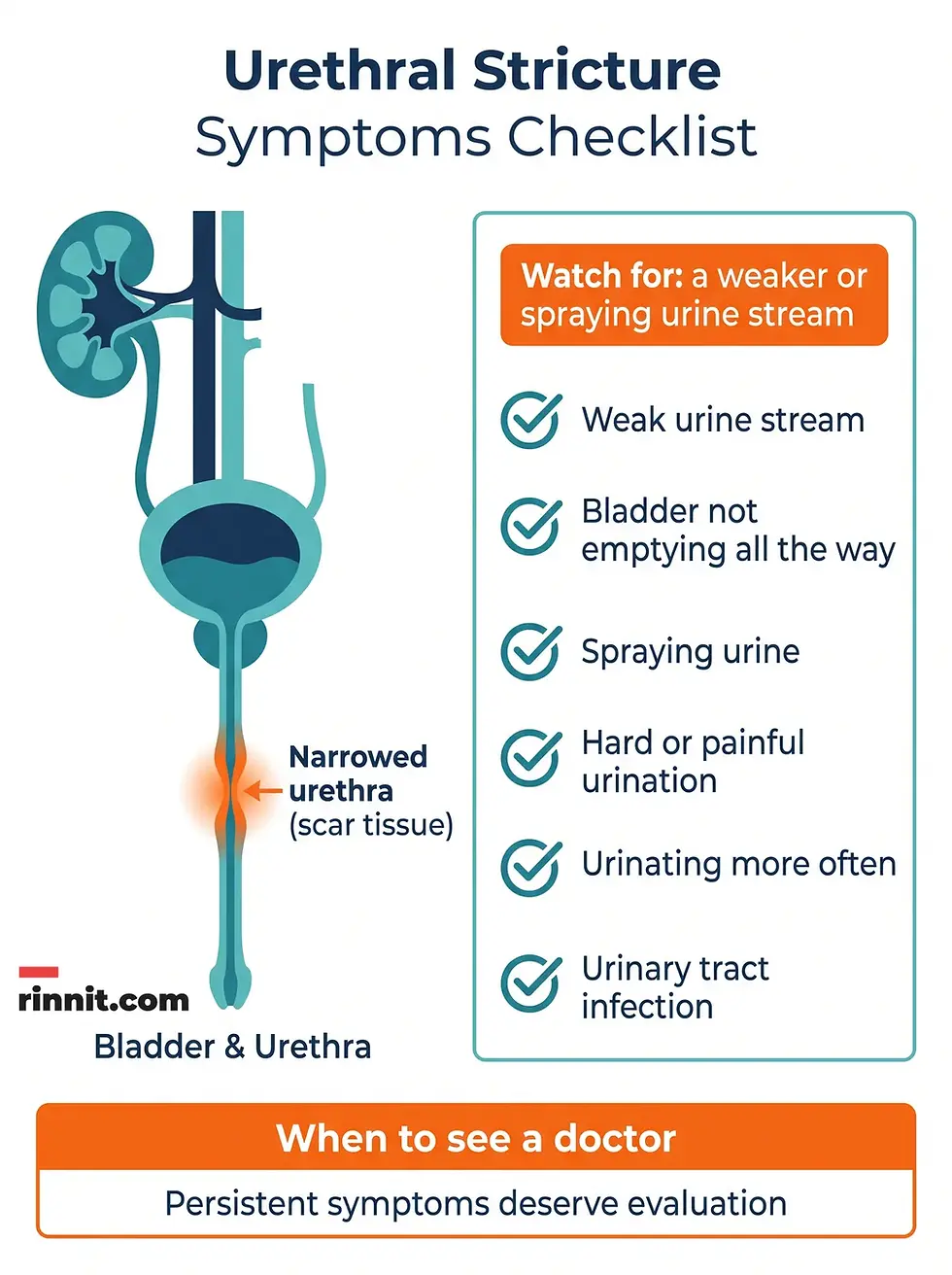
Quick Answer
A urethral stricture is scarring that narrows the urethra, the tube that carries urine out of the body, so less urine leaves the bladder and problems such as infection can occur. [1] It is much more common in males, and the cause is often unknown. [1] Symptoms include a weak or spraying stream, incomplete bladder emptying, painful or frequent urination and UTIs. [1]
What the research says
Dilation and internal urethrotomy work equally well as first treatment, but both fail more often as the stricture gets longer. In a randomized trial of 210 men (106 had dilation, 104 had optical internal urethrotomy), there was no significant difference in stricture recurrence. Recurrence at 12 months was about 40% for strictures shorter than 2 cm and about 80% for those longer than 4 cm, and each extra centimeter of length raised the risk of recurrence by 1.22 times (95% CI 1.05–1.43). The authors recommended primary urethroplasty for strictures longer than 4 cm (Steenkamp et al., Journal of Urology, 1997) [3].
Self-dilation may lower the chance of the stricture coming back. A systematic review pooled six randomized trials (very low-quality evidence) and found that recurrent urethral stricture was less likely in men who performed intermittent self-dilation than in those who did not (RR 0.70, 95% CI 0.48–1.00); the authors called for a well-designed trial to confirm this (Ivaz et al., Neurourology and Urodynamics, 2016) [4].
What Is a Urethral Stricture?
A urethral (pronounced u-REE-thrul) stricture involves scarring that narrows the tube that carries urine out of the body, called the urethra. [1] The urethra is the final tube in the urinary system, connecting the bladder to the outside of the body.
As a result of a stricture, less urine comes out of the bladder. This can cause problems in the urinary tract, such as infection. [1] Urethral stricture is much more common in males than in females. [1] Often the cause is unknown. [1]
What Does a Urethral Stricture Feel Like?
Symptoms of urethral stricture can include:
When to See a Doctor
A urine stream that has become noticeably weaker, sprays instead of flowing steadily, or is accompanied by pain or frequent urination deserves evaluation. Because a stricture can lead to urinary tract infections and bladder-emptying problems, persistent symptoms should be checked by a healthcare professional rather than managed at home.
What Causes a Urethral Stricture?
A urethral stricture involves scar tissue. Scar tissue, which can narrow the urethra, can be due to:
Cause | How it narrows the urethra |
A medical procedure involving the urethra | A procedure that involves putting a tool, such as an endoscope, into the urethra can leave scarring [1] |
A catheter | A tube put into the urethra to drain the bladder can cause scar tissue over time [1] |
Trauma or injury | Trauma or injury to the urethra or pelvis can damage the tube and heal with scar tissue [1] |
Enlarged prostate or its surgery | An enlarged prostate, or having had surgery to remove or reduce an enlarged prostate gland, can be a cause [1] |
Cancer of the urethra or prostate | These cancers can be linked to urethral narrowing [1] |
Sexually transmitted infections | Infections passed through sexual contact can cause scarring in the urethra [1] |
Radiation therapy | Radiation to the area can lead to scar tissue that narrows the urethra [1] |
Lichen sclerosus | A skin condition that causes patchy, discolored, thin skin that often affects the genital area [1] |
Who Gets Urethral Stricture?
Urethral stricture is much more common in males than in females. [1] Often the cause is unknown. [1]
Can Urethral Stricture Be Prevented?
Because the cause is often unknown, and because some causes (such as pelvic trauma or medical procedures) cannot be avoided, there is no reliable way to prevent urethral stricture. What can be done is to act early when symptoms appear, since timely treatment helps prevent urinary tract infections and bladder-emptying complications.
How Is Urethral Stricture Diagnosed?
To make a diagnosis, a member of your healthcare team will ask about your symptoms and your medical history and do an exam. [2] Tests that can help find where the stricture is, how long it is and what’s causing it might include:

Diagnostic test | What it does |
Urine tests | Look for infection, blood or cancer in the urine [2] |
Urinary flow test | Measures the urine flow and how strong it is [2] |
Urethral ultrasound | Shows how long the stricture is [2] |
Pelvic ultrasound | Looks at whether there’s still urine in the bladder after emptying it [2] |
Pelvic MRI scan | Looks at the pelvic bone to see how it’s involved with the condition [2] |
Retrograde urethrogram | Uses X-ray images to look for a problem or injury of the urethra; also shows how long the stricture is and where it is [2] |
Cystoscopy | Uses a thin, tubelike tool with a lens, called a cystoscope, to look inside the urethra and bladder [2] |
How Is Urethral Stricture Treated?
Treatment might depend on the type of stricture, its size and how bad the symptoms are. [2] Treatments can include catheterization, dilation, urethroplasty, endoscopic urethrotomy, and an implanted stent or long-term catheter. [2]

Catheterization
Putting a small tube called a catheter into the bladder to drain urine is often the first step for treating urine blockage. [2] Antibiotics treat an infection if there is one. [2] Self-catheterization might be a choice for those diagnosed with a short stricture. [2]
Widening, Called Dilation
Dilation starts with a tiny wire put through the urethra and into the bladder. [2] Larger and larger dilators pass over the wire to increase the size of the opening of the urethra little by little. [2] This outpatient procedure may be a choice to treat recurrent urethral strictures. [2]
Urethroplasty
Urethroplasty involves surgically removing the narrowed section of the urethra or making it larger. [2] The procedure might also involve rebuilding tissues around the urethra. [2] Tissues from other areas of the body, such as the skin or mouth, may be used as a graft during the process. [2] The chance of urethral stricture coming back after a urethroplasty is low. [2]
Endoscopic Urethrotomy
Endoscopic urethrotomy uses a thin, tubelike tool with a lens, called a cystoscope. [2] The cystoscope goes into the urethra. [2] Then a tool is put through the cystoscope to remove the stricture or treat it with a laser. [2] This surgical procedure has a faster recovery than some other procedures. [2] It doesn’t leave much scarring, and the risk of infection is low. [2] However, urethral stricture can come back after this procedure. [2] [3]
Implanted Stent or Long-Term Catheter
This treatment might be for people with a severe stricture who don’t want surgery. [2] A tube, called a stent, is put into the urethra to keep it open. [2] Or a permanent catheter is put in to drain the bladder. [2] These procedures have a risk of bladder irritation, discomfort and urinary tract infections. [2] They also need to be watched closely. [2] Urethral stents are rarely used. [2]
Comparing the Treatment Options
Treatment | Best suited for | Key points |
Catheterization | Immediate relief of urine blockage; short strictures | Often the first step; antibiotics if infected; self-catheterization may be an option [2] |
Dilation | Recurrent urethral strictures | Outpatient; widens the opening little by little over a wire [2] |
Urethroplasty | Longer-term fix of the narrowed section | May use grafts from skin or mouth; low chance of the stricture returning [2] |
Endoscopic urethrotomy | Less invasive option with faster recovery | Low scarring and infection risk, but the stricture can come back [2] |
Stent or long-term catheter | Severe stricture when surgery is declined | Risks of irritation, discomfort and infections; needs close watching; stents are rarely used [2] |
Conclusion: What to Do Next
If your urine stream has become weak, sprays, is painful, or leaves you feeling that your bladder never fully empties, the pattern of symptoms matches what a urethral stricture can cause. Because a stricture narrows the tube that carries urine out of the body, it can lead to urinary tract infections and other urinary tract problems, and it is much more common in males than in females.
Diagnosis is straightforward, using urine tests, a urinary flow test, ultrasound, MRI, a retrograde urethrogram and cystoscopy to locate the stricture and measure its length. Treatment has several proven options, and the best choice depends on the type of stricture, its size and how bad the symptoms are. For a durable fix, urethroplasty offers the lowest chance of the stricture returning; dilation and endoscopic urethrotomy offer less invasive paths that may suit recurrent cases.
Talk to your doctor about a weak or spraying urine stream. A simple evaluation can find where the narrowing is and how long it is, and treatment options can restore a normal flow of urine.
Related Reading
Urethral Dilation: Procedure, Recovery and Results explains urethral dilation.
Urethroplasty: Procedure, Recovery and Success Rate explains urethroplasty for urethral stricture.
Retrograde Urethrogram (RUG): Why It's Done, What to Expect and Results explains the X-ray test that checks the urethra for strictures and injury.
Frequently Asked Questions
What is a urethral stricture?
A urethral stricture involves scarring that narrows the tube that carries urine out of the body, called the urethra. As a result, less urine comes out of the bladder, which can cause problems in the urinary tract, such as infection.
What does a urethral stricture feel like?
Symptoms can include a weak urine stream, the bladder not emptying all the way, spraying urine, finding it hard or painful to pass urine, passing urine more often or feeling the urge more often, and urinary tract infections.
Why does my urine stream spray instead of flowing straight?
Spraying is one of the classic signs of a urethral stricture. The scar tissue narrows the urethra, disrupting the normal steady flow of urine.
Who gets urethral strictures?
Urethral stricture is much more common in males than in females. Often the cause is unknown.
Can a catheter cause a stricture?
Yes. A tube that’s put into the urethra to drain the bladder, called a catheter, is one of the causes of scar tissue that can narrow the urethra.
Can medical procedures cause urethral stricture?
Yes. A medical procedure that involves putting a tool, such as an endoscope, into the urethra can cause the scarring that leads to a stricture.
Can trauma cause urethral stricture?
Yes. Trauma or injury to the urethra or pelvis is one of the causes of scar tissue that can narrow the urethra.
Can sexually transmitted infections cause urethral stricture?
Yes. Sexually transmitted infections are listed among the causes of scar tissue that can narrow the urethra.
What is lichen sclerosus and how does it relate?
Lichen sclerosus is a skin condition that causes patchy, discolored, thin skin that often affects the genital area. It can cause scar tissue that narrows the urethra.
How is a urethral stricture diagnosed?
A healthcare team member asks about your symptoms and medical history and does an exam, then may order urine tests, a urinary flow test, urethral ultrasound, pelvic ultrasound, pelvic MRI, a retrograde urethrogram and cystoscopy to find where the stricture is, how long it is and what’s causing it.
What does a urinary flow test measure?
A urinary flow test measures the urine flow and how strong it is.
What is a retrograde urethrogram?
This test uses X-ray images to look for a problem or injury of the urethra. It also shows how long the stricture is and where it is.
Is surgery always needed?
No. Treatment depends on the type of stricture, its size and how bad the symptoms are. Catheterization and dilation are non-surgical or minor options; surgery is one path among several.
What is urethroplasty?
Urethroplasty involves surgically removing the narrowed section of the urethra or making it larger. The procedure might also involve rebuilding tissues around the urethra, using tissue grafts from other areas of the body such as the skin or mouth. The chance of the stricture coming back after a urethroplasty is low.
What is endoscopic urethrotomy?
It is a procedure in which a cystoscope, a thin tubelike tool with a lens, goes into the urethra, and a tool passed through it removes the stricture or treats it with a laser. It has a faster recovery, little scarring and a low infection risk, but the stricture can come back.
What is dilation for urethral stricture?
Dilation starts with a tiny wire put through the urethra into the bladder. Larger and larger dilators pass over the wire to increase the size of the opening of the urethra little by little. This outpatient procedure may be a choice to treat recurrent urethral strictures.
What if I don’t want surgery?
For people with a severe stricture who don’t want surgery, a stent (a tube put into the urethra to keep it open) or a permanent catheter may be used. These carry risks of bladder irritation, discomfort and urinary tract infections, need close watching, and urethral stents are rarely used.
Is a urethral stricture dangerous if left untreated?
Left untreated, a stricture means less urine comes out of the bladder, which can cause problems in the urinary tract, such as infection, and can leave urine behind in the bladder. That is why persistent symptoms should be evaluated.
Can a urethral stricture come back after treatment?
It can, depending on the treatment. The chance of the stricture returning after a urethroplasty is low, but a urethral stricture can come back after endoscopic urethrotomy. Dilation is one option used for recurrent strictures.
Sources
Mayo Clinic Staff. Urethral stricture - Symptoms and causes. Mayo Clinic. December 23, 2025. https://www.mayoclinic.org/diseases-conditions/urethral-stricture/symptoms-causes/syc-20362330
Mayo Clinic Staff. Urethral stricture - Diagnosis & treatment. Mayo Clinic. December 23, 2025. https://www.mayoclinic.org/diseases-conditions/urethral-stricture/diagnosis-treatment/drc-20556091
Steenkamp JW, Heyns CF, de Kock ML. Internal urethrotomy versus dilation as treatment for male urethral strictures: a prospective, randomized comparison. J Urol. 1997;157(1):98-101. PMID 8976225. https://pubmed.ncbi.nlm.nih.gov/8976225/
Ivaz SL, Veeratterapillay R, Jackson MJ, et al. Intermittent self-dilatation for urethral stricture disease in males: a systematic review and meta-analysis. Neurourol Urodyn. 2016;35(7):759-763. PMID 26094812. https://doi.org/10.1002/nau.22803
Medical disclaimer
This article is for general information only and is not a substitute for professional medical advice, diagnosis or treatment. Always consult a qualified healthcare provider about your individual condition.



Comments