Urethroplasty: Procedure, Recovery and Success Rate

Updated: 2 days ago
Written and medically reviewed by Dr. Baraa Alnahhal, MD · Last reviewed: November 2026 · How we review
Quick Answer
Urethroplasty is surgery to repair or rebuild the urethra, the tube that carries urine out of the body, after scar tissue narrows it (urethral stricture). A urologist removes the scarred section and reconnects the ends or rebuilds it with healthy tissue. Success rates are 85% to 90% for simple repairs and about 80% for complex ones.
What the research says
Cheek grafts worked equally well on either side: a meta-analysis of 8 studies with 655 people found top (dorsal) and bottom (ventral) placement of a cheek graft had the same success rate, but temporary erectile dysfunction was less common with the ventral approach (Hassan AA et al., BJU International, 2025) [2]
Repairs after failed hypospadias surgery often succeeded: a meta-analysis of 20 studies found success rates of 78.1% for single-stage and 76.2% for staged urethroplasty after failed hypospadias repair, with complication rates of 10% to 50% (Kojovic V et al., International Journal of Impotence Research, 2026) [3]
Key takeaways
Urethroplasty repairs a urethra narrowed by scar tissue.
The surgeon removes the scar or rebuilds the urethra with tissue grafts.
Surgery takes three to six hours.
You'll have a catheter for three to four weeks.
Success rates are about 80% to 90%.
What is urethroplasty?
The urethra carries urine, and semen in males, out of the body. When scar tissue narrows it, urine flow can be blocked. Urethroplasty is considered the best way to treat urethral strictures so urine flows freely. Sources: [1]
Why it's done

It's done by a urologist.
Urethral stricture.
Blockages after childhood repair of hypospadias or epispadias. Sources: [1]
Graft tissue options
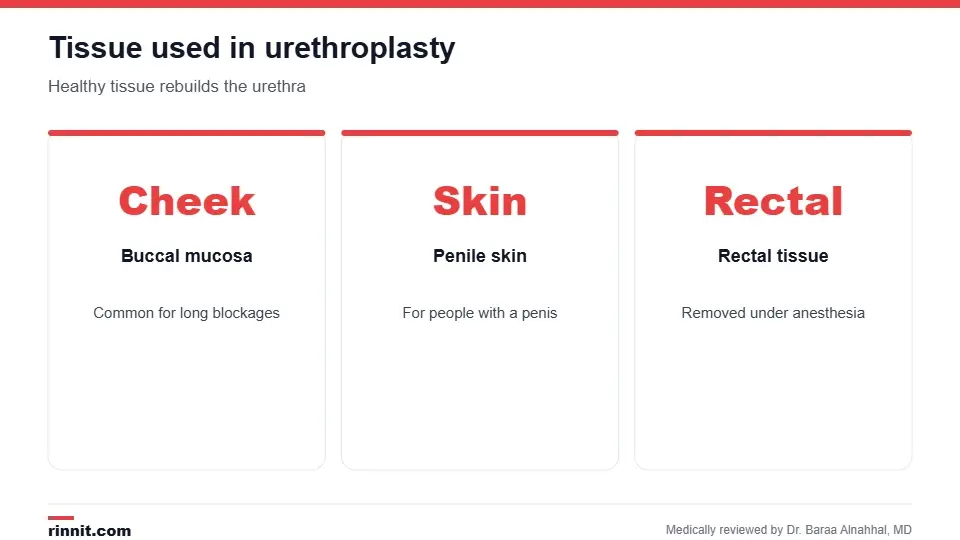
The choice depends on the blockage's length and location.
Tissue source | Notes |
Inner cheek (buccal mucosa) | Commonly used for longer blockages |
Penile skin | For people with a penis |
Rectal tissue | Removed through the anus under anesthesia |
Sources: [1, 2]
How to prepare
A retrograde urethrogram (X-ray with contrast) and cystoscopy show where the scar is.
Share all medicines and supplements; some raise bleeding risk.
Report allergies to medicines, skin cleaners, latex or foods.
A catheter through the belly (suprapubic) may be placed to let the urethra rest. Sources: [1]
What happens during surgery
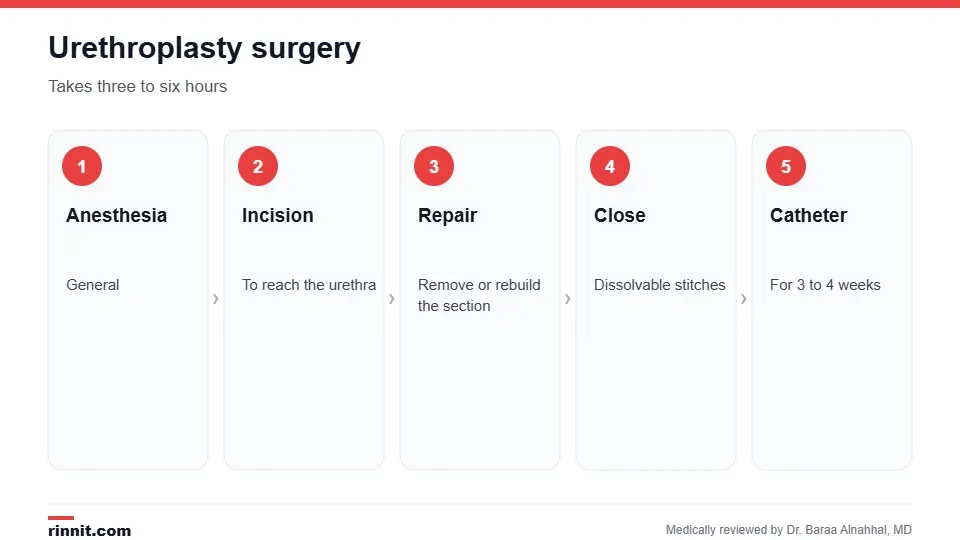
Most procedures take three to six hours.
You get general anesthesia.
The urologist makes an incision to reach the urethra.
The blockage is removed or the section is rebuilt.
Dissolvable stitches close the incision.
A urinary catheter is placed, and sometimes a drain. Sources: [1]
Risks
The repair may not last, requiring more procedures.
Infection.
Catheter leakage or blockage.
Nerve injury or pain from positioning.
Urinary leakage.
Erectile dysfunction, usually temporary and often resolving within 18 months. Sources: [1, 2]
Recovery
Most go home the same day or after one night.
The catheter is removed about three to four weeks after surgery.
Avoid driving and long sitting or squatting while the catheter is in.
Avoid sex for at least six weeks after the catheter comes out.
If cheek tissue was used, your mouth heals in about three weeks.
Full recovery takes about six weeks. Sources: [1]
A follow-up voiding cystourethrogram may check healing. Sources: [1]
Outlook
Success is about 85% to 90% for simple repairs and about 80% for complex ones. The repair is permanent for many people, though some need more procedures. Sources: [1, 3]
When to call your provider
Signs of infection, like fever or discoloration at the incision.
An incision that opens.
Lots of blood or pus-like drainage.
Unexpected severe pain.
A blocked catheter.
Frequent painful erections while the catheter is in. Sources: [1]
Conclusion
Urethroplasty offers the best long-term fix for a narrowed urethra. Careful catheter care and keeping follow-up visits help your repair heal and last.
Keep learning: read about urethral stricture and cystoscopy.
Frequently asked questions
What is urethroplasty?
Surgery to repair or rebuild a narrowed urethra.
What does it treat?
Urethral stricture and blockages after hypospadias or epispadias repair.
Where does graft tissue come from?
Usually the inner cheek; sometimes penile skin or rectal tissue.
How long does surgery take?
Three to six hours.
Will I go home the same day?
Most people go home the same day or after one night.
How long will I have a catheter?
About three to four weeks.
When can I have sex again?
At least six weeks after the catheter is removed.
How successful is urethroplasty?
About 85% to 90% for simple repairs and 80% for complex ones.
Will it affect erections?
Erectile problems can happen but are usually temporary.
How long is recovery?
About six weeks.
Related Reading
Urethral Dilation: Procedure, Recovery and Results explains urethral dilation.
Urethral Stricture: Symptoms, Causes, Diagnosis, and Treatment Explained the main condition treated.
Retrograde Urethrogram (RUG): Why It's Done, What to Expect and Results an X-ray of the urethra.
Cystoscopy: Purpose, Procedure, Recovery and Risks a scope test of the bladder and urethra.
Hypospadias Repair: Surgery, Recovery & Risks Explained childhood urethra repair.
Restoring Urinary Flow: A Guide to Posterior Urethral Reconstruction reconstruction of the deeper urethra.
References
Cleveland Clinic. Urethroplasty: Procedure, Risks, Results & Recovery. Cleveland Clinic. Last updated December 12, 2025. https://my.clevelandclinic.org/health/treatments/22166-urethroplasty
Hassan AA, Soliman AM, Shouman HA, et al. Dorsal- vs ventral-onlay buccal mucosal graft urethroplasty for urethral strictures: a meta-analysis. BJU International. 2025;136(3):385-394. PMID 40484913. https://doi.org/10.1111/bju.16811
Kojovic V, Marjanovic M, Ilic P, et al. Surgical approaches for distal urethral strictures after failed hypospadias repair: a systematic review and meta-analysis. International Journal of Impotence Research. 2026;38(4):276-285. PMID 40954196. https://doi.org/10.1038/s41443-025-01167-7
Medical disclaimer
This article is for general education only and does not replace advice from a qualified healthcare professional. Talk to your doctor about your own diagnosis and treatment, and seek emergency care right away for severe or sudden symptoms.



Comments