Voiding Cystourethrogram (VCUG): Why It's Done, What to Expect and Reflux Grades

Updated: 2 days ago
Written and medically reviewed by Dr. Baraa Alnahhal, MD · Last reviewed: November 2026 · How we review
Quick Answer
A voiding cystourethrogram (VCUG) is an X-ray test that uses contrast dye to show the bladder and urethra while they fill and empty. It's used to check for vesicoureteral reflux, when urine flows backward from the bladder toward the kidneys. It's the most common test for reflux in children. It takes 30 to 45 minutes and needs no sedation.
What the research says
Treating reflux found on VCUG prevents repeat infections: in the RIVUR trial of 607 children with reflux after a first or second urinary tract infection, daily preventive antibiotics cut the risk of another infection by about 50%, but didn't reduce kidney scarring, and resistant bacteria were more common (RIVUR Trial Investigators, Hoberman A et al., New England Journal of Medicine, 2014) [2]
Not every child needs a VCUG after one infection: the American Academy of Pediatrics' evidence review for febrile infants and young children found that trials didn't support routine preventive antibiotics for reflux, which argues against routine VCUG after a first urinary tract infection (Finnell SM et al., Pediatrics, 2011) [3]
Key takeaways
An X-ray test of the bladder and urethra as they fill and empty.
Mainly used to diagnose vesicoureteral reflux, especially in children with repeated UTIs.
A catheter fills the bladder with contrast; X-rays are taken during filling and peeing.
About 30–45 minutes; small radiation dose; sedation rarely needed.
Reflux is graded 1–5; mild burning and pink urine for a day or two are normal.
What is a VCUG?
"Voiding" means peeing, "cysto" refers to the bladder and "urethrogram" is an image of the urethra. Using fluoroscopy, a type of moving X-ray, the radiologist watches the contrast fill the bladder and then flow out through the urethra. If contrast flows up into the ureters or kidneys, that's vesicoureteral reflux. Sources: [1]
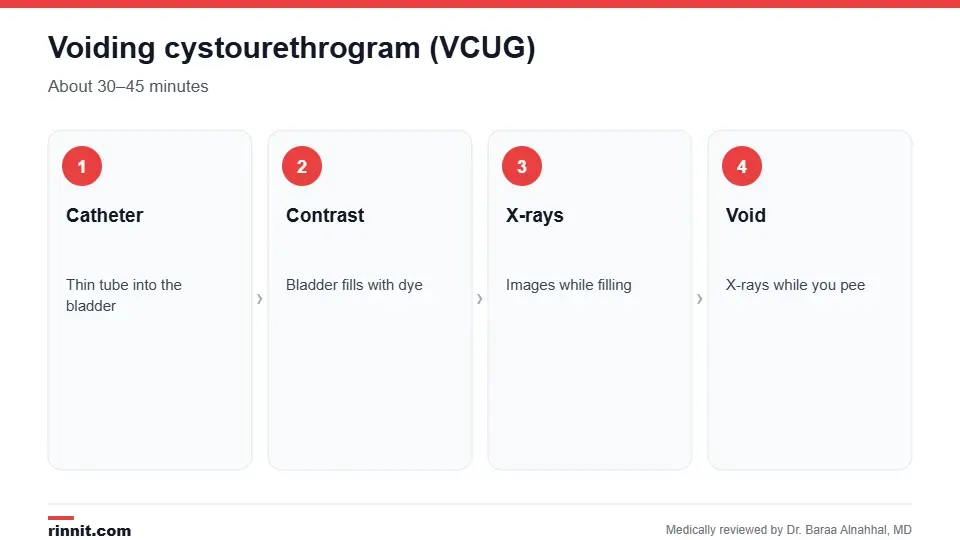
A VCUG takes about 30 to 45 minutes.
Why is it done?
To diagnose vesicoureteral reflux, most often in children with repeated urinary tract infections.
When an ultrasound shows swelling of the kidneys (hydronephrosis).
To find urethral narrowing (strictures) or blockages, such as posterior urethral valves in boys.
For urinary incontinence, an enlarged prostate or after urethral injury or surgery.
When there's a family history of reflux. Sources: [1]
A kidney ultrasound is often done first, and a renal scan may check for kidney scarring. Sources: [1, 3]
How do I prepare?
Tell your provider about medicines, allergies, especially to contrast dye, and possible pregnancy.
You can usually eat and drink normally because sedation is rarely used.
For children, explain the test in simple terms; a parent can usually stay in the room, and child life specialists may help. Sources: [1]
What happens during the test?
You or your child undress from the waist down and lie on an X-ray table.
The genital area is cleaned, and numbing gel may be applied.
A thin, soft catheter is passed through the urethra into the bladder.
Contrast fills the bladder while X-ray images are taken.
When the bladder is full, the catheter is removed and you pee into a bedpan, urinal or onto a towel while more X-rays are taken. Sources: [1]
The test takes about 30–45 minutes. A protective cover shields other parts of the body from radiation. Sources: [1]
Understanding your results

Treatment depends on the reflux grade.
Reflux grade | What it means |
1 | Urine flows back into the ureter only |
2 | Reaches the kidney without swelling |
3 | Mild to moderate swelling of the ureter and kidney |
4 | Moderate swelling and twisting of the ureter |
5 | Severe swelling and twisting |
Sources: [1]
A radiologist sends a report to your provider, usually within two days. Mild reflux often improves as children grow. Treatment may include watchful waiting, preventive antibiotics, treating bladder and bowel problems, injections such as Deflux or surgery. Sources: [1, 2]
After the test
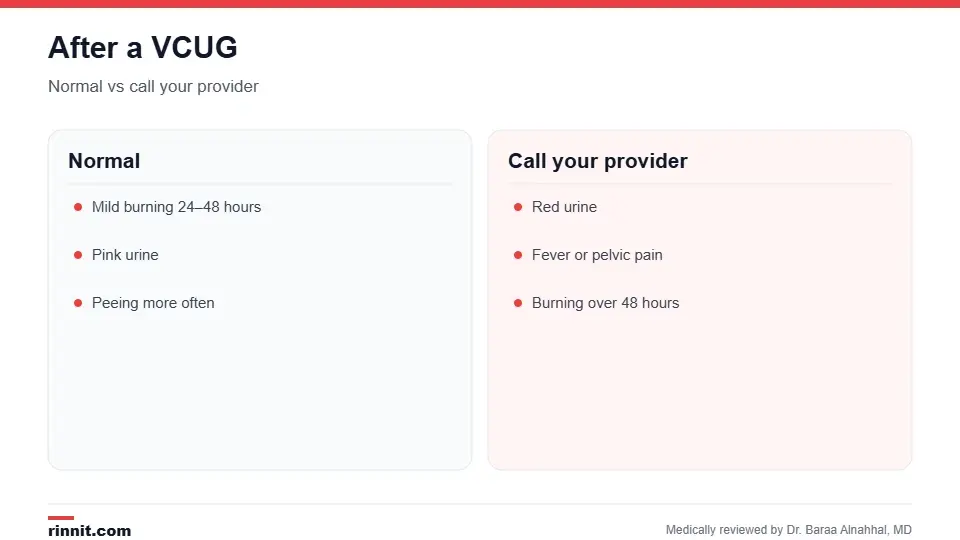
Drink plenty of fluids after the test.
Normal: mild burning when peeing for 24–48 hours, pink urine and peeing more often.
Drink plenty of fluids and pee when you feel the urge.
Call your provider for red urine, fever, pelvic pain or burning that lasts longer than 48 hours. Sources: [1]
Risks
Risks are low. The radiation dose is small. Side effects can include brief discomfort, burning when peeing, nausea or flushing and, rarely, a UTI from the catheter. Serious reactions to contrast are rare because it stays in the bladder. Sources: [1]
Conclusion
A VCUG is the standard test for vesicoureteral reflux, giving a clear picture of how urine moves through the bladder and urethra. Although the catheter can be uncomfortable, the test is quick and safe, and the results help decide whether a child needs treatment to protect the kidneys.
Keep learning: read about vesicoureteral reflux and hydronephrosis.
Frequently asked questions
What does a VCUG show?
How the bladder and urethra fill and empty, and whether urine flows back toward the kidneys.
Why do children get a VCUG?
Most often to check for reflux after repeated urinary tract infections.
Does a VCUG hurt?
Placing the catheter can be uncomfortable, but it's brief.
How long does a VCUG take?
About 30–45 minutes.
Is my child sedated?
Rarely; most children don't need sedation.
How much radiation is used?
A small amount, with shielding for other areas.
What are reflux grades?
A scale from 1 (mild) to 5 (severe).
Is burning after the test normal?
Yes, for 24–48 hours.
When should I call the doctor?
For red urine, fever, pelvic pain or burning beyond 48 hours.
Can adults have a VCUG?
Yes, for strictures, incontinence or prostate problems.
Related Reading
What Is Vesicoureteral Reflux? A Plain-Language Guide to the Urine-Backflow Condition in Children the condition a VCUG diagnoses.
Deflux Treatment for Vesicoureteral Reflux: How It Works, Success Rates and Recovery a treatment for reflux.
Hydronephrosis: What Causes Kidney Swelling, How It Is Found, and How It Is Treated kidney swelling that can prompt a VCUG.
Recurrent UTI: Symptoms, Causes, Diagnosis, and Prevention repeated infections that often lead to testing.
Restoring Urinary Flow: A Guide to Posterior Urethral Reconstruction urethral problems a VCUG can reveal.
Retrograde Urethrogram (RUG): Why It's Done, What to Expect and Results explains the X-ray test that checks the urethra for strictures and injury.
References
Cleveland Clinic. Voiding Cystourethrogram (VCUG): Procedure & Results. Cleveland Clinic. Last updated June 6, 2023. https://my.clevelandclinic.org/health/diagnostics/16431-vcug
RIVUR Trial Investigators; Hoberman A, Greenfield SP, Mattoo TK, et al. Antimicrobial prophylaxis for children with vesicoureteral reflux. N Engl J Med. 2014;370(25):2367-2376. PMID 24795142. https://doi.org/10.1056/NEJMoa1401811
Finnell SM, Carroll AE, Downs SM; Subcommittee on Urinary Tract Infection. Technical report: diagnosis and management of an initial UTI in febrile infants and young children. Pediatrics. 2011;128(3):e749-e770. PMID 21873694. https://doi.org/10.1542/peds.2011-1332
Medical disclaimer
This article is for general education only and does not replace advice from a qualified healthcare professional. Talk to your doctor about your own diagnosis and treatment, and seek emergency care right away for severe or sudden symptoms.



Comments