Fluoroscopy: What It Is, How It Works, Risks and What to Expect

Updated: 2 days ago
Written and medically reviewed by Dr. Baraa Alnahhal, MD · Last reviewed: November 2026 · How we review
Quick Answer: What is fluoroscopy?
Fluoroscopy is an imaging method that uses a series of quick X-ray pulses to show the inside of the body moving in real time, like a video. Providers use it to diagnose problems with organs and to guide procedures like placing a catheter or stent. The main risk is radiation exposure, which is very low for diagnostic exams. [1]
What the research says
Skin injury from fluoroscopy needs very high doses. A review of fluoroscopically guided procedures found that visible skin changes generally appear about a month after a peak skin dose above several grays, far higher than routine diagnostic exams; specialized wound care may be needed above 10 Gy. (Balter et al., Radiology, 2010) [2]
Experience and technique cut radiation during surgery. In 759 children having elbow fracture pinning, surgeons in their first year of practice used more fluoroscopy time (56.9 vs. 42.1 seconds) and a higher radiation dose, and the authors recommend steps such as pulsed instead of continuous fluoroscopy to reduce exposure. (Magee et al., Journal of Pediatric Orthopaedics, 2021) [3]
Key takeaways
Fluoroscopy shows your body moving in real time, unlike a still X-ray image. [1]
It is used both for diagnostic exams and to guide procedures and surgery. [1]
Contrast may be swallowed, injected into a vein or given by enema. [1]
Tell your provider if you are pregnant or have had a reaction to contrast dye. [1]
Radiation from diagnostic fluoroscopy is very low, and serious side effects are very unlikely. [1]
What is fluoroscopy?

Fluoroscopy shows motion; an X-ray shows a single moment.
Fluoroscopy uses a special camera and brief pulses of X-ray beams to capture images inside your body while your organs work normally or while a provider performs a procedure. [1]
A plain X-ray is like a snapshot, while fluoroscopy is more like a video. A CT scan also captures a single moment, whereas fluoroscopy shows motion over time, so providers can see how organs work or exactly where a device is being placed. [1]
What is fluoroscopy contrast?
Some fluoroscopy exams use a contrast agent, often called dye, though it does not stain like clothing dye. Depending on the exam, you may swallow it as a liquid, receive it through a vein or have it given into your rectum by enema. [1]
What is fluoroscopy used for?
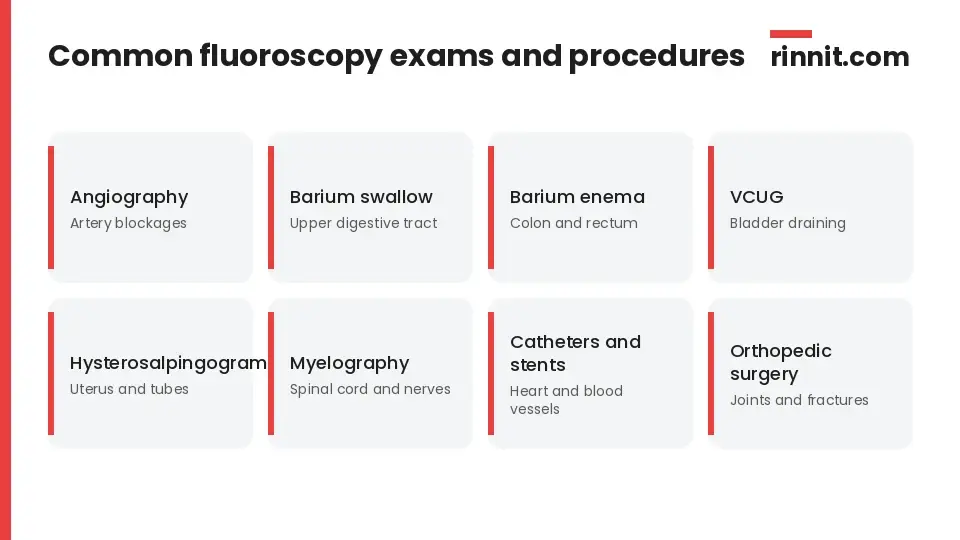
Fluoroscopy is used for both diagnosis and treatment.
Providers use fluoroscopy to diagnose problems in specific body parts, to guide procedures such as placing devices inside the body, and to guide injections or fluid removal. [1]
Diagnostic exams that use fluoroscopy
Exam | What it checks |
Angiography | Narrowing or blockages in your arteries |
Barium swallow (esophagram) | Your upper digestive tract |
Barium enema | Your colon and rectum |
Cystography, including voiding cystourethrogram (VCUG) | Your bladder and how well it drains |
Hysterosalpingogram | Your uterus and fallopian tubes |
Myelography | Your spinal cord, nerve roots and spinal lining |
Sniff test | How well your diaphragm works |
Sources: [1]
Procedures guided by fluoroscopy
Cardiac and blood vessel catheterization: lets providers see blood flowing through your arteries
Catheter placement: thin tubes placed through the urethra, blood vessels or bile ducts, including during angioplasty
Stent placement: devices that open narrowed or blocked blood vessels
Orthopedic surgery: joint replacement and repair of broken bones
Sources: [1]
How do you prepare for fluoroscopy?

Tell your provider about pregnancy and contrast allergies.
Preparation depends on the exam. Some need none, while others require you to avoid certain medicines or not eat or drink for several hours. Ask your provider for instructions. [1]
Tell your provider if you are allergic to contrast dye or have reacted to it before
Tell your provider if you are or might be pregnant, because radiation can harm a developing fetus
You may need to remove jewelry and change into a gown
Sources: [1]
What happens during fluoroscopy?
Fluoroscopy is done at an outpatient center or during a hospital stay. You lie on a table or sit in a chair. If your exam uses contrast, you swallow it or receive it by injection or enema. You may be asked to change position or briefly hold your breath while an X-ray scanner captures images that your provider watches on a screen. [1]
For catheter procedures, your provider inserts a needle in an area such as your groin or elbow. If you need to be asleep, an anesthesiologist gives general anesthesia through a vein in your arm. [1]
Will you be awake?
It depends on the exam. Sedation or anesthesia is more likely when fluoroscopy guides surgery or stent placement. For most diagnostic exams you stay awake so you can follow instructions. [1]
Does fluoroscopy hurt?
The imaging itself is painless and noninvasive. Any discomfort comes from the procedure it is guiding, and your provider will explain what to expect. [1]
What are the risks of fluoroscopy?
The main risk is radiation exposure. Diagnostic fluoroscopy uses very low levels of radiation, but longer exposure during complex procedures could: [1]
Damage your skin and the tissue underneath (radiation burns)
Slightly raise your risk of cancer later in life
Harm a fetus if you are pregnant
These side effects are very unlikely, and when the procedure is medically necessary, its benefits outweigh the radiation risk. Contrast dye also carries a small risk of an allergic reaction. [1]
When will you get your results?
It depends on the exam. You may learn results during or right after the test, after you wake up from surgery, or after a radiologist reviews the images, which can take anywhere from a day to about a week. If a body part is not working properly, you may need more tests or treatment. [1]
When should you call your provider?
Contact your provider if you have questions about how to prepare for your exam or about what your results mean. [1]
Conclusion
Fluoroscopy lets providers watch your body at work, which helps them find problems that a single picture might miss and place devices precisely. For most diagnostic exams, the radiation dose is low and the benefits clearly outweigh the risks.
Before your exam, tell your provider about any pregnancy or past contrast reactions, and ask how to prepare.
Keep learning: Read our guides to the esophagram (barium swallow) and cardiac catheterization, two common fluoroscopy exams. For more background, see the FDA page on fluoroscopy.
FAQ
What is fluoroscopy?
An imaging method that uses a series of X-rays to show the inside of your body moving in real time. [1]
How is fluoroscopy different from an X-ray?
A regular X-ray is a still picture, while fluoroscopy shows movement, like a video. [1]
What is fluoroscopy used for?
Diagnosing problems in organs, such as with barium studies and angiograms, and guiding catheters, stents and orthopedic surgery. [1]
Does fluoroscopy use contrast dye?
Some exams do; it may be swallowed, injected into a vein or given by enema. [1]
Is fluoroscopy safe?
Diagnostic fluoroscopy uses very low radiation, and serious side effects are very unlikely. [1]
What are the risks of fluoroscopy?
Radiation exposure, which with long procedures can cause skin burns or slightly raise cancer risk, and a small risk of contrast allergy. [1]
Can I have fluoroscopy while pregnant?
Tell your provider if you are or might be pregnant, because radiation can harm a developing fetus. [1]
Does fluoroscopy hurt?
No; the imaging is painless, though the procedure it guides may cause discomfort. [1]
Will I be awake during fluoroscopy?
Usually yes for diagnostic exams; sedation or anesthesia is more likely for surgery or stent placement. [1]
When will I get fluoroscopy results?
During or right after the exam, or within a day to about a week after a radiologist reviews it. [1]
Related Reading
Dysphagia (Trouble Swallowing): Symptoms, Causes, Diagnosis & Treatment — Complete Guide explains a swallowing problem often checked with a fluoroscopic barium swallow.
Coronary Artery Disease: Symptoms, Causes, Diagnosis, Treatment and Prevention — What You Need to Know covers artery blockages found and treated with fluoroscopy-guided catheterization.
What Is Vesicoureteral Reflux? A Plain-Language Guide to the Urine-Backflow Condition in Children describes a condition diagnosed with a voiding cystourethrogram.
Acid Reflux & GERD: Symptoms, Causes, Diagnosis, and Treatment covers a digestive problem that fluoroscopic upper GI studies can help evaluate.
Bone Fractures: What Happens When a Bone Breaks, and How It Heals explains injuries often repaired with fluoroscopy guidance.
Sniff Test: Diaphragm Fluoroscopy for Weakness and Paralysis explains the X-ray test that checks how the diaphragm moves.
References
Cleveland Clinic. Fluoroscopy: What It Is, Purpose, Procedure & Results. Cleveland Clinic. Last updated April 14, 2025. https://my.clevelandclinic.org/health/diagnostics/21992-fluoroscopy
Balter S, Hopewell JW, Miller DL, et al. Fluoroscopically guided interventional procedures: a review of radiation effects on patients' skin and hair. Radiology. 2010;254(2):326-341. PMID 20093507. https://doi.org/10.1148/radiol.2542082312
Magee LC, Karkenny AJ, Nguyen JC, et al. Does Surgical Experience Decrease Radiation Exposure in the Operating Room? J Pediatr Orthop. 2021;41(6):389-394. PMID 34096557. https://doi.org/10.1097/BPO.0000000000001825
Medical disclaimer
This article is for general education only and does not replace advice from a qualified healthcare professional. Talk to your doctor about your own diagnosis and treatment, and seek emergency care right away for severe or sudden symptoms.



Comments