Sniff Test: Diaphragm Fluoroscopy for Weakness and Paralysis

Updated: 3 days ago
Written and medically reviewed by Dr. Baraa Alnahhal, MD · Last reviewed: November 2026 · How we review
Quick Answer
A sniff test is a real-time X-ray (fluoroscopy) of the chest that watches the diaphragm, the main breathing muscle, while you breathe and sniff quickly through your nose. If one side moves up when you breathe in, it suggests weakness or paralysis, often from a phrenic nerve problem. It takes about 15 minutes and uses very little radiation.
What the research says
Diaphragm weakness shows up when lying down: a review of respiratory muscle testing noted that in diaphragmatic paralysis, vital capacity can fall by 25–50% when moving from sitting to lying flat, and that imaging such as chest X-ray, fluoroscopy and ultrasound helps confirm the diagnosis (Fitting JW, Schweizerische Medizinische Wochenschrift, 1998) [2]
The sniff test can uncover a hidden cause of breathlessness: in a reported case of unexplained exertional shortness of breath, a fluoroscopic sniff test showed diaphragmatic dysfunction, and nerve conduction studies then confirmed damage to both phrenic nerves (Rafiq A et al., Medicine (Baltimore), 2016) [3]
Key takeaways
A fluoroscopy test of diaphragm movement, not a test of smell.
Normal: the diaphragm moves down when you breathe in.
Abnormal: a side moves up when you sniff, suggesting weakness or paralysis.
Takes about 15 minutes; no preparation; very low radiation.
Often followed by nerve and muscle tests if abnormal.
What does the sniff test check?
The diaphragm is a dome-shaped muscle under your lungs, controlled by the phrenic nerves from your neck. A quick sniff makes the diaphragm contract sharply, which makes weakness easier to see on live fluoroscopy. Sources: [1, 2]
Why is it done?

A sniff test looks for diaphragm weakness or paralysis.
Unexplained shortness of breath, especially when lying flat.
A raised diaphragm seen on a chest X-ray.
Suspected phrenic nerve injury, including after chest, heart or neck surgery.
Nerve and muscle conditions such as ALS, CIDP, dermatomyositis, Guillain-Barré syndrome, Lambert-Eaton syndrome, multiple sclerosis, muscular dystrophy, myasthenia gravis, Pompe disease, post-polio syndrome and spinal cord injury. Sources: [1]
How do I prepare?
No special preparation is needed. You'll remove jewelry and metal from your chest area and may change into a gown. Tell your provider if you could be pregnant. Sources: [1]
What happens during the test?
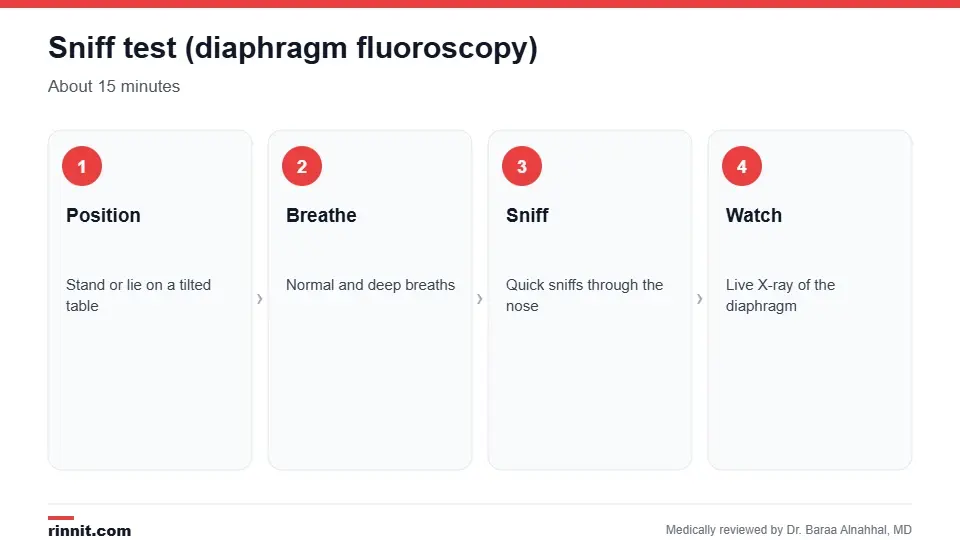
The sniff test takes about 15 minutes.
You stand, or sit or lie on a tilting table with safety straps.
The radiologist watches your diaphragm on a live X-ray screen.
You breathe normally, then take deep breaths and breathe out fully.
You sniff quickly and sharply through your nose several times, with your mouth closed.
The images are recorded and reviewed; the test takes about 15 minutes. Sources: [1]
Risks
The sniff test uses a very low dose of radiation and has no known side effects. Sources: [1]
Understanding your results
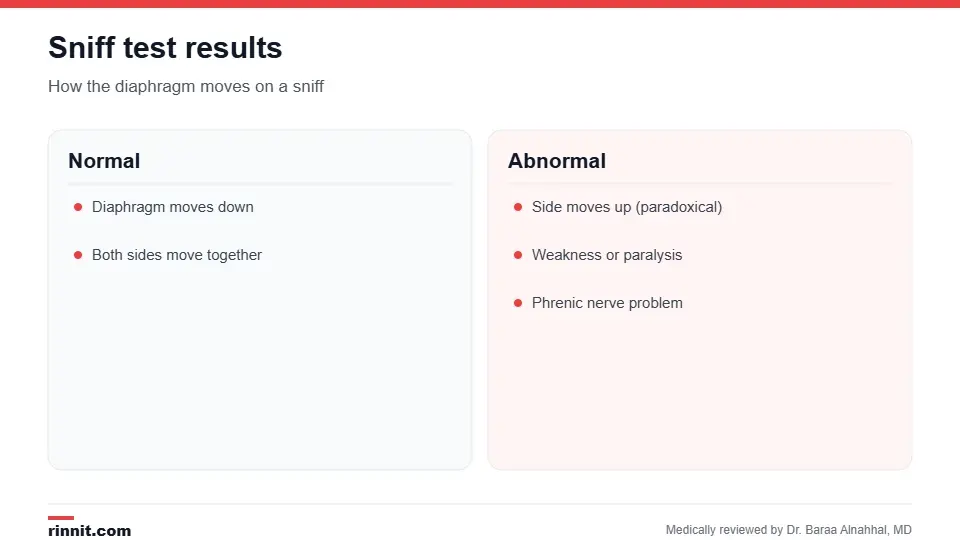
Paradoxical upward motion suggests diaphragm paralysis.
Result | What it shows | What it may mean |
Normal (negative) | Both sides move down together when you breathe in | Normal diaphragm function |
Abnormal (positive) | One side moves up, or barely moves, when you sniff | Weakness or paralysis, often from a phrenic nerve problem |
Results may be shared right away or within a few days. False positives and false negatives can happen, so your provider may order pulmonary function tests, nerve conduction studies or EMG to confirm the cause. Sources: [1, 2, 3]
Conclusion
The sniff test is a quick, simple way to see whether your diaphragm is moving the way it should. An abnormal result points your care team toward nerve or muscle causes of breathing trouble.
Keep learning: read about the diaphragm and fluoroscopy.
Frequently asked questions
Is a sniff test a smell test?
No. It's an X-ray test of diaphragm movement.
What does a sniff test show?
Whether your diaphragm moves normally when you breathe and sniff.
What is a normal result?
Both sides of the diaphragm move down when you breathe in.
What is an abnormal result?
A side moves up, suggesting weakness or paralysis.
How long does it take?
About 15 minutes.
Do I need to prepare?
No special preparation is needed.
Is there radiation?
Yes, but a very low dose.
Does it hurt?
No. You just breathe and sniff.
What causes diaphragm paralysis?
Often phrenic nerve injury or nerve and muscle diseases.
What happens after an abnormal result?
Your provider may order breathing, nerve or muscle tests.
Related Reading
The Diaphragm: Understanding Your Body’s Primary Breathing Muscle the muscle the sniff test checks.
Phrenic Nerve: Function, Anatomy, Breathing and Hiccups the nerve that controls the diaphragm.
Fluoroscopy: What It Is, How It Works, Risks and What to Expect the live X-ray used for the test.
Pulmonary Function Tests (PFTs): Types, Preparation and What Your Results Mean breathing tests often done alongside.
Chest X-Ray (CXR): What It Shows, How It's Done and What Results Mean may first show a raised diaphragm.
References
Cleveland Clinic. Sniff Test: What It Is, Purpose, Procedure & Results. Cleveland Clinic. Last updated October 23, 2024. https://my.clevelandclinic.org/health/diagnostics/sniff-test
Fitting JW. Evaluation of respiratory muscles. Schweiz Med Wochenschr. 1998;128(33):1212-1216. PMID 9757485. https://pubmed.ncbi.nlm.nih.gov/9757485/
Rafiq A, Ijaz M, Tariq H, et al. Failing phrenics: an obscure cause of exertional dyspnea: case report and literature review. Medicine (Baltimore). 2016;95(29):e4263. PMID 27442657. https://doi.org/10.1097/MD.0000000000004263
Medical disclaimer
This article is for general education only and does not replace advice from a qualified healthcare professional. Talk to your doctor about your own diagnosis and treatment, and seek emergency care right away for severe or sudden symptoms.



Comments