Phrenic Nerve: Function, Anatomy, Breathing and Hiccups

Updated: 3 days ago
Medically reviewed by Dr. Baraa Alnahhal, MD · Last reviewed: October 2026
Quick Answer: what is the phrenic nerve?
The phrenic nerve is the main motor nerve for the diaphragm and an essential part of the respiratory system. It carries signals that change the diaphragm's shape, allowing the lungs to expand for inhalation and return toward their starting position for exhalation. [1]
Core idea | Plain-language meaning |
Number | Two: a left and a right phrenic nerve. |
Starting point | Neck near C3, with connections to C4 and C5. |
Destination | The diaphragm beneath the lungs. |
Main motor role | Moves the diaphragm during breathing. |
Sensory role | Carries touch and pain from several nearby structures. |
Possible concern | Damage may weaken or paralyze the diaphragm. |
What the research says
Diaphragm paralysis after phrenic nerve injury can often be improved with surgical repair. A systematic review and meta-analysis of 96 studies (1,846 patients) on diaphragmatic plication found that paralysis was mostly unilateral and mostly iatrogenic (caused by medical procedures), with shortness of breath the main presenting symptom. After repair, forced vital capacity and forced expiratory volume in 1 second improved, more than 70% of patients returned to normal breathing, and in-hospital mortality was 0.51%. Whether surgery is appropriate is an individual decision for a specialist team (Rahouma et al., Surgery, 2025). [2]
Diaphragm paralysis can be present with few or no symptoms. In a meta-analysis of 617 patients followed after phrenic nerve transfer (a nerve surgery used to restore arm movement), 4.9% reported respiratory symptoms, yet 67.4% of those assessed showed unilateral diaphragm paralysis. Only 15 patients (2.4%) had mild but persistent respiratory symptoms, and the authors recommended long-term monitoring and careful patient selection, particularly for people with reduced pulmonary reserve (Emamhadi et al., J Neurosurg, 2026). [3]
What does the phrenic nerve do?
The phrenic nerve is an important part of the respiratory system. It is the only nerve that gives the diaphragm motor function, meaning it sends the signals that make the diaphragm expand and contract during breathing. [1]
When the phrenic nerve signals the diaphragm to contract, the diaphragm becomes thicker and flatter. This gives the lungs room to expand and take in air. When the nerve relaxes the diaphragm, the lungs return toward their starting position, push air out and become smaller. [1]
Breathing phase | Phrenic nerve and diaphragm action |
Inhalation | Signals make the diaphragm contract, become thicker and flatter, and give the lungs room to expand. |
Exhalation | The diaphragm relaxes, and the lungs return toward their starting position and push air out. |
Where is the phrenic nerve located?
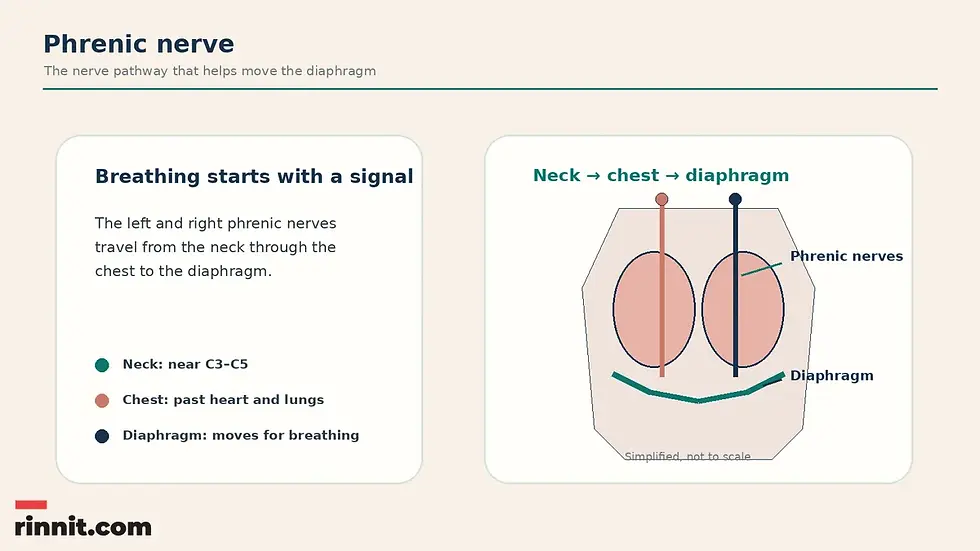
The phrenic nerve starts in the neck near the C3 vertebra and connects with C4 and C5. It travels downward through the chest, past the heart and lungs, before reaching the diaphragm. Along its path, it is connected to nerve roots in the spinal cord. [1]
You have two phrenic nerves. The left phrenic nerve controls the left side of the diaphragm, and the right phrenic nerve controls the right side. Each performs the same essential job on its side. [1]
What sensations does the phrenic nerve carry?
In addition to moving the diaphragm, the phrenic nerve provides touch and pain sensation to several structures.
Structure | Relationship |
Diaphragm | The muscle the nerve controls for breathing. |
Diaphragmatic pleura | Tissue covering the upper part of the diaphragm. |
Mediastinal pleura | Thin tissue covering the space in the chest between the lungs. |
Pericardium | Protective sac around the heart. |
Peritoneum | Thin, protective lining inside the abdomen. |
What happens when the phrenic nerve is damaged?
Anything that damages the phrenic nerve can weaken or paralyze the diaphragm. If the nerve cannot control the diaphragm as it should, the muscle may not change shape properly, making it harder for the lungs to move and work correctly. [1]
Paralysis can affect one side of the diaphragm (unilateral) or both sides (bilateral). Severe bilateral diaphragm paralysis may require mechanical ventilation to support breathing. [1]
Symptoms can be difficult to notice, especially when only one side is affected. A person may experience shortness of breath, particularly when lying down, recurrent pneumonia, sleep apnea or another new sleep disorder. Unusually weak crying is also a sign in babies. [1]

What can cause diaphragm paralysis?
Possible causes include autoimmune diseases and inflammatory conditions, birth defects or trauma during labor and delivery, cervical spondylosis, complications from neck or chest surgery or trauma, neurological disorders, spinal cord injuries, spine tumors, lung cancer and metastatic cancers. [1]
A cause on this list does not establish that it is responsible for a particular person's symptoms. Evaluation by a healthcare professional is needed to understand an individual situation.
Cause category | Examples |
Autoimmune or inflammatory | Guillain-Barré syndrome and Parsonage-Turner syndrome. |
Birth-related | Birth defects or trauma during labor and delivery. |
Spine-related | Cervical spondylosis or spinal cord injuries. |
Procedure or trauma | Complications from neck or chest surgery, or trauma. |
Neurological | Amyotrophic lateral sclerosis and multiple sclerosis. |
Tumor or cancer-related | Spine tumors, lung cancer and metastatic cancers. |
How can an irritated phrenic nerve cause hiccups?
An irritated phrenic nerve can cause hiccups that last for days or even a month or longer. Surgical procedures, tumors and other issues may irritate the nerve and lead to persistent hiccups. [1]
Persistent hiccups can interfere with talking, sleeping and eating. Treatment categories include oral medicines, nerve blocks that stop signals triggering diaphragm contractions and, rarely, phrenicotomy. Phrenicotomy severs the phrenic nerve and permanently paralyzes one side of the diaphragm. [1]
Treatment choices depend on the cause and the person's medical situation. This article does not recommend a medication, procedure or dose.
What symptoms should you watch for?
Contact a healthcare provider for new symptoms that affect breathing. These include hiccups that do not go away on their own, shortness of breath or trouble breathing, and difficulty breathing comfortably while lying down that requires multiple pillows or cushions. [1]
Other warning signs include new snoring, waking up gasping, extreme fatigue or other signs of sleep apnea. Unexplained shoulder pain or arm weakness is another reason to seek professional attention, especially when it occurs with shortness of breath. [1]
Symptom or sign | Why it matters |
Persistent hiccups | May occur when the phrenic nerve is irritated. |
Shortness of breath | Can occur when diaphragm movement is impaired. |
Trouble breathing lying down | Needs professional attention. |
Recurrent pneumonia | Listed with possible diaphragm-paralysis symptoms. |
New snoring or waking gasping | Possible signs of sleep apnea. |
Extreme fatigue | May accompany a new sleep disorder. |
Shoulder pain or arm weakness | Especially concerning when paired with shortness of breath. |
How is a phrenic nerve problem evaluated?
A healthcare professional can determine what examination or testing is appropriate based on the breathing pattern, medical history and other symptoms. Do not use an online article to decide whether a diaphragm is paralyzed or whether breathing difficulty is caused by the phrenic nerve. Breathing changes can have many causes and should be assessed professionally.

How can you support phrenic nerve and nervous system health?
General habits can support the phrenic nerve and the rest of the nervous system. These steps cannot prevent every cause of phrenic nerve damage. They are general health measures rather than individualized treatment or a guarantee against a nerve problem.
General health topic | Guidance |
Nutrition and weight | Eat healthy food and maintain a weight that is healthy for you. |
Sleep | Get a healthy amount of sleep. |
Activity | Get exercise and physical activity. |
Chronic conditions | Manage diabetes and high blood pressure, which can damage nerves. |
Stress | Manage stress. |
Tobacco and nicotine | Try to quit smoking and avoid other tobacco and nicotine. |
When should you seek medical care?
Contact a healthcare professional if hiccups do not go away on their own, if you have shortness of breath or trouble breathing, or if breathing is difficult when lying down and you need several pillows or cushions to breathe comfortably.
Also seek professional attention for new snoring, waking up gasping, extreme fatigue, or unexplained shoulder pain or arm weakness, especially when shoulder or arm symptoms occur with shortness of breath.
Do not ignore a change in breathing, even if the cause turns out not to involve the phrenic nerve. Call 911 or go to the emergency room for severe or rapidly worsening trouble breathing, blue or gray lips or face, confusion or chest pain.
Conclusion: a small nerve with a vital breathing role
The phrenic nerve is the essential motor nerve for the diaphragm. Its left and right branches travel from the neck through the chest to the diaphragm, sending signals that support inhalation and exhalation. The nerve also carries sensation from the diaphragm and nearby tissues. Damage can weaken or paralyze one or both sides of the diaphragm, while irritation may contribute to persistent hiccups.
New breathing difficulty, hiccups that do not resolve, sleep-related breathing signs, or shoulder and arm symptoms with shortness of breath deserve professional attention. Use this guide to prepare questions for a clinician.
Frequently Asked Questions
What is the phrenic nerve?
It is the nerve that provides the diaphragm's motor function and plays a key role in breathing.
How many phrenic nerves do people have?
Two: a left and a right phrenic nerve. Each controls the corresponding side of the diaphragm.
Where does the phrenic nerve start?
It starts in the neck near the C3 vertebra and connects with C4 and C5.
Where does the phrenic nerve travel?
It travels down through the chest past the heart and lungs before reaching the diaphragm.
How does the phrenic nerve help with inhalation?
It signals the diaphragm to contract, become thicker and flatter, and give the lungs room to expand.
How does the phrenic nerve support exhalation?
When the nerve relaxes the diaphragm, the lungs return toward their starting position and push air out.
What other sensations does the phrenic nerve carry?
It provides touch and pain sensations to the diaphragm, diaphragmatic pleura, mediastinal pleura, pericardium and peritoneum.
What is unilateral diaphragm paralysis?
Paralysis affecting one side of the diaphragm.
What is bilateral diaphragm paralysis?
Paralysis affecting both sides of the diaphragm. Severe bilateral paralysis may require mechanical ventilation.
What are symptoms of a paralyzed diaphragm?
Possible symptoms include shortness of breath, especially when lying down, recurrent pneumonia, sleep apnea or a new sleep disorder. Unusually weak crying is a sign in babies.
Can phrenic nerve irritation cause hiccups?
Yes. Irritation can cause hiccups lasting days or even a month or longer.
What can irritate the phrenic nerve?
Surgical procedures, tumors and other issues can irritate the nerve.
What causes can damage the phrenic nerve?
Possible causes include autoimmune or inflammatory conditions, birth defects or birth-related trauma, cervical spondylosis, neck or chest surgery complications or trauma, neurological disorders, spinal cord injuries, spine tumors, lung cancer and metastatic cancers.
Are persistent hiccups always caused by the phrenic nerve?
No. An irritated phrenic nerve can cause persistent hiccups, but hiccups can have other causes.
How are phrenic nerve problems diagnosed?
A healthcare professional determines which examination or tests are appropriate based on symptoms, breathing pattern and medical history.
How can I protect my phrenic nerve?
General measures include healthy eating, a healthy weight for you, adequate sleep, exercise, managing diabetes and high blood pressure, managing stress, quitting smoking and avoiding tobacco and nicotine.
When should I contact a healthcare professional?
Contact one for hiccups that do not resolve, shortness of breath or trouble breathing, breathing difficulty while lying down, signs of sleep apnea, or unexplained shoulder pain or arm weakness, especially with shortness of breath.
Related reading
Sniff Test: Diaphragm Fluoroscopy for Weakness and Paralysis explains the X-ray test that checks how the diaphragm moves.
References
Cleveland Clinic. Phrenic Nerve: Function, Anatomy & Damage. Cleveland Clinic. Updated May 7, 2025. https://my.clevelandclinic.org/health/body/22270-phrenic-nerve
Rahouma M, Al-Thani S, Baudo M, et al. Diaphragmatic plication for diaphragmatic paralysis: A systematic review and meta-analysis of surgical outcomes. Surgery. 2025;187:109640. PMID 40886457. https://doi.org/10.1016/j.surg.2025.109640
Emamhadi M, Shoubash L, Haghani Dogahe M, et al. Impact on pulmonary function from phrenic nerve transfer: a systematic review and meta-analysis. J Neurosurg. 2026;145(2):509-520. PMID 42214098. https://doi.org/10.3171/2025.11.JNS251462
Disclaimer
This article is for general educational purposes and is not a substitute for professional medical advice, diagnosis or treatment. Always seek the advice of a qualified healthcare professional with any questions about a medical condition or treatment.



Comments