The Human Nervous System: Anatomy, Function, and Health

Updated: 3 days ago
Medically reviewed by Dr. Baraa Alnahhal, MD · Last reviewed: October 2026
The nervous system is the body's command center, regulating everything from voluntary movements and complex thoughts to involuntary processes like breathing and digestion [1]. It is divided into the central nervous system (CNS), the brain and spinal cord, and the peripheral nervous system (PNS), a network of nerves branching throughout the body [1]. Healthy habits and recognizing emergency symptoms like sudden weakness or slurred speech help prevent long-term damage [1].
Quick Answer: What is the nervous system?
The nervous system is a network of neurons that transmits electrical signals between the brain and the rest of the body to regulate physical and mental activity [1]. It comprises the central nervous system, the brain and spinal cord, and the peripheral nerves [1]. It controls movement, processes sensory information and maintains automatic functions [1]. Protective gear helps protect it [1] [3].
What the research says
Stroke warning-sign scales are useful but imperfect. In a meta-analysis of 9 studies (6,151 participants), the FAST scale (Face, Arm, Speech, Time) had pooled sensitivity of 0.77 (95% CI 0.64-0.86) and specificity of 0.60 (95% CI 0.38-0.78) for acute ischemic stroke, while the BEFAST scale, which adds Balance and Eyes, had sensitivity of 0.68 and specificity of 0.85 (Chen et al., Frontiers in Neurology, 2022) [2].
Helmets lower the risk of brain injury. A systematic review and meta-analysis of 37 studies (37,233 participants) found that full-face motorcycle helmets reduced traumatic brain injury (odds ratio 0.40; 95% CI 0.23-0.70) (Urréchaga et al., American Journal of Surgery, 2022) [3].
Lowering high blood pressure reduces stroke risk. A meta-analysis of 123 trials (613,815 participants) found that every 10 mm Hg reduction in systolic blood pressure lowered stroke risk (relative risk 0.73; 95% CI 0.68-0.77) (Ettehad et al., The Lancet, 2016) [4].
Core Structure and Function
The nervous system serves as the fundamental communication network for the human body. It operates by sending and receiving electrical signals via specialized cells called neurons [1]. With approximately 86 billion neurons in the brain alone [1], this system monitors internal and external environments to coordinate appropriate responses.
Functions regulated by the nervous system include both voluntary actions, such as walking and speaking, and involuntary processes, such as heartbeat regulation and digestion. It also plays a critical role in complex cognitive tasks, including learning, memory, and emotional processing [1].

The Role of Neurons
Neurons are the building blocks of the nervous system, categorized by the specific tasks they perform. Motor neurons carry signals from the brain to the muscles to facilitate movement [1] and autonomic functions. Sensory neurons transmit data from the senses—sight, sound, taste, touch, and smell—back to the brain for interpretation [1].
Interneurons act as the essential bridge between sensory and motor neurons [1]. They are responsible for regulating movements in response to sensory input, such as the reflexive action of pulling away from a hot surface [1]. These cells also play a foundational role in how the brain learns and stores information [1].

Conditions, Symptoms, and Emergency Care
A wide range of conditions can impact the nervous system, ranging from neurodegenerative diseases like Alzheimer's and Parkinson's to acute injuries and infections like meningitis [1]. Common symptoms of these disorders include changes in coordination, persistent pain or numbness, and difficulty with reasoning or memory [1].
Certain neurological events, such as a stroke, are medical emergencies that require immediate intervention [1]. Recognizing the signs of a stroke—often referred to as FAST (Face drooping, Arm weakness, Speech difficulty, Time to call 911) [2]—is critical for survival and recovery.
Emergency Warning: Contact emergency services immediately if you experience sudden vision loss, slurred speech, confusion, or muscle paralysis on one side of the body [1].
Conclusion
The nervous system is the indispensable command center that defines the human experience. By coordinating every movement, thought, and sensation, it ensures that the body functions as a unified whole. Understanding its anatomy and maintaining proactive care through healthy habits and regular medical screenings are the most effective ways to preserve neurological function throughout life.
Take Action for Nervous System Health
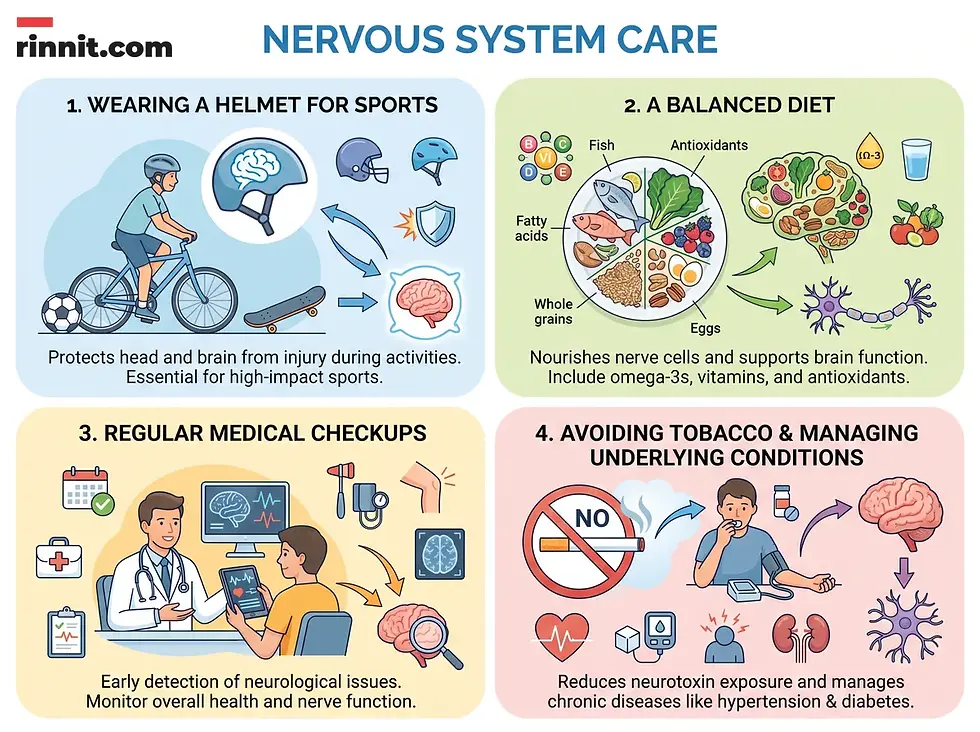
Safety First: Always wear a helmet during sports or high-risk activities to protect your brain from traumatic injury [1] [3].
Healthy Habits: Maintain a balanced diet and avoid tobacco to support the health of your neurons and blood vessels [1].
Monitor Symptoms: Pay close attention to sudden changes in coordination, memory, or sensation, and report them to a doctor [1].
Manage Conditions: Work with healthcare providers to control underlying issues like high blood pressure or diabetes that can damage nerves.
Frequently Asked Questions
What is the nervous system?
The nervous system is the body's command center, made up of the brain, spinal cord, and a vast network of nerves.
What are the two main parts of the nervous system?
The central nervous system (CNS) and the peripheral nervous system (PNS).
What does the central nervous system do?
The central nervous system consists of the brain and spinal cord and acts as the primary control center for the body.
What is the difference between the somatic and autonomic systems?
The somatic system guides voluntary movements, while the autonomic system regulates involuntary ones like breathing.
How many neurons are in the human brain?
There are approximately 86 billion neurons in the human brain.
What are motor neurons?
Motor neurons carry signals from the brain to the muscles to enable movement and function.
What are interneurons?
Interneurons communicate between motor and sensory neurons and play a role in learning and memory.
What are the signs of a stroke?
Common signs include slurred speech, sudden confusion, vision loss, and one-sided muscle weakness.
How can I keep my nervous system healthy?
Eat a balanced diet, avoid tobacco, wear protective gear, and get regular medical checkups.
When should I call a doctor about my nerves?
Seek medical attention for sudden numbness, tremors, vision changes, or problems with coordination.
Related Reading
Peripheral Nervous System: Parts, Functions, Symptoms, Tests and Care explains the nerves outside the brain and spinal cord and their disorders.
Understanding the Spinal Cord: Anatomy, Function, and Care describes how the spinal cord carries signals and how to protect it.
Peripheral Neuropathy: Symptoms, Causes, and Treatment Options Explained explains nerve damage that causes numbness, tingling and pain.
What Is Multiple Sclerosis? A Plain-Language Guide to Symptoms, Types, and How It's Treated explains how MS damages nerve coverings and how it is treated.
References
Cleveland Clinic. Nervous System. Cleveland Clinic. Last updated November 16, 2023. https://my.clevelandclinic.org/health/body/21202-nervous-system
Chen X, Zhao X, Xu F, et al. A systematic review and meta-analysis comparing FAST and BEFAST in acute stroke patients. Frontiers in Neurology. 2022;12:765069. PMID 35153975. https://doi.org/10.3389/fneur.2021.765069
Urréchaga EM, Kodadek LM, Bugaev N, et al. Full-face motorcycle helmets to reduce injury and death: a systematic review, meta-analysis, and practice management guideline from the Eastern Association for the Surgery of Trauma. American Journal of Surgery. 2022;224(5):1238-1246. PMID 35821175. https://doi.org/10.1016/j.amjsurg.2022.06.018
Ettehad D, Emdin CA, Kiran A, et al. Blood pressure lowering for prevention of cardiovascular disease and death: a systematic review and meta-analysis. The Lancet. 2016;387(10022):957-967. PMID 26724178. https://doi.org/10.1016/S0140-6736(15)01225-8
Medical disclaimer
The information provided in this article is for educational purposes only and should not be used as a substitute for professional medical advice, diagnosis, or treatment. Always seek the advice of your physician or other qualified health provider with any questions you may have regarding a medical condition.



Comments