Obstructive Sleep Apnea: Symptoms, Causes, and What Actually Helps

Updated: 2 days ago
Medically reviewed by Dr. Baraa Alnahhal, MD · Last reviewed: September 2026
Obstructive Sleep Apnea: Symptoms, Causes, and What Actually Helps
TL;DR: Obstructive sleep apnea (OSA) is the most common sleep-related breathing disorder. People with OSA repeatedly stop and start breathing during sleep because throat muscles relax too much and temporarily block the airway. Loud snoring, witnessed breathing pauses, waking up gasping, and severe daytime sleepiness are the hallmark signs. OSA is usually diagnosed with an overnight sleep study or a home breathing test, and the most proven treatment is a CPAP machine that keeps the airway open with gentle air pressure. Untreated OSA raises the risk of high blood pressure, heart attack, stroke, and driving accidents — but treatment works, and simple steps like sleeping on your side and losing weight can reduce symptoms.
Quick Answer: What You Need to Know About Obstructive Sleep Apnea
What it is: A disorder where throat muscles relax and block the airway during sleep, causing repeated breathing pauses (apneas) that can happen more than five times an hour.
Most common signs: Loud snoring, witnessed pauses in breathing, waking up gasping or choking, and excessive daytime sleepiness.
How it is diagnosed: A doctor evaluates your symptoms and throat, then orders an overnight sleep study (polysomnography) or a home sleep apnea test.
Most proven treatment: Positive airway pressure (PAP) therapy — usually a CPAP machine that delivers continuous air pressure through a mask to keep the airway open.
Other options: Oral appliances, weight-loss programs (including newer FDA-approved weight-loss medications for moderate to severe OSA), and surgery for stubborn cases.
Why treatment matters: Untreated OSA is linked to high blood pressure, heart attack, stroke, irregular heartbeat, memory problems, and a higher risk of car crashes.
Self-care that helps: Lose weight, exercise, avoid alcohol before bed, sleep on your side, and keep nasal passages open.
What Is Obstructive Sleep Apnea?
Obstructive sleep apnea (OSA) is the most common sleep-related breathing disorder. People with OSA repeatedly stop and start breathing while they sleep. Each breathing pause is known as an apnea, and in untreated OSA these pauses can happen many times every hour.
OSA occurs when the muscles in the back of the throat relax too much and block the airway. Unlike other types of sleep apnea, the obstruction is physical — the airway itself closes off. This happens off and on many times during the night, often without the person ever remembering it.
Loud snoring is a common sign. But the condition is easy to miss, because many people are not aware of their interrupted sleep. They only notice the fallout the next day: exhaustion, brain fog, and irritability.

What Does Obstructive Sleep Apnea Feel Like?
Symptoms fall into two groups: what happens at night, and what happens during the day. The nighttime events are often noticed first by a bed partner — the person with OSA may sleep right through them.
| When | Symptom | What It Looks Like | |---|---|---| | At night | Loud snoring | Snoring loud enough to disturb your sleep or others' | | At night | Pauses in breathing | Often noticed by a partner; may include periods of silence | | At night | Waking gasping or choking | Short bursts of breathlessness that correct in 1–2 deep breaths | | At night | Frequent nighttime urination | Needing to get up to urinate often | | During the day | Excessive daytime sleepiness | May fall asleep while working, watching TV, or even driving | | During the day | Waking with dry mouth or sore throat | Common with mouth breathing during sleep | | During the day | Morning headaches | Linked to drops in oxygen and sleep disruption | | During the day | Trouble focusing | Difficulty concentrating and memory concerns | | During the day | Mood changes | Feeling depressed or easily upset | | During the day | High blood pressure | Especially if it takes multiple medicines to manage | | During the day | Decreased interest in sex | A less-recognized but documented symptom |
Not everyone who snores has OSA, and snoring doesn't always indicate something serious. However, you should talk to a healthcare professional if snoring is interrupted by periods of silence, or if you experience regular fatigue, sleepiness, or irritability. Fatigue can also stem from other conditions such as narcolepsy, which are treated differently — which is another reason an evaluation matters.
When Should You See a Doctor?
Make an appointment if you have any of the following:
| Warning Sign | Why It Matters | |---|---| | Snoring loud enough to disturb your sleep or others' | A common first clue of OSA | | Waking up gasping or choking | Direct sign of nighttime breathing pauses | | Pausing in breathing during sleep | Witnessed apneas strongly suggest OSA | | Excessive daytime drowsiness | Raises the risk of falling asleep at work or while driving |
If you feel drowsy during the day, do not drive. People with untreated OSA face a higher risk of motor vehicle accidents. Take rest breaks, and don't drive if a friend or family member says you appear sleepier than you feel.
How Does Obstructive Sleep Apnea Happen?
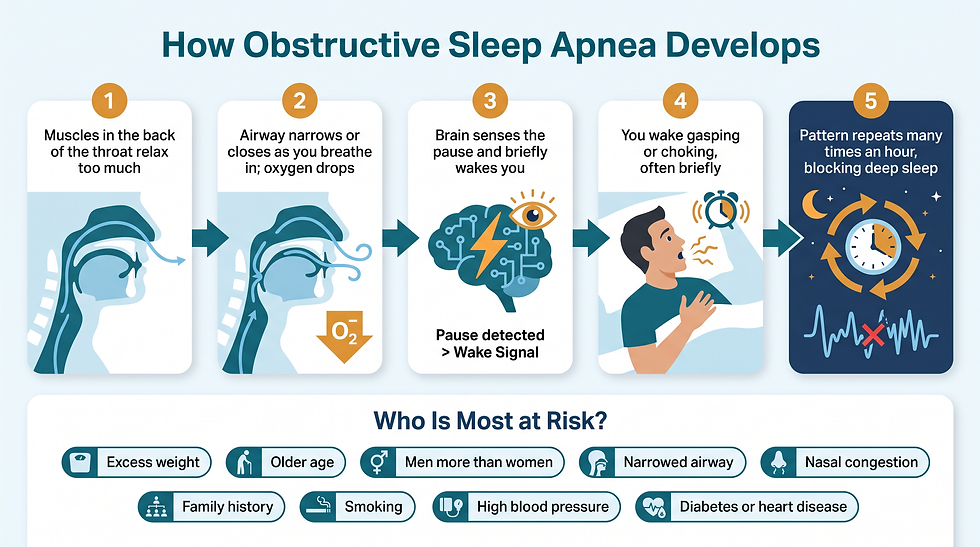
OSA develops through a five-step nightly cycle:
Muscles in the back of the throat relax too much. These muscles normally support the soft palate, tongue, and side walls of the throat.
The airway narrows or closes as you breathe in. Oxygen in the blood drops and carbon dioxide builds up.
The brain senses the pause and briefly wakes you to reopen the airway — usually so briefly that you never remember it.
You may awaken with shortness of breath that corrects itself in one or two deep breaths, or with snorting, choking, or gasping sounds.
The pattern repeats many times an hour — more than five times per hour is the diagnostic threshold — and the disruptions prevent deep, restful sleep, causing daytime sleepiness.
What Raises Your Risk of Obstructive Sleep Apnea?
| Risk Factor | Why It Matters | |---|---| | Excess weight | Fat deposits around the upper airway can obstruct breathing. Most — but not all — people with OSA are overweight. Conditions linked to obesity, such as hypothyroidism and polycystic ovary syndrome (PCOS), can also cause OSA. | | Older age | Risk increases with age, then levels off after the 60s and 70s. | | Male sex | Men are 2–3 times more likely than premenopausal women to develop OSA; risk rises in women after menopause. | | Family history | Sleep apnea tends to run in families. | | Narrowed airway | Enlarged tonsils or adenoids can block the airway; enlarged tonsils are an important risk factor in children. A narrowed airway can also be inherited. | | Chronic nasal congestion | OSA occurs twice as often in people with consistent nighttime nasal congestion, whatever the cause. | | Smoking | People who smoke are more likely to have OSA. | | High blood pressure or heart disease | OSA is associated with high blood pressure, heart attack, stroke, irregular heartbeat, and diabetes. |
Why Untreated Sleep Apnea Is Dangerous
The breathing pauses of OSA are not just a sleep problem. Each pause drops blood oxygen and strains the cardiovascular system, and the cumulative effects touch nearly every part of daily life.
| Complication | How OSA Causes It | |---|---| | Fatigue and trouble concentrating | Severe drowsiness, irritability, memory concerns, and poor school or work performance; higher risk of fatal work and motor vehicle accidents | | Heart and blood vessel problems | Sudden oxygen drops raise blood pressure and increase the risk of coronary artery disease, heart attack, heart failure, and stroke; repeated arrhythmias (irregular heartbeats) with underlying heart disease could lead to sudden death | | Complications with medicines and surgery | Sedatives, some painkillers, and general anesthetics make breathing harder; major surgery can worsen breathing issues, especially when sedated lying on the back | | Eye conditions | A connection has been found with glaucoma; it is usually treatable | | Sleep-deprived partners | Loud snoring disrupts relationships; partners may end up sleeping in another room | | Severe COVID-19 | OSA might be a risk factor for severe COVID-19 and hospitalization |
Before any surgery: tell your surgeon if you have OSA or symptoms of OSA. You may need testing before surgery, since anesthetics and lying on your back can make breathing harder.
How Is Obstructive Sleep Apnea Diagnosed?
Diagnosis starts with your symptoms and a physical exam — the doctor looks at the back of your throat, mouth, and nose, and measures neck and waist circumference and blood pressure. You may be referred to a sleep specialist, a doctor who diagnoses and determines the severity of the disorder and plans treatment.
| Diagnostic Step | What Happens | |---|---| | Symptom review | Your doctor asks about snoring, daytime sleepiness, and witness accounts | | Physical exam | Throat, mouth, and nose examined; neck and waist measured; blood pressure checked | | Polysomnography (sleep study) | Overnight equipment monitors heart, lung, and brain activity, breathing patterns, arm and leg movements, and blood oxygen levels. In a split-night study, you are monitored for the first half of the night; if OSA is confirmed, you are woken and fitted with a CPAP for the second half. | | Home sleep apnea testing | A simplified at-home version under certain circumstances; monitors a limited number of variables to detect breathing pauses |
A sleep study can also look for other disorders that cause daytime sleepiness, such as periodic limb movement disorder or narcolepsy.

What Is the Best Treatment for Sleep Apnea?
The most studied and recommended treatment is positive airway pressure (PAP) therapy, which delivers pressurized air to keep the airway open during sleep. The right plan depends on severity, your anatomy, and your lifestyle.
| Treatment | How It Works | Best For | |---|---|---| | CPAP machine | Delivers continuous constant air pressure — just enough to keep the upper airway passages open — through a mask over the nose or nose and mouth | First-line treatment; reduces breathing stoppages and daytime sleepiness, improves quality of life | | APAP machine | Air pressure varies automatically as the device senses changes in airway resistance (such as snoring) | When the ideal fixed pressure is hard to identify, common with home testing; evidence suggests results equivalent to CPAP | | BPAP machine | Preset pressure when breathing in, a different preset when breathing out | Less commonly used | | Oral appliance (mouthpiece) | Keeps the throat open by bringing the lower jaw forward or holding the tongue in a different position | Mild to moderate OSA, or severe OSA when CPAP cannot be used; see a dentist experienced in dental sleep medicine | | Tongue electrical stimulation device | A small implanted device stimulates the tongue to keep the airway open | Very mild sleep apnea and snoring in small studies; not a replacement for CPAP in moderate to severe OSA; not for people with a pacemaker or implanted electrical device |
Choosing the Right CPAP Mask
Modern machines are smaller and quieter than earlier models, and mask designs vary widely. Contact your healthcare team if you have trouble tolerating the pressure, are still snoring or sleepy despite treatment, start snoring again, or your weight changes by 10% or more.
| Mask Style | Good If You... | |---|---| | Nasal pillow mask (fits at the nostrils) | Feel claustrophobic in bigger masks, want full vision, wear glasses, or have facial hair | | Nasal mask (covers the nose) | Were prescribed higher air pressure, or move around a lot in sleep | | Full-face mask (covers nose and mouth) | Have nasal obstruction or congestion, or breathe through your mouth despite a month of nasal mask use with heated humidity and a chin strap |
Surgery and Procedures
Surgery is considered only if other therapies are not effective or don't fit your lifestyle.
| Procedure | What It Involves | |---|---| | Surgical tissue removal (UPPP) | Removes tissue from the back of the mouth and top of the throat (tonsils and adenoids may also be removed); corrects anatomic obstructions so the airway stays open | | Nerve stimulation implant (hypoglossal nerve stimulator) | An impulse generator implanted under the skin of the upper chest stimulates the nerve controlling tongue movement; the tongue moves forward instead of blocking the throat; approved for moderate to severe OSA in people who can't tolerate CPAP/BPAP | | Jaw surgery (maxillomandibular advancement) | Moves the upper and lower jaw forward, enlarging the space behind the tongue and soft palate | | Tracheostomy | A tube through an opening in the neck allows air to bypass the blocked throat airway; reserved for life-threatening OSA when other treatments failed | | Other procedures | Nasal surgery to remove polyps or straighten a deviated septum; tonsil or adenoid removal; bariatric surgery to support weight loss in people with obesity |
Weight-Loss Medications
Studies show weight-loss medications can help improve OSA symptoms. The FDA recently approved tirzepatide (sold under two brand names), combined with diet and exercise, for treatment of moderate to severe OSA. Some people may still need OSA treatment after weight loss, although symptoms are usually milder — so keep working with your healthcare professional.
What Can I Do at Home to Improve My Sleep?
| Self-Care Step | Why It Helps | |---|---| | Lose weight | Even moderate weight loss may relieve airway narrowing and reduce daytime sleepiness | | Exercise regularly | Aim for about 150 minutes a week of aerobic and strength training, most days | | Avoid alcohol and certain medicines | Alcohol, some anti-anxiety medicines, and sleeping pills worsen OSA and sleepiness | | Sleep on your side or stomach, not your back | Snoring is loudest and apneas are most common on the back; a tennis ball in the back of a pajama top or special pillows can help | | Keep nasal passages open | Saline nasal spray helps congestion; ask about nasal decongestants or antihistamines (some are safe only short-term) |
Preparing for Your Appointment
Before your visit, keep a sleep diary recording bedtime, hours slept, nighttime awakenings, awake time, your daily routine, naps, and how you feel during the day. Write down your symptoms and when they began, key personal information (recent health concerns, stresses, life changes), and a list of all medicines, vitamins, and supplements with doses — including sleep aids. Bring your bed partner if possible, or gather their observations about your snoring and sleep.
| Questions You Can Ask | Questions Your Doctor May Ask You | |---|---| | What's the most likely cause of my symptoms? | When did you first notice symptoms? Off and on or constant? | | What tests do I need? Do I need to go to a sleep clinic? | Do you snore? Does it disrupt others' sleep? | | What treatments are available, and which do you recommend for me? | Do you snore in all positions, or only on your back? | | I have other health conditions. How can I best manage these together? | Do you snore, snort, gasp, or choke yourself awake? | | | Has anyone seen you stop breathing during sleep? | | | How refreshed do you feel when waking? Tired during the day? | | | Do you wake with a headache or dry mouth? | | | Do you doze off while sitting quietly or driving? Do you nap during the day? | | | Do any family members have sleep disorders? |
Conclusion: Better Sleep Is Worth Pursuing
Obstructive sleep apnea is common, often unnoticed, and genuinely dangerous when left untreated — but it is also highly treatable. The warning signs are easy to recognize once you know them: loud snoring broken by silence, gasping awakenings, and unexplained exhaustion. If they describe your nights, talk to a healthcare professional about a sleep study. Whether your path leads to a CPAP machine, an oral appliance, weight loss, or surgery, treatment consistently restores restful sleep, sharpens daytime focus, and protects your heart.
Don't let poor sleep quietly shape your health. Share this guide with anyone who snores loudly or wakes up tired — then book an evaluation with your doctor and take the first step back to restorative sleep.
Frequently Asked Questions
Is obstructive sleep apnea dangerous?
Yes, when untreated. OSA is the most common sleep-related breathing disorder, and its repeated breathing pauses strain the heart and blood vessels. Untreated OSA is linked to high blood pressure, heart attack, stroke, irregular heartbeat, memory problems, and a higher risk of car and work accidents.
What are the first signs of obstructive sleep apnea?
Loud snoring — especially snoring interrupted by periods of silence — is the most common sign. Other early signs include witnessed pauses in breathing during sleep, waking up gasping or choking, waking with a dry mouth or sore throat, and morning headaches.
Can obstructive sleep apnea go away on its own?
No. OSA typically persists and often worsens over time. However, symptoms can improve substantially with weight loss, positional changes (sleeping on your side), and avoiding alcohol before bed. These self-care steps help but usually don't replace treatment.
Is CPAP the only treatment?
No. While CPAP is the most studied and recommended treatment, options also include APAP and BPAP machines, oral appliances worn like a mouthguard, weight-loss programs including newer FDA-approved weight-loss medications for moderate to severe OSA, and several surgical procedures for cases that don't respond to other therapies.
Does everyone who snores have sleep apnea?
No. Snoring doesn't always indicate something serious, and not everyone who snores has OSA. However, you should talk to a healthcare professional if snoring is loud enough to disturb sleep or is interrupted by periods of silence, or if you also have daytime sleepiness.
How is obstructive sleep apnea diagnosed?
Diagnosis combines a symptom review, physical exam of the throat and airway, and a sleep test — either an overnight sleep study (polysomnography) in a sleep center or a simplified home sleep apnea test that monitors breathing pauses. A sleep specialist determines severity and plans treatment.
Will losing weight cure my sleep apnea?
Weight loss is one of the most effective ways to improve OSA, and even moderate weight loss may relieve airway narrowing. Newer weight-loss medications, including tirzepatide for moderate to severe OSA, have shown symptom improvement in studies. However, some people still need OSA treatment after weight loss, although symptoms are usually milder.
Can children get obstructive sleep apnea?
Yes. In children, enlarged tonsils and adenoids are an important risk factor for a narrowed airway. Untreated OSA in children is associated with poor school performance and attention or behavior problems. Treatment differs from adults and often involves removing enlarged tonsils or adenoids.
References
This guide is based on medical information last reviewed on December 4, 2025. Always consult a healthcare professional for diagnosis and treatment decisions.
Health information, not medical advice. This article is for general education and is not a substitute for professional diagnosis or treatment. Always consult a qualified healthcare provider about your own health, and seek emergency care for urgent symptoms.
Comments