Epworth Sleepiness Scale (ESS): Questions, Scoring and What Your Score Means

Updated: 2 days ago
Written and medically reviewed by Dr. Baraa Alnahhal, MD · Last reviewed: November 2026 · How we review
Quick Answer: What is the Epworth Sleepiness Scale?
The Epworth Sleepiness Scale (ESS) is a short self-assessment that measures how likely you are to doze off during the day. You rate eight everyday situations from 0 to 3, for a total of 0 to 24. A score of 0 to 10 is normal, while 11 or higher suggests excessive daytime sleepiness that may need more testing. [1]
What the research says
ESS scores separate people with sleep disorders from healthy sleepers. In the original study of 180 adults, total scores distinguished healthy people from patients with obstructive sleep apnea, narcolepsy and idiopathic hypersomnia, and higher scores matched shorter sleep latency on sleep testing. (Johns, Sleep, 1991) [2]
The ESS is consistent, but works best alongside other tests. A review of 35 studies found good internal consistency (Cronbach's alpha 0.73 to 0.86) but only weak to moderate links with objective sleep tests, so it suits group comparisons better than single-person decisions. (Kendzerska et al., Sleep Medicine Reviews, 2014) [3]
Key takeaways
The ESS asks how likely you are to doze off in eight common situations. [1]
Each answer is scored 0 to 3, for a total of 0 to 24. [1]
Scores of 0 to 10 are normal; 11 or higher suggests excessive daytime sleepiness. [1]
It takes a few minutes and is often done before a sleep study. [1]
It doesn't diagnose a sleep disorder, but it helps decide whether you need more testing. [1]
What is the Epworth Sleepiness Scale?
The Epworth Sleepiness Scale (ESS) is a short self-assessment that shows how likely you are to fall asleep during the daytime. Its eight questions focus on common situations that may make you sleepy enough to doze off. [1]
The ESS isn't a diagnostic test for sleep disorders. It helps your provider learn more about daytime sleepiness and whether it gets in the way of your routine tasks. [1]
When is the Epworth Sleepiness Scale used?
A healthcare provider may use it to: [1]
See how daytime sleepiness affects you
Measure how your sleepiness changes before and after a medicine or treatment
Decide whether you need more tests for a condition that affects sleep, such as sleep apnea or narcolepsy
You'll usually fill it out before an appointment, often before a sleep study. [1]
How does the test work?
The self-assessment takes only a few minutes. You read each question and answer with a number from 0 to 3, as best you can. It doesn't ask for any other details about your sleepiness. When you finish, your provider adds up your answers to get your score. [1]
What are the eight situations on the Epworth Sleepiness Scale?
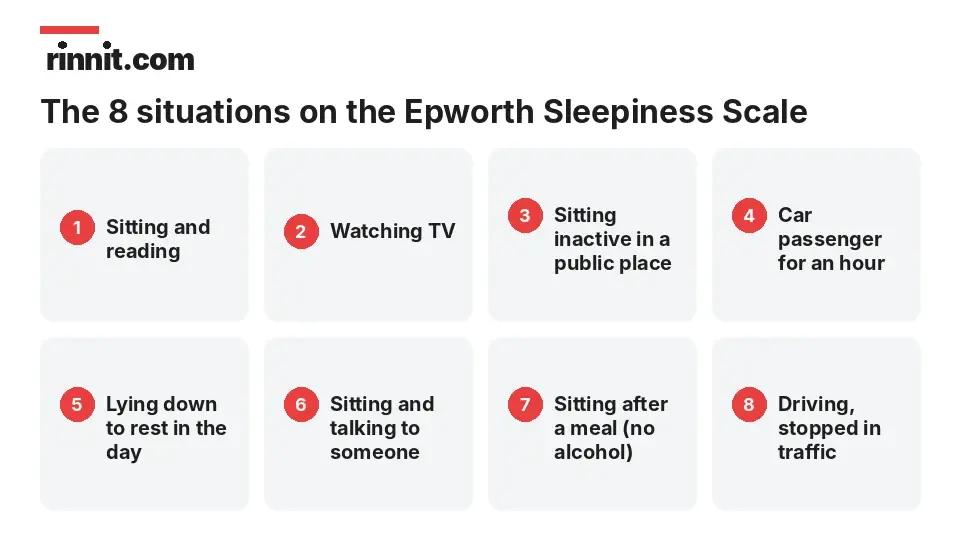
You rate your chance of dozing off in each situation from 0 to 3.
You rate your chance of falling asleep in each of these situations: [1]
Sitting and reading
Watching TV
Sitting inactive in a public place, such as a meeting or dinner event
Riding as a passenger in a car for an hour without a break
Lying down to rest during the day
Sitting and talking to another person
Sitting after a meal (without alcohol)
Driving a car while stopped in traffic for a few minutes
How is the Epworth Sleepiness Scale scored?
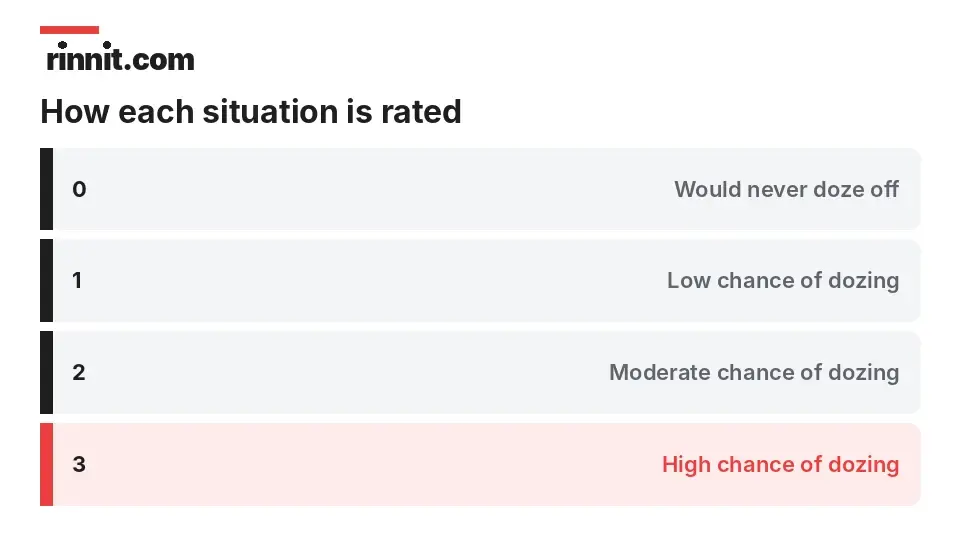
Your eight answers add up to a total from 0 to 24.
Each situation gets a score on a four-point scale, from 0 (no chance of falling asleep) to 3 (high chance of falling asleep). Your eight answers add up to a total score between 0 and 24. [1]
What do Epworth Sleepiness Scale scores mean?

A score of 11 or more suggests excessive daytime sleepiness.
Total score | What it means |
0 to 5 | Low daytime sleepiness (normal) |
6 to 10 | Higher daytime sleepiness (normal) |
11 to 12 | Mild excessive daytime sleepiness |
13 to 15 | Moderate excessive daytime sleepiness |
16 to 24 | Severe excessive daytime sleepiness |
Sources: [1]
A score of 10 or less is in the normal range. A low score may not be a concern, though it doesn't rule out trouble sleeping at night, such as insomnia. [1]
A score of 11 or higher points to excessive daytime sleepiness. This may be a side effect of a medicine or the result of a health condition. [1]
You'll know your score right away, and your provider will explain what it means. [1]
What happens if your score is high?
If you score 11 or higher, you may need to change your sleep habits at night. Your provider may recommend more tests to see whether a medical or psychiatric condition, a substance or medicine, or a primary sleep disorder is affecting your ability to stay awake. [1]
Excessive daytime sleepiness is a symptom, not a disease. Testing helps find the cause. [1]
When should you call your provider?
Contact a provider if you feel sleepy during the day and can't stay awake during routine activities. [1]
Conclusion
The Epworth Sleepiness Scale is a quick starting point for understanding how daytime sleepiness affects your life. It doesn't diagnose a sleep disorder, but a high score tells your provider that more testing may help. [1]
If you have trouble staying awake during the day, talk to a provider. Medicines and health conditions can disrupt your sleep, and treatment can help. [1]
Keep learning: Read our obstructive sleep apnea guide or our narcolepsy guide. For more background, see the official Epworth Sleepiness Scale page.
FAQ
What is the Epworth Sleepiness Scale?
An eight-question self-assessment that measures how likely you are to doze off during the day.
How is the Epworth Sleepiness Scale scored?
Each of eight situations is rated 0 to 3, for a total of 0 to 24.
What is a normal Epworth score?
0 to 10 is normal.
What Epworth score is concerning?
11 or higher suggests excessive daytime sleepiness.
What does a score of 16 or more mean?
Severe excessive daytime sleepiness.
Can the Epworth Sleepiness Scale diagnose sleep apnea?
No. It isn't a diagnostic test, but a high score may lead to a sleep study.
How long does the Epworth Sleepiness Scale take?
Only a few minutes.
What situations does the ESS ask about?
Reading, watching TV, sitting in public, riding in a car, resting, talking, sitting after a meal and stopping in traffic.
What happens if my Epworth score is high?
Your provider may suggest better sleep habits and tests to find the cause.
When should I see a provider about daytime sleepiness?
If you can't stay awake during routine activities.
Related Reading
Obstructive Sleep Apnea: Symptoms, Causes, and What Actually Helps explains a common cause of daytime sleepiness.
Narcolepsy: Symptoms, Types, Causes, Diagnosis & Treatment covers a sleep disorder that causes severe sleepiness.
Hypersomnia: Symptoms, Causes, and Treatment explains excessive sleepiness despite enough sleep.
What Is Restless Legs Syndrome? describes a condition that can disrupt sleep and cause daytime tiredness.
Multiple Sleep Latency Test (MSLT): How It Diagnoses Narcolepsy and What to Expect explains the daytime nap test used to diagnose narcolepsy and hypersomnia.
References
Cleveland Clinic. Epworth Sleepiness Scale (ESS): What It Is & Results. Cleveland Clinic. Last updated November 6, 2023. https://my.clevelandclinic.org/health/diagnostics/epworth-sleepiness-scale-ess
Johns MW. A new method for measuring daytime sleepiness: the Epworth sleepiness scale. Sleep. 1991;14(6):540-545. PMID 1798888. https://doi.org/10.1093/sleep/14.6.540
Kendzerska TB, Smith PM, Brignardello-Petersen R, et al. Evaluation of the measurement properties of the Epworth sleepiness scale: a systematic review. Sleep Med Rev. 2014;18(4):321-331. PMID 24135493. https://doi.org/10.1016/j.smrv.2013.08.002
Medical disclaimer
This article is for general education only and does not replace advice from a qualified healthcare professional. Talk to your doctor about your own diagnosis and treatment, and seek emergency care right away for severe or sudden symptoms.



Comments