Multiple Sleep Latency Test (MSLT): How It Diagnoses Narcolepsy and What to Expect

Updated: 2 days ago
Written and medically reviewed by Dr. Baraa Alnahhal, MD · Last reviewed: November 2026 · How we review
Quick Answer
The multiple sleep latency test (MSLT) measures how quickly you fall asleep during a series of daytime naps and whether you enter REM sleep early. It's the main test for narcolepsy and idiopathic hypersomnia. It's always done the day after an overnight sleep study. You take up to five 20-minute naps, two hours apart.
What the research says
MSLT results can change on repeat testing: in 36 people with narcolepsy without cataplexy or idiopathic hypersomnia who had two MSLTs years apart, the diagnosis changed in 53%, mainly because of differences in sleep latency or the number of REM naps, so results should be interpreted alongside symptoms (Trotti LM et al., Journal of Clinical Sleep Medicine, 2013) [2]
The MSLT is highly accurate for narcolepsy type 1 in children: in 357 children evaluated for narcolepsy, a mean sleep latency of 8.2 minutes or less, or at least two REM naps, identified those with low hypocretin, the cause of narcolepsy type 1, with near-perfect accuracy (Pizza F et al., Neurology, 2019) [3]
Key takeaways
Measures how fast you fall asleep in daytime naps and whether REM sleep comes early.
Used to diagnose narcolepsy and hypersomnia.
Always follows an overnight sleep study.
Up to five 20-minute naps, two hours apart; you go home after the last nap.
Preparation takes weeks: regular sleep, a sleep diary and often a sleep-tracking watch.
What is sleep latency?
Sleep latency is the time it takes to fall asleep. Most people take more than 10 minutes to fall asleep during the day and reach REM sleep about 90 minutes after falling asleep. People with narcolepsy fall asleep very quickly and often enter REM sleep within minutes, called a sleep-onset REM period (SOREMP). Sources: [1]
Why is it done?
To diagnose narcolepsy, including narcolepsy in children.
To diagnose hypersomnia, including idiopathic hypersomnia.
When severe daytime sleepiness has lasted months and interferes with work, school or driving. Sources: [1]
Before ordering the test, providers often ask you to complete the Epworth Sleepiness Scale. The overnight sleep study beforehand checks that you slept enough and rules out other causes of sleepiness, such as obstructive sleep apnea. Sources: [1]
How do I prepare?
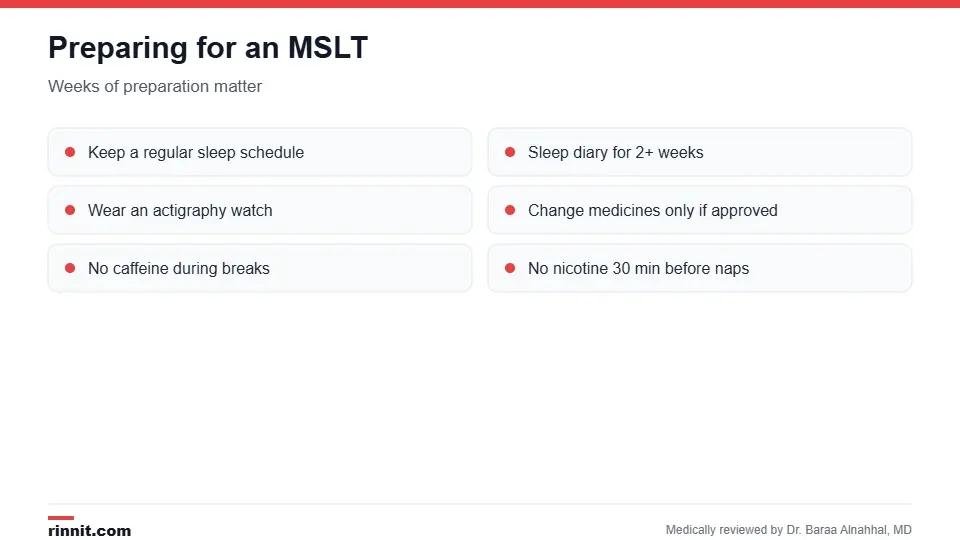
Good preparation makes the results reliable.
Keep a regular sleep schedule for several weeks before the test.
Keep a sleep diary for at least two weeks.
Wear an actigraphy device, a watch that tracks sleep and activity, if asked.
Don't stop or change medicines unless your provider tells you to; some, such as stimulants and antidepressants, may need to be stopped beforehand under supervision.
You may have a urine drug screen on the day of the test.
Avoid caffeine during the test day, and stop nicotine at least 30 minutes before each nap. Sources: [1]
What happens during the test?
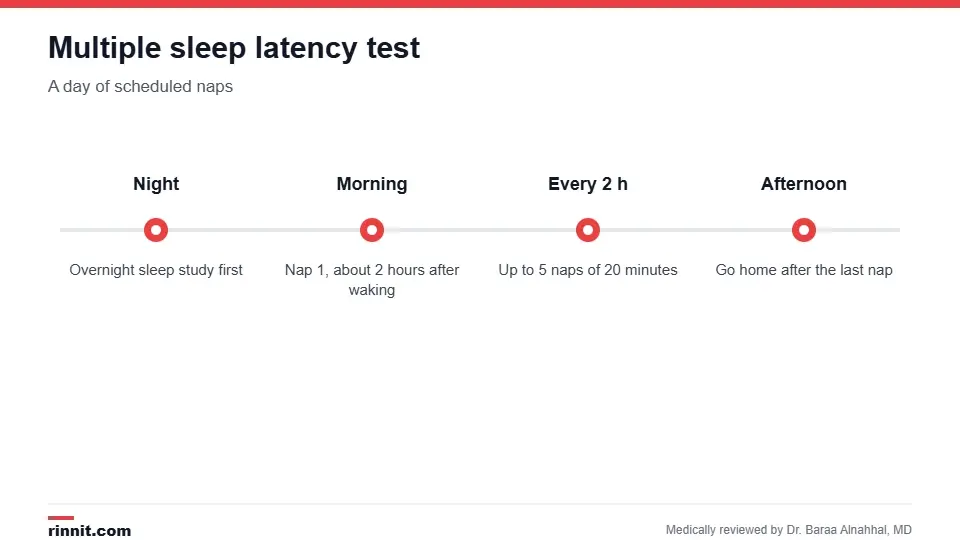
The MSLT takes most of the day.
The morning after your overnight sleep study, sensors on your scalp, face and chin record your brain waves, eye movements and muscle activity.
About 1.5–3 hours after you wake, you lie down in a dark, quiet room and try to fall asleep.
Each nap lasts up to 20 minutes; if you fall asleep, you're allowed to sleep for a set time to see whether REM sleep appears.
Between naps, you stay awake for two hours.
The process repeats for up to five naps. You go home after the last nap. Sources: [1]
What do the results mean?

The average time to fall asleep across naps is key.
Finding | What it may mean |
Mean sleep latency under 8 minutes and REM in 2 or more naps | Narcolepsy |
Mean sleep latency under 8 minutes and REM in fewer than 2 naps | Hypersomnia |
Mean sleep latency around 10–20 minutes | Typical daytime alertness |
Sources: [1, 3]
The MSLT is reliable for diagnosing narcolepsy, especially type 1, but results can vary between tests, particularly for narcolepsy type 2 and idiopathic hypersomnia. That's why providers combine them with your symptoms, the overnight study and sometimes other tests. You'll usually review the results at a follow-up visit a few days later. Sources: [1, 2]
Risks
The MSLT is safe and noninvasive. The sensor paste may irritate the skin slightly. Sources: [1]
Conclusion
The MSLT turns daytime sleepiness into measurable data, making it the key test for narcolepsy and hypersomnia. Careful preparation, especially a regular sleep schedule and supervised medicine changes, helps make your results accurate.
Keep learning: read about narcolepsy and the sleep study.
Frequently asked questions
What does the MSLT measure?
How fast you fall asleep during the day and whether you enter REM sleep early.
Why is the MSLT done after a sleep study?
To make sure you slept enough the night before and to rule out other sleep disorders.
How many naps are in an MSLT?
Up to five, each up to 20 minutes, two hours apart.
What MSLT result means narcolepsy?
Falling asleep in under 8 minutes on average with REM sleep in at least two naps.
How long does the MSLT take?
Most of the day after your overnight study.
Can I drink coffee during the MSLT?
No. Avoid caffeine on the test day.
Do I need to stop my medicines?
Only if your provider tells you to; some medicines affect results.
Is the MSLT accurate?
It's reliable for narcolepsy, but results can vary between tests.
What if I can't fall asleep during a nap?
That's fine; the nap is recorded as 20 minutes.
Is the MSLT safe?
Yes. It's painless and noninvasive.
Related Reading
Narcolepsy: Symptoms, Types, Causes, Diagnosis & Treatment — Complete Guide the sleep disorder the MSLT diagnoses.
Hypersomnia: Symptoms, Causes, and Treatment excessive sleepiness that the MSLT evaluates.
Sleep Study (Polysomnography): What It Tests, What to Expect and Results the overnight study done before the MSLT.
Epworth Sleepiness Scale (ESS): Questions, Scoring and What Your Score Means the questionnaire used to rate daytime sleepiness.
What Is Narcolepsy in Children? how narcolepsy shows up in kids.
References
Cleveland Clinic. Multiple Sleep Latency Test (MSLT): What It Is & Procedure. Cleveland Clinic. Last updated July 23, 2024. https://my.clevelandclinic.org/health/diagnostics/multiple-sleep-latency-test-mslt
Trotti LM, Staab BA, Rye DB. Test-retest reliability of the multiple sleep latency test in narcolepsy without cataplexy and idiopathic hypersomnia. J Clin Sleep Med. 2013;9(8):789-795. PMID 23946709. https://doi.org/10.5664/jcsm.2922
Pizza F, Barateau L, Jaussent I, et al. Validation of multiple sleep latency test for the diagnosis of pediatric narcolepsy type 1. Neurology. 2019;93(11):e1034-e1044. PMID 31405906. https://doi.org/10.1212/WNL.0000000000008094
Medical disclaimer
This article is for general education only and does not replace advice from a qualified healthcare professional. Talk to your doctor about your own diagnosis and treatment, and seek emergency care right away for severe or sudden symptoms.



Comments