Sleep Study (Polysomnography): What It Tests, What to Expect and Results

Updated: 2 days ago
Written and medically reviewed by Dr. Baraa Alnahhal, MD · Last reviewed: November 2026 · How we review
Quick Answer: What is a sleep study?
A sleep study, or polysomnogram, is a painless overnight test that records several body systems while you sleep, including brain waves, eye and muscle movements, heart rhythm, breathing and blood oxygen. It helps diagnose sleep disorders such as obstructive sleep apnea, narcolepsy, restless legs and insomnia. Most studies take one night in a sleep lab. [1]
What the research says
An in-lab sleep study remains the standard test for sleep apnea. American Academy of Sleep Medicine guidance names polysomnography the standard diagnostic test for obstructive sleep apnea in adults and recommends it over home testing for people with significant heart or lung disease, neuromuscular weakness, chronic opioid use, a history of stroke or severe insomnia. (Kapur et al., Journal of Clinical Sleep Medicine, 2017) [2]
Sleep apnea is extremely common worldwide. An analysis based on 17 studies from 16 countries estimated that about 936 million adults aged 30 to 69 have mild to severe obstructive sleep apnea (an apnea-hypopnea index of 5 or more events per hour), and about 425 million have moderate to severe disease (15 or more events per hour). (Benjafield et al., The Lancet Respiratory Medicine, 2019) [3]
Key takeaways
A sleep study records your brain, heart, breathing, oxygen and movements during sleep. [1]
It is painless and usually takes one night. [1]
Avoid caffeine and alcohol for at least 8 hours beforehand, and do not nap on the day of the study. [1]
At-home sleep apnea tests use fewer sensors and are mainly for strongly suspected sleep apnea. [1]
A sleep specialist interprets the results and explains next steps, usually within a few days. [1]
What is a sleep study?
A sleep study (polysomnogram) tracks several of your body systems, such as brain activity, heart rhythm and breathing, while you sleep. It is usually scheduled during your normal sleep hours, though labs can arrange daytime studies for people who sleep during the day, such as night-shift workers. [1]
A pulmonologist or sleep medicine specialist usually recommends the test based on your symptoms and health history. Sleep studies are very common: in 2014, people on Medicare alone had more than 800,000 of them. [1]
What does a sleep study diagnose?
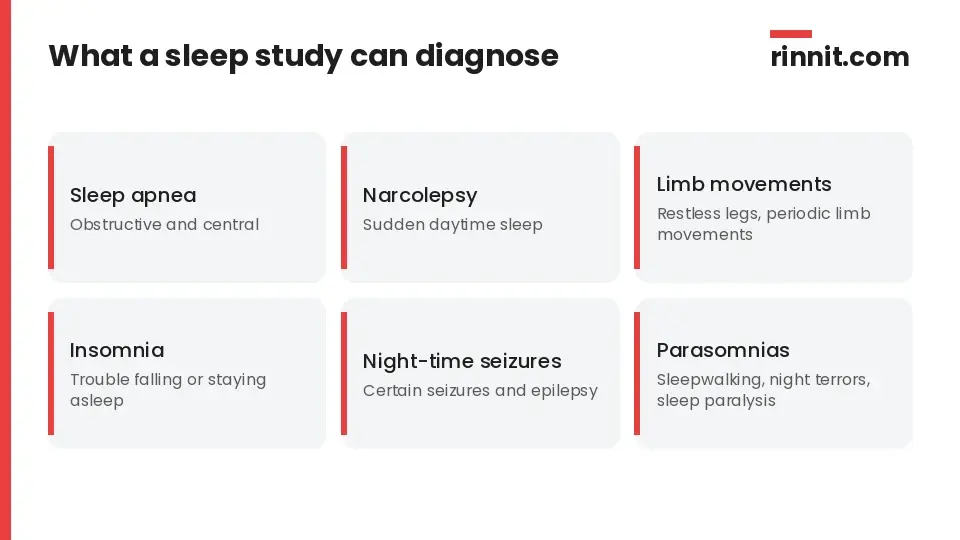
Sleep studies help diagnose many sleep disorders.
A sleep study can help diagnose: [1]
Obstructive and central sleep apnea
Narcolepsy
Periodic limb movement disorder, including restless legs syndrome
Insomnia
Certain seizures and epilepsy
Night terrors, nocturnal panic attacks and sleepwalking
Sleep paralysis and other parasomnias or sleep behavior disorders
What does a sleep study measure?
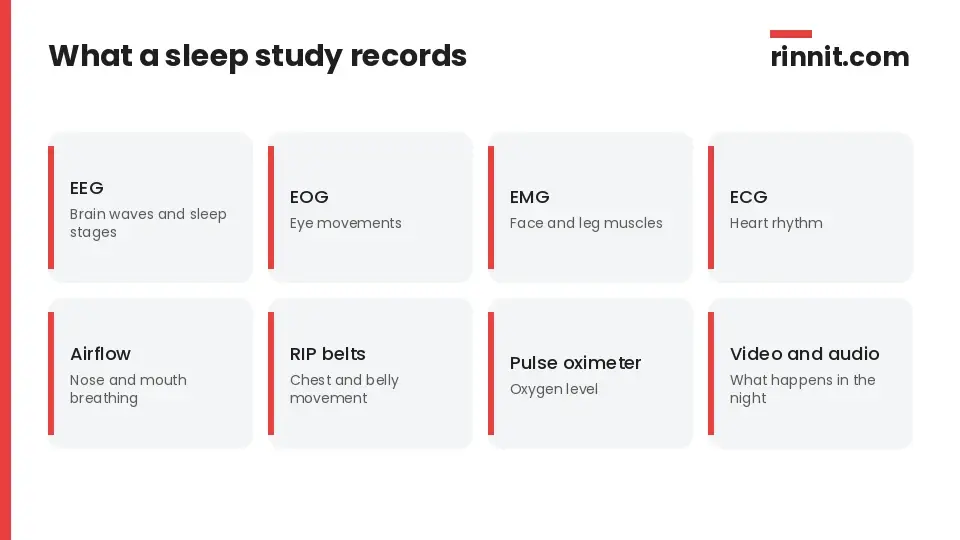
Each sensor tracks a different part of your sleep.
Each sensor tracks a different part of how you sleep. [1]
Sensor | What it records |
EEG (electroencephalogram) | Brain waves, which change with each stage of sleep |
EOG (electrooculogram) | Eye movements, using sensors around each eye |
EMG (electromyogram) | Muscle movement, usually on your face and a leg |
ECG/EKG (electrocardiogram) | Your heart's rhythm and electrical activity |
Airflow sensors | Air moving through your nose and mouth |
RIP belts | Your chest and belly rising and falling as you breathe |
Pulse oximeter | Your pulse and blood oxygen level from a fingertip sensor |
Low-light video and audio | What you do and sound like while you sleep |
Sources: [1]
What is an at-home sleep apnea test?
A home sleep apnea test uses fewer sensors. It skips the brain wave, eye movement and heart sensors and tracks your breathing airflow and chest and belly movement instead. It is generally used when sleep apnea is strongly suspected or for follow-up testing. [1]
How do you prepare for a sleep study?
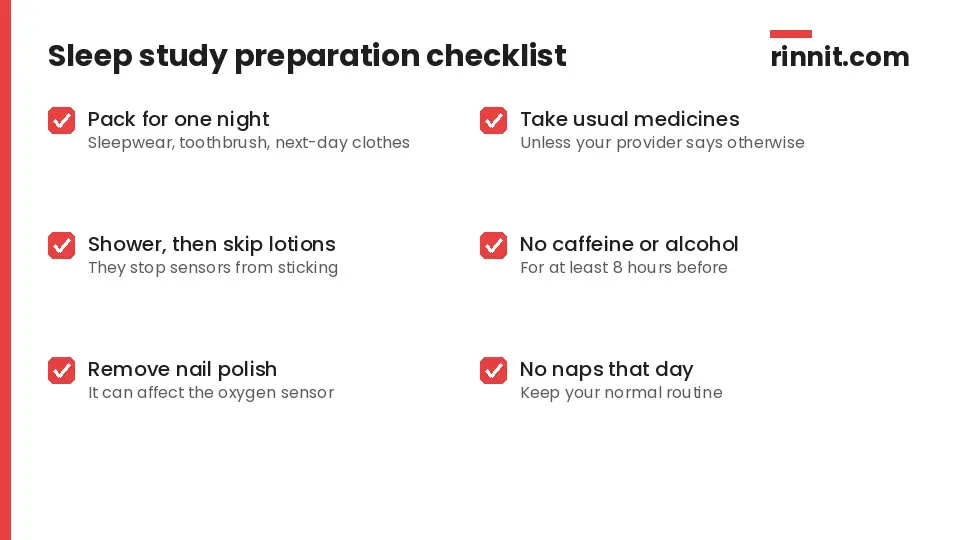
Keeping your normal routine gives the most accurate results.
Pack as you would for a hotel stay: sleepwear, a toothbrush, clothes for the next day and makeup remover if needed
Shower beforehand, then skip creams, lotions and hair products, which can stop sensors from sticking
Remove nail polish and artificial nails, which can affect the oxygen sensor
Take your usual medicines unless your provider tells you otherwise, because some should not be stopped suddenly
Tell your provider if you are allergic to adhesives
On the day of the study, keep your usual routine, avoid caffeine and alcohol for at least 8 hours and do not nap
Sources: [1]
What happens during a sleep study?
Staff show you to a private room, where you change into sleepwear and they attach the sensors with adhesive or tape. They test the sensors by asking you to move your eyes, open and close your mouth and move your legs. The wires are long enough for you to move in bed. [1]
You can read or watch TV before you fall asleep. Most people do not sleep as well in a new place, but this usually does not affect the results. Staff may come in if a sensor comes loose or if there is a serious problem, such as a seizure, and you can get up to use the bathroom. [1]
How long does a sleep study take?
It usually takes one night, and the study counts if you sleep for two hours or more in total. Some people need more than one night. [1]
Does a sleep study hurt?
No. Removing the sensors in the morning may cause mild discomfort. [1]
Are there risks?
Side effects are rare. The most likely are skin irritation or an allergic reaction to the adhesive, and poorer sleep in an unfamiliar room. [1]
What do sleep study results mean?
A trained specialist, such as a pulmonologist or sleep medicine physician, reviews the many types of data your study collected. They decide whether you have a sleep disorder, contact you to explain what they found and recommend next steps, often at a follow-up visit where you discuss treatment options. You should usually hear from your provider within a few days, though timing varies by facility. [1]
For sleep apnea, results are often summarized as the apnea-hypopnea index (AHI), the number of breathing pauses and shallow breaths per hour of sleep. Research definitions treat 5 or more events per hour as mild to severe sleep apnea and 15 or more as moderate to severe. [3]
Conclusion
A sleep study gives a detailed, objective picture of what happens to your body while you sleep, which is often the only way to find the cause of loud snoring, daytime sleepiness or unusual night-time behaviors. It is painless, and preparing well helps the results reflect your normal sleep.
If you have symptoms of a sleep disorder, ask your provider whether an in-lab study or a home test fits you best.
Keep learning: Read our guide to obstructive sleep apnea or our guide to narcolepsy. For more background, see the MedlinePlus page on polysomnography.
FAQ
What is a sleep study?
A painless overnight test that records your brain, heart, breathing, oxygen and movements while you sleep. [1]
What does a sleep study diagnose?
Sleep apnea, narcolepsy, restless legs and periodic limb movements, insomnia, certain seizures and parasomnias such as sleepwalking. [1]
How long does a sleep study take?
Usually one night; it counts if you sleep two hours or more. [1]
How should I prepare for a sleep study?
Shower, skip lotions and nail polish, avoid caffeine and alcohol for 8 hours, don't nap and keep your normal routine. [1]
Can I take my medicines before a sleep study?
Usually yes, unless your provider tells you otherwise. [1]
Does a sleep study hurt?
No; removing the sensors may cause mild discomfort. [1]
What if I can't sleep during the study?
Most people sleep less well in a new place, but this usually does not affect the results. [1]
Can I use the bathroom during a sleep study?
Yes; staff will tell you whether you need help. [1]
What is a home sleep apnea test?
A simpler test with fewer sensors that tracks your breathing, used mainly when sleep apnea is strongly suspected. [1]
When will I get my sleep study results?
Usually within a few days, often discussed at a follow-up visit. [1]
Related Reading
CPAP Machine: How It Works, Masks and Side Effects explains how CPAP machines treat sleep apnea.
Obstructive Sleep Apnea: Symptoms, Causes, and What Actually Helps explains the most common condition a sleep study diagnoses.
Obstructive Sleep Apnea in Children Comprehensive Guide: Symptoms, Treatment, and Long-Term Health covers sleep apnea testing and care in children.
Narcolepsy: Symptoms, Types, Causes, Diagnosis & Treatment — Complete Guide describes a sleep disorder that needs sleep testing to confirm.
What Is Restless Legs Syndrome? A Plain-Language Guide to the Urge to Move Your Legs at Night covers a movement disorder a sleep study can evaluate.
What Is REM Sleep Behavior Disorder? A Plain-Language Guide to Acting Out Your Dreams, Causes, and Treatment explains a parasomnia diagnosed with polysomnography.
Multiple Sleep Latency Test (MSLT): How It Diagnoses Narcolepsy and What to Expect explains the daytime nap test used to diagnose narcolepsy and hypersomnia.
References
Cleveland Clinic. Sleep Study: What It Is, What To Expect, Types & Results. Cleveland Clinic. Last updated February 10, 2023. https://my.clevelandclinic.org/health/diagnostics/12131-sleep-study-polysomnography
Kapur VK, Auckley DH, Chowdhuri S, et al. Clinical Practice Guideline for Diagnostic Testing for Adult Obstructive Sleep Apnea: An American Academy of Sleep Medicine Clinical Practice Guideline. J Clin Sleep Med. 2017;13(3):479-504. PMID 28162150. https://doi.org/10.5664/jcsm.6506
Benjafield AV, Ayas NT, Eastwood PR, et al. Estimation of the global prevalence and burden of obstructive sleep apnoea: a literature-based analysis. Lancet Respir Med. 2019;7(8):687-698. PMID 31300334. https://doi.org/10.1016/S2213-2600(19)30198-5
Medical disclaimer
This article is for general education only and does not replace advice from a qualified healthcare professional. Talk to your doctor about your own diagnosis and treatment, and seek emergency care right away for severe or sudden symptoms.



Comments