CPAP Machine: How It Works, Masks and Side Effects

Updated: 2 days ago
Written and medically reviewed by Dr. Baraa Alnahhal, MD · Last reviewed: November 2026 · How we review
Quick Answer
A CPAP machine (continuous positive airway pressure) treats obstructive sleep apnea by blowing a steady stream of air through a mask while you sleep. The gentle pressure keeps the airway from collapsing. It's often the first treatment for sleep apnea and is very effective when used every night. Benefits include better sleep, less snoring and less daytime sleepiness.
What the research says
CPAP improves sleepiness and quality of life: in the SAVE trial of 2,717 adults with sleep apnea and heart or blood vessel disease, CPAP used about 3 hours a night didn't prevent heart events over about 4 years but reduced snoring and daytime sleepiness and improved mood and quality of life (McEvoy RD et al., New England Journal of Medicine, 2016) [2]
CPAP lowered hard-to-control blood pressure: in the HIPARCO trial of 194 people with sleep apnea and resistant high blood pressure, 12 weeks of CPAP lowered 24-hour blood pressure, with bigger drops in those who used it more hours (Martínez-García MA et al., JAMA, 2013) [3]
Key takeaways
CPAP keeps your airway open with steady air pressure while you sleep.
It's often the first treatment for obstructive sleep apnea.
It works best when used every night, including naps and travel.
Benefits include better sleep, less snoring and lower blood pressure.
A heated humidifier and the right mask ease most side effects.
What is a CPAP machine?
In obstructive sleep apnea, the tongue, soft palate and uvula relax and block your airway during sleep, causing pauses in breathing. A CPAP machine pulls in room air, filters it, pressurizes it and sends it through a tube to your mask. The steady airflow holds your airway open. CPAP is also used for premature babies in the NICU whose lungs aren't fully developed. Sources: [1]
Why it's used
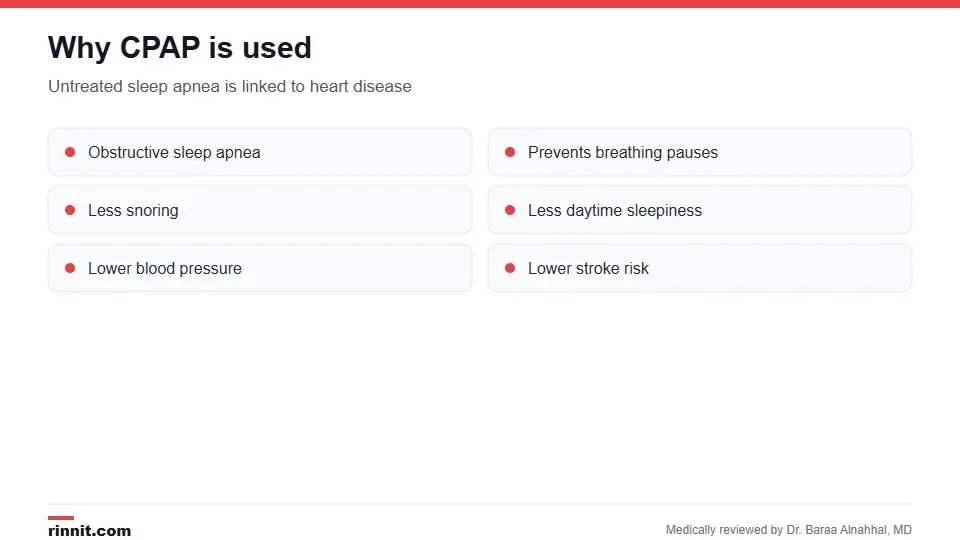
Untreated sleep apnea is linked to heart disease, stroke and diabetes.
Untreated sleep apnea is linked to heart disease, high blood pressure, stroke, type 2 diabetes, memory problems and car crashes. CPAP treats the airway blockage that causes these problems. Your provider will usually confirm sleep apnea with a sleep study first. Sources: [1]
Parts and types
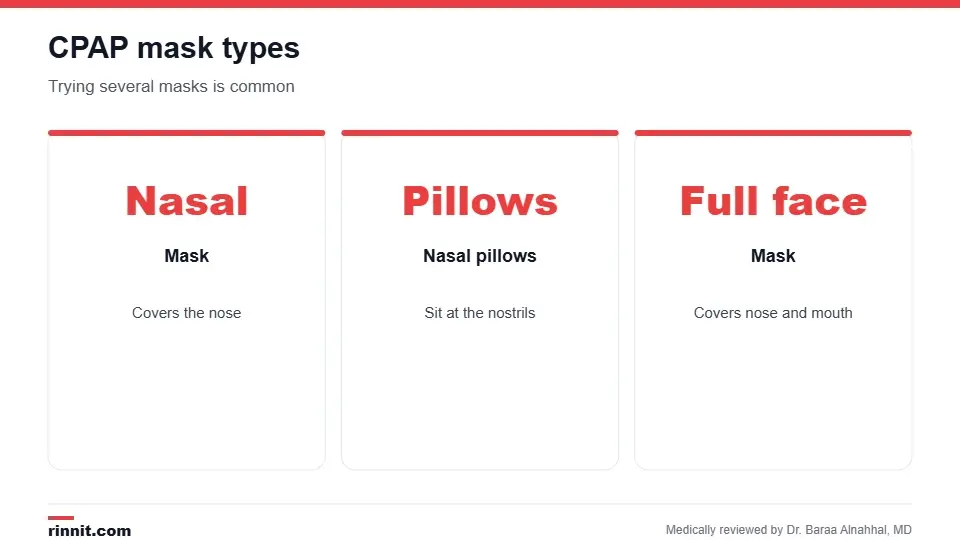
Trying several masks to find the right fit is common.
Part | What it does |
Motor | Draws in and pressurizes room air |
Filter | Cleans the air |
Tube | Carries air to the mask |
Mask and straps | Deliver air to your nose or mouth |
Heated humidifier (some models) | Adds moisture to prevent dryness |
Mask type | Best for |
Nasal mask | Covers the nose; good for many people |
Nasal pillows | Small cushions at the nostrils; less contact with the face |
Full face mask | Covers nose and mouth; good for mouth breathers |
Hybrid | Nasal pillows plus a mouth cover |
Other machines include auto CPAP (APAP), which adjusts pressure automatically, bilevel PAP and adaptive servo-ventilation for some types of central sleep apnea. Sources: [1]
How to use CPAP
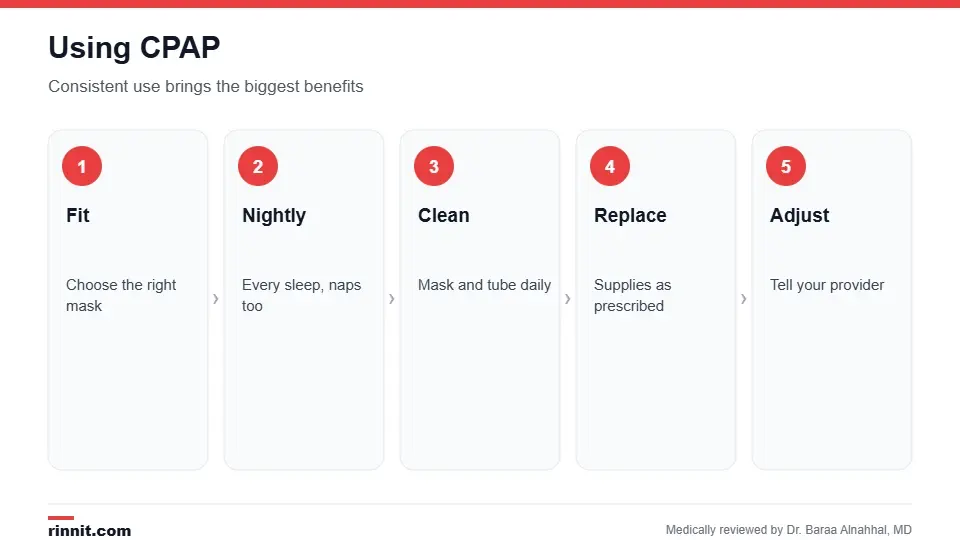
Consistent use brings the biggest benefits.
Choose a mask with your provider based on comfort and how you breathe.
Wear it every time you sleep, including naps and when you travel.
Clean the mask and tube every day.
Renew your prescription to replace the mask and tube regularly.
Tell your provider about any discomfort so they can adjust the mask or settings. Sources: [1]
Side effects and fixes
Problem | What helps |
Dry mouth, stuffy or runny nose, nosebleeds | A heated humidifier |
Skin irritation or redness | A better-fitting mask or extra padding |
Mask discomfort or feeling closed in | Try a different mask style |
Trouble falling asleep | Practice wearing it while awake; it gets easier with time |
Many side effects come from cold, dry air and improve with a humidifier. Sources: [1]
Benefits
When | Benefits |
Short term | Better sleep, less snoring, less daytime sleepiness, better mood |
Long term | Modestly lower blood pressure, better memory and thinking. Large trials haven't shown that CPAP prevents heart attacks or strokes |
The benefits depend on using CPAP consistently. Sources: [1, 2, 3]
When to call your provider
You're having trouble getting used to CPAP.
Your mask is uncomfortable or leaks.
You still feel sleepy or snore despite using it.
You need new supplies. Sources: [1]
Conclusion
CPAP is one of the most effective treatments for obstructive sleep apnea when used every night. Finding the right mask and settings makes it easier to stick with and helps you feel the full benefits.
Keep learning: read about oral appliances for sleep apnea and the sleep apnea implant.
Frequently asked questions
What is a CPAP machine?
A device that blows steady air through a mask to keep your airway open while you sleep.
What does CPAP treat?
Obstructive sleep apnea.
How does CPAP work?
Air pressure keeps your throat tissues from blocking your airway.
Do I need to use it every night?
Yes, including naps and travel, for the best results.
What are the side effects?
Dry mouth, stuffy nose, skin irritation and mask discomfort.
How can I make CPAP more comfortable?
Try a different mask and use a heated humidifier.
How often should I clean it?
Clean the mask and tube every day.
What's the difference between CPAP and APAP?
CPAP uses one steady pressure; APAP adjusts pressure automatically.
Does CPAP lower blood pressure?
Yes, with consistent use.
Are there alternatives to CPAP?
Yes, such as oral appliances or an implanted nerve stimulator.
Related Reading
Positive Airway Pressure (PAP) Therapy: CPAP, BPAP and Benefits explains positive airway pressure therapy.
BiPAP Machine: Uses, How It Works and Side Effects explains BiPAP machines and how they support breathing.
Obstructive Sleep Apnea: Symptoms, Causes, and What Actually Helps the condition CPAP treats.
APAP Machine: Automatic Airway Support for Sleep Apnea a machine that adjusts pressure automatically.
Oral Appliances for Sleep Apnea: How They Work, Who They Help, and What to Expect a mouthpiece alternative to CPAP.
Sleep Apnea Implant: Advanced Upper Airway Stimulation Therapy an implant for sleep apnea.
Sleep Study (Polysomnography): What It Tests, What to Expect and Results the test that diagnoses sleep apnea.
References
Cleveland Clinic. CPAP Machine: What It Is, How It Works & Side Effects. Cleveland Clinic. Last updated July 11, 2024. https://my.clevelandclinic.org/health/treatments/22043-cpap-machine
McEvoy RD, Antic NA, Heeley E, et al. CPAP for prevention of cardiovascular events in obstructive sleep apnea. New England Journal of Medicine. 2016;375(10):919-931. PMID 27571048. https://doi.org/10.1056/NEJMoa1606599
Martínez-García MA, Capote F, Campos-Rodríguez F, et al. Effect of CPAP on blood pressure in patients with obstructive sleep apnea and resistant hypertension: the HIPARCO randomized clinical trial. JAMA. 2013;310(22):2407-2415. PMID 24327037. https://doi.org/10.1001/jama.2013.281250
Medical disclaimer
This article is for general education only and does not replace advice from a qualified healthcare professional. Talk to your doctor about your own diagnosis and treatment, and seek emergency care right away for severe or sudden symptoms.



Comments