Oral Appliances for Sleep Apnea: How They Work, Who They Help, and What to Expect

Updated: 6 days ago
Written and medically reviewed by Dr. Baraa Alnahhal, MD · Last reviewed: October 2026 · How we review
Quick Answer: What is oral appliance therapy for sleep apnea?
Oral appliance therapy for sleep apnea is a treatment that uses a dental mouthpiece, worn during sleep, to pull the lower jaw or tongue forward and keep the airway open. It mainly suits adults with mild to moderate obstructive sleep apnea who cannot use CPAP, and it does not treat central sleep apnea. [1][3]
What the research says
Oral appliances reduce breathing pauses at every severity level. A meta-analysis of 42 studies with 2,265 patients found the apnea-hypopnea index fell by 48% in mild, 67% in moderate and 62% in severe obstructive sleep apnea; jaw-advancing devices outperformed tongue-retaining devices in mild cases (58% vs 21%). (Liao et al., Otolaryngology–Head and Neck Surgery, 2024) [4]
Custom-made devices beat ready-made ones. A meta-analysis of 3 randomized trials found custom mandibular advancement appliances lowered the apnea-hypopnea index by a further 3.2 events per hour compared with ready-made devices, with stronger patient preference and higher self-reported use (6.4–7 nights a week). (Johal & Agha, Journal of Sleep Research, 2018) [5]
A custom fit matters more than the exact design. A systematic review of 20 randomized trials and 6 cohort studies found no single custom design clearly superior for breathing, sleepiness, comfort, side effects or cost, but custom devices outperformed thermoplastic ("boil and bite") ones. (Uniken Venema et al., Sleep Medicine Reviews, 2021) [6]
Key takeaways
An oral appliance is a mouthpiece worn at night that moves the lower jaw or tongue forward to keep the airway open. [1]
The mandibular advancement device (MAD) is the most common type; the tongue-stabilizing device (TSD) is an alternative for people whose teeth can't hold a MAD. [1]
Oral appliances work best for mild to moderate obstructive sleep apnea when CPAP isn't workable. They don't treat central sleep apnea, and in severe OSA they are mainly for people who can't use CPAP, with a follow-up sleep test. [1]
Custom-made devices, fitted by a dentist after a sleep study, give the best results. [1][5]
Most people adjust within 2 to 4 weeks; early side effects such as drooling or jaw soreness usually settle. [1]

What are oral appliances for sleep apnea?
Oral appliances for sleep apnea are dental devices, or mouthpieces, worn in the mouth during sleep to keep the airway open and treat obstructive sleep apnea (OSA). [1]
In OSA, the upper airway becomes partly or fully blocked during sleep. The drop in airflow makes the brain wake you just enough to start breathing again. This cycle of blocked airflow, waking and falling back asleep repeats through the night. [1]
These repeated episodes stop you from sleeping soundly and reduce the oxygen reaching your vital organs. Left untreated, OSA can lead to serious health conditions and can be fatal. [1]
An oral appliance holds your mouth in a position that keeps air flowing. That means easier breathing and fewer night-time wake-ups. [1] For a full overview of the condition itself, see our guide to obstructive sleep apnea symptoms and treatment.
What types of oral appliances treat sleep apnea?
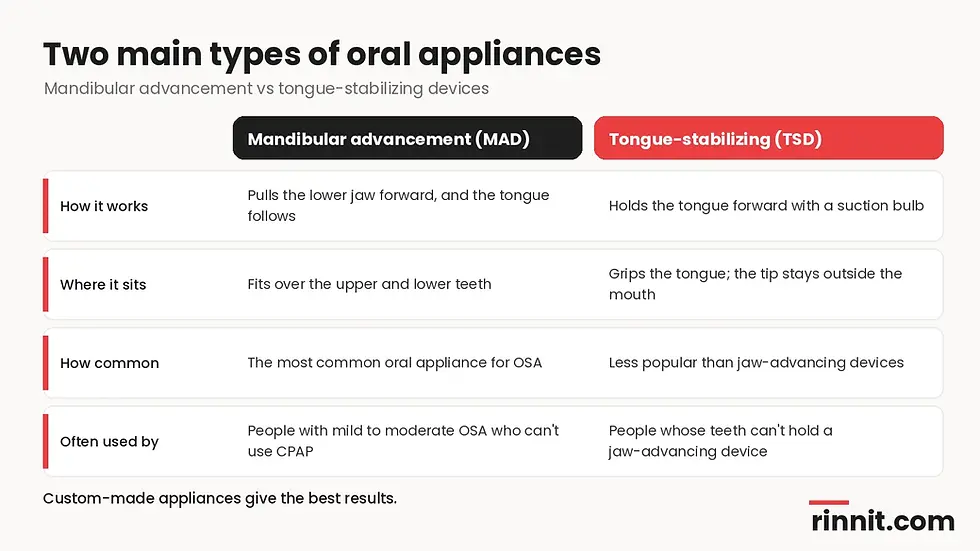
The two main types of oral appliances that treat sleep apnea are mandibular advancement devices (MADs) and tongue-stabilizing devices (TSDs). [1]
Mandibular advancement devices (MADs)
A mandibular advancement device is the most common oral appliance for OSA. It is also called a mandibular advancement splint, mandibular advancement appliance or mandibular repositioning appliance. [1]
A MAD pulls the lower jaw (mandible) forward. The tongue moves forward with the jaw, which creates more space for air at the back of the throat. [1]
Most MADs fit over the teeth in two parts — one for the upper teeth and one for the lower. Screws, hinges or adapted rubber bands connect the two parts so the lower piece can draw the jaw forward. Some designs use separate, interchangeable arches instead. [1]
MADs differ in:
Size
Material (how firm or soft they feel)
How the upper and lower pieces connect (in two-piece models)
How much your teeth touch when you close your mouth
How far the device moves your jaw [1]
Tongue-stabilizing devices (TSDs)
A tongue-stabilizing device, also called a tongue-retaining device, holds the tongue forward using suction. A suction bulb grips the tongue during sleep, and the tip of the device stays outside the mouth. Like a MAD, it opens the airway by moving the base of the tongue forward. [1]
TSDs are less popular than MADs. They can be an option for people who want an oral appliance but can't use a MAD — for example, when the teeth aren't strong enough to hold a MAD in place. TSDs are also sold over the counter. [1]
Feature | Mandibular advancement device (MAD) | Tongue-stabilizing device (TSD) |
How it works | Pulls the lower jaw forward; the tongue follows | Holds the tongue forward with a suction bulb |
Where it sits | Over the upper and lower teeth | On the tongue; the tip stays outside the mouth |
How common | Most common oral appliance for OSA | Less popular |
Often used by | Most people offered oral appliance therapy | People whose teeth can't hold a MAD |
Are custom-made oral appliances better than over-the-counter ones?
Custom-made oral appliances are the most effective type for sleep apnea, because they are built to fit your mouth. [1]
You can buy oral appliances without a prescription, including "boil and bite" models that mould to an impression of your teeth. These may help, but custom-made devices give the best results for OSA. [1] Pooled trial data back this up: custom devices lowered breathing pauses further and were worn more consistently than ready-made versions. [5][6]
How does oral appliance therapy work?
Oral appliance therapy works by pulling the base of the tongue forward to open more space at the back of the throat. [1]
Most devices do this by moving the lower jaw forward while the tongue stays in place relative to the jaw. Others latch onto the tongue itself and pull it forward. [1]
You put the device in before you go to sleep, wear it all night, and take it out when you wake up. [1]
Who is a good candidate for oral appliance therapy?
Oral appliance therapy works best for adults with mild to moderate obstructive sleep apnea who can't use a CPAP (continuous positive airway pressure) machine. [1]
A CPAP machine sends pressurized air through a tube and a mask worn at night to keep the airways open. It is the most effective way to improve airflow in sleep apnea, but many people find it hard to use night after night and eventually stop. [1] Clinical practice guidelines recommend that sleep physicians consider an oral appliance — rather than no treatment — for adults who can't tolerate CPAP or prefer another option. [3]
Usually a good fit | Not a good fit (or only with specialist advice) |
Adults with mild to moderate OSA | Central sleep apnea — breathing pauses come from brain signaling problems, which an oral appliance can't fix |
People who can't use CPAP consistently | Children — breathing problems in children often need different treatment; use one only if your child's provider recommends it |
People who want a portable option for travel | Severe OSA — relying on an oral appliance alone can be dangerous; follow your provider's guidance |
Sources: [1]
If you have central or complex sleep apnea, read about adaptive servo-ventilation (ASV) machines. For children, see our guide to pediatric sleep apnea.
How does oral appliance therapy compare with CPAP?
Oral appliance therapy is less effective than CPAP at improving airflow, but it does improve symptoms in some people and is often easier to stick with. [1][2]
CPAP | Oral appliance | |
Effect on airflow | Most effective option | Less effective than CPAP |
Day-to-day use | Many people find nightly use hard and stop | Small mouthpiece worn overnight |
Travel | Machine, tubing and mask | Easy to pack |
Best suited to | All severities, including severe OSA | Mild to moderate OSA, or CPAP intolerance |
Because people tend to wear oral appliances more consistently than CPAP, overall health outcomes from the two treatments can end up similar. [2]
You don't always have to choose one. Some people use CPAP at home and an oral appliance when travelling. Others wear both together so the CPAP can run at a lower pressure. [1] If CPAP pressure is the problem, an APAP machine, which adjusts pressure automatically, is another option to discuss.
How do you get an oral appliance for sleep apnea?
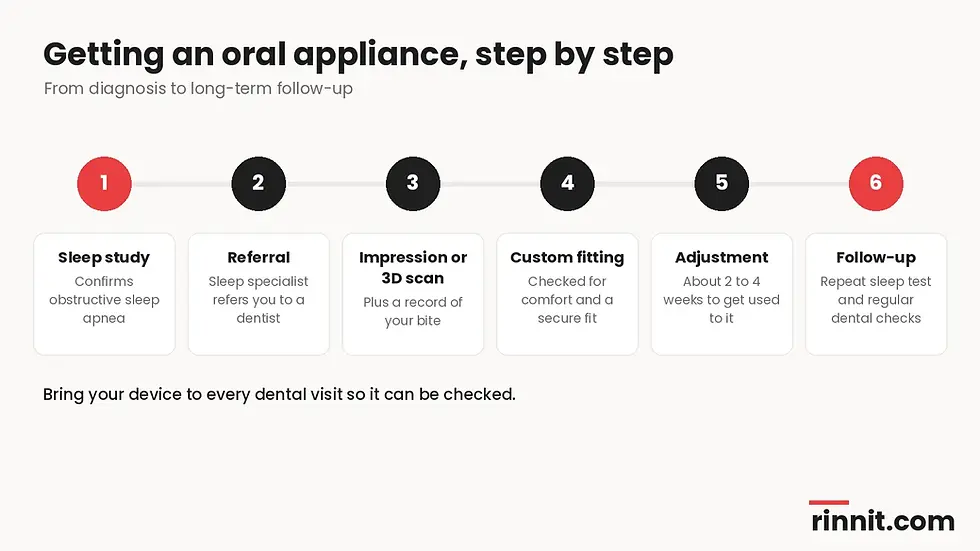
Getting an oral appliance for sleep apnea starts with a sleep study to confirm obstructive sleep apnea, followed by a referral to a dentist if your sleep specialist thinks an appliance suits you. [1]
To fit a mandibular advancement device, the dentist will:
Take an impression or 3D scan of your teeth, plus a record of how your teeth bite together.
Send it to a manufacturer, who builds the device to the dentist's custom design.
Fit the device at a return visit, checking that it is comfortable and won't slip out during sleep.
Explain how to clean and care for the appliance. [1]
Your dentist may recommend another sleep test once you have the device, to check how well it works. The results may lead to further adjustments. [1] Guidelines also recommend that a qualified dentist use a custom, adjustable (titratable) appliance and stay involved in follow-up. [3]
How long does it take to get used to an oral appliance?
Getting used to an oral appliance takes about 2 to 4 weeks for most people. [1]
A mouthpiece can feel strange at first. Start by wearing it for a few hours, then gradually extend the time. For most users, it eventually becomes a normal part of the bedtime routine. [1]
What are the side effects of oral appliance therapy?
The side effects of oral appliance therapy are usually mild and short-lived, appearing in the first week or two and easing as you adjust. [1]
Short-term (common, usually settle) | Long-term (uncommon with a well-fitted device) |
Extra saliva while the device is in | Changes in your bite |
Pain in the jaw, teeth or jaw joint (TMJ) | Tooth movement or loose teeth |
Dry mouth | Changes in the jaw muscles or jaw joint |
Gum irritation |
Sources: [1]
See a dentist regularly so they can check your teeth, correct problems early and make sure the device is still in good shape. Bring your device to every dental appointment. [1] Guidelines recommend this dental oversight specifically to catch bite changes and other dental side effects. [3] If jaw pain persists, our guide to TMJ disorders explains the warning signs.
What are the benefits of oral appliance therapy?
The main benefits of oral appliance therapy are fewer sleep apnea symptoms, less snoring and a treatment option for people who can't use CPAP. [1]
Oral appliance therapy can:
Improve OSA symptoms such as daytime sleepiness and trouble concentrating
Give some people deeper sleep with fewer disruptions
Reduce or stop snoring
Offer an alternative for people who can't use CPAP
Travel easily [1]
Results depend on the shape of your mouth and how severe your OSA is. Some people with mild to moderate OSA find their symptoms resolve completely; others notice little change and need a different treatment. [1] About one in three people show negligible improvement with a mandibular advancement device, which is why careful patient selection matters. [2]
If an oral appliance doesn't help enough, surgical options such as uvulopalatopharyngoplasty (UPPP) or a sleep apnea implant may be discussed.
What should you ask your provider about oral appliance therapy?
The most useful questions to ask your provider about oral appliance therapy cover cost, visits, testing and side effects:
How much does oral appliance therapy cost?
Will my insurance cover it?
How many visits will I need?
How many sleep tests will I need?
Which side effects should I watch for?
How long will the device last? [1]
Conclusion
Oral appliances give people with obstructive sleep apnea a quiet, portable way to keep the airway open at night. They work best for mild to moderate OSA, especially when CPAP has been hard to live with, and custom-made devices fitted by a dentist give the strongest results. [1][5]
They are not right for everyone: central sleep apnea, severe OSA and children usually need other approaches. A sleep study, a proper fitting and regular dental follow-up are what make this treatment safe and effective. [1][3]
Struggling with CPAP? Bring this guide to your next appointment and ask your sleep specialist whether an oral appliance fits your sleep study results. To keep learning, start with our complete obstructive sleep apnea guide — written and medically reviewed by a physician.
FAQ
Do oral appliances for sleep apnea really work?
Oral appliances for sleep apnea improve symptoms for many people with mild to moderate obstructive sleep apnea, including daytime sleepiness and snoring. Results vary: some people's symptoms resolve completely, while others see little change and need another treatment. [1][4]
Is an oral appliance as good as CPAP?
An oral appliance is not as effective as CPAP at improving airflow. Because many people find an oral appliance easier to wear every night, overall health outcomes can end up similar for some patients. [1][2]
Can I buy an over-the-counter mouthpiece for sleep apnea?
Over-the-counter sleep apnea mouthpieces, including "boil and bite" models, are available without a prescription and may help. Custom-made appliances fitted by a dentist give the best results, so speak to your sleep specialist first. [1][5]
Can oral appliances treat severe sleep apnea?
Oral appliances work less well than CPAP for severe obstructive sleep apnea, but guidelines support them over no treatment for people who can't use CPAP, with a follow-up sleep test to check they work. Your provider will advise when an oral appliance is safe to use, sometimes alongside CPAP. [1]
How long does it take to get used to a sleep apnea mouthpiece?
Getting used to a sleep apnea mouthpiece takes about 2 to 4 weeks. Wearing it for a few hours at first and gradually increasing the time makes the adjustment easier. [1]
What are the side effects of a sleep apnea mouthpiece?
The most common side effects of a sleep apnea mouthpiece are extra saliva, jaw or tooth pain, dry mouth and gum irritation, which usually ease within a week or two. Bite changes and tooth movement are uncommon with a well-fitted device but need regular dental checks. [1]
Can I use an oral appliance and CPAP together?
Oral appliances and CPAP can be used together. Some people use CPAP at home and an oral appliance when travelling, and wearing both can lower the CPAP pressure needed. [1]
Can children use oral appliances for sleep apnea?
Children should use an oral appliance for sleep apnea only if their healthcare provider recommends it. Breathing problems in children often need different treatments from those used in adults. [1]
Does insurance cover an oral appliance for sleep apnea?
Many medical insurance plans cover a custom oral appliance when a sleep study confirms obstructive sleep apnea. Check with your insurer, because rules and costs vary.
Do you need a follow-up sleep study with an oral appliance?
Often yes. A follow-up sleep test after the appliance has been adjusted checks that it is controlling your sleep apnea.
Related Reading
Positive Airway Pressure (PAP) Therapy: CPAP, BPAP and Benefits explains positive airway pressure therapy.
CPAP Machine: How It Works, Masks and Side Effects explains how CPAP machines treat sleep apnea.
Double Jaw Surgery (Bimaxillary Osteotomy): Procedure and Recovery explains surgery that repositions both the upper and lower jaws.
References
Cleveland Clinic. Oral Appliances for Sleep Apnea. Cleveland Clinic. Last updated April 19, 2024. https://my.clevelandclinic.org/health/treatments/21129-oral-appliance-therapy-for-sleep-apnea
Dieltjens M, Vanderveken O. Oral Appliances in Obstructive Sleep Apnea. Healthcare (Basel). 2019;7(4):141. PMID 31717429. https://doi.org/10.3390/healthcare7040141
Ramar K, Dort LC, Katz SG, et al. Clinical Practice Guideline for the Treatment of Obstructive Sleep Apnea and Snoring with Oral Appliance Therapy: An Update for 2015. J Clin Sleep Med. 2015;11(7):773-827. PMID 26094920. https://doi.org/10.5664/jcsm.4858
Liao J, Shi Y, Gao X, et al. Efficacy of Oral Appliance for Mild, Moderate, and Severe Obstructive Sleep Apnea: A Meta-analysis. Otolaryngol Head Neck Surg. 2024;170(5):1270-1279. PMID 38363016. https://doi.org/10.1002/ohn.676
Johal A, Agha B. Ready-made versus custom-made mandibular advancement appliances in obstructive sleep apnea: A systematic review and meta-analysis. J Sleep Res. 2018;27(6):e12660. PMID 29405512. https://doi.org/10.1111/jsr.12660
Uniken Venema JAM, Rosenmöller BRAM, de Vries N, et al. Mandibular advancement device design: A systematic review on outcomes in obstructive sleep apnea treatment. Sleep Med Rev. 2021;60:101557. PMID 34662769. https://doi.org/10.1016/j.smrv.2021.101557
Further reading (external):
Randerath W, Verbraecken J, de Raaff CAL, et al. European Respiratory Society guideline on non-CPAP therapies for obstructive sleep apnoea. Eur Respir Rev. 2021;30(162):210200. PMID 34853097. https://doi.org/10.1183/16000617.0200-2021
Medical disclaimer
This article is for general education and does not replace advice from a qualified healthcare professional. Talk to your doctor, sleep specialist or dentist before starting, stopping or changing any sleep apnea treatment. If you notice choking or gasping during sleep, severe daytime sleepiness, or chest pain, seek medical care promptly.



Comments