Positive Airway Pressure (PAP) Therapy: CPAP, BPAP and Benefits

Updated: 2 days ago
Written and medically reviewed by Dr. Baraa Alnahhal, MD · Last reviewed: November 2026 · How we review
Quick Answer
Positive airway pressure (PAP) therapy treats sleep apnea with a machine that pushes air through a mask into your airways to keep them open while you sleep. The two main types are CPAP, with one constant pressure, and BPAP, with two pressure levels. Benefits include less daytime tiredness, less snoring and lower blood pressure.
What the research says
PAP improved sleep apnea, sleepiness and blood pressure: an American Academy of Sleep Medicine review of 336 studies found PAP reduced sleep apnea severity, daytime sleepiness, blood pressure and car accidents compared with no treatment, and auto-adjusting or bilevel PAP was no better than standard CPAP (Patil SP et al., Journal of Clinical Sleep Medicine, 2019) [2]
CPAP improved quality of life, though not heart events at low use: in the SAVE trial of 2,717 adults with sleep apnea and heart or brain vessel disease, CPAP used about 3.3 hours a night didn't lower heart events, but it reduced snoring and sleepiness and improved mood and quality of life (McEvoy RD et al., New England Journal of Medicine, 2016) [3]
Key takeaways
PAP therapy keeps your airway open with pressurized air.
CPAP uses one pressure; BPAP uses two.
It mainly treats sleep apnea.
Use it every night for the best results.
Side effects like dry mouth and congestion are usually manageable.
What is positive airway pressure therapy?
PAP is the most common treatment for obstructive sleep apnea. The airflow pressure keeps your airway from collapsing and helps get more oxygen into your lungs. Sources: [1]
What it treats
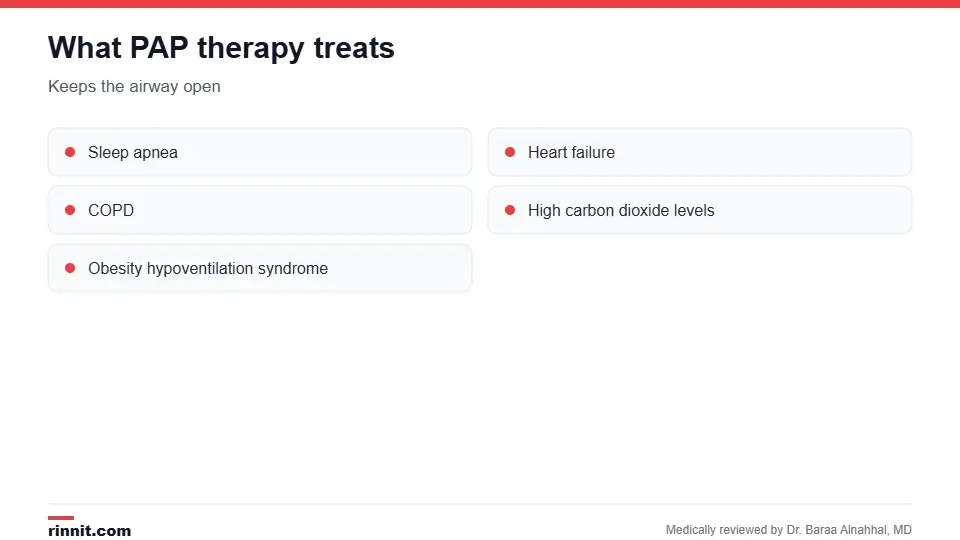
Sleep apnea is the most common reason.
Sleep apnea.
Heart failure.
COPD.
High carbon dioxide levels (hypercapnia).
Obesity hypoventilation syndrome. Sources: [1]
CPAP vs. BPAP

Your provider decides which fits you.
Feature | CPAP | BPAP |
Pressure | One constant pressure | Two pressures |
Breathing out | Same pressure | Lower pressure, easier exhaling |
Common use | Most sleep apnea | When higher pressures or breathing support are needed |
Learn more about CPAP machines, BiPAP and APAP. Sources: [1, 2]
How to use PAP
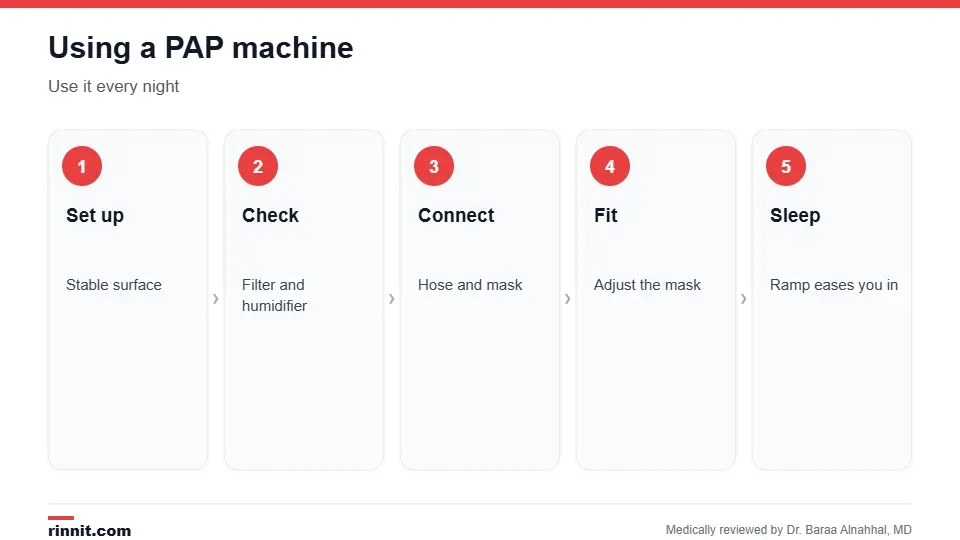
A ramp feature lowers pressure while you fall asleep.
Place the machine on a stable surface.
Check the filter and set up the humidifier.
Connect the hose to the machine and mask.
Put on and adjust the mask, usually sitting up.
Turn the machine on, lie down and readjust as needed. Sources: [1]
A "ramp" feature starts with lower pressure while you fall asleep, then raises it. Sources: [1]
Side effects
Stuffy or runny nose.
Dry mouth.
Nosebleeds.
Feeling closed in by the mask.
Rarely, low blood pressure, aspiration pneumonia or lung injury from too much pressure. Sources: [1]
Tips for success
Get used to the mask while you're awake.
Use the machine every night.
Ask for a different mask if yours is uncomfortable. Sources: [1, 3]
Benefits
Less daytime tiredness and more energy.
Better thinking and memory.
Lower blood pressure, though it hasn't been shown to prevent heart attacks or strokes.
Less snoring. Sources: [1, 2, 3]
For sleep apnea, you may feel better in a few days to a few weeks. Sources: [1]
When to call your provider
Contact your provider if you have questions about using the machine, making it more comfortable or when you'll feel better. Sources: [1]
Conclusion
PAP therapy is a highly effective way to keep your airway open and sleep better. Finding a comfortable mask and using it nightly makes the biggest difference.
Keep learning: read about CPAP machines and oral appliances for sleep apnea.
Frequently asked questions
What is PAP therapy?
A machine that pushes air through a mask to keep your airway open.
What's the difference between CPAP and BPAP?
CPAP uses one pressure; BPAP uses a lower pressure for breathing out.
What does PAP treat?
Mainly sleep apnea, plus heart failure, COPD and breathing failure.
How long until I feel better?
A few days to a few weeks.
Do I need to use it every night?
Yes, for the best results.
What is the ramp feature?
It starts with low pressure while you fall asleep.
What are common side effects?
Dry mouth, congestion and nosebleeds.
What if my mask is uncomfortable?
Ask your provider about other mask styles.
Is auto-adjusting PAP better?
Studies show it's about as effective as standard CPAP.
Does PAP stop snoring?
Yes, it usually reduces snoring.
Related Reading
CPAP Machine: How It Works, Masks and Side Effects continuous pressure machines.
BiPAP Machine: Uses, How It Works and Side Effects bilevel pressure machines.
Obstructive Sleep Apnea: Symptoms, Causes, and What Actually Helps the condition PAP treats.
Oral Appliances for Sleep Apnea: How They Work, Who They Help, and What to Expect a PAP alternative.
Sleep Apnea Implant: Advanced Upper Airway Stimulation Therapy an implant option.
References
Cleveland Clinic. Positive Airway Pressure Therapy: Types & Benefits. Cleveland Clinic. Last updated July 13, 2026. https://my.clevelandclinic.org/health/treatments/pap-therapy
Patil SP, Ayappa IA, Caples SM, et al. Treatment of adult obstructive sleep apnea with positive airway pressure: an American Academy of Sleep Medicine systematic review, meta-analysis, and GRADE assessment. Journal of Clinical Sleep Medicine. 2019;15(2):301-334. PMID 30736888. https://doi.org/10.5664/jcsm.7638
McEvoy RD, Antic NA, Heeley E, et al. CPAP for prevention of cardiovascular events in obstructive sleep apnea. New England Journal of Medicine. 2016;375(10):919-931. PMID 27571048. https://doi.org/10.1056/NEJMoa1606599
Medical disclaimer
This article is for general education only and does not replace advice from a qualified healthcare professional. Talk to your doctor about your own diagnosis and treatment, and seek emergency care right away for severe or sudden symptoms.



Comments