Adaptive Servo-Ventilation (ASV) Machines: Advanced Sleep Apnea Therapy

Updated: 2 days ago
Medically reviewed by Dr. Baraa Alnahhal, MD · Last reviewed: September 2026
Last updated: September 2026
TL;DR
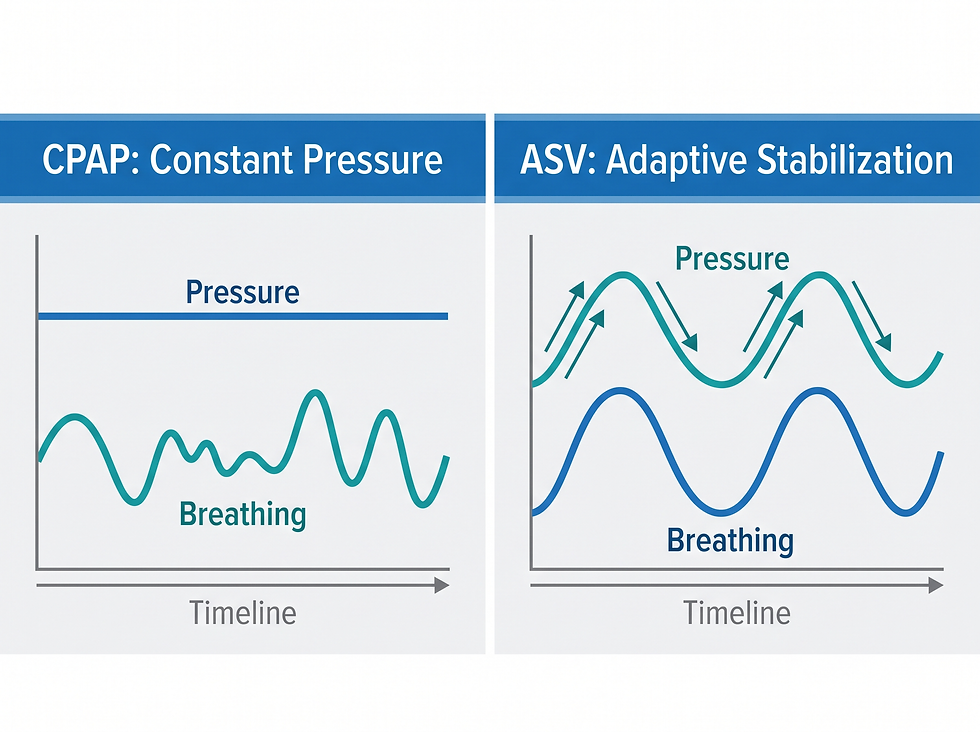
Adaptive servo-ventilation (ASV) is an advanced positive airway pressure (PAP) therapy designed mainly for central and complex sleep apnea. Unlike standard CPAP machines, which deliver a constant flow of air, ASV machines use sensors to monitor breathing in real time and deliver pressurized air only as needed to stabilize respiration and support deep, restful sleep.
Quick Answer
What is an ASV machine?
A specialized medical device used to treat central sleep apnea (CSA) and complex sleep apnea.
It monitors breathing and automatically adjusts the air pressure it delivers.
If it detects a pause in breathing or a slow breathing rate, it increases pressure to prompt a breath; if breathing is steady, it reduces pressure.
This on-demand delivery makes it more comfortable and effective than standard CPAP or BiPAP for certain breathing disorders.
Overview
Adaptive-servo ventilation (ASV) is a significant advancement in sleep medicine, offering a targeted solution for people whose sleep apnea is not effectively managed by standard therapies. Most people are familiar with continuous positive airway pressure (CPAP) for obstructive sleep apnea, but ASV is specifically engineered to address central sleep apnea (CSA) — a condition in which the brain fails to signal the muscles to breathe. By combining smart sensors with responsive airflow technology, ASV machines bridge the gap between simple air delivery and physiological stabilization.
How Adaptive-Servo Ventilation Works
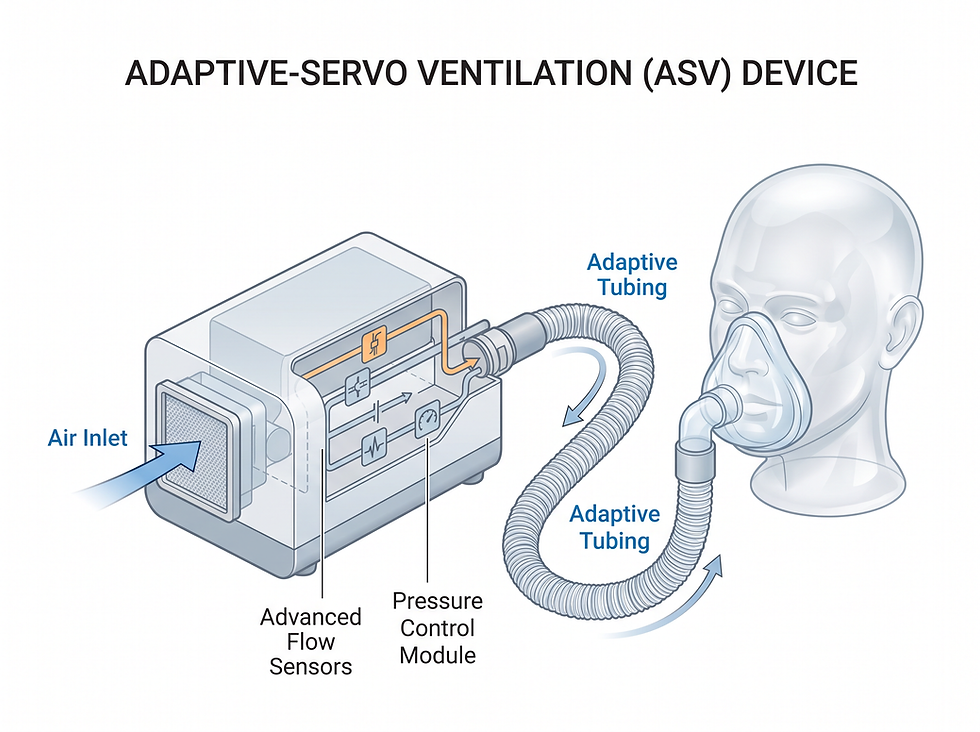
The basic operation of an ASV machine involves taking in room air, filtering it, and pressurizing it before delivering it through a mask. What sets the device apart is its "adaptive" nature. Built-in sensors continuously track the user's respiratory rate and volume. When the sensors detect long pauses or a significant slowing of breath, the machine immediately increases airflow to maintain stability. If the user is breathing at a steady, consistent rate, the machine reduces pressure or may stop sending air entirely, avoiding the discomfort of forced air during normal breathing.
Feature | ASV machine | CPAP machine | Bi-level PAP (BiPAP) |
Primary use | Central and complex sleep apnea | Obstructive sleep apnea | CPAP-intolerant OSA |
Airflow delivery | On-demand, adaptive | Continuous, steady flow | Fixed inhale/exhale levels |
Sensor technology | Advanced real-time monitoring | Basic pressure maintenance | Basic flow detection |
Comfort level | High (adjusts to the user) | Moderate (constant pressure) | Moderate (dual pressure) |
Indications for ASV Therapy
Healthcare providers typically prescribe ASV machines for patients diagnosed with central sleep apnea or complex sleep apnea. Complex sleep apnea occurs when a patient has both obstructive and central components, often emerging when obstructive apnea is treated but breathing remains unstable. Central sleep apnea can be triggered by a range of underlying factors, from age to neurological conditions.
Medication effects. Opioid pain medications can suppress the respiratory drive, leading to central apnea.
Age factors. Adults age 60 or older face a higher risk of developing central breathing disruptions.
Cardiac conditions. Chronic heart issues such as congestive heart failure (CHF) or atrial fibrillation are frequently linked to CSA.
Neurological disorders. A history of stroke or congenital central nervous system issues can interfere with the brain's breathing signals.
High altitudes. Traveling or living above 8,500 feet can cause hypoxia, which can trigger unstable breathing patterns.
Advantages and Clinical Benefits
The primary advantage of ASV therapy is its effectiveness for difficult-to-manage sleep disorders. Because the machine delivers air only when the body needs it, many users find it noticeably more comfortable than CPAP machines, which can feel like they are constantly "pushing" air into the mouth. This improved comfort often leads to better adherence to therapy, resulting in more consistent sleep and improved daytime alertness.
Risks and Safety Considerations
While ASV is a powerful tool, it is not suitable for everyone. A critical safety concern exists for people with certain heart conditions: clinical evidence suggests that patients with congestive heart failure may face an increased risk of sudden cardiac death when using ASV machines. It is essential for patients with both central sleep apnea and heart failure to have a detailed consultation with their medical team before starting this therapy.
Aspect | Details |
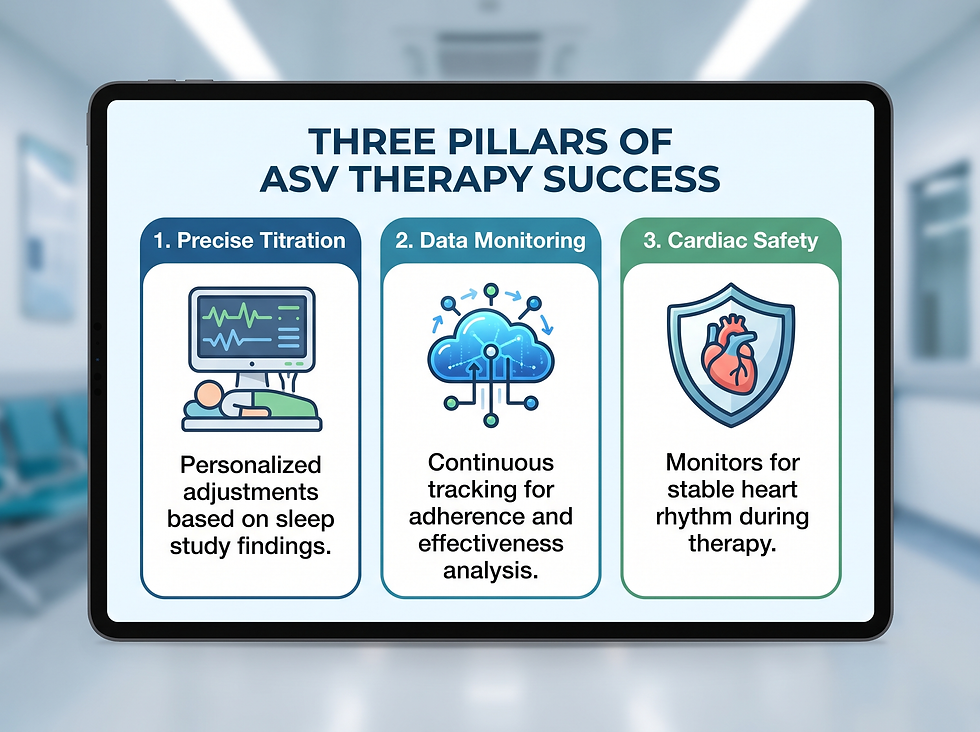
Required study | Titration study (sleep study) to set airflow levels |
Maintenance | Regular sensor checks and data monitoring |
Key risk | Congestive heart failure contraindications |
Comfort | On-demand delivery reduces the "forced air" sensation |
Conclusion
Adaptive-servo ventilation is a specialized, effective treatment for central and complex sleep apnea. By mimicking the body's natural breathing needs through real-time sensor technology, ASV machines provide a level of comfort and stabilization that traditional PAP devices cannot match. If you struggle with interrupted sleep, or have been diagnosed with central sleep apnea, or are managing pediatric sleep apnea in your family, talk with your healthcare provider about whether an ASV titration study is the right next step.
Experiencing symptoms of central sleep apnea? Long pauses in breathing during sleep or excessive daytime fatigue are worth discussing with a sleep specialist. Don't wait — ask whether an ASV machine could help you regain the rest you deserve.
Frequently Asked Questions
What exactly does "adaptive-servo" mean?
"Adaptive" refers to the machine's ability to adjust to your breathing in real time, while "servo" indicates a system that uses feedback from sensors to control a mechanism — in this case, the air pressure delivery.
Is ASV the same as a BiPAP machine?
No. A BiPAP uses fixed settings for inhalation and exhalation. ASV is more advanced, changing its pressure levels dynamically based on your specific breathing patterns.
Can I use an ASV machine for simple snoring?
ASV is a specialized medical device for sleep apnea. Simple snoring is usually treated with lifestyle changes or standard CPAP if obstructive sleep apnea is present.
How does the machine know I've stopped breathing?
The machine contains highly sensitive flow sensors that monitor the volume and rate of air moving through the mask. If it detects a drop below a certain threshold, it responds immediately.
Will ASV help if I have heart failure?
ASV is often used for patients with heart conditions, but it is strictly contraindicated for those with symptomatic congestive heart failure because of increased cardiac risks. Always consult a cardiologist.
What is a titration study?
It is a specialized sleep study in which technicians monitor your breathing while you use an ASV machine to find the exact pressure settings needed to stabilize your breathing.
Is the ASV mask different from a CPAP mask?
Generally, the masks are interchangeable. You can use nasal masks, full-face masks, or nasal pillows depending on your comfort and your provider's recommendation.
Can I travel with an ASV machine?
Yes, most modern ASV machines are portable and designed for travel. They can also adjust to changes in altitude, which is helpful since high altitudes can trigger central apnea.
Does ASV track my sleep data?
Yes, most machines record data on breathing events, usage time, and mask fit. This data can be reviewed by you and your doctor to make sure the treatment is working.
Is ASV more expensive than CPAP?
Yes. Because the technology is significantly more complex and the sensors are more advanced, ASV machines typically cost more than standard CPAP devices.
How long does it take to get used to ASV?
Most people adjust within a few days to a couple of weeks. Because it delivers air only as needed, many find it easier to tolerate than CPAP from the first night.
What are the signs that my ASV machine isn't working?
If you continue to feel exhausted during the day, wake up gasping, or the machine alerts you to high air leaks or sensor errors, contact your provider.
Can opioids cause the need for an ASV?
Yes. Opioid medications can interfere with the brain's respiratory center, causing central sleep apnea, which is one of the primary conditions ASV is designed to treat.
Do I need a prescription for an ASV machine?
Yes. ASV is a regulated medical device and requires a prescription from a healthcare provider following a formal diagnosis and sleep study.
Can ASV be used for children?
While it is primarily used for adults, ASV may be prescribed for children with specific neurological or inherited disorders, such as Rett syndrome, under strict specialist supervision.
References
This article is based on medically reviewed clinical information, including the sources below.
This article is for educational purposes only and is not a substitute for professional medical advice. Always consult a qualified healthcare professional for diagnosis and treatment.
Comments