Pediatric Sleep Apnea: Symptoms, Causes & Treatment — A Parent's Guide

Updated: 2 days ago
Medically reviewed by Dr. Baraa Alnahhal, MD · Last reviewed: September 2026
Pediatric Sleep Apnea: Symptoms, Causes, and Treatment — A Parent's Guide
TL;DR
Pediatric obstructive sleep apnea is a condition in which a child's breathing is partly or completely blocked during sleep, causing brief pauses that can repeat many times a night. It looks different from adult sleep apnea: while adults typically show daytime sleepiness, children are more likely to present with behavior problems such as hyperactivity or poor attention. The leading risk factor in children is enlarged tonsils and adenoids. The main test is an overnight sleep study called a polysomnogram. Treatment ranges from watchful waiting (some children outgrow it), to nasal steroid medicines, to surgery removing the enlarged tonsils and adenoids (adenotonsillectomy), to airway devices such as CPAP. Untreated, it can affect growth, learning, behavior, and long-term heart health — so a professional evaluation is the safe first step.
Quick Answer: What Is Pediatric Sleep Apnea?
Pediatric obstructive sleep apnea occurs when a child's breathing is partly or completely blocked during sleep, with brief pauses repeating many times a night.
It happens when the upper airway narrows or is blocked while the child sleeps, often due to relaxed throat muscles.
Children usually show behavior issues (hyperactivity, poor attention, school trouble) rather than the daytime sleepiness typical in adults.
The main risk factor in children is enlarged tonsils and adenoids; obesity is an important factor mainly among teenagers.
The key diagnostic test is an overnight sleep study (polysomnogram) that records brain waves, breathing, snoring, oxygen levels, heart rate, and muscle activity.
The most common first treatment is surgery to remove enlarged tonsils and adenoids (adenotonsillectomy); some children improve with medicines or airway devices.
Some children with mild to moderate obstructive sleep apnea can outgrow the condition, and doctors may recommend watchful waiting for up to six months.
Figure 1: Pediatric sleep apnea in one view — what happens during sleep, and who it affects most.
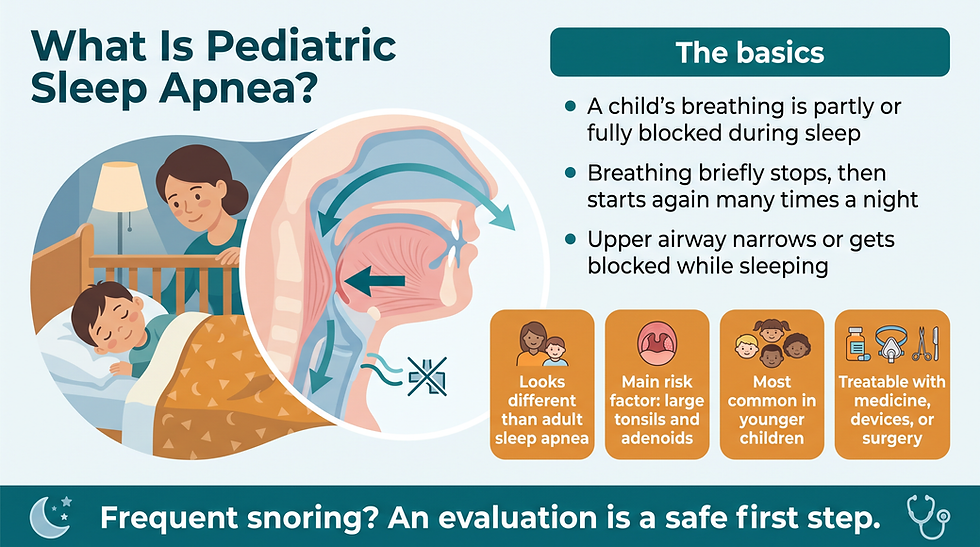
What Is Pediatric Sleep Apnea?
Pediatric obstructive sleep apnea is a condition in which a child's breathing is partly or completely blocked during sleep. Breathing can briefly stop and start again many times a night. The condition happens when the upper airway — the passage from the nose and mouth down the back of the throat — narrows or is blocked while the child sleeps.
The upper airway sits behind the nose and mouth. Two small pads of tissue can narrow it: the adenoids, which are two small pads of tissue in the back of the nose, and the tonsils, two oval-shaped pads in the back of the mouth.
Importantly, pediatric sleep apnea looks different in children than it does in adults. Adults usually have daytime sleepiness. Children are more likely to have behavior issues, such as acting hyper or not paying attention. Risk factors also differ: in adults, the key risk factors are obesity and age. Although obesity can play a role in children, the main risk factor in children is having tonsils and adenoids that are larger than usual.
| Fact | Detail | |---|---| | What it is | A child's breathing is partly or fully blocked during sleep | | How it presents | Breathing pauses repeatedly during the night; symptoms differ from adult sleep apnea | | Main pediatric risk factor | Enlarged tonsils and adenoids (especially in younger children) | | Main adult risk factors | Obesity and age | | Typical pediatric symptoms | Snoring, breathing pauses, restless sleep, behavior or learning issues | | Why early treatment matters | Prevents complications affecting growth, learning, behavior, and heart health |
It is important for healthcare professionals to find and treat pediatric obstructive sleep apnea as soon as possible. Early treatment helps prevent complications — other health conditions the apnea can cause — which can affect children's growth, learning, behavior, and heart health. The first treatment may be surgery to remove enlarged tonsils and adenoids, but some children get better using medical devices or taking medicines.
What Are the Symptoms of Pediatric Sleep Apnea?
During sleep, the most recognizable signs happen at night:
| Nighttime symptom | What parents may notice | |---|---| | Snoring | Frequent, often nightly | | Pauses in breathing | Breathing briefly stops | | Restless sleep | Tossing, turning, unsettled sleep | | Snorting, gasping, coughing, or choking | Sudden sounds as breathing resumes | | Mouth breathing | Breathing through the mouth instead of the nose | | Nighttime sweating | Sweating during sleep | | New bed-wetting | Bed-wetting that starts after a long period of dry overnights |
One detail parents of younger children should know: infants and young children with obstructive sleep apnea don't always snore. They might just have disturbed sleep.
During the day, children with sleep apnea might show a very different set of signs — and these are the signs most often mistaken for ordinary misbehavior:
| Daytime symptom | How it shows up | |---|---| | Morning headaches | Headaches when waking | | Mouth breathing | Breathing through the mouth or trouble breathing through the nose | | Learning trouble | Difficulty learning and paying attention | | Poor school performance | Doing poorly in school | | Behavior issues | Acting hyper, impulsive, or aggressive | | Poor weight gain | Slower-than-expected growth | | Sleepiness | Talking about feeling sleepy, or falling asleep during school or during short car or bus rides |
When to See a Doctor
The guidance is deliberately simple: see the child's healthcare professional if the child has any symptoms of obstructive sleep apnea, including frequent snoring. You do not need to count breathing pauses or measure oxygen levels at home — snoring alone is a legitimate reason to ask for an evaluation.
What Causes Pediatric Sleep Apnea?
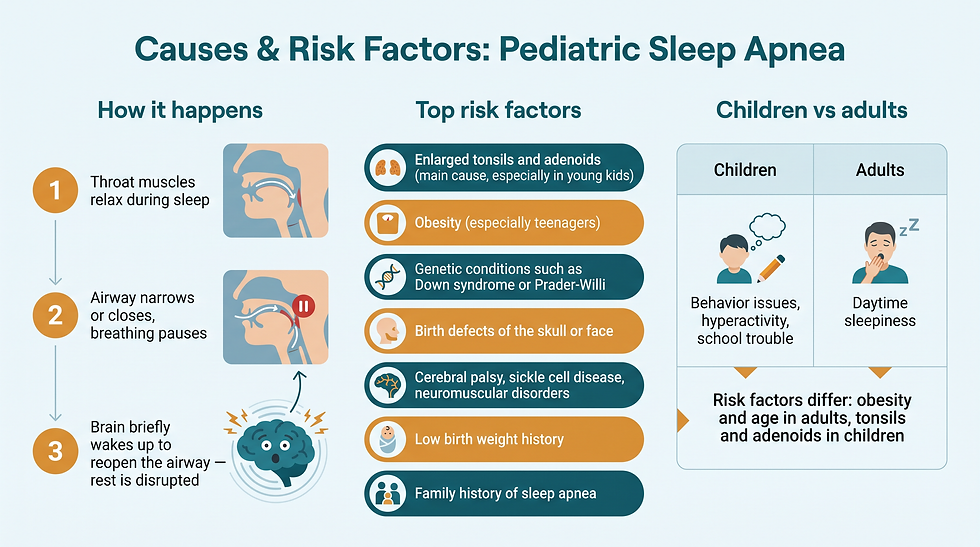
Pediatric obstructive sleep apnea is caused by muscles in the back of the throat relaxing and blocking the upper airway during sleep. In children, this leads to pauses in breathing that last about twice as long as the typical breath.
When breathing stops, this triggers the brain to wake up so that the airway can open again. This makes it hard to get enough rest.
The chain of events repeats through the night: the throat narrows, breathing pauses, the brain briefly rouses to reopen the airway, and the cycle continues. That is why the child wakes unrefreshed even after a full night in bed.
Commonly, enlarged tonsils in the back of the mouth and enlarged adenoids in the back of the nose cause the blockage. Other possible causes include being born with a birth defect related to the shape of the face or head and certain health conditions.
Figure 2: How the airway gets blocked, the risk factors that raise the odds, and why children's sleep apnea looks different from adults'.
Who Is Most at Risk?
The main risk factor for pediatric obstructive sleep apnea is enlarged tonsils and adenoids, especially in younger children. Obesity also is an important risk factor, mainly among teenagers.
| Risk factor | Notes | |---|---| | Enlarged tonsils and adenoids | The main risk factor, especially in younger children | | Obesity | Important mainly among teenagers | | Genetic conditions | Such as Down syndrome or Prader-Willi syndrome | | Birth defects | Of the skull or face | | Cerebral palsy | A group of conditions that affect movement and posture | | Sickle cell disease | A group of inherited blood disorders | | Neuromuscular disorders | Conditions that affect muscle function due to nerve and muscle problems | | Low birth weight | A history of low birth weight raises risk | | Family history | A family history of obstructive sleep apnea |
Can Pediatric Sleep Apnea Cause Complications?
Without treatment, pediatric obstructive sleep apnea can lead to complications. The concerns span from growth in the youngest children to heart health in later life.
| Complication | What happens | |---|---| | Slowed growth | Rarely, infants and young children do not grow as much as children without the condition | | High blood pressure | Later risk without treatment | | High cholesterol | Later risk without treatment | | Elevated blood sugar | A higher than typical blood sugar level that raises the risk of diabetes | | Heart and blood vessel conditions | Other cardiovascular conditions linked to untreated apnea |
Very rarely, children with certain genetic conditions can have serious symptoms of pediatric obstructive sleep apnea that can lead to death. But in most children, treatment can help manage complications. This is a strong argument for taking early symptoms seriously rather than assuming a child will simply outgrow the snoring.
How Is Pediatric Sleep Apnea Diagnosed?
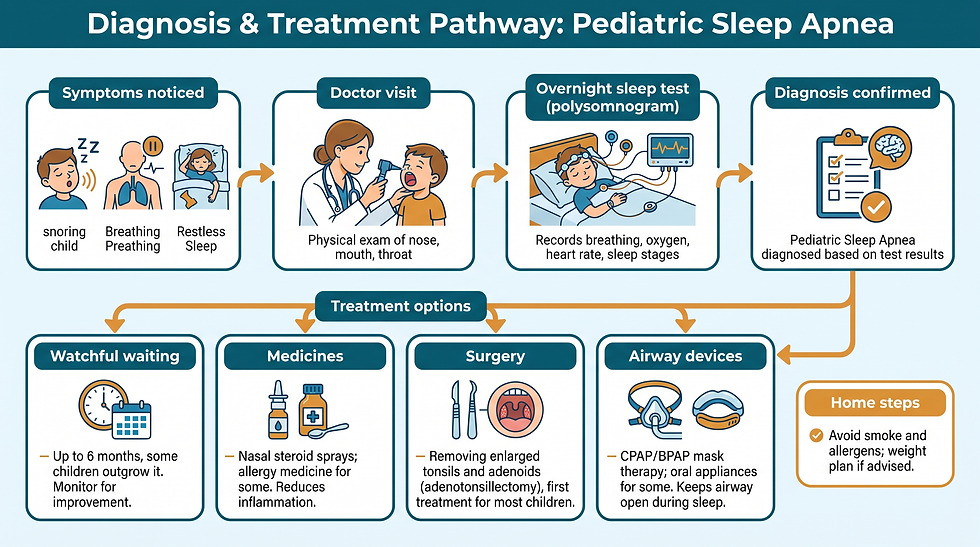
Diagnosis involves the steps a healthcare professional takes to find out whether a child has pediatric obstructive sleep apnea. It begins with a review of the child's symptoms and health history plus a physical exam. The professional likely will look at the child's head, neck, nose, mouth, and tongue — checking, among other things, whether the tonsils and adenoids are enlarged.
The main test to check for sleep apnea in children is called a polysomnogram. This is an overnight sleep test. Sensors are placed on the child's body, and they record brain waves, breathing patterns, snoring, oxygen levels, heart rate, and muscle activity while the child sleeps. The test may take place at a sleep center.
| Test | What it involves | What it shows | |---|---|---| | Symptom and history review | Questions about sleep, behavior, and health history | Patterns pointing to apnea | | Physical exam | Exam of head, neck, nose, mouth, and tongue | Enlarged tonsils or adenoids; facial structure | | Polysomnogram (main test) | Overnight sleep study with body sensors | Brain waves, breathing patterns, snoring, oxygen levels, heart rate, muscle activity during sleep |
The polysomnogram is the decisive test: it confirms whether breathing pauses are happening, how long they last, and how much oxygen is reaching the child's body — the information that shapes the treatment plan.
How Is Pediatric Sleep Apnea Treated?
A healthcare professional works with the family to find the right treatment for the child's pediatric obstructive sleep apnea. The right plan depends on the child's sleep apnea symptoms and risk factors. Some children may also get better without sleep apnea treatments at all.
Most often, the first treatment for the condition is surgery to remove enlarged tonsils and adenoids. This is called adenotonsillectomy (ad-uh-no-ton-sil-EK-tuh-me). But some children get better with medicines or medical devices. Other treatments may be needed if this surgery isn't right for the child, or if it doesn't fully treat the child's obstructive sleep apnea.
Watchful Waiting: Monitoring for Up to Six Months
Some kids get better without sleep apnea treatments. It's possible for some children with mild to moderate obstructive sleep apnea to outgrow the condition. A healthcare professional may recommend closely watching a child for up to six months to see if the symptoms get better. This is called watchful waiting. If the child also has allergies or other conditions that irritate the airway, watchful waiting can include treatment for those.
Medications
Topical nasal steroids might ease sleep apnea symptoms for some children with mild obstructive sleep apnea. These medicines include fluticasone (Flovent HFA, Xhance, others) and budesonide (Rhinocort, Pulmicort Flexhaler, others). For kids with allergies, montelukast (Singulair) might help relieve symptoms when used alone or with nasal steroids.
Therapies and Devices
A healthcare professional may recommend devices such as:
| Device | How it works | When it is used | |---|---|---| | CPAP (continuous positive airway pressure) | A small machine gently blows air through a tube attached to a mask around the child's nose or nose and mouth; air pressure keeps the airway open | Often an option if medicines or removal of the adenoids and tonsils doesn't work | | BPAP (bilevel positive airway pressure) | A positive airway pressure variant with two pressure levels | Same role as CPAP | | Oral appliances | Dental devices and mouthpieces that expand the roof of the mouth and nasal passages and may move the lower jaw and tongue forward | Only some children benefit from these devices |
Proper fitting of the mask and refitting as the child grows can make the mask more comfortable to wear.
Surgery
Adenotonsillectomy to remove the tonsils and adenoids might improve obstructive sleep apnea by opening the airway. It's often a treatment option for children with moderate to severe obstructive sleep apnea. The child's primary healthcare professional might refer the family to a pediatric ear, nose and throat specialist to talk about surgery. Other forms of upper airway surgery might be recommended based on the child's condition.
How the Options Compare
| Scenario | Typical approach | |---|---| | Mild to moderate symptoms, otherwise low risk | Watchful waiting for up to six months; treating allergies or airway irritants | | Mild symptoms | Topical nasal steroids; montelukast for children with allergies | | Moderate to severe symptoms | Adenotonsillectomy — the most common first treatment | | Surgery not suitable, or symptoms persist after surgery | CPAP or BPAP mask therapy | | Jaw or palate anatomy contributing | Oral appliances, for the children who benefit from them |
Figure 3: The pediatric sleep apnea pathway — from first signs, through the overnight sleep test, to treatment options and home support steps.
What Can Families Do at Home?
The following steps at home can help a child with pediatric obstructive sleep apnea.
| Home step | Why it helps | |---|---| | Avoid airway irritants and allergens | Keep the child away from tobacco smoke and other indoor allergens or pollutants; irritants and allergens irritate the airway and cause congestion — especially important for children with obstructive sleep apnea | | Weight-loss plan if advised | If the child is obese, ask the healthcare professional about a weight-loss plan covering diet and physical activity; referral to obesity specialists is possible because obesity is a complex disease | | Watchful waiting | Some children may outgrow their obstructive sleep apnea while healthcare professionals track their health — especially kids with mild disease and no other risk factors |
Weight-loss surgery is a treatment option for some teenagers who have obstructive sleep apnea and severe obesity. This is a decision made with specialist support, not a first step.
Preparing for a Pediatric Sleep Apnea Appointment
You'll likely start by seeing your child's regular healthcare professional. Or you might be referred right away to an ear, nose and throat specialist or a sleep medicine specialist.
Before the appointment, make lists of: your child's symptoms (including any that don't seem related to the reason for your appointment), all medicines, vitamins, or other supplements the child takes (including doses), and questions to ask.
Questions worth asking the healthcare professional:
| Question | Why ask it | |---|---| | What tests are needed? | Clarifies whether an overnight sleep study is the next step | | Is this condition likely short term or long term? | Sets expectations — some children outgrow it | | What's the best course of action? | Anchors the treatment decision to your child's specific picture | | Are there other treatment options aside from the main suggestion? | Opens discussion of medicines or devices if surgery isn't right | | Should I take my child to a specialist? | Routes the child to ENT or sleep medicine expertise | | Are there brochures, printed material, or recommended websites? | Supports learning between visits |
What to expect from the healthcare professional: expect questions such as whether the child snores, what else you have noticed about your child's sleep, whether the child has trouble paying attention or learning, and whether there is a family history of obstructive sleep apnea.
Conclusion
Pediatric sleep apnea is easy to underestimate. The nighttime signs — snoring, pauses in breathing, restless sleep — can sound like ordinary childhood noise, and the daytime signs — hyperactivity, impulsivity, school trouble — can be mistaken for a behavior problem. The difference is that sleep apnea is treatable, and treatment is what protects a child's growth, learning, behavior, and long-term heart health.
If your child snores frequently, pauses breathing during sleep, or shows unexplained behavior or learning changes, schedule an evaluation with a healthcare professional. The overnight sleep test is straightforward, and for most children the treatment path — whether watchful waiting, medication, devices, or adenotonsillectomy — is well established and effective.
Frequently Asked Questions
Does every child who snores have sleep apnea?
No. Snoring is common in children and most snoring children do not have obstructive sleep apnea. But frequent snoring is a symptom of the condition, and it is one of the stated reasons to see a healthcare professional for an evaluation. Only a professional exam and, if needed, a sleep test can confirm or rule it out.
Is pediatric sleep apnea the same as adult sleep apnea?
No. Although both involve a blocked upper airway during sleep, the presentation differs: adults usually have daytime sleepiness, while children are more likely to have behavior issues such as acting hyper or not paying attention. The risk factors differ too — obesity and age dominate in adults, while enlarged tonsils and adenoids dominate in children.
Why do children with sleep apnea act hyper instead of sleepy?
Children with obstructive sleep apnea are more likely than adults to show behavior issues, such as acting hyper, impulsive, or aggressive, along with trouble learning and paying attention. The source material notes this pattern without claiming a single mechanism; the practical takeaway is that hyperactive or inattentive behavior in a snoring child deserves a sleep evaluation.
Can a child outgrow pediatric sleep apnea?
Yes, in some cases. Children with mild to moderate obstructive sleep apnea may outgrow the condition, and a healthcare professional may recommend watchful waiting for up to six months — often alongside treatment for allergies or other airway-irritating conditions. This is especially true for kids with mild disease and no other risk factors.
What is the main test for pediatric sleep apnea?
The main test is a polysomnogram, an overnight sleep study. Sensors placed on the child's body record brain waves, breathing patterns, snoring, oxygen levels, heart rate, and muscle activity during sleep. The test may take place at a sleep center.
What is the first treatment for pediatric sleep apnea?
Most often, the first treatment is surgery to remove enlarged tonsils and adenoids, called adenotonsillectomy. However, some children get better with medicines (such as nasal steroid sprays) or medical devices (such as CPAP), and these may be recommended instead when surgery isn't right or if it doesn't fully resolve the apnea.
Is pediatric sleep apnea dangerous if left untreated?
Untreated pediatric obstructive sleep apnea can affect growth in infants and young children and raise later risks of high blood pressure, high cholesterol, elevated blood sugar (raising diabetes risk), and other heart and blood vessel conditions. Very rarely, children with certain genetic conditions can have serious symptoms that can lead to death — but in most children, treatment can help manage complications.
Do devices like CPAP work for children?
Positive airway pressure therapy — CPAP and BPAP — gently blows air through a tube attached to a mask around the nose or nose and mouth to keep the airway open. It is often used when medicines or tonsil and adenoid removal doesn't work. Proper mask fitting, and refitting as the child grows, makes it more comfortable. Oral appliances help only some children.
Who should we see for pediatric sleep apnea?
You'll likely start with your child's regular healthcare professional, who may examine the child's head, neck, nose, mouth, and tongue and order a sleep study. Depending on the case, you might be referred right away to an ear, nose and throat specialist or a sleep medicine specialist.
References
Pediatric obstructive sleep apnea — Symptoms & Causes. Clinical reference page, last reviewed November 6, 2024. https://www.mayoclinic.org/diseases-conditions/pediatric-sleep-apnea/symptoms-causes/syc-20376196
Pediatric obstructive sleep apnea — Diagnosis & Treatment. Clinical reference page, last reviewed November 6, 2024. https://www.mayoclinic.org/diseases-conditions/pediatric-sleep-apnea/diagnosis-treatment/drc-20376199
This article is for general informational purposes and is not a substitute for professional medical advice, diagnosis, or treatment. Always consult a qualified healthcare professional about any medical condition.
Comments