Blood Oxygen Level: Normal Range, How It's Tested and When to Worry

Updated: 2 days ago
Written and medically reviewed by Dr. Baraa Alnahhal, MD · Last reviewed: November 2026 · How we review
Quick Answer: What is a normal blood oxygen level?
Your blood oxygen level (blood oxygen saturation) is the amount of oxygen circulating in the blood. For most people, a normal pulse oximeter reading is 95% to 100%. At home, call your provider if your reading is 92% or lower, and go to the nearest emergency room if it is 88% or lower. [1]
What the research says
Too much extra oxygen can also be harmful. A meta-analysis of 25 randomized trials in 16,037 acutely ill adults found that a liberal oxygen strategy raised in-hospital death risk by 21% (relative risk 1.21) compared with a conservative strategy, with no gain in other outcomes. The authors suggest extra oxygen may become unfavorable above a saturation of about 94% to 96%. (Chu et al., The Lancet, 2018) [2]
Pulse oximeters may read slightly high on darker skin. A review of 32 studies with 6,505 people found that pulse oximetry probably overestimates oxygen saturation in people with high levels of skin pigmentation (average bias 1.11%) and in people described as Black or African American (1.52%). (Shi et al., BMC Medicine, 2022) [3]
Key takeaways
Blood oxygen level is the amount of oxygen your blood carries to your organs.
A normal pulse oximeter reading for most people is 95% to 100%.
The two main tests are a finger pulse oximeter and an arterial blood gas (ABG) blood test, which is more accurate.
A home reading of 92% or lower is a reason to call your provider; 88% or lower needs emergency care.
A low level shows that something is wrong but can't tell you the cause, so more tests usually follow.
What does blood oxygen level mean?
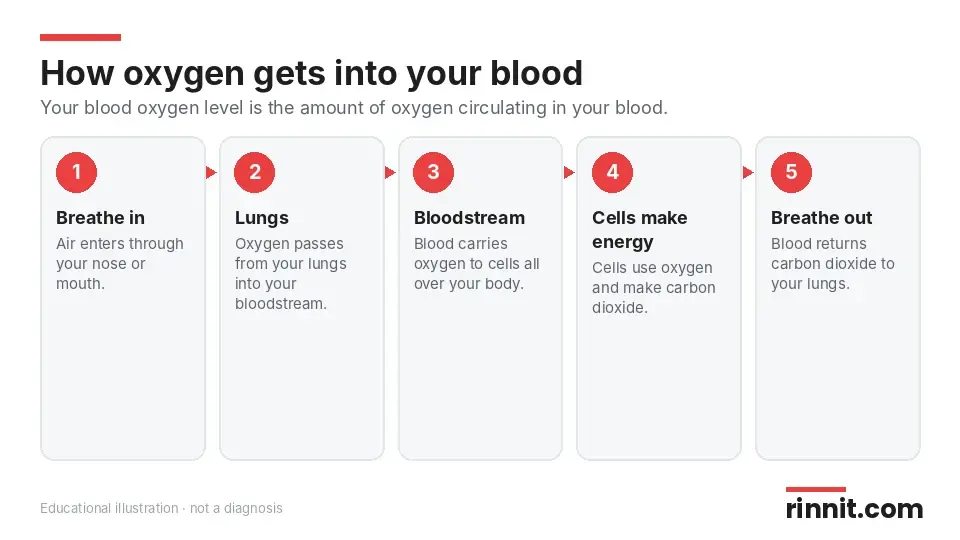
Oxygen enters your body when you breathe in through your nose or mouth. It passes through your lungs into your bloodstream, which carries it to cells all over your body. Your cells need oxygen to make energy for everything from digestion to thinking. [1]
Once your cells use oxygen, they make carbon dioxide. Your blood carries the carbon dioxide back to your lungs, and you breathe it out. [1]
Your body tightly controls how much oxygen is in your blood. A low level, called hypoxemia, can damage organs, especially your brain and heart. It can also be a sign that your lungs or circulatory system aren't working as they should. [1]
How is blood oxygen level tested?
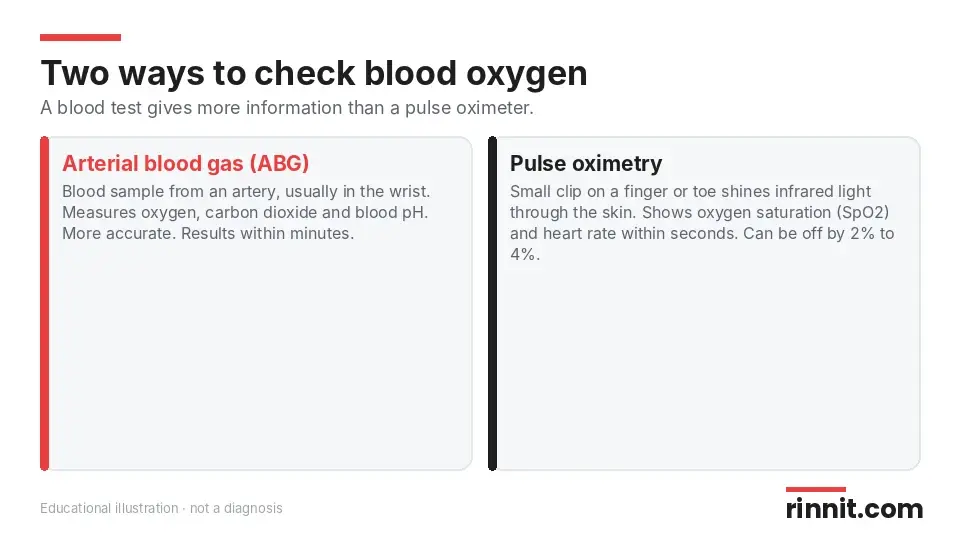
There are two main ways to check your blood oxygen level. A blood test gives much more information than a pulse oximeter. [1]
Test | How it's done | What it shows |
Arterial blood gas (ABG) | Blood sample from an artery, usually in the wrist | Oxygen, carbon dioxide and blood pH (acid-base balance) |
Pulse oximetry | Small clip on a finger or toe | Oxygen saturation (SpO2) and heart rate |
Sources: [1]
Arterial blood gas (ABG) test
An ABG test measures the oxygen and carbon dioxide in your blood. It also checks your blood's pH balance, because too much or too little acid in your blood can harm your health. A specialist called a respiratory therapist usually takes the sample. [1]
Pulse oximetry
A pulse oximeter is a small clip, usually placed on your finger or toe. It shines infrared light through your skin into the blood in your tiny blood vessels. It then measures how much light is reflected off the hemoglobin in your blood to estimate your oxygen saturation. You won't feel anything, and you get a number within seconds. [1]
Pulse oximeters are used often in hospitals, and you can also buy one for home use. [1]
Why would you need a blood oxygen test?
Your provider may check your blood oxygen level if you have a sudden, serious problem such as: [1]
Trouble breathing (including newborns with breathing problems)
A recent head or neck injury that affects breathing
COVID-19 or pneumonia
Carbon monoxide poisoning or a smoke inhalation injury
Repeated nausea or vomiting
A drug overdose
It is also used to check that treatment is working if you have a lung or heart condition such as asthma, chronic obstructive pulmonary disease (COPD), cystic fibrosis or heart disease. If you get oxygen therapy in the hospital, your level is watched to make sure you get the right amount. [1]
What happens during the test?
Before the test
If blood will be taken from your wrist, the respiratory therapist may first do an Allen test. You hold your hand up with a clenched fist while they press on the arteries in your wrist for a few seconds. This checks that both arteries are open and working. [1]
If you are on supplemental oxygen, your provider may turn it off for about 20 minutes before the blood draw. This is called a room air test. It isn't done if you can't breathe without oxygen. [1]
During an ABG blood draw
Most blood tests use a vein, but this one uses an artery, because arterial blood carries more oxygen. Arteries are deeper and surrounded by nerves, so this draw usually hurts more. You may feel lightheaded, dizzy or sick to your stomach. [1]
You sit or lie down, and the respiratory therapist finds an artery, usually inside your wrist. They may use ultrasound to help.
They clean and disinfect the area.
They insert a small needle into the artery. You may feel a sharp pain.
A small amount of blood collects in a syringe.
They remove the needle and press on the site for 5 to 10 minutes, or longer if you take blood thinners.
They place a bandage over the site.
Sometimes the sample comes from an artery in your elbow or groin. In newborns, it may come from the heel or umbilical cord. [1]
During pulse oximetry
The provider clips the pulse oximeter onto a fingertip.
Harmless infrared light passes through your skin.
The device measures light reflected off hemoglobin in your blood.
After a few seconds, it shows your heart rate and oxygen level.
What can make a home reading less accurate?
Nail polish on the finger or toe you are testing
Very bright lighting in the room
Moving a lot while taking the reading
Sources: [1]
After the test
After a blood draw, you may have some bruising or soreness. Your provider may advise you not to lift heavy objects for 24 hours. [1]
What do blood oxygen results mean?
Labs may use slightly different normal ranges, and your report will list that lab's range. For most people, a normal pulse oximeter reading is between 95% and 100%. If you have a lung disease such as COPD or pneumonia, or live at high elevation, your normal level may be lower. Your provider will tell you what levels are acceptable for you. [1]
Pulse oximeter reading (SpO2) | What it means | What to do |
95% to 100% | Normal for most people | No action needed |
92% or lower | Low | Call your healthcare provider |
88% or lower | Dangerously low | Go to the nearest emergency room |
Sources: [1]
Keep in mind that a pulse oximeter is an estimate. Your actual level may be 2% to 4% higher or lower than the reading. For a more accurate result, your provider may check your oxygen with a blood test. [1]

What does an abnormal blood test result mean?
If your blood gas results aren't normal, it may mean you aren't taking in enough oxygen, aren't getting rid of enough carbon dioxide, or have a pH imbalance (your blood is too acidic or too basic). [1]
What causes low blood oxygen?
A lower-than-normal blood oxygen level is called hypoxemia. The lower the level, the higher the risk of harm to tissues and organs. Common causes include: [1]
Heart conditions
Lung conditions such as asthma, emphysema and bronchitis
Strong pain medicines or other problems that slow breathing
Sleep apnea
Inflammation or scarring of lung tissue
High altitudes, where there is less oxygen in the air
A blood oxygen test alone can't find the cause, so your provider will likely order more tests. [1]
Symptoms of low blood oxygen
Symptoms vary from person to person and with how low the level is. They include: [1]
Headache
Shortness of breath
Fast heartbeat
Coughing or wheezing
Confusion
A bluish color in your skin, fingernails or lips
A cherry-red color in your skin, fingernails or lips, which can be a sign of carbon monoxide poisoning
How can you increase your blood oxygen level?
Some simple steps can help raise the oxygen in your blood: [1]
Breathe fresh air. Opening windows or going for a walk outside increases the oxygen you take in.
Quit smoking. Circulation often improves within 2 to 3 weeks of quitting, and shortness of breath eases after 1 to 9 months.
Practice breathing exercises. Pursed-lip breathing and deep belly breathing can open your airways.
These steps may not be enough if you have an underlying illness such as pneumonia or carbon monoxide poisoning. If you have signs of hypoxemia, get to the nearest hospital as soon as possible. [1]
Is a low oxygen level a sign of COVID-19?
Some people with COVID-19 have low blood oxygen, but not everyone does. A normal level doesn't rule out COVID-19, and a low level doesn't mean you have it. The only way to know is to get tested, so don't rely on a pulse oximeter to diagnose COVID-19. [1]
When will you get your results?
Blood gas results are usually ready within minutes. A pulse oximeter shows your level within seconds. [1]
When should you call your doctor?
Call your provider if a home pulse oximeter shows 92% or lower. Go to the nearest emergency room if it shows 88% or lower. If you have a long-term lung condition like COPD or asthma, see your provider regularly and call them if your symptoms change. [1]
Questions to ask your provider
What blood oxygen level is normal for me?
Do I need a pulse oximeter at home, and how often should I check?
What reading should make me call you or go to the ER?
What is causing my low oxygen level?
Do I need oxygen therapy?
Conclusion
Your blood oxygen level shows how well your lungs and heart are delivering oxygen to your body. A finger pulse oximeter gives a quick estimate, while an arterial blood gas test gives a fuller and more accurate picture. For most people, 95% to 100% is normal.
Unless you have a condition that affects your breathing, you don't need to check your oxygen level regularly. If you have trouble breathing or notice signs of low oxygen, contact your provider or get emergency care right away.
Keep learning: Read our guides to pulse oximetry, the arterial blood gas (ABG) test, heart rate and pulmonary function tests. For more on this test, see MedlinePlus: Blood Oxygen Level.
FAQ
What is a normal blood oxygen level?
For most people, a normal pulse oximeter reading is 95% to 100%. [1]
What oxygen level is too low?
Call your provider at 92% or lower on a home pulse oximeter, and go to the emergency room at 88% or lower. [1]
What is low blood oxygen called?
A lower-than-normal blood oxygen level is called hypoxemia. [1]
How is blood oxygen level tested?
It is tested with a finger pulse oximeter or with an arterial blood gas blood test, which is more accurate. [1]
Are pulse oximeters accurate?
They give a good estimate, but the true level may be 2% to 4% higher or lower than the reading. [1]
Does an arterial blood gas test hurt?
It usually hurts more than a regular blood draw because arteries are deeper and surrounded by nerves. [1]
What are the symptoms of low blood oxygen?
Symptoms include headache, shortness of breath, fast heartbeat, coughing, wheezing, confusion and bluish skin, nails or lips. [1]
Can COPD lower my normal oxygen level?
Yes. People with lung diseases such as COPD may have a lower normal level, and their provider sets an acceptable target. [1]
How can I raise my oxygen level naturally?
Breathing fresh air, quitting smoking and doing breathing exercises can help, but they may not be enough if you are ill. [1]
How fast are results ready?
Blood gas results usually come within minutes, and a pulse oximeter gives a reading within seconds. [1]
Related Reading
Learn more in our guide to Hypoxemia: Causes, Symptoms, and Emergency Management.
Learn more in our guide to What Is Chronic Obstructive Pulmonary Disease (COPD)? Symptoms, Causes, Stages, and Treatment.
Learn more in our guide to Pneumonia: Complete Guide to Symptoms, Causes, and Treatment.
Learn more in our guide to What Is Carbon Monoxide Poisoning? Symptoms, Causes and How It's Treated.
Learn more in our guide to Obstructive Sleep Apnea: Symptoms, Causes, and What Actually Helps.
Learn more in our guide to Asthma: Symptoms, Causes, Triggers, Diagnosis & Treatment — Complete Guide.
References
Cleveland Clinic. Blood Oxygen Level: What It Is & How To Increase It. Cleveland Clinic. Last updated February 18, 2022. https://my.clevelandclinic.org/health/diagnostics/22447-blood-oxygen-level
Chu DK, Kim LH, Young PJ, et al. Mortality and morbidity in acutely ill adults treated with liberal versus conservative oxygen therapy (IOTA): a systematic review and meta-analysis. Lancet. 2018;391(10131):1693-1705. PMID 29726345. https://doi.org/10.1016/S0140-6736(18)30479-3
Shi C, Goodall M, Dumville J, et al. The accuracy of pulse oximetry in measuring oxygen saturation by levels of skin pigmentation: a systematic review and meta-analysis. BMC Med. 2022;20(1):267. PMID 35971142. https://doi.org/10.1186/s12916-022-02452-8
Medical disclaimer
This article is for general education only and does not replace advice from a qualified healthcare professional. Talk to your doctor about your own diagnosis and treatment, and seek emergency care right away for severe or sudden symptoms.



Comments