Heart Rate (Pulse): Normal Ranges by Age, How to Check It and Target Heart Rate

Updated: 2 days ago
Written and medically reviewed by Dr. Baraa Alnahhal, MD · Last reviewed: November 2026 · How we review
Quick Answer: What is a normal heart rate?
Your heart rate is the number of times your heart beats in one minute. For adults and teens, a normal resting heart rate is about 60 to 100 beats per minute (bpm), while babies and young children run faster. You can check it by counting your pulse at the wrist for one full minute. [1]
What the research says
A higher resting heart rate is linked with a higher risk of death. A meta-analysis of 46 studies with more than 1.2 million people found that every 10 bpm rise in resting heart rate was tied to a 9% higher risk of death from any cause and an 8% higher risk of cardiovascular death. People with resting rates above 80 bpm had a 45% higher risk of death from any cause than those in the lowest group. (Zhang et al., Canadian Medical Association Journal, 2016) [2]
Children's heart rates change a lot in the first two years. Pooling 69 studies covering heart rate data from 143,346 healthy children, researchers found the typical (median) rate rose from 127 bpm at birth to a peak of 145 bpm at about 1 month, then fell to 113 bpm by age 2. Many older published ranges did not match the real data well. (Fleming et al., The Lancet, 2011) [3]
The "220 minus age" formula may underestimate maximum heart rate in older adults. Combining data from 351 studies with 18,712 people, and testing it in a lab study of 514 healthy adults, researchers found maximum heart rate was best predicted by 208 minus 0.7 times age. It was not affected by sex or usual activity level. (Tanaka et al., Journal of the American College of Cardiology, 2001) [4]
Key takeaways
A normal resting heart rate for adults and teens is 60 to 100 bpm; newborns can be as high as 205 bpm. [1]
You can check your pulse by placing three middle fingers on your wrist and counting beats for one minute. [1]
A resting rate below 60 bpm is called bradycardia, and above 100 bpm is called tachycardia, but context such as fitness or medicine matters. [1]
Your target heart rate for exercise is usually 60% to 85% of your maximum heart rate, roughly 220 minus your age. [1]
Higher resting heart rates are linked with a higher risk of death in large population studies. [2]
Get urgent care if a very slow or fast rate comes with chest pain, shortness of breath, dizziness or palpitations. [1]
What is heart rate?
Heart rate is how many times your heart beats each minute. Your body adjusts it automatically, speeding it up when you exercise, feel excited or get scared, and slowing it down when you rest or relax. [1]
Some health conditions can push your heart rate faster or slower than is normal for you. That is why your heart rate is one of the basic vital signs checked at almost every medical visit. [1]
Is heart rate the same as pulse?
Not exactly. Heart rate is how often your heart squeezes, while your pulse is how often your arteries (the blood vessels carrying blood away from the heart) expand and relax as blood moves through them. [1] In most people the two numbers are the same, so counting your pulse is a reliable way to estimate your heart rate. [1]
Why is your heart rate checked?
A healthcare provider may measure your heart rate: [1]
During your yearly checkup
When you're sick or staying in the hospital
After an injury
Before surgery
You may also want to check it yourself, either to keep an eye on your health or to see how hard you're working during exercise. [1] Knowing your usual resting number makes it easier to notice when something changes.
How is heart rate measured?
There are several ways to measure heart rate, from devices in a clinic to a simple finger check at home. [1]
In a clinic or hospital
Electrocardiogram (EKG or ECG): Records your heart's electrical activity and can show a rate that's too fast, too slow or irregular. [1]
Blood pressure monitors and pulse oximeters: Many of these devices also display your heart rate. [1]
Telemetry: A monitor that continuously tracks your vital signs while you're in the hospital. Some people wear a portable version at home. [1]
At home
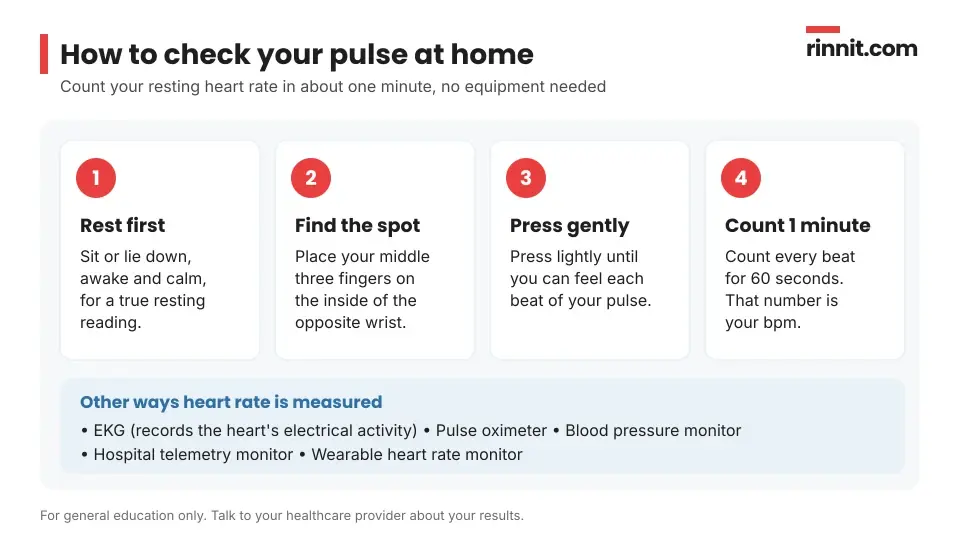
How do you check your pulse yourself?
Checking your pulse takes about a minute and needs no equipment. For a resting reading, sit or lie down and stay awake and calm first. [1]
If a reading seems unusual, think about what you were doing just before you checked. A cup of coffee, a stressful moment or climbing stairs can all raise your number for a while. [1]
What is a normal resting heart rate by age?
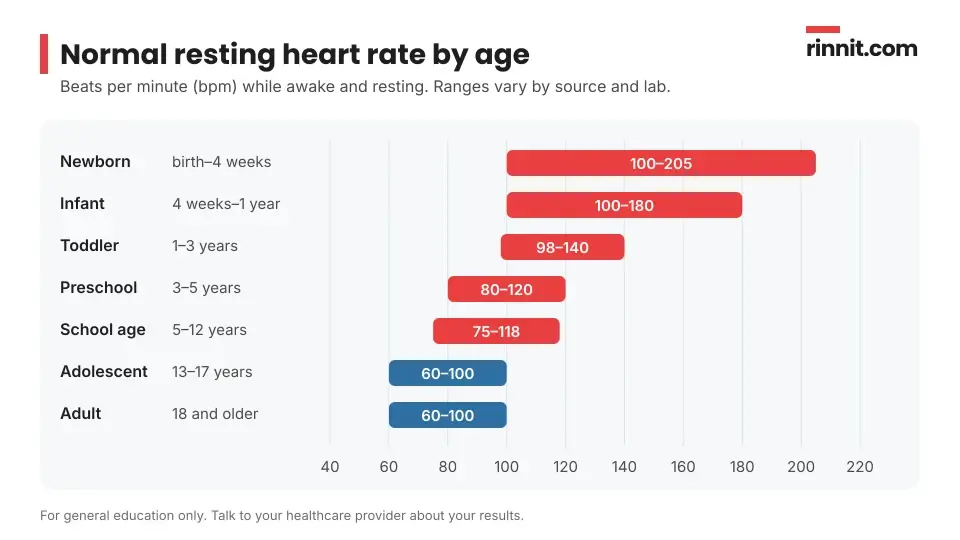
"Resting" means you're awake but sitting or lying down. Your heart rate is usually lower than this while you sleep and higher when you're active. [1] Normal ranges are highest in newborns and slowly come down through childhood: [1]
Age group | Normal resting heart rate |
Newborn (birth to 4 weeks) | 100 to 205 bpm |
Infant (4 weeks to 1 year) | 100 to 180 bpm |
Toddler (1 to 3 years) | 98 to 140 bpm |
Preschool (3 to 5 years) | 80 to 120 bpm |
School age (5 to 12 years) | 75 to 118 bpm |
Adolescent (13 to 17 years) | 60 to 100 bpm |
Adult (18 and older) | 60 to 100 bpm |
Sources: [1]
Ranges vary by source and lab, and research in children shows that heart rate shifts quickly in the first two years of life. [3] Your provider will interpret your number, or your child's, in context.
Your own baseline matters most. If your resting heart rate is usually in the 60s but suddenly stays around 90, something may be causing that change, even though 90 is still within the normal range. [1]
What do high and low heart rate results mean?
For adults, a resting heart rate outside 60 to 100 bpm has a name: [1]
These labels don't always mean something is wrong. Rates in the 40s or 50s are common in athletes and in people who take beta-blockers or calcium channel blockers (medicines that slow the heart). [1] A rate over 100 at rest usually isn't normal, but it can be short-lived, such as during stress or anxiety, so it's worth checking again later. [1]
An arrhythmia is abnormal electrical activity in the heart that can make it beat too fast, too slow or irregularly. Some arrhythmias need treatment to prevent serious complications. [1]
Over the long term, a higher resting heart rate may also say something about your health. In a large meta-analysis, people with resting rates above 80 bpm had a higher risk of death from any cause than people with the lowest rates, even after accounting for other heart risk factors. [2]
What can affect your heart rate?
Many everyday factors can raise or lower your heart rate: [1]
Health conditions: Many chronic conditions affect heart rate. For example, an overactive thyroid can push it above 100 bpm. [1]
Emotions: Stress and anxiety raise your heart rate, while calm and relaxation lower it. [1]
Fitness level: Athletes often have resting rates in the 40s, while being inactive can keep your rate at the higher end of normal. [1]
Medicines: Some medicines speed up or slow down your heart rate. Ask your provider about the ones you take. [1]
Pregnancy: Resting and exercise heart rates are both higher than before pregnancy. [1]
Sleep: Poor sleep can raise your heart rate, and good rest can lower it. [1]
Substances: Alcohol, caffeine and smoking all raise heart rate. [1]
Weight: A body mass index (BMI) above 25 may lead to a higher resting heart rate. [1]
What is a target heart rate for exercise?
Your maximum heart rate is the fastest your heart can beat during hard exercise. Your target heart rate is a safer, effective range for workouts, usually 60% to 85% of your maximum if you exercise regularly. [1]
How to calculate it
Using those steps, here are estimated ranges for common ages (rounded to the nearest beat):
Age | Estimated maximum (220 − age) | Target range (60% to 85%) |
20 | 200 bpm | 120 to 170 bpm |
30 | 190 bpm | 114 to 162 bpm |
40 | 180 bpm | 108 to 153 bpm |
50 | 170 bpm | 102 to 145 bpm |
60 | 160 bpm | 96 to 136 bpm |
70 | 150 bpm | 90 to 128 bpm |
Sources: [1]
This formula is only an estimate, because many factors besides age affect your maximum heart rate. An exercise stress test can give your provider a more accurate number. [1] Research pooling data from more than 18,000 people suggests that 208 minus 0.7 times your age may be more accurate, especially for older adults. [4]

If you're not physically active, talk with a provider before starting a workout routine, especially if you have heart, lung or circulation problems. [1]
When should you call your provider about your heart rate?
What you notice | What to do |
Heart rate below 35 to 40 bpm or above 100 bpm with palpitations, shortness of breath, chest pain or dizziness | Get medical help right away |
Resting rate that's consistently too fast or too slow | Book a visit with your primary care provider |
A pulse that skips or feels irregular | Book a visit with your primary care provider |
Feeling your heartbeat when you aren't checking it | Book a visit with your primary care provider |
A buzzing or vibrating feeling (a "thrill") when you take your pulse | Book a visit with your primary care provider |
Sources: [1]
Your primary care provider may refer you to a cardiologist (heart specialist) if needed. Treating a serious heart problem early lowers the risk of complications later. [1]
How often should you check your heart rate?
Your heart rate is checked routinely at your yearly checkup, so keep up with annual visits. [1] Between visits, checking at home now and then helps you learn your normal range, which makes it easier to spot a real change. [1]
Questions to ask your provider
What is a normal resting heart rate for me?
Could any of my medicines be affecting my heart rate?
Is my heart rate a sign of a rhythm problem that needs testing?
What target heart rate range should I aim for when I exercise?
Would an exercise stress test help find my true maximum heart rate?
Which symptoms with a fast or slow heart rate mean I should get urgent care?
Conclusion
Heart rate is one of the simplest numbers you can track about your health. For most adults, a resting rate of 60 to 100 bpm is normal, and children have higher ranges that come down with age. [1]
Learn your own baseline, check it under the same conditions each time, and use your target range to guide exercise. If a slow or fast rate comes with chest pain, dizziness or trouble breathing, get care right away. [1]
Keep learning: Read our guides to bradycardia (slow heart rate), heart palpitations and normal blood pressure by age. For more, see MedlinePlus's page on pulse.
FAQ
What is a normal heart rate?
For adults and teens, a normal resting heart rate is 60 to 100 beats per minute. Babies and young children have higher normal ranges. [1]
How do I check my pulse?
Place the middle three fingers of one hand on the inside of your opposite wrist, press gently until you feel a beat, and count for one full minute. [1]
Why is heart rate checked?
Providers check it at yearly exams, during illness or hospital stays, after injuries and before surgery. You can also check it to track your health or exercise effort. [1]
How should I prepare to measure my resting heart rate?
Sit or lie down and stay calm and awake first. Caffeine, alcohol, smoking and stress can raise your reading, so keep that in mind. [1]
Does checking your heart rate hurt?
No. A pulse check only uses gentle finger pressure, and devices like pulse oximeters or EKGs are painless. [1]
Is a heart rate below 60 bad?
Not always. A resting rate below 60 bpm is called bradycardia, but rates in the 40s or 50s are common in athletes and people on certain heart medicines. [1]
What is a target heart rate?
It's usually 60% to 85% of your maximum heart rate. Estimate your maximum as 220 minus your age, then multiply by 0.6 and 0.85. [1]
When is a fast or slow heart rate an emergency?
Get help right away if your rate is below 35 to 40 bpm or above 100 bpm and you have chest pain, shortness of breath, dizziness or palpitations. [1]
Does resting heart rate affect long-term health?
Large studies link a higher resting heart rate with a higher risk of death. Rates above 80 bpm carried a 45% higher risk of death from any cause than the lowest rates. [2]
How often should I check my heart rate?
It's measured at your yearly checkup. Checking at home now and then helps you learn your normal range so you can spot changes. [1]
Related Reading
Learn more in our guide to Bradycardia: Slow Heart Rate, Symptoms, Causes, and Treatment.
Learn more in our guide to Atrial Fibrillation (AFib): Symptoms, Causes & Treatment Guide.
Learn more in our guide to Heart Palpitations: Causes, Symptoms & Treatment Guide.
Learn more in our guide to Understanding Vagal Maneuvers: A First-Line Treatment for Fast Heart Rate.
Learn more in our guide to Normal Blood Pressure by Age: What Your Numbers Mean.
References
Cleveland Clinic. Heart Rate: Normal Rates & What To Know. Cleveland Clinic. Last updated June 4, 2026. https://my.clevelandclinic.org/health/diagnostics/heart-rate
Zhang D, Shen X, Qi X. Resting heart rate and all-cause and cardiovascular mortality in the general population: a meta-analysis. CMAJ. 2016;188(3):E53-E63. PMID 26598376. https://doi.org/10.1503/cmaj.150535
Fleming S, Thompson M, Stevens R, et al. Normal ranges of heart rate and respiratory rate in children from birth to 18 years of age: a systematic review of observational studies. Lancet. 2011;377(9770):1011-1018. PMID 21411136. https://doi.org/10.1016/S0140-6736(10)62226-X
Tanaka H, Monahan KD, Seals DR. Age-predicted maximal heart rate revisited. J Am Coll Cardiol. 2001;37(1):153-156. PMID 11153730. https://doi.org/10.1016/s0735-1097(00)01054-8
Medical disclaimer
This article is for general education only and does not replace advice from a qualified healthcare professional. Talk to your doctor about your own diagnosis and treatment, and seek emergency care right away for severe or sudden symptoms.



Comments