Pulse Oximetry: Normal Oxygen Levels, How It Works and What Affects Accuracy

Updated: 2 days ago
Written and medically reviewed by Dr. Baraa Alnahhal, MD · Last reviewed: November 2026 · How we review
Quick Answer: What is pulse oximetry?
Pulse oximetry is a painless test that measures the oxygen level in the blood and the heart rate using a clip on the fingertip. A normal oxygen level is 95% to 100% for all ages. Contact a provider if your reading is 92% or lower at home, and get medical help right away if it's 88% or lower. [1]
What the research says
Hidden low oxygen is more common in Black patients. A meta-analysis of 15 studies covering 732,505 paired readings from 207,464 hospitalized patients found that occult hypoxemia, low blood oxygen missed by a pulse oximeter, was 1.67 times as common in Black patients as in White patients, and 1.39 times as common in several other racial and ethnic groups. (Parr et al., Journal of General Internal Medicine, 2024) [2]
Pulse oximeters tend to read too high in darker skin. A systematic review of 42 studies comparing fingertip readings with arterial blood gas results found consistent evidence that pulse oximeters overestimate oxygen saturation in people with darker skin, especially at lower oxygen levels, which may delay care. (Cotton et al., Clinical Nursing Research, 2025) [3]
Key takeaways
A pulse oximeter uses light to estimate how much oxygen your red blood cells carry and shows your pulse rate. [1]
A normal oxygen saturation is 95% to 100%; readings may be lower with lung disease or at high altitude. [1]
At home, call a provider at 92% or lower and get help right away at 88% or lower. [1]
Dark nail polish, poor circulation, cold skin, carbon monoxide and darker skin can affect accuracy. [1] [3]
An arterial blood gas test is more accurate when an exact oxygen level matters. [1]
What is pulse oximetry?
Pulse oximetry is a quick, painless way to measure your heart rate and the level of oxygen in your blood. Many providers consider it a vital sign. It's used to find low oxygen (hypoxia), and it can warn your provider that your oxygen level is low before you have symptoms. [1]
What is a pulse oximeter?
A pulse oximeter, or pulse ox, is the device that takes the measurement. Often it's a hinged clip that fits over your finger, but it can also be a sensor on tape wrapped around a finger, toe, earlobe or nose, or a wired probe. For babies, it may go on the arm or foot. You can also buy one to use at home. The device can show two or three numbers: oxygen saturation, pulse rate and sometimes signal strength. [1]
When is pulse oximetry used?
Your provider may check your oxygen level with a pulse oximeter during: [1]
Routine check-ups, emergency room visits and hospital stays
Surgery
Lung conditions such as asthma, COPD or lung cancer
COVID-19
Heart failure
Shortness of breath
Sleep apnea
How does a pulse oximeter work?
A pulse oximeter shines light through your finger and analyzes it. By measuring how much light a protein in your red blood cells absorbs, it can tell how much oxygen those cells carry, then does the math and shows you a number. [1]

How do you prepare?
You don't need to do anything to prepare, though you may want to remove dark nail polish so the light can pass through your nail and finger. [1]
What happens during the test?
A provider usually clips the pulse oximeter over your fingertip, though it can also go on your toes, ears, foot, nose or forehead. You may see a harmless red light from the device. At a routine visit, it's removed once a reading appears; in the hospital, it may stay on to check your oxygen nonstop. [1]
What do pulse oximetry results mean?
Results appear within seconds as a percentage of oxygen saturation, along with your pulse. You want to see a number higher than 92%. A normal level is 95% to 100% for all ages. You may have a lower number if you have lung disease or live at a high elevation, and pulse oximeter readings can be slightly higher or lower than results from a blood sample. [1]

Reading | What it means |
95% to 100% | Normal oxygen level for all ages |
92% or lower (at home) | Contact a healthcare provider |
88% or lower | Get medical help right away |
Pulse 60 to 100 beats per minute | Normal resting heart rate for adults |
Sources: [1]
If your oxygen level is low, you may need oxygen therapy, because every cell needs oxygen and too little can damage your organs. [1]
What can affect pulse oximeter accuracy?
Pulse oximetry is safe and noninvasive, but readings can be inaccurate in some situations: [1]
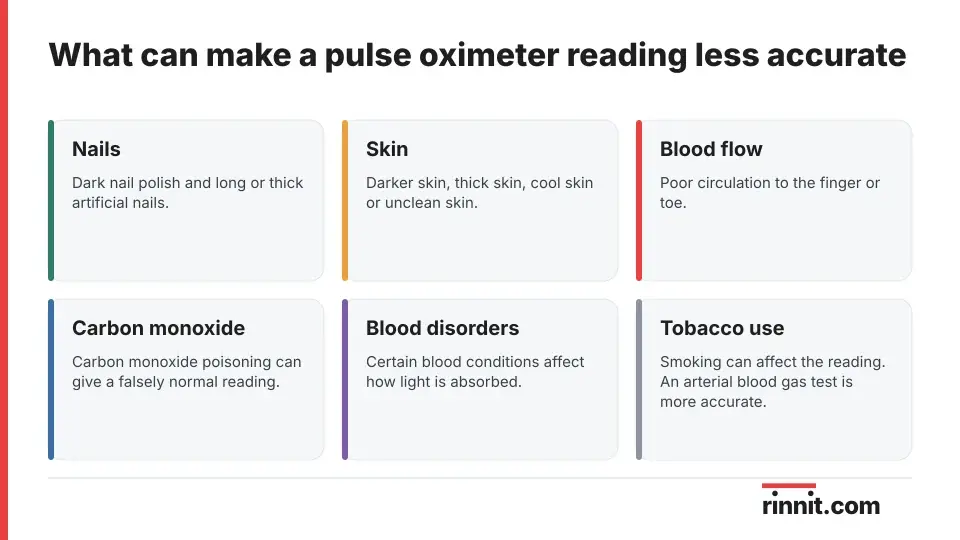
Factor | Examples |
Nails | Dark nail polish; long or thick artificial nails |
Skin | Dark skin, thick skin, cool skin or unclean skin |
Blood flow and blood | Poor circulation; certain blood disorders |
Exposures | Carbon monoxide poisoning; tobacco use |
Sources: [1]
Research shows that pulse oximeters can overestimate oxygen levels in people with darker skin, so low oxygen may be missed more often. If an exact number matters, an arterial blood gas test, which measures oxygen in a blood sample, is more accurate. [1] [2] [3]
What are the risks of pulse oximetry?
The test is safe. Some people react to the adhesive on stick-on sensors, and long-term use can cause blisters or nail damage. If a device left on in the hospital is uncomfortable, ask the care team to move it to another spot. [1]
When should you call your doctor?
Contact a provider if your oxygen saturation is 92% or lower at home, or if your resting heart rate is outside the normal range. Get medical help right away if your oxygen is 88% or lower, because your body isn't getting enough oxygen. Also get emergency care for severe shortness of breath, chest pain, confusion or bluish lips, even if your reading looks normal. [1]
Questions to ask your provider
What oxygen level is normal for me, given my health?
Should I check my oxygen at home, and how often?
Which home pulse oximeter should I use?
Could my skin, nails or circulation affect my readings?
At what number should I call you or seek emergency care?
Conclusion
Pulse oximetry is a fast, painless way to check your blood oxygen and pulse with a small clip, and a normal oxygen level is 95% to 100%. Readings of 92% or lower at home need a call to a provider, and 88% or lower needs urgent care. [1]
Because nails, circulation, carbon monoxide and darker skin can skew results, use the number together with how you feel, and ask about a blood test when accuracy matters. [1] [3]
Keep learning: Read our guides to hypoxemia, COPD and sleep apnea. For more, see the FDA's pulse oximeter basics.
FAQ
What is pulse oximetry?
Pulse oximetry is a painless test that uses a fingertip clip to measure the oxygen level in your blood and your heart rate. [1]
What is a normal pulse oximeter reading?
A normal oxygen saturation is 95% to 100% for all ages. [1]
What oxygen level is too low?
Contact a provider if your reading is 92% or lower at home, and get medical help right away at 88% or lower. [1]
How does a pulse oximeter work?
It shines light through your finger and measures how much light a protein in your red blood cells absorbs to estimate oxygen. [1]
Does nail polish affect pulse oximeter readings?
Yes. Dark nail polish and long or thick artificial nails can make readings less accurate. [1]
Are pulse oximeters accurate on dark skin?
Studies show pulse oximeters can overestimate oxygen levels in people with darker skin, so low oxygen may be missed. [1] [3]
Is pulse oximetry safe?
Yes. It is safe and noninvasive, though adhesive sensors can irritate skin and long-term use can cause blisters. [1]
What is a normal pulse rate on a pulse oximeter?
A normal resting heart rate for adults is 60 to 100 beats per minute. [1]
Is a pulse oximeter as accurate as a blood test?
No. An arterial blood gas test is more accurate; pulse oximeter readings can be slightly higher or lower. [1]
What happens if my oxygen level is low?
You may need oxygen therapy, because too little oxygen can damage your organs. [1]
Related Reading
DLCO Lung Diffusion Test: Purpose, Normal Range and Results explains the breathing test that shows how well oxygen moves into your blood.
Learn more in our guide to Hypoxemia: Causes, Symptoms, and Emergency Management.
Learn more in our guide to What Is Chronic Obstructive Pulmonary Disease (COPD)? Symptoms, Causes, Stages, and Treatment.
Learn more in our guide to Obstructive Sleep Apnea: Symptoms, Causes, and What Actually Helps.
Learn more in our guide to Respiratory Failure: Symptoms, Causes, and Management.
Learn more in our guide to Cyanosis: Symptoms, Causes, Types, Diagnosis, and Treatment — A Complete Guide.
Capillary Refill Time: Normal Range and What a Slow Refill Means explains the quick fingertip test used to spot poor blood flow and shock.
References
Cleveland Clinic. Pulse Oximetry: Function, Method & Readings. Cleveland Clinic. Last updated September 23, 2025. https://my.clevelandclinic.org/health/diagnostics/pulse-oximetry
Parr NJ, Beech EH, Young S, et al. Racial and Ethnic Disparities in Occult Hypoxemia Prevalence and Clinical Outcomes Among Hospitalized Patients: A Systematic Review and Meta-analysis. J Gen Intern Med. 2024;39(13):2543-2553. PMID 39020232. https://doi.org/10.1007/s11606-024-08852-1
Cotton SA, Lee JA, Malhotra A, et al. Do Differences in Skin Pigmentation Affect Detection of Hypoxemia by Pulse Oximetry: A Systematic Review of the Literature. Clin Nurs Res. 2025;34(8):403-411. PMID 41045137. https://doi.org/10.1177/10547738251374746
Medical disclaimer
This article is for general education only and does not replace advice from a qualified healthcare professional. Talk to your doctor about your own diagnosis and treatment, and seek emergency care right away for severe or sudden symptoms.



Comments