Capillary Refill Time: Normal Range and What a Slow Refill Means

Updated: 3 days ago
Written and medically reviewed by Dr. Baraa Alnahhal, MD · Last reviewed: November 2026 · How we review
Quick Answer
Capillary refill time (CRT) is a quick bedside test that shows how well blood is reaching the skin. A provider presses on a fingertip or toe until it turns pale, then counts how long normal color takes to return. Normal is about 3 seconds or less in adults. A slow refill can be an early sign of shock.
What the research says
A slow refill is a red flag in children: a systematic review of 24 studies found that children with prolonged capillary refill time had about a four-fold higher risk of dying, with high specificity (92%) but low sensitivity (35%), so a normal result shouldn't falsely reassure (Fleming S et al., PLoS One, 2015) [2]
CRT can guide shock treatment: in a randomized trial of adults with septic shock, resuscitation aimed at normalizing capillary refill time led to less organ dysfunction at 72 hours and did not do worse than targeting blood lactate, although the drop in 28-day deaths wasn't statistically significant (Hernández G et al., JAMA, 2019) [3]
Key takeaways
A quick fingertip or toe test of blood flow to the skin.
Normal is about 3 seconds or less in adults.
Slow refill can signal shock, dehydration or poor circulation.
A normal result doesn't rule out illness.
Used with pulse, blood pressure and other checks.
Why is it checked?
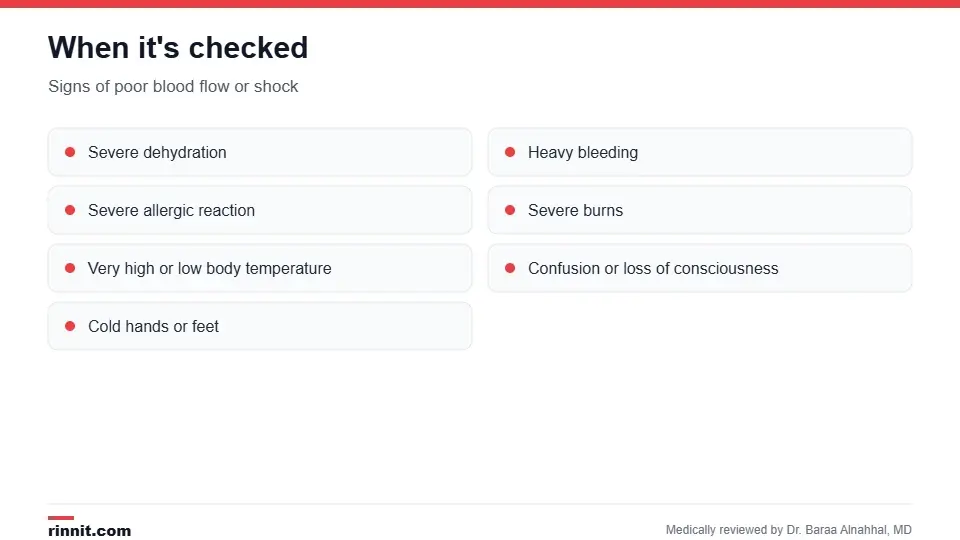
CRT helps spot shock quickly.
CRT helps detect changes in blood flow that can lead to shock, a dangerous drop in blood flow to the organs. Because shock can develop quickly, CRT is useful when there's no time to wait for lab tests or scans. Sources: [1]
Dehydration or heavy bleeding, which can lead to hypovolemic shock.
A severe allergic reaction (anaphylaxis).
Sepsis and distributive shock.
Severe burns, very high body temperature or hypothermia.
Confusion, cold hands and feet, abnormal vital signs or loss of consciousness.
To check whether shock treatment is working. Sources: [1, 3]
How is it done?
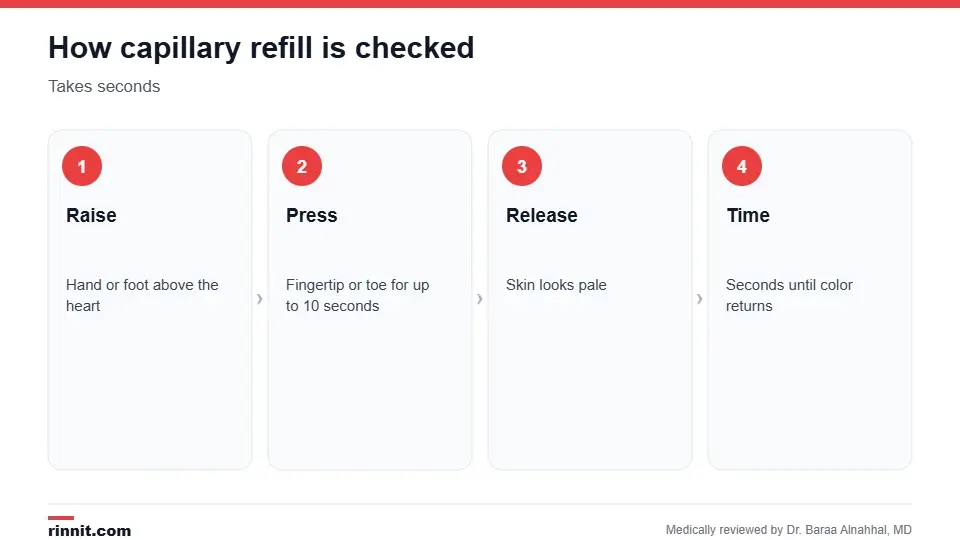
The test takes only seconds.
The provider raises your hand or foot above the level of your heart.
They press on a fingertip or toe for up to 10 seconds, until it looks pale.
They release the pressure.
They count the seconds until the skin returns to the color of the nearby skin. Sources: [1]
If a finger or toe can't be used, or if you're very cold, the skin over the breastbone may be pressed instead. Sources: [1]
Normal capillary refill times
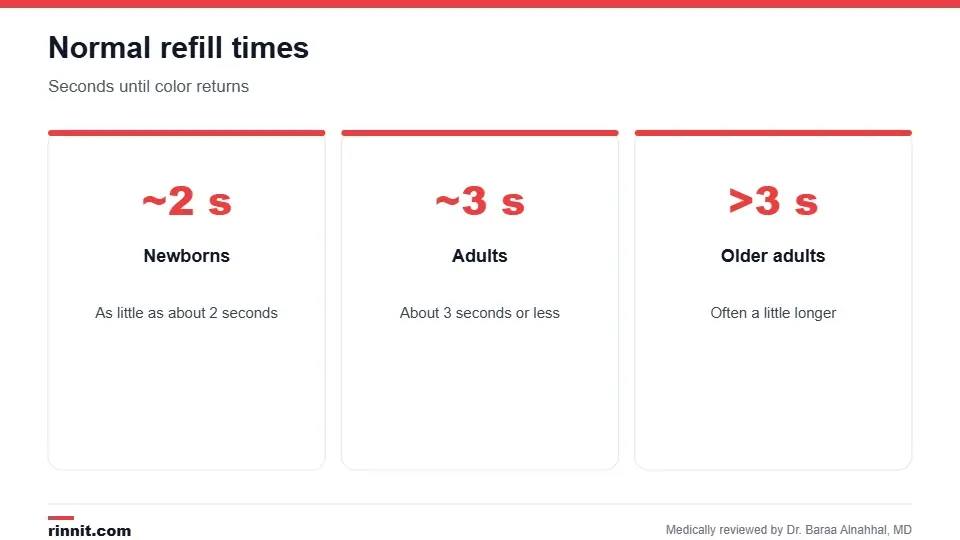
Age affects normal refill time.
Group | Typical refill time |
Newborns | As little as about 2 seconds |
Adults | About 3 seconds or less |
Older adults | Often a little over 3 seconds |
Sources: [1]
What does a slow refill mean?
A slow refill suggests blood isn't reaching the skin well, which may be an early sign of shock or a circulation problem. Your provider will quickly do other tests to find the cause, such as checking pulse oximetry, pulse, blood pressure, alertness and urine output. Sources: [1, 2]
A normal result doesn't rule out illness; it suggests the problem may not be in the circulation, so providers keep looking. Sources: [1, 2]
Treatment if shock is found
Depending on the cause, treatment may include IV fluids, a blood transfusion, oxygen, medicines such as antibiotics or steroids, cooling for overheating, or breathing support. Sources: [1, 3]
Conclusion
Capillary refill time is a simple, seconds-long test that can flag a dangerous drop in blood flow. It's one of many quick checks that help emergency teams act fast.
Keep learning: read about shock first aid and dehydration.
Frequently asked questions
What is capillary refill time?
How long it takes for color to return to a pressed fingertip.
What is a normal capillary refill time?
About 3 seconds or less in adults.
What does a slow refill mean?
Possible poor blood flow or early shock.
How is it done?
A fingertip or toe is pressed and the color return is timed.
Does it hurt?
No.
Is it different in babies?
Newborns can refill in about 2 seconds.
Does age matter?
Yes. Older adults may refill more slowly.
Can a normal result miss a problem?
Yes. It doesn't rule out illness.
What other tests are done?
Pulse, blood pressure, oxygen levels and urine output.
Can I check it at home?
It's a clinical sign; seek care if you're worried about shock.
Related Reading
Essential Shock First Aid: Immediate Actions and Lifesaving Steps what to do if someone is in shock.
Understanding Hypovolemic Shock: Causes, Symptoms, and Emergency Treatment shock from fluid or blood loss.
Dehydration: Symptoms, Causes, Risk Groups & Treatment — Complete Guide a common cause of slow refill.
Sepsis: Complete Guide to Symptoms, Causes, Risks, and Treatment a serious infection that can cause shock.
Pulse Oximetry: Normal Oxygen Levels, How It Works and What Affects Accuracy another quick bedside check.
References
Cleveland Clinic. What Is Capillary Refill Time? Cleveland Clinic. Last updated June 27, 2022. https://my.clevelandclinic.org/health/diagnostics/23376-capillary-refill-time
Fleming S, Gill P, Jones C, et al. The diagnostic value of capillary refill time for detecting serious illness in children: a systematic review and meta-analysis. PLoS One. 2015;10(9):e0138155. PMID 26375953. https://doi.org/10.1371/journal.pone.0138155
Hernández G, Ospina-Tascón GA, Damiani LP, et al. Effect of a resuscitation strategy targeting peripheral perfusion status vs serum lactate levels on 28-day mortality among patients with septic shock: the ANDROMEDA-SHOCK randomized clinical trial. JAMA. 2019;321(7):654-664. PMID 30772908. https://doi.org/10.1001/jama.2019.0071
Medical disclaimer
This article is for general education only and does not replace advice from a qualified healthcare professional. Talk to your doctor about your own diagnosis and treatment, and seek emergency care right away for severe or sudden symptoms.



Comments