Distributive Shock (Vasodilatory Shock): The Most Common Type of Shock — The 3 Types, 14 Symptoms, Causes, Tests, Treatment and Survival Odds — What You Need to Know

Updated: 2 days ago
Medically reviewed by Dr. Baraa Alnahhal, MD | Last reviewed: October 7, 2026
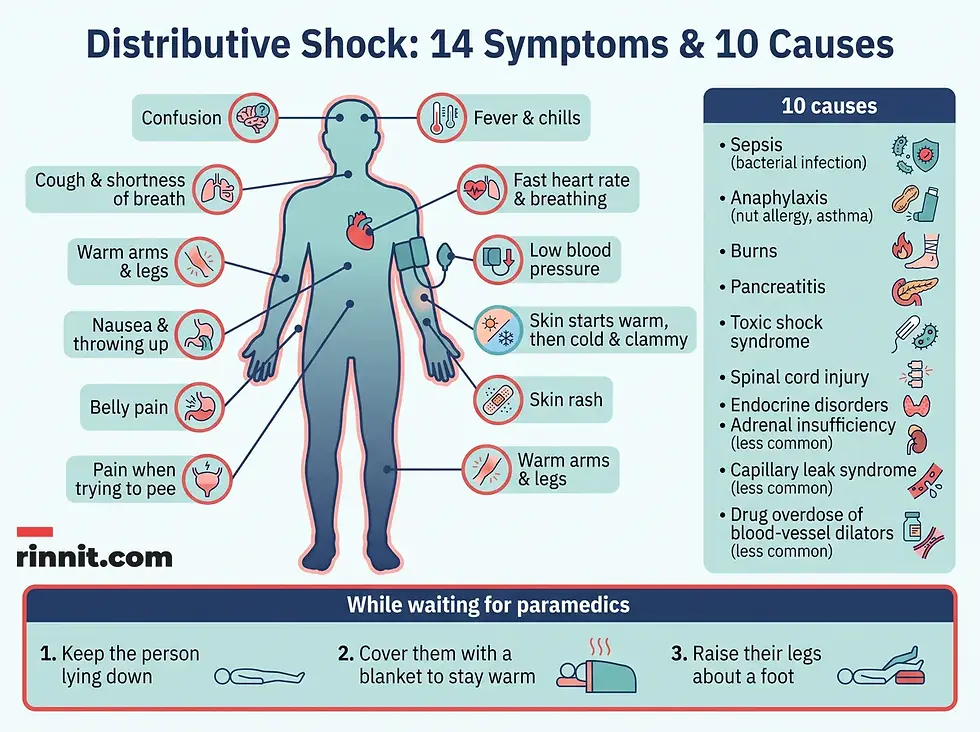
Medical emergency: call 911 now. Anyone with signs of distributive shock should go to the emergency department immediately. Organs stop getting enough blood and oxygen, and without treatment shock is often fatal. Quick treatment gives the best odds of survival. While waiting for paramedics, make sure the person is lying down, put a blanket on them to keep them warm, and raise their legs up about a foot from the ground to improve circulation.

Quick Answer
Distributive shock (vasodilatory shock) is a medical emergency in which extremely dilated blood vessels drop blood pressure so the heart, brain and kidneys do not get enough blood. [1] It is the most common type of shock, and septic shock is its leading cause. [1] [6] Treatment means immediate IV fluids, cause-specific medications and intensive care; untreated, it is often fatal. [1]
What the research says
Septic shock, the leading cause of distributive shock, still kills roughly one in three people within 30 days. A systematic review and meta-analysis of 170 studies found an average 30-day mortality of 34.7% (95% CI 32.6–36.9%) and 90-day mortality of 38.5% (95% CI 35.4–41.5%) for septic shock, versus 24.4% and 32.2% for sepsis. Regional 30-day septic shock mortality was 33.7% in North America, 32.5% in Europe and 26.4% in Australia, and each 1-point rise in the average SOFA score was linked to 1.8–3.3% higher mortality (Bauer et al., Critical Care, 2020) [2].
Vasopressin, one of the blood-pressure-raising drugs used in septic shock, has not been shown to improve 28-day survival, but its side effects differ. An individual patient data meta-analysis of four randomized trials (1,453 patients with septic shock) found no effect of vasopressin versus other vasoactive drugs on 28-day mortality (relative risk 0.98, 95% CI 0.86–1.12). Vasopressin caused more digital ischemia (absolute risk difference 1.7%) but fewer arrhythmias (−2.8%); a lower need for renal replacement therapy (RR 0.86, 95% CI 0.74–0.99) was not robust to sensitivity analyses (Nagendran et al., Intensive Care Medicine, 2019) [3].
About 1 in 10 anaphylaxis reactions needs more than one dose of epinephrine. A systematic review and meta-analysis of 86 studies covering 36,557 anaphylaxis events found that 7.7% of events from any cause (95% CI 6.4–9.1) were treated with multiple epinephrine doses; counting only reactions in which later doses were given by a health care professional, 11.1% of food-induced and 17.1% of venom-induced reactions needed more than one dose (Patel et al., Journal of Allergy and Clinical Immunology, 2021) [4].
What is distributive shock?
Distributive shock, or vasodilatory shock, is a medical emergency where your body cannot get enough blood to your heart, brain and kidneys. This happens because your blood vessels are extremely dilated (flaccid or relaxed), which brings down your blood pressure and cuts down on how much blood can get to your organs. [1] Often the small blood vessels (capillaries) are leaky in distributive shock, resulting in some fluid loss from the circulation. [1] [6] You need to get treatment as soon as possible.
What are the three types of distributive shock?
Type | Cause | Example |
Septic shock | A bacterial infection | A serious infection complication called sepsis gets so bad it leads to septic shock |
Anaphylactic shock | An allergic reaction or asthma attack | An allergic reaction to peanuts leads to anaphylactic shock |
Neurogenic shock | A spinal cord injury that has damaged your nervous system | A diving accident that injures your spinal cord leads to neurogenic shock |
Distributive shock vs. hypovolemic shock
Both are types of shock, meaning your vital organs are not getting enough blood and oxygen. The difference is the cause. Most often, sepsis or a severe allergic reaction causes distributive shock. A large amount of bleeding, or fluid loss from diarrhea or throwing up, causes hypovolemic shock. [1]
Distributive shock vs. septic shock
Septic shock is a type of distributive shock. When you have an infection called sepsis, it can get so bad that it turns into septic shock. [1]
How common is distributive shock?
Distributive shock is the most common of the four types of shock; the others are hypovolemic, cardiogenic and obstructive shock. [1] [5] Each year, 1 million Americans get septic shock, which is the top cause of distributive shock. [1] It can affect anyone.
How does distributive shock affect your body?
Because of unusually flaccid blood vessels, distributive shock lowers the pressure driving blood flow to your organs and prevents your organs from receiving enough blood to do their jobs. This lack of oxygen and nutrients can make your organs stop working correctly. When your organs fail, it can be fatal. [1]
What are the symptoms of distributive shock?
Distributive shock signs and symptoms may vary depending on the cause. They include skin rash, fast heart rate and breathing, low blood pressure, warm arms and legs, skin that starts out warm and then turns cold and clammy, fever, chills, pain in your belly, confusion, cough, shortness of breath, nausea, throwing up, and pain when trying to pee. [1]
Symptom | What you will notice |
Low blood pressure | Abnormally low blood pressure readings |
Fast heart rate and breathing | Racing heartbeat and rapid breaths |
Warm arms and legs | Unusual warmth in the limbs |
Changing skin temperature | Skin that starts out warm, then turns cold and clammy |
Fever and chills | Elevated temperature with shivering chills |
Skin rash | A rash on the skin |
Confusion | Difficulty thinking clearly |
Shortness of breath | Trouble catching your breath |
Cough | Coughing |
Nausea and vomiting | Feeling sick to your stomach and throwing up |
Belly pain | Pain in your abdomen |
Painful urination | Pain when trying to pee |
What causes distributive shock?
The most common causes are sepsis (a bacterial infection) and anaphylaxis (from nut allergies or asthma). [1] [6] But distributive shock has a wider range of triggers.
Cause | Detail |
Sepsis | From a bacterial infection |
Anaphylaxis | From nut allergies or asthma |
Burns | Severe burn injuries |
Pancreatitis | Inflammation of the pancreas |
Toxic shock syndrome | Including cases linked to leaving tampons in too long |
Spinal cord injury | Damages the nervous system |
Endocrine disorders | Hormone system disorders |
Adrenal insufficiency | Less common |
Capillary leak syndrome | Less common |
Drug overdose | Of medicine that dilates your blood vessels; less common |
How is distributive shock diagnosed?
Your provider will want a physical exam and medical history. Often, someone in shock may not be able to speak for themselves. A loved one can tell your provider if you have an allergy or have had anaphylaxis in the past. Knowing what medicines or drugs you are taking will also help your provider with a diagnosis. [1]
What tests will be done?
Your healthcare provider will order the following tests, some of which may be brought to your bedside.
Test | Purpose |
Blood tests | Check organ function and infection markers |
Electrocardiogram (EKG) | Check the heart’s electrical activity |
Chest X-ray | Look at the lungs and heart area |
Ultrasound | Of the heart, lungs and belly |
How is distributive shock treated?
Your healthcare provider will give you IV fluids, like saline. Next, they will give you medicines to address the cause of your vasodilatory shock. Then, they may give you some nourishment, probably through a tube feeding. [1]
You will be in the intensive care unit (ICU) after most likely starting out in the emergency room. Your provider will continue to check your vital signs and watch for side effects of your treatment. You may need a ventilator to help you breathe if you are having trouble breathing on your own. [1]
What medications are used?
Depending on the cause, your provider will give you one or more of the following.
Medication | When used | Purpose |
Vasopressors (epinephrine, vasopressin, norepinephrine, phenylephrine) | All types | Raise your blood pressure |
Antibiotics | If there is an infection | Treat the bacterial infection |
Antihistamines | If you have had an allergic reaction | Counteract the allergic response |
Steroids | For an allergic reaction or severe sepsis | Reduce inflammation |
Albuterol (such as Accuneb or ProAir HFA) | If your shock is due to an asthma attack | Open the airways |
What are the side effects of treatment?
Side effects from vasopressors include abnormal heart rhythm (arrhythmia), anxiety, a collection of fluid in your lungs (pulmonary edema), chest pain, and coronary artery narrowing, which can cause a heart attack. [1] Antibiotics can cause nausea and diarrhea. Albuterol can make you feel nervous, dizzy or sick to your stomach. Antihistamines can make you sleepy or dizzy, and they can also give you a headache or fast heart rate. [1]

What can I expect if I have distributive shock?
If sepsis caused your vasodilatory shock, you may have long-term problems, such as feeling tired, having nightmares or not wanting to eat. [1] No matter what caused your distributive shock, you will need to keep going to follow-up appointments with your provider and keep taking any medicines your provider prescribed.
How long does distributive shock last?
Depending on how sick you are, you may be in the hospital for a few days or weeks as your body recovers. [1]
What is the outlook for distributive shock?
Depending on the cause, the likelihood of dying from distributive shock is 20% to 80%. [1] [6] Without treatment, shock is often fatal. A quick diagnosis and treatment give you the best chance of survival. Older adults and those who drink alcohol have worse odds, as do people who have problems with more than one organ. [1] [6] If your body responds well to fluids and your organs are able to keep working, you will likely have a good outlook. [1]
How can I reduce my risk of distributive shock?
Although you may not be able to avoid some causes, such as infections or burns, you can cut down your risk of shock from known problems.
Prevention step | For whom |
Carry epinephrine (EpiPen Auto-Injector or Adrenalin) and understand how to use it | Anyone with a nut allergy or other serious food allergy |
Keep taking albuterol or salbutamol and do not run out | People who have asthma attacks often |
Do not leave tampons in too long; they can cause toxic shock syndrome, which can lead to distributive shock | Everyone |
Do not dive in shallow water or into water of unknown depth | Everyone |
Do not take too much medicine that opens your blood vessels | Anyone taking vasodilator medication |
Living with distributive shock
How do I take care of myself after the hospital?
After you go home from the hospital, follow your provider’s instructions for caring for yourself. You might have to rest at home for a few days or weeks to feel well enough to go back to work. [1] Keep going to any follow-up appointments and keep taking your prescription medicines.
When should I see my healthcare provider?
Contact your provider if you start feeling worse when you are recovering at home.
When should I go to the ER?
Anyone with signs of distributive shock should go to the emergency department immediately. While waiting for paramedics to arrive, make sure the person with shock is lying down, put a blanket on them to keep them warm, and raise their legs up about a foot from the ground to improve their circulation. [1]
What questions should I ask my doctor?
Am I at risk of getting distributive shock again?
How long do I need to go to follow-up appointments?
Will distributive shock have long-term effects on me?
A note from the experts: Distributive shock is a medical emergency that needs to be treated right away. Getting help quickly is crucial and improves your chances of survival. Be patient with yourself, because recovery takes time. While you are recovering at home, make sure you take the medicines your provider ordered and go to any follow-up appointments.
The Bottom Line: What You Need to Know About Distributive Shock
Distributive shock, also called vasodilatory shock, is the most common of the four types of shock, and the one healthcare providers see most often. The core problem is simple to describe but dangerous in practice: your blood vessels become extremely relaxed and flaccid, blood pressure falls, and your heart, brain and kidneys stop getting the blood, oxygen and nutrients they need. Leaky capillaries add to the problem by draining fluid out of the circulation. [1] [6] Organs that cannot work correctly fail, and organ failure can be fatal.
Three named types cover the main triggers. Septic shock, driven by bacterial infection and sepsis, is the leader: about 1 million Americans develop it every year, and it tops the list of distributive shock causes. [1] Anaphylactic shock follows from severe allergic reactions (a peanut allergy is the example) or asthma attacks. Neurogenic shock results from spinal cord injuries that damage the nervous system, with diving accidents as a classic route. Beyond these, burns, pancreatitis, toxic shock syndrome, endocrine disorders, adrenal insufficiency, capillary leak syndrome and overdoses of vasodilator medications round out the cause list. [1] [6]
Symptoms vary with the cause, but the pattern includes low blood pressure, fast heart rate and breathing, warm arms and legs that later turn cold and clammy, fever, chills, rash, confusion, cough, shortness of breath, nausea, vomiting, belly pain and painful urination. Because a person in shock often cannot speak for themselves, family and bystanders play a key role by reporting known allergies, past anaphylaxis and current medications. Diagnosis combines a physical exam, medical history, blood tests, an EKG, a chest X-ray and ultrasounds of the heart, lungs and belly. [1]
Treatment moves fast: IV saline, then cause-matched medications (vasopressors such as epinephrine, vasopressin, norepinephrine and phenylephrine to lift blood pressure; antibiotics for infection; antihistamines and steroids for allergic reactions; albuterol for asthma) [1], followed by nutrition, usually through tube feeding, in an ICU after an ER start, with a ventilator on standby if breathing fails. Vasopressors carry serious side effects, including arrhythmia, pulmonary edema, chest pain and even heart attack, which is why the ICU watches so closely.
The survival math is sobering but clear: depending on the cause, the likelihood of dying is 20% to 80% [1] [6], and without treatment shock is often fatal. Quick diagnosis and treatment give you the best chance. Older adults, people who drink alcohol and anyone with problems in more than one organ have worse odds, while a body that responds well to fluids with organs still working points to a good outlook. Sepsis survivors should expect possible long-term effects like tiredness, nightmares or loss of appetite, and everyone needs follow-up appointments and their prescribed medicines.
Take the first step. If you have a serious food allergy, carry epinephrine and know how to use it. If asthma attacks are frequent, never let your albuterol run out. Do not leave tampons in too long, do not dive into water of unknown depth, and never take too much vasodilator medication. And if shock ever looks imminent, call 911 now.
Frequently Asked Questions
What is distributive shock?
Distributive shock (vasodilatory shock) is a medical emergency where your body cannot get enough blood to your heart, brain and kidneys because your blood vessels are extremely dilated (flaccid or relaxed), bringing down your blood pressure.
What is vasodilatory shock?
Vasodilatory shock is another name for distributive shock. The dilated blood vessels lower the pressure driving blood flow, and often leaky capillaries lose fluid from the circulation.
Is distributive shock a medical emergency?
Yes. You need treatment as soon as possible, and anyone with signs of distributive shock should go to the emergency department right away. Without treatment, shock is often fatal.
What causes distributive shock?
Sepsis (bacterial infection), anaphylaxis (nut allergies or asthma), burns, pancreatitis, toxic shock syndrome, spinal cord injury, endocrine disorders, adrenal insufficiency, capillary leak syndrome, and drug overdose of medicines that dilate blood vessels.
What is the most common cause of distributive shock?
Septic shock from sepsis is the top cause. Each year, 1 million Americans get septic shock.
How common is distributive shock?
It is the most common of the four types of shock. Septic shock, its leading cause, affects 1 million Americans per year.
What are the four types of shock?
Distributive, hypovolemic, cardiogenic and obstructive shock. Distributive is the most common.
What is the difference between distributive shock and hypovolemic shock?
In both, vital organs do not get enough blood and oxygen. Distributive shock is most often caused by sepsis or a severe allergic reaction. Hypovolemic shock is caused by a large amount of bleeding or fluid loss from diarrhea or throwing up.
What is the difference between distributive shock and septic shock?
Septic shock is a type of distributive shock. When sepsis gets bad enough, it turns into septic shock.
What are the three types of distributive shock?
Septic shock (bacterial infection), anaphylactic shock (allergic reaction or asthma attack) and neurogenic shock (spinal cord injury).
What causes septic shock?
A bacterial infection: sepsis that gets so bad it leads to septic shock.
What causes anaphylactic shock?
A severe allergic reaction (for example, to peanuts) or an asthma attack.
What causes neurogenic shock?
A spinal cord injury that damages your nervous system, for example from a diving accident.
What are the symptoms of distributive shock?
Skin rash, fast heart rate and breathing, low blood pressure, warm arms and legs, skin that starts warm then turns cold and clammy, fever, chills, belly pain, confusion, cough, shortness of breath, nausea, throwing up, and pain when trying to pee.
Why do the legs feel warm in distributive shock?
Because the blood vessels are extremely dilated and relaxed, arms and legs can feel warm early on, and the skin may then turn cold and clammy.
How is distributive shock diagnosed?
With a physical exam and medical history (a loved one can report allergies or past anaphylaxis if the person cannot speak), plus blood tests, an EKG, a chest X-ray and ultrasounds of the heart, lungs and belly. Some tests can be done at the bedside.
What is the first treatment for distributive shock?
IV fluids, such as saline, followed by medicines that address the cause.
What medications are used to treat distributive shock?
Vasopressors (epinephrine, vasopressin, norepinephrine, phenylephrine) to raise blood pressure; antibiotics if there is an infection; antihistamines for allergic reactions; steroids for allergic reactions or severe sepsis; and albuterol if the shock is due to an asthma attack.
What are vasopressors?
Medicines that raise blood pressure. Epinephrine, vasopressin, norepinephrine and phenylephrine are the ones providers use for distributive shock.
What are the side effects of vasopressors?
Abnormal heart rhythm (arrhythmia), anxiety, fluid collection in the lungs (pulmonary edema), chest pain, and coronary artery narrowing, which can cause a heart attack.
What are the side effects of the other shock medications?
Antibiotics can cause nausea and diarrhea. Albuterol can make you feel nervous, dizzy or sick to your stomach. Antihistamines can cause sleepiness, dizziness, headache or fast heart rate.
Will I need the ICU?
Most people with distributive shock are in the intensive care unit after likely starting in the emergency room, and some need a ventilator to breathe.
What is the survival rate for distributive shock?
Depending on the cause, the likelihood of dying is 20% to 80%. Without treatment, shock is often fatal. A quick diagnosis and treatment give you the best chance of survival.
Who has the worst odds of surviving distributive shock?
Older adults, people who drink alcohol, and people with problems in more than one organ.
How long is the hospital stay?
Depending on how sick you are, a few days or weeks.
Can distributive shock cause long-term problems?
If sepsis was the cause, you may have long-term problems such as feeling tired, having nightmares or not wanting to eat. Follow-up appointments and prescribed medicines are needed no matter the cause.
What should I do while waiting for paramedics?
Make sure the person is lying down, put a blanket on them to keep them warm, and raise their legs up about a foot to improve circulation.
Can distributive shock be prevented?
Not all causes (like infections or burns) can be avoided, but you can carry epinephrine for serious food allergies, keep taking albuterol for frequent asthma attacks, avoid leaving tampons in too long, avoid diving into shallow or unknown-depth water, and never take too much medicine that opens your blood vessels.
How do I care for myself after leaving the hospital?
Follow your provider’s instructions, rest at home for a few days or weeks before returning to work, keep all follow-up appointments and keep taking your prescription medicines. Contact your provider if you start feeling worse during recovery.
What questions should I ask my doctor?
Am I at risk of getting distributive shock again? How long do I need to go to follow-up appointments? Will distributive shock have long-term effects on me?
Related reading on Rinnit
Sources
Cleveland Clinic. Distributive Shock. Cleveland Clinic. Last updated April 16, 2022. https://my.clevelandclinic.org/health/diseases/22762-distributive-shock
Bauer M, Gerlach H, Vogelmann T, et al. Mortality in sepsis and septic shock in Europe, North America and Australia between 2009 and 2019- results from a systematic review and meta-analysis. Crit Care. 2020;24(1):239. PMID 32430052. https://doi.org/10.1186/s13054-020-02950-2
Nagendran M, Russell JA, Walley KR, et al. Vasopressin in septic shock: an individual patient data meta-analysis of randomised controlled trials. Intensive Care Med. 2019;45(6):844-855. PMID 31062052. https://doi.org/10.1007/s00134-019-05620-2
Patel N, Chong KW, Yip AYG, et al. Use of multiple epinephrine doses in anaphylaxis: A systematic review and meta-analysis. J Allergy Clin Immunol. 2021;148(5):1307-1315. PMID 33862009. https://doi.org/10.1016/j.jaci.2021.03.042
Standl T, Annecke T, Cascorbi I, et al. The Nomenclature, Definition and Distinction of Types of Shock. Dtsch Arztebl Int. 2018;115(45):757-768. PMID 30573009. https://doi.org/10.3238/arztebl.2018.0757
Smith N, Lopez RA, Silberman M. Distributive Shock. In: StatPearls [Internet]. Treasure Island (FL): StatPearls Publishing; last update July 24, 2023. PMID 29261964. https://pubmed.ncbi.nlm.nih.gov/29261964/
Medical disclaimer
This article is provided for general educational purposes only and is not a substitute for professional medical advice, diagnosis or treatment. Distributive shock is a life-threatening medical emergency: if you or someone else shows signs of shock (low blood pressure, confusion, fast heart rate, cold and clammy skin, difficulty breathing), call 911 immediately. Only emergency medical teams and qualified healthcare providers can diagnose and treat shock.



Comments