Pulmonary Function Tests (PFTs): Types, Preparation and What Your Results Mean

Updated: 2 days ago
Written and medically reviewed by Dr. Baraa Alnahhal, MD · Last reviewed: November 2026 · How we review
Quick Answer: What are pulmonary function tests?
Pulmonary function tests (PFTs) are noninvasive breathing tests that show how well your lungs work. They measure how much air you move in and out, how well gas passes from your lungs into your blood and how your lungs cope with exercise. Most tests take 15 to 45 minutes, don't hurt, and results come back within a few days. [1]
What the research says
Breathing tests often find lung disease that has never been diagnosed. In a review of primary care studies, 14% to 26% of smokers with breathing symptoms had COPD on spirometry but no diagnosis in their records. About 1 in 4 people already using inhalers met the spirometry criteria without a COPD diagnosis, and 25% to 50% of recorded COPD cases showed no airflow blockage when retested. (Perret et al., BMJ Open Respiratory Research, 2023) [2]
A "reduced but not blocked" spirometry pattern is common worldwide. Pooling 33 studies, about 12% of people had preserved ratio impaired spirometry (PRISm), meaning lower breathing numbers without the usual airway-narrowing pattern. It was more common in low- and middle-income countries (19%) than in high-income countries (11%), and diabetes was a significant risk factor. (Robertson et al., Chest, 2025) [3]
That pattern is linked to a higher risk of death, even without COPD. Across 8 cohort studies including 40,699 people with PRISm, the pattern was tied to a 71% higher risk of death from any cause, 57% higher risk of heart-related death and 97% higher risk of lung-related death, compared with normal spirometry. (Yang et al., European Respiratory Review, 2023) [4]
Key takeaways
PFTs are a group of breathing tests, including spirometry, lung volume testing, lung diffusion testing, exercise testing and the methacholine challenge. [1]
They help diagnose and track conditions such as asthma, COPD, pulmonary fibrosis, weak breathing muscles and a narrowed windpipe. [1]
To prepare, wear loose clothing and avoid tobacco, heavy meals, caffeine and hard exercise before the test. Your provider may ask you to pause breathing medicines. [1]
You can't fail a PFT. Your results are compared with typical values for people of your age, height, weight and sex. [1]
Spirometry often uncovers lung disease that hasn't been diagnosed yet, especially in smokers with symptoms. [2]
What are pulmonary function tests?
Pulmonary function tests, also called lung function tests or PFTs, are a set of breathing tests. They look at how much air your lungs hold, how fast you can move air in and out, and how well oxygen passes from your lungs into your bloodstream. [1]
The tests are noninvasive (nothing goes inside your body). Most involve breathing through a mouthpiece while a soft clip keeps your nose closed, so all the air goes through the machine. [1]
What are the different types of pulmonary function tests?
Your provider may order one test or several, depending on your symptoms and what they want to learn. [1]
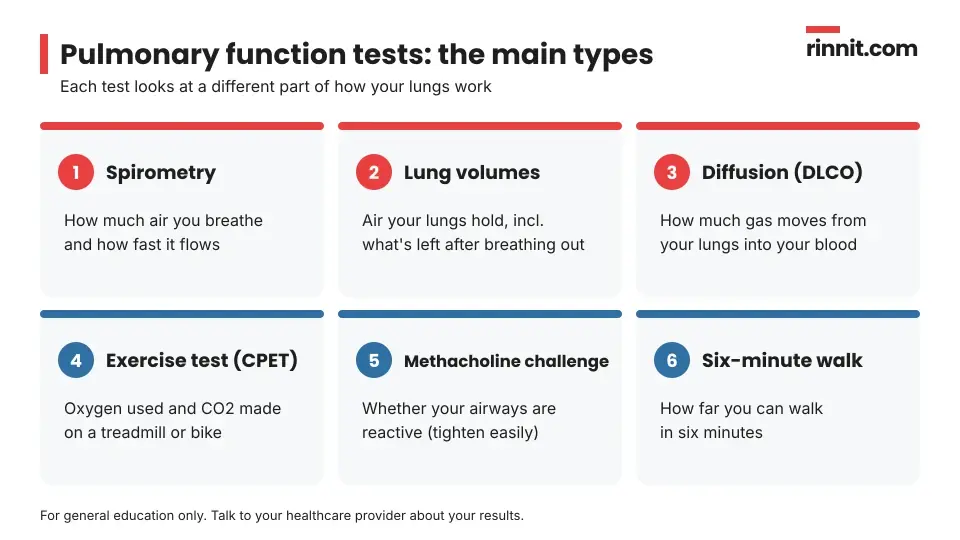
Test | What it measures | What you do |
Spirometry | How much air you breathe and how fast it flows | Take a deep breath, then blow out as hard and as long as you can |
Body plethysmography (lung volumes) | How much air your lungs hold, including the air left after you breathe out fully | Sit in a clear, closed booth and breathe or pant into a mouthpiece |
Lung diffusion test (DLCO) | How much gas moves from your lungs into your blood | Breathe in a tiny, safe amount of carbon monoxide |
Cardiopulmonary exercise test (CPET) | How much oxygen you use and carbon dioxide you make during exercise | Walk on a treadmill or pedal a stationary bike while being monitored |
Methacholine challenge (bronchoprovocation) | Whether your airways are reactive (tighten easily) | Breathe in a substance, then repeat breathing tests |
Six-minute walk test | How far you can walk in six minutes | Walk back and forth along a hallway or room |
Sources: [1]
Why would I need a pulmonary function test?
Your provider may suggest PFTs if you have breathing symptoms that need explaining. These include: [1]
A cough, especially one that brings up mucus
Shortness of breath or trouble taking a deep breath
Wheezing (a whistling sound when you breathe)
Chest tightness, pain or pressure
The tests can show whether your airways are narrowed, whether your lungs or breathing muscles are weak, or whether less oxygen than expected is reaching your blood. [1]
PFTs are also used to check whether you're healthy enough for surgery, whether a treatment is working, whether a medicine improves your breathing, and how tobacco or substances in your environment have affected your lungs. [1]
Conditions PFTs can help diagnose
Asthma
Chronic obstructive pulmonary disease (COPD)
Pulmonary fibrosis (scarring of lung tissue)
Weak breathing muscles
Narrowing of the trachea (windpipe)
Sources: [1]
Testing matters because lung disease is easy to miss. In primary care research, 14% to 26% of smokers with breathing symptoms met the spirometry criteria for COPD but had never been told they had it. [2]
How do I prepare for a pulmonary function test?
A little planning helps you get accurate results. Follow any specific instructions your care team gives you. [1]

Before your test | Why it helps |
Ask whether to pause your breathing medicines | Some medicines change your results, so your provider may ask you to stop them for a short time |
Wear loose, comfortable clothing | Tight clothes can squeeze your chest and limit deep breaths |
Skip tobacco | Smoking can affect how your lungs perform on the day |
Avoid a heavy meal | A full stomach can make deep breathing harder |
Avoid caffeine (coffee, tea, soda, chocolate) | Caffeine can affect your breathing results |
Avoid intense exercise | Hard activity beforehand can change your results |
Sources: [1]
Never stop a prescribed medicine on your own. Always check with your provider first, and bring your rescue inhaler if you have one.
What happens during a pulmonary function test?
A specially trained respiratory therapist usually runs the tests, either in a hospital or a provider's office. [1]
The therapist records your height, weight, age and sex so your results can be compared with typical values for people like you. [1]
You sit upright and put a soft clip on your nose, then seal your lips around a mouthpiece. [1]
The therapist coaches you through each breathing pattern, such as a deep breath followed by a hard, long breath out. [1]
You repeat some steps a few times, because consistent results are more accurate. You can rest between tries. [1]
For an exercise test, you walk or cycle while your heart rate, blood pressure and blood oxygen are tracked. [1]

How long does it take?
Most PFT sessions last 15 to 45 minutes, depending on how many tests you need. Tell the therapist if you feel tired, since you can take breaks. [1]
Does a pulmonary function test hurt?
No. PFTs aren't painful, though the deep, forceful breathing can leave you feeling dizzy or lightheaded for a moment. Let the therapist know if this happens. [1]
What do pulmonary function test results mean?
Your numbers are compared with typical results for people of the same age, height, weight and sex. This comparison is often reported as a z-score (how far your result sits from the expected value). Expected values and ranges vary by lab. [1]
You can't "fail" a PFT. If your results fall outside the expected range, your provider may order more tests to find the cause. [1]
Patterns your provider may look for
Narrowed airways: air flows out more slowly than expected, as can happen with asthma or COPD. [1]
Restriction: your lungs don't fill fully when you breathe in. A restrictive spirometry pattern is also a risk factor for heart problems, including heart failure. [1]
Reduced gas transfer: less oxygen than expected passes from your lungs into your blood. [1]
Lower numbers without airway narrowing: this pattern, called preserved ratio impaired spirometry (PRISm), affects about 12% of people worldwide and is linked to a higher risk of heart- and lung-related death. [3] [4]
Your results usually arrive within a few days, sometimes at a follow-up visit. Your provider will explain what they mean for you alongside your symptoms and history. [1]
Are there any risks or side effects?
PFTs are generally safe. Still, a few side effects are possible: [1]
Possible effect | What to know |
Dizziness or lightheadedness | Comes from deep, forceful breathing and usually passes quickly |
Asthma or COPD symptoms | Testing can trigger them, so rescue medicines are kept on hand |
Faster heart rate | Tell your provider if you've had a recent heart attack or have another heart condition |
Collapsed lung | Very rare |
Sources: [1]
When should I call my healthcare provider?
Contact your provider if: [1]
You haven't heard about your results after a few days
You notice changes in your breathing
You have questions about a new diagnosis or your next steps
If you suddenly can't breathe, have severe chest pain or your lips turn blue, get emergency care right away.
How often do you need a pulmonary function test?
There's no single schedule. If you're diagnosed with a lung condition, you may need regular PFTs to track your lungs over time and see how well your treatment is working. [1]
Repeat testing can also correct the record. In one review, only 50% to 75% of people with COPD in their health records showed airflow blockage when retested with spirometry. [2]
Questions to ask your provider
Which pulmonary function tests am I having, and why?
Should I stop any of my inhalers or other medicines before the test, and for how long?
Can I eat or drink anything on the day of my test?
What do my results show compared with expected values for someone like me?
Do my results point to narrowed airways, restriction or another pattern?
Will I need more tests, and how often should I repeat my PFTs?
Could my lung results affect my heart health?
Conclusion
Pulmonary function tests give your provider a clear, painless look at how your lungs move air and pass oxygen to your blood. With simple preparation, such as loose clothes and no caffeine, tobacco or heavy meals beforehand, most people finish in under an hour. [1]
There's no pass or fail. Your results are a starting point for answers, and research shows they often reveal lung problems that would otherwise go unnoticed. [2] If you have a lasting cough, wheezing or breathlessness, ask your provider whether PFTs are right for you.
Keep learning: Read our guides to asthma, pulmonary fibrosis and chronic bronchitis. For more, see MedlinePlus's page on pulmonary function tests.
FAQ
What is a pulmonary function test?
It's a group of noninvasive breathing tests that measure how well your lungs move air and pass oxygen into your blood. [1]
Why would a doctor order a PFT?
To look into symptoms like cough, wheezing, shortness of breath or chest tightness, and to diagnose or monitor conditions such as asthma, COPD and pulmonary fibrosis. [1]
How do I prepare for a pulmonary function test?
Wear loose clothing and avoid tobacco, heavy meals, caffeine and hard exercise beforehand. Your provider may ask you to pause breathing medicines. [1]
Does a pulmonary function test hurt?
No. It isn't painful, though deep, forceful breathing may make you briefly dizzy or lightheaded. [1]
How long does a pulmonary function test take?
Usually 15 to 45 minutes, depending on how many tests you need. You can take breaks. [1]
What is a normal PFT result?
Results are compared with typical values for people of your age, height, weight and sex, often as a z-score. Expected ranges vary by lab, and you can't fail the test. [1]
Are pulmonary function tests safe?
Yes, they're generally safe. They can trigger asthma or COPD symptoms, raise your heart rate and, very rarely, cause a collapsed lung. [1]
Can I use my inhaler before a PFT?
Ask your provider. They may want you to stop some breathing medicines for a short time before testing. [1]
How often should I have a pulmonary function test?
It depends on your health. If you have a lung condition, you may need regular tests to track your lungs and your treatment. [1]
When should I call my doctor after a PFT?
Call if you haven't heard your results within a few days or if you notice any changes in your breathing. [1]
Related Reading
DLCO Lung Diffusion Test: Purpose, Normal Range and Results explains the breathing test that shows how well oxygen moves into your blood.
FEV1 (Forced Expiratory Volume): What Your Lung Test Numbers Mean explains the key spirometry number and what a low FEV1 means.
Learn more in our guide to Asthma: Symptoms, Causes, Triggers, Diagnosis & Treatment — Complete Guide.
Learn more in our guide to Pulmonary Fibrosis: Symptoms, Causes, Diagnosis, and Treatment Explained.
Learn more in our guide to Interstitial Lung Disease: What It Is, What Causes the Scarring, and What Treatment Can Actually Do.
Learn more in our guide to Sarcoidosis: Complete Guide to the Condition That Forms Granulomas Throughout the Body.
Learn more in our guide to Bronchiectasis: The Widened Airways Condition That Makes Mucus Hard to Clear — Explained.
Learn more in our guide to Chronic Bronchitis: Symptoms, Causes, Treatment and Outlook.
Body Plethysmography: What It Measures, How It's Done and Results explains the booth-based lung test that measures total lung capacity, residual volume and airway resistance.
Methacholine Challenge Test: How It Diagnoses Asthma, How to Prepare and What Results Mean explains the breathing challenge test used to confirm or rule out asthma.
Cardiopulmonary Exercise Test (CPET): What It Measures, How to Prepare and What to Expect explains the exercise test that measures heart, lung and muscle performance together.
Sniff Test: Diaphragm Fluoroscopy for Weakness and Paralysis explains the X-ray test that checks how the diaphragm moves.
Sweat Test for Cystic Fibrosis: How It Works and What Results Mean explains the sweat chloride test used to diagnose cystic fibrosis.
References
Cleveland Clinic. Pulmonary Function Test (PFT): Purpose, Procedure & Results. Cleveland Clinic. Last updated July 28, 2026. https://my.clevelandclinic.org/health/diagnostics/17966-pulmonary-function-testing
Perret J, Yip SWS, Idrose NS, et al. Undiagnosed and 'overdiagnosed' COPD using postbronchodilator spirometry in primary healthcare settings: a systematic review and meta-analysis. BMJ Open Respir Res. 2023;10(1):e001478. PMID 37130651. https://doi.org/10.1136/bmjresp-2022-001478
Robertson NM, Centner CS, Tejwani V, et al. Preserved Ratio Impaired Spirometry Prevalence, Risk Factors, and Outcomes: A Systematic Review and Meta-Analysis. Chest. 2025;167(6):1591-1614. PMID 39742912. https://doi.org/10.1016/j.chest.2024.12.025
Yang S, Liao G, Tse LA. Association of preserved ratio impaired spirometry with mortality: a systematic review and meta-analysis. Eur Respir Rev. 2023;32(170):230135. PMID 37914194. https://doi.org/10.1183/16000617.0135-2023
Medical disclaimer
This article is for general education only and does not replace advice from a qualified healthcare professional. Talk to your doctor about your own diagnosis and treatment, and seek emergency care right away for severe or sudden symptoms.



Comments