FEV1 (Forced Expiratory Volume): What Your Lung Test Numbers Mean

Updated: 3 days ago
Written and medically reviewed by Dr. Baraa Alnahhal, MD · Last reviewed: November 2026 · How we review
Quick Answer
FEV1 (forced expiratory volume in one second) is the amount of air you can forcefully blow out in the first second after taking the deepest breath you can. It's measured with spirometry. Healthy lungs push out more than 70% of their air in that first second. A low FEV1 can point to asthma, COPD or restrictive lung disease.
What the research says
Low lung function early in life predicts COPD: among people followed for about 22 years, 26% of those with an FEV1 below 80% of predicted before age 40 developed COPD, compared with 7% of those with a normal early FEV1 (Lange P et al., New England Journal of Medicine, 2015) [2]
Quitting smoking slows FEV1 loss: a classic long-term study of working men showed that FEV1 falls gradually with age, smoking causes faster, irreversible decline in susceptible people, and stopping smoking returns the rate of loss to normal (Fletcher C et al., British Medical Journal, 1977) [3]
Key takeaways
FEV1 is how much air you can force out in the first second of a big breath.
It's measured during spirometry, a type of pulmonary function test.
Healthy lungs exhale more than 70% of their air in the first second.
A low FEV1/FVC ratio suggests obstructive disease, such as asthma or COPD.
The test is safe and painless, though some people feel briefly lightheaded.
What is FEV1?
When you breathe out as hard and fast as you can, most air leaves your lungs in the first second. If your airways are narrowed or inflamed, air flows out more slowly, so less leaves in that first second and FEV1 drops. Providers use FEV1 to help diagnose lung disease, see whether it's getting worse and check how well treatment is working. It can't be measured at home; a peak flow meter is sometimes used between visits. Sources: [1]
FEV1, FVC and the FEV1/FVC ratio

These three numbers together describe how your lungs empty.
Measurement | What it means | Typical finding |
FEV1 | Air forced out in the first second | Compared with a predicted value for your age, height and sex |
FVC | Total air forced out after a deep breath | Lower in restrictive disease |
FEV1/FVC ratio | Share of air exhaled in the first second | Normal is usually above 70% |
Sources: [1]
Why it's done
Diagnosing asthma, COPD and other lung diseases.
Checking whether a lung condition is getting worse.
Seeing how well inhalers or other medicines are working.
Assessing breathing before surgery or for certain jobs. Sources: [1]
How to prepare
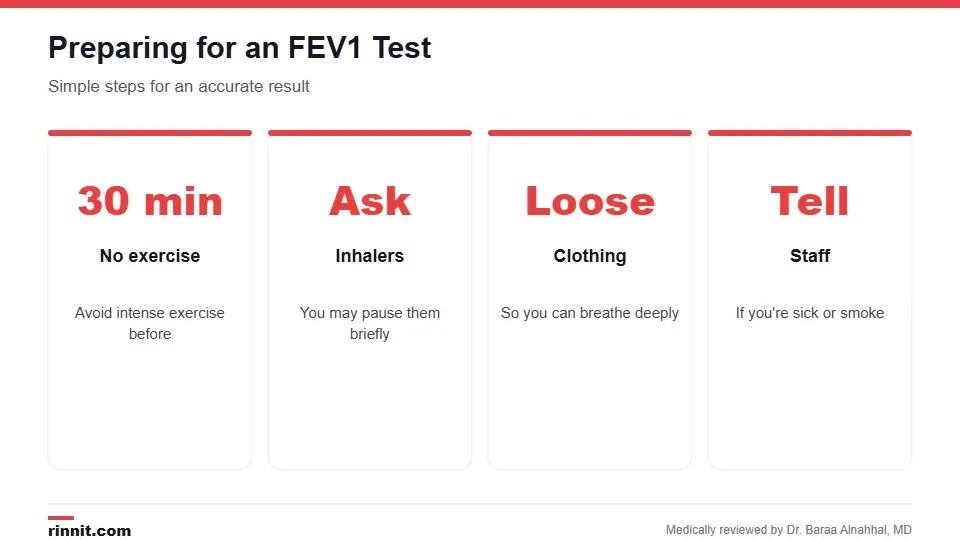
Simple steps help you get an accurate result.
Avoid intense exercise for at least 30 minutes before the test.
Ask whether to stop your breathing medicines for a short time beforehand.
Wear loose clothing so you can breathe deeply.
Tell your provider if you're sick or smoke. Sources: [1]
What happens during the test
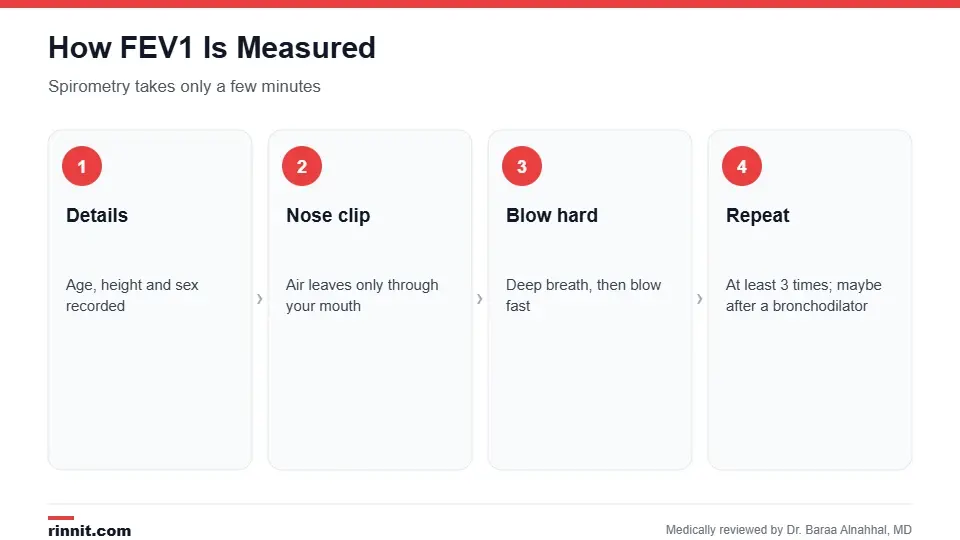
The breathing part takes only a few minutes.
Staff record your age, height and sex, which are used to calculate your predicted values.
A soft clip is placed on your nose so air only leaves through your mouth.
You take the deepest breath you can, seal your lips around the mouthpiece and blow out as hard and fast as possible.
You repeat this at least three times.
You may inhale a bronchodilator medicine and repeat the test to see whether your airways open up. Sources: [1]
The test is done by a respiratory therapist, nurse or physician, often as part of a full set of pulmonary function tests. Sources: [1]
Risks
FEV1 testing is very safe and painless. Some people feel tired, dizzy or lightheaded from the repeated hard breaths, and you can take breaks between tries. Sources: [1]
What the results mean

A lung specialist interprets the pattern.
Pattern | What you may see | Example conditions |
Normal | FEV1 and FVC near predicted; ratio above 70% | Healthy lungs |
Obstructive | Low FEV1 and low FEV1/FVC ratio | Asthma, COPD, cystic fibrosis |
Restrictive | Low FVC with a normal or high ratio |
Results usually take a few days and are reviewed by a specialist. Abnormal results may lead to blood tests, a chest X-ray or CT scan, and treatment such as inhalers or respiratory therapy. Sources: [1]
Conclusion
FEV1 is one of the most useful numbers in lung health. A quick breathing test shows how well air leaves your lungs, helping your provider diagnose conditions like asthma and COPD and track how you respond to treatment.
Keep learning: read about spirometry and pulmonary function tests.
Frequently asked questions
What does FEV1 stand for?
Forced expiratory volume in one second.
What is a normal FEV1/FVC ratio?
Usually above 70%.
How is FEV1 measured?
With spirometry, by blowing hard into a mouthpiece.
What does a low FEV1 mean?
It can suggest obstructive lung disease, such as asthma or COPD.
Can I measure FEV1 at home?
No. It needs a spirometer; a peak flow meter can help between visits.
Does the test hurt?
No, but you may feel briefly lightheaded.
Should I stop my inhaler before the test?
Ask your provider; you may be told to pause it briefly.
How long does the test take?
The breathing part takes a few minutes.
What is FVC?
The total amount of air you can forcefully blow out.
When will I get results?
Usually within a few days.
Related Reading
Spirometry: What the Lung Function Test Measures, How It's Done and What Results Mean the breathing test that measures FEV1.
Pulmonary Function Tests (PFTs): Types, Preparation and What Your Results Mean the full set of lung tests.
What Is Chronic Obstructive Pulmonary Disease (COPD)? Symptoms, Causes, Stages, and Treatment a lung disease that lowers FEV1.
Asthma: Symptoms, Causes, Triggers, Diagnosis & Treatment — Complete Guide a common cause of a low FEV1.
Peak Flow Meter: Monitoring Asthma and Lung Function at Home a home check of airflow.
References
Cleveland Clinic. Forced Expiratory Volume (FEV1): Test & Measurement. Cleveland Clinic. Last updated January 12, 2026. https://my.clevelandclinic.org/health/diagnostics/forced-expiratory-volume-fev
Lange P, Celli B, Agustí A, et al. Lung-function trajectories leading to chronic obstructive pulmonary disease. New England Journal of Medicine. 2015;373(2):111-122. PMID 26154786. https://doi.org/10.1056/NEJMoa1411532
Fletcher C, Peto R. The natural history of chronic airflow obstruction. British Medical Journal. 1977;1(6077):1645-1648. PMID 871704. https://doi.org/10.1136/bmj.1.6077.1645
Medical disclaimer
This article is for general education only and does not replace advice from a qualified healthcare professional. Talk to your doctor about your own diagnosis and treatment, and seek emergency care right away for severe or sudden symptoms.

Comments