Methacholine Challenge Test: How It Diagnoses Asthma, How to Prepare and What Results Mean

Updated: 2 days ago
Written and medically reviewed by Dr. Baraa Alnahhal, MD · Last reviewed: November 2026 · How we review
Quick Answer
The methacholine challenge test is a breathing test that checks whether the airways are overly sensitive, a hallmark of asthma. You inhale increasing doses of methacholine and do spirometry after each dose. If your FEV1 falls by 20% or more, the test is positive. A negative test makes asthma very unlikely. It takes 1–2 hours.
What the research says
It's the most specific standard test for cough-variant asthma: in 109 patients with chronic cough, the methacholine test had 64% sensitivity and 88% specificity for cough-variant asthma, compared with 25% sensitivity for a bronchodilator test; a body plethysmography measure was more sensitive but less specific (Karamarkovic Lazarusic N et al., Journal of Clinical Medicine, 2025) [2]
FEV1 is the measure to trust: in 878 people undergoing methacholine challenge, peak flow readings disagreed with FEV1 in about 40% of cases where they flagged narrowing, supporting spirometry-based FEV1 as the standard way to read the test (Csonka LL et al., Clinical Physiology and Functional Imaging, 2024) [3]
Key takeaways
A bronchoprovocation test: you inhale increasing methacholine doses with spirometry after each.
Positive if FEV1 drops 20% or more; negative makes asthma very unlikely.
Avoid caffeine and stop certain asthma medicines beforehand as directed.
Not for people with very low lung function, recent heart attack or stroke, uncontrolled high blood pressure, aneurysm, or who are pregnant or breastfeeding.
Cough, wheeze or chest tightness are common and reversed with albuterol.
What is the methacholine challenge test?
In asthma, the airways react too strongly to triggers and narrow, a feature called airway hyperresponsiveness or bronchoconstriction. Methacholine causes airway muscles to tighten. People without asthma usually tolerate high doses, while people with asthma react at lower doses. The test is a type of pulmonary function test done in a lung function lab under supervision. Sources: [1]
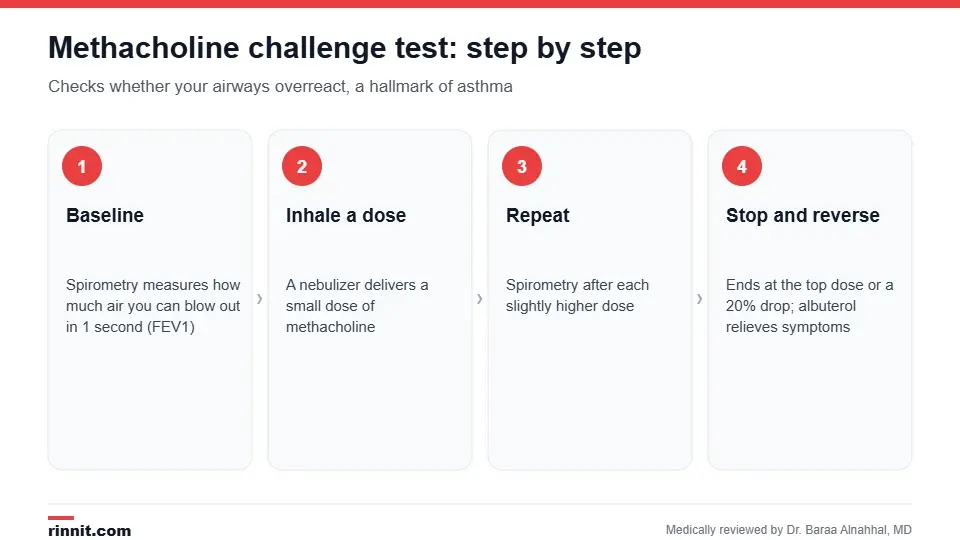
The test takes about 1–2 hours.
Why is it done?
To confirm or rule out asthma when symptoms suggest it but spirometry is normal.
To look for cough-variant asthma in a chronic cough.
To investigate exercise-induced asthma or occupational asthma.
Sometimes before jobs that require normal airway function. Sources: [1]
Who shouldn't have the test?
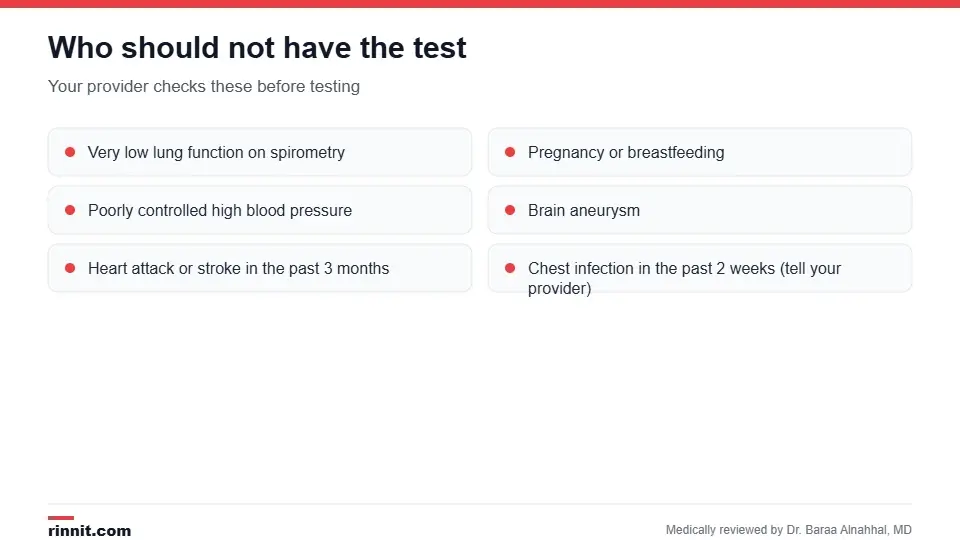
Your provider checks these before scheduling the test.
People with very low lung function on baseline spirometry.
Anyone who had a heart attack or stroke in the past 3 months.
People with uncontrolled high blood pressure or a known aortic or brain aneurysm.
People who are pregnant or breastfeeding.
People who can't perform spirometry reliably. Sources: [1]
How do I prepare?
Avoid caffeine (coffee, tea, cola, chocolate) on the day of the test.
Stop inhalers and other asthma medicines for the time your provider tells you; some must be stopped days ahead.
Avoid smoking and heavy exercise before the test.
Tell your provider if you've had a cold or respiratory infection in the last 2 weeks; the test may be rescheduled.
Consider bringing someone to drive you home. Sources: [1]
What happens during the test?
You do baseline spirometry: a deep breath in, then blowing out as hard and fast as you can.
You inhale a mist of saline or a very low dose of methacholine through a nebulizer.
After each dose, you repeat spirometry.
The dose increases step by step.
The test stops when FEV1 falls by 20% or the highest dose is reached.
You inhale albuterol to open your airways, and spirometry is repeated to confirm recovery. Sources: [1]
Understanding your results
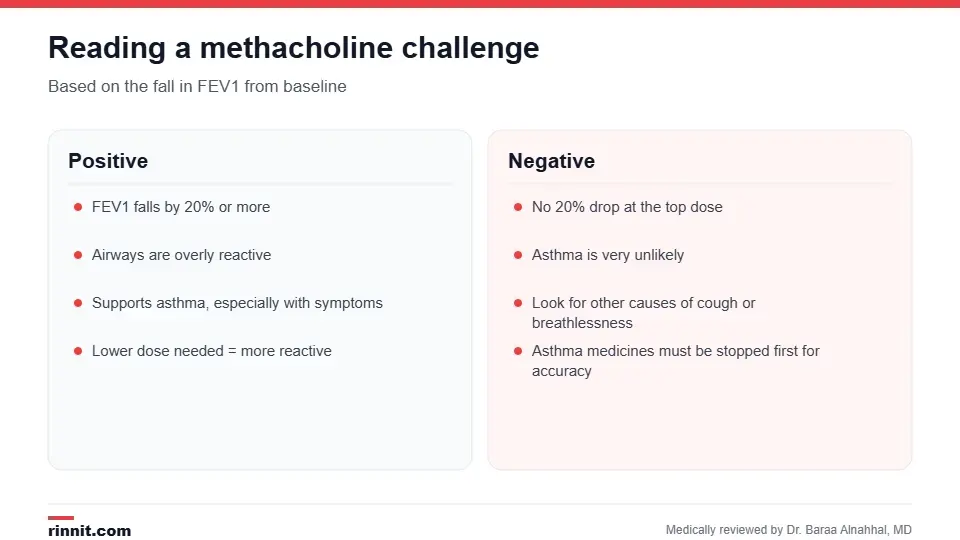
The result is based on how much FEV1 falls.
Result | What it means |
Positive (FEV1 falls 20% or more) | Airways are hyperresponsive; supports asthma, especially at low doses |
Negative (FEV1 falls less than 20% at the highest dose) | Asthma is very unlikely |
The dose that causes a 20% fall (called PC20 or PD20) shows how sensitive your airways are: the lower the dose, the more sensitive. A positive test isn't specific to asthma; it can also occur with allergic rhinitis, COPD, recent infection or smoking, so your provider interprets it with your symptoms. A negative test is the more powerful result, because it makes current asthma very unlikely. Sources: [1, 2]
Side effects and risks
Common side effects are cough, wheezing, chest tightness, shortness of breath, lightheadedness and headache, which usually improve quickly with albuterol. Serious reactions are rare because the test stops as soon as FEV1 falls significantly, and staff monitor you throughout. Sources: [1]
Conclusion
The methacholine challenge test helps answer whether your symptoms come from asthma when other breathing tests look normal. Its greatest strength is a negative result, which makes asthma very unlikely. Prepare by avoiding caffeine and stopping medicines as instructed, and expect mild, short-lived symptoms that resolve with a rescue inhaler.
Keep learning: read about spirometry and pulmonary function tests.
Frequently asked questions
What is a positive methacholine challenge test?
A fall in FEV1 of 20% or more after inhaling methacholine, showing your airways are overly sensitive.
Can you have asthma with a negative test?
It's unlikely. A negative test makes current asthma very unlikely, though results can be affected if medicines weren't stopped.
How long does the test take?
About 1–2 hours.
Is the methacholine test safe?
Yes, when done in a lab with monitoring. Symptoms are usually mild and reversed with albuterol.
Do I need to stop my inhalers?
Usually yes, for a set time. Follow your provider's instructions.
Can I drink coffee before the test?
No. Avoid caffeine on the test day because it can open the airways.
Who shouldn't take the test?
People with very low lung function, recent heart attack or stroke, uncontrolled high blood pressure, an aneurysm, or who are pregnant or breastfeeding.
What does it feel like?
You may cough or feel chest tightness or shortness of breath for a short time.
Can I drive afterward?
Most people can, but bringing a driver is recommended in case you feel unwell.
What if I had a recent cold?
Tell your provider. A respiratory infection within 2 weeks can cause a false positive, so the test may be rescheduled.
Related Reading
Spirometry: What the Lung Function Test Measures, How It's Done and What Results Mean the breathing test done before and after each dose.
Pulmonary Function Tests (PFTs): Types, Preparation and What Your Results Mean the family of lung tests that includes this challenge.
Exercise-Induced Asthma: Symptoms, Triggers & How to Exercise Safely — Complete Guide asthma triggered by exercise.
Occupational Asthma Comprehensive Guide: Symptoms, High-Risk Jobs, and Treatment Options asthma caused by workplace exposures.
What Is Bronchoconstriction? Symptoms, Causes, Triggers, Diagnosis, and Treatment the airway narrowing this test provokes.
References
Cleveland Clinic. Methacholine Challenge Test: Procedure & Results. Cleveland Clinic. Last updated October 12, 2026. https://my.clevelandclinic.org/health/diagnostics/methacholine-challenge
Karamarkovic Lazarusic N, Popovic-Grle S, Tolic E, et al. The value of body plethysmography (sGaw) in the assessment of airway hyperreactivity in cough variant asthma. Journal of Clinical Medicine. 2025;14(1):74. PMID 39797163. https://doi.org/10.3390/jcm14010074
Csonka LL, Tikkakoski A, Vuotari L, et al. Relation of changes in peak expiratory flow (PEF) and forced expiratory volume in 1 s (FEV1) during bronchoconstriction. Clinical Physiology and Functional Imaging. 2024;44(6):447-453. PMID 38923340. https://doi.org/10.1111/cpf.12898
Medical disclaimer
This article is for general education only and does not replace advice from a qualified healthcare professional. Talk to your doctor about your own diagnosis and treatment, and seek emergency care right away for severe or sudden symptoms.



Comments