Exercise-Induced Asthma: Symptoms, Triggers & How to Exercise Safely — Complete Guide

Updated: 3 days ago
Medically reviewed by Dr. Baraa Alnahhal, MD · Last reviewed: October 17, 2026
Quick Answer
Exercise-induced asthma, medically called exercise-induced bronchoconstriction (EIB), is a condition in which the airways narrow during or after physical activity, causing coughing, wheezing and shortness of breath. It affects about 90% of people with asthma but also occurs in people without asthma. Breathing cold, dry air is the most common trigger. Pre-exercise medicines like albuterol help most people stay active.
What the research says
EIB is common among athletes. A systematic review of 60 studies in 7,501 post-pubertal adult athletes reported a 23% prevalence of EIB, and found a higher prevalence of atopy (allergic tendency) in athletes with EIB. (Rodriguez Bauza & Silveyra, Int J Environ Res Public Health, 2020) [3]
Symptoms alone are not enough to diagnose it. A meta-analysis of 26 studies (2,624 participants) found that in athletes with symptoms, exercise challenge tests confirmed the diagnosis with 51% sensitivity and 84% specificity, while methacholine tests were 55% sensitive and 56% specific; the authors concluded methacholine tests had lower overall performance. (Reier-Nilsen et al., Br J Sports Med, 2023) [4]
Several daily controller regimens improve EIB. A network meta-analysis of 11 randomized trials (1,054 patients) with asthma and EIB found low-dose inhaled corticosteroid plus montelukast gave the largest improvement in post-exercise lung function (mean difference 14.96%, 95% CI 9.61 to 20.31), and low-dose inhaled corticosteroid alone and as-needed ICS-formoterol were equally effective. (Vichara-Anont et al., J Allergy Clin Immunol Pract, 2025) [5]
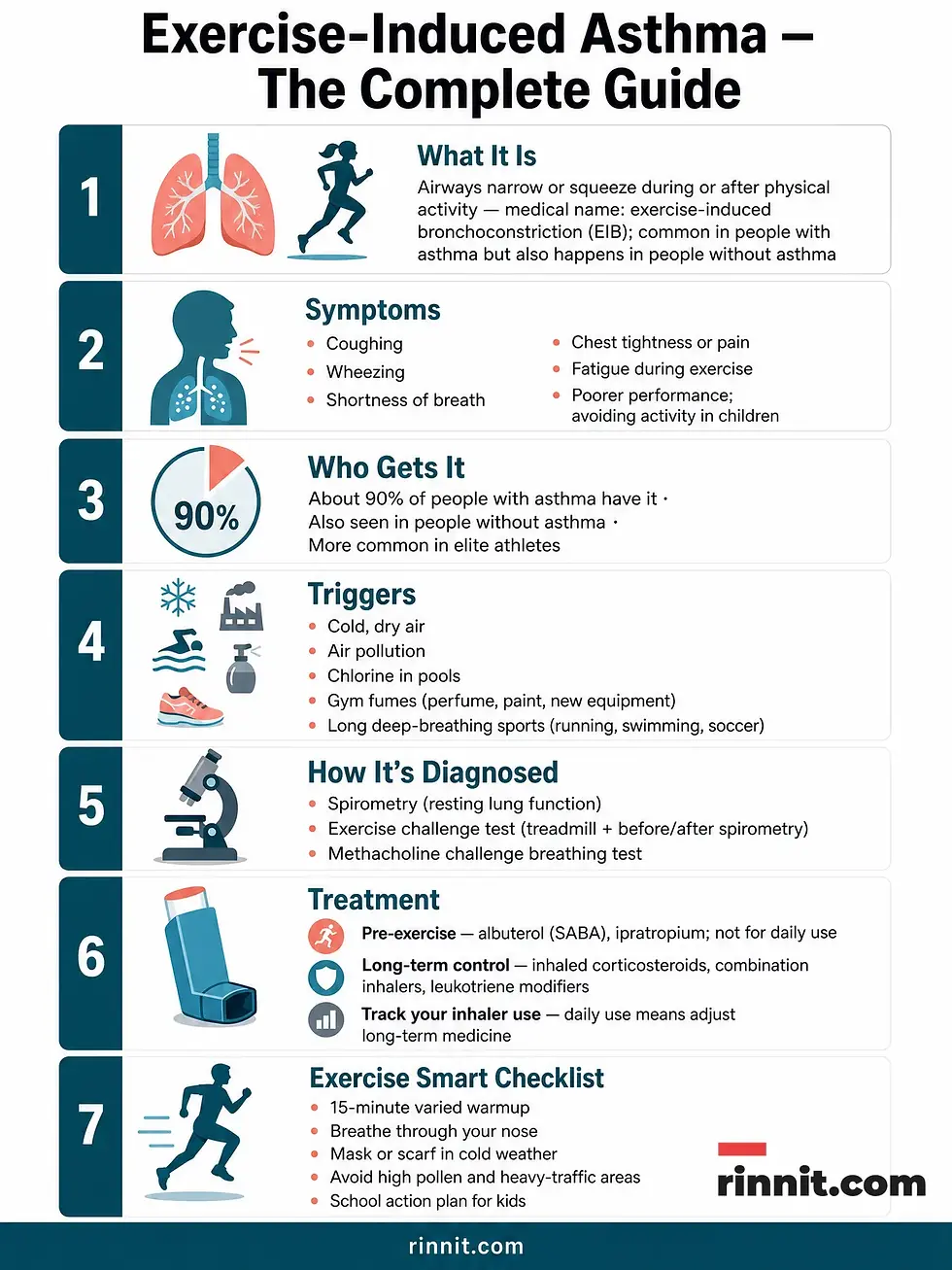
Exercise-Induced Asthma at a Glance
Aspect | Summary |
What it is | Airways narrow or squeeze during or after physical activity (exercise-induced bronchoconstriction) |
Who it affects | ~90% of people with asthma; also people without asthma, including elite athletes |
Symptom timing | During or soon after exercise; lasts an hour or longer if untreated |
Main trigger | Cold, dry air dehydrating the air passages — dry air is a more likely culprit than cold alone |
Other triggers | Air pollution, pool chlorine, gym fumes (perfume, paint, new equipment), long deep-breathing sports |
How diagnosed | Spirometry with bronchodilator, exercise challenge test, methacholine challenge test |
Treatment | Pre-exercise inhalers (not for daily use) + daily long-term control medicines when needed |
Key self-care | 15-minute warmup, nasal breathing, mask in cold weather, avoid pollution and high pollen |
What Is Exercise-Induced Asthma?
Exercise-induced asthma happens when the airways narrow or squeeze during or after physical activity. It causes shortness of breath, wheezing, coughing, and other symptoms during or after exercise.
The medical term for this condition is exercise-induced bronchoconstriction (brong-koh-kun-STRIK-shun). Many people with asthma have exercise-induced asthma, but people without asthma can also have it. The most important message for anyone affected:
Most people with exercise-induced asthma can continue to exercise and remain active if they treat symptoms. Treatment includes asthma medicines and taking steps to prevent symptoms before physical activity starts.

Symptoms: What Happens During and After Exercise
Symptoms of exercise-induced asthma usually begin during or soon after exercise and can last for an hour or longer if untreated. The symptoms include:
Coughing
Wheezing
Shortness of breath
Chest tightness or pain
Fatigue during exercise
Poorer than expected athletic performance
Avoiding activity — this happens mostly in young children
When to See a Doctor
See your healthcare professional if you have symptoms of exercise-induced asthma. A few conditions can cause similar symptoms, so it's important to get a diagnosis as soon as you can.
When to Seek Emergency Care
Get emergency medical treatment if you have:
Shortness of breath or wheezing that is quickly getting worse, making it hard to breathe
No improvement even after using a prescription inhaler for asthma attacks
What Causes Exercise-Induced Asthma?
It's not exactly clear what causes exercise-induced asthma. For a long time, the cause was thought to be cold air. However, recent studies found dry air to be a more likely culprit.
Here's how it works: cold air contains less moisture than warm air. Breathing in cold, dry air dehydrates the air passages. This causes them to narrow, reducing airflow. Other factors can contribute as well — chlorine or other fumes can irritate the lining of the airways and add to breathing difficulties.
Risk Factors: Who Is Most Likely to Get It?
Two groups stand out:
People with asthma. About 90% of people with asthma have exercise-induced asthma. However, it can happen in people who don't have asthma.
Elite athletes. Although anyone can have exercise-induced asthma, it's more common in high-level athletes.
Trigger / Risk Factor | Why It Matters |
Dry air | More likely culprit than cold — dehydrates the air passages |
Cold air | Contains less moisture than warm air |
Air pollution | Irritates the airway lining |
Chlorine in swimming pools | Irritates the airway lining |
Gym fumes | Perfume, paint, new equipment, or carpet fumes irritate airways |
Long periods of deep breathing | Activities such as long-distance running, swimming, or soccer |
Complications: What Happens Without Treatment?
If not treated, exercise-induced asthma can result in:
Serious or life-threatening breathing difficulties, particularly among people with poorly managed asthma
Lower quality of life because of not being able to exercise
How Exercise-Induced Asthma Is Diagnosed
To diagnose exercise-induced asthma, a healthcare professional typically takes a medical history and does a physical exam before doing any tests. You also may have tests to check your lung function and rule out other conditions.
Test | What It Does |
Spirometry | Shows how well the lungs function when you are not exercising. A spirometer measures how much air is inhaled, how much is exhaled, and how quickly the air is exhaled. The test may be repeated after taking an inhaled bronchodilator (a medicine that opens the lungs), and the two measurements are compared to see if airflow improved. This initial test is important for ruling out chronic asthma as the cause of symptoms |
Exercise challenge test | Involves running on a treadmill or using other stationary exercise equipment to increase the breathing rate. The exercise needs to be intense enough to trigger symptoms; if needed, a real-life challenge such as climbing stairs may be done. Spirometry tests before and after the challenge provide evidence of exercise-induced asthma |
Methacholine challenge breathing test | Involves inhaling an agent — often methacholine — that narrows the airways in some people with exercise-induced asthma. A spirometry test afterward checks lung function. This test mimics the conditions likely to trigger the condition |
Spirometer: A diagnostic device that measures the amount of air you're able to breathe in and out, and tracks the time it takes you to exhale completely after taking a deep breath.
Treatment: Medicines Before Exercise and Long-Term Control
A healthcare professional might prescribe medicines to take shortly before exercise or to take daily for long-term control.
Pre-Exercise Medicines
If a healthcare professional prescribes a medicine to take before exercising, ask how much time is needed between taking the medicine and starting the activity.
Medicine | How It Works | Key Notes |
Short-acting beta agonists (SABAs) | Inhaled medicines that open the airways — albuterol (ProAir HFA, Proventil-HFA, Ventolin HFA) and levalbuterol (Xopenex HFA) | The most commonly prescribed pre-exercise medicines. Do not use them every day — it can make them less effective |
Ipratropium (Atrovent HFA) | Inhaled medicine that relaxes the airways | May be effective for some people; a generic version can also be taken with a nebulizer |
Long-Term Control Medicines
A healthcare professional may prescribe a long-term control medicine to manage underlying asthma or to control symptoms when pre-exercise treatment alone doesn't work. These are usually taken daily:
Inhaled corticosteroids calm inflammation in the airways. This treatment may need to be used for up to four weeks before it reaches maximum benefit.
Combination inhalers contain a corticosteroid and a long-acting beta agonist (LABA) — a medicine that relaxes the airways. They are prescribed for long-term control, though a professional may recommend using them before exercise.
Leukotriene modifiers are oral medicines that block inflammatory activity for some people. They can be used daily or before exercise if taken at least two hours in advance. Possible side effects include behavior and mood changes and suicidal thoughts — talk to your healthcare professional if you experience these symptoms. Montelukast (Singulair) carries an FDA boxed warning about these serious mental health side effects.
Don't Rely Only on Quick-Relief Medicines
Pre-exercise medicines may be recommended as a quick-relief treatment for symptoms, but a pre-exercise inhaler should not be used more often than recommended. Keep a record of:
How many puffs are used each week
How often the pre-exercise inhaler is used for prevention
How often it is used to treat symptoms
If you use your inhaler daily or often use it for symptom relief, your healthcare professional might adjust your long-term control medicine.
Self-Care: Five Habits That Let You Keep Exercising
Exercise is an important part of a healthy lifestyle for everyone — including most people with exercise-induced asthma. Besides taking medicine, these steps help prevent or ease symptoms:
Warm up for about 15 minutes, varying the intensity, before beginning regular exercise.
Breathe through your nose to warm and humidify the air before it enters your lungs.
Wear a face mask or scarf when exercising, especially in cold, dry weather.
Avoid allergen triggers if you have allergies — for example, don't exercise outside when pollen counts are high.
Avoid areas with high air pollution, such as roads with heavy traffic.
At School
If your child has exercise-induced asthma, talk with a healthcare professional about providing an action plan. This document gives teachers, nurses, and coaches step-by-step instructions explaining:
What treatments your child needs
When treatments should be given
What to do if your child has symptoms
Alternative Medicine
There is limited evidence that any alternative treatments benefit people with exercise-induced asthma. For example, it has been suggested that fish oil or vitamin C supplements can help prevent exercise-induced asthma — but there isn't enough evidence to show whether they're useful.
Preparing for Your Appointment
You're likely to start by seeing someone on your primary healthcare team. A member of your care team may refer you to someone who specializes in asthma, such as an allergist-immunologist or a pulmonologist.
Questions the Doctor Will Likely Ask
Be prepared to answer the following questions:
What symptoms have you had?
Do they start right away when you start exercising, sometime during a workout, or after you exercise?
How long do the symptoms last?
Do you have breathing difficulties when you're not exercising?
What are your typical workouts or recreational activities?
Have you recently made changes to your exercise routine?
Do the symptoms happen every time you exercise or only in certain environments?
Have you been diagnosed with allergies or asthma?
What other medical conditions do you have?
What medicines do you take? What is the dosage of each medicine?
What dietary supplements or herbal medicines do you take?
Frequently Asked Questions
What is exercise-induced asthma?
Exercise-induced asthma, medically called exercise-induced bronchoconstriction, happens when the airways narrow or squeeze during or after physical activity. It causes shortness of breath, wheezing, and coughing during or after exercise. Many people with asthma have it, but people without asthma can also have it.
Can you get exercise-induced asthma without having asthma?
Yes. Although about 90% of people with asthma have exercise-induced asthma, it can happen in people who don't have asthma — including elite athletes.
What triggers exercise-induced asthma?
The main trigger is breathing cold, dry air, which dehydrates the air passages and causes them to narrow. Other triggers include air pollution, chlorine in swimming pools, gym fumes from perfume or paint, and activities with long periods of deep breathing such as long-distance running, swimming, and soccer.
How long do symptoms last?
Symptoms usually begin during or soon after exercise and can last for an hour or longer if untreated.
How is exercise-induced asthma diagnosed?
A healthcare professional takes a medical history and does a physical exam, then uses lung function tests. Spirometry at rest — repeated after an inhaled bronchodilator — rules out chronic asthma, while an exercise challenge test and a methacholine challenge breathing test provide evidence that exercise triggers the airway narrowing.
What medicines treat exercise-induced asthma?
Pre-exercise inhalers such as albuterol (a short-acting beta agonist) and ipratropium are taken shortly before activity — but not every day, as daily use makes them less effective. When pre-exercise treatment alone doesn't work, daily long-term control medicines such as inhaled corticosteroids, combination inhalers, or leukotriene modifiers may be prescribed.
How can I prevent symptoms while still exercising?
Warm up for about 15 minutes with varying intensity, breathe through your nose to warm and humidify the air, wear a face mask or scarf in cold, dry weather, avoid high-pollen and high-pollution areas, and ask your healthcare professional about a written action plan for school or team settings.
When should I get emergency help for asthma during exercise?
Call 911 if breathing is very hard, you cannot speak in full sentences, your lips or fingernails turn blue or gray, or your quick-relief inhaler is not helping.
Which sports are easier with exercise-induced asthma?
Activities with short bursts of effort, such as baseball, gymnastics or walking, are often easier. Long endurance activities in cold, dry air, such as distance running or cross-country skiing, tend to trigger more symptoms.
Can children have exercise-induced asthma?
Yes. A child may cough, wheeze, stop playing early or avoid sports. Talk with your child's provider, who can test for it and make a plan for safe activity.
Conclusion
By now, you understand the essentials of exercising with this manageable condition:
You don't need to stop moving. Exercise-induced asthma narrows the airways during or after activity, but with the right medicines and simple habits, most people — including elite athletes — keep exercising and stay active.
Dry air is the bigger villain. Cold air was long blamed, but dry air dehydrating the air passages is the more likely culprit — which is why nasal breathing, masks in cold weather, and indoor alternatives matter.
Pre-exercise medicine is a tool, not a habit. Albuterol before a workout helps, but daily use backfires by making it less effective; that's your cue to add or adjust a daily long-term control medicine.
This guide has walked you through the symptoms and their timing, the triggers, the diagnosis tests, the full treatment ladder, and the self-care habits that keep you on the track, in the pool, and on the field. If you want to go deeper into respiratory health, explore our related guides:
Asthma Complete Guide — the underlying condition behind exercise-induced asthma
Asthma Attack Complete Guide — how to spot, stop, and treat attacks when they happen
Childhood Asthma Complete Guide — for parents of young athletes
Explore more health topics at the rinnit.com homepage.
Medical disclaimer: The information in this article is for general educational purposes only and does not replace professional medical advice, diagnosis, or treatment. Always consult a qualified healthcare provider about your individual condition.
Related Reading
Methacholine Challenge Test: How It Diagnoses Asthma, How to Prepare and What Results Mean explains the breathing challenge test used to confirm or rule out asthma.
References
Mayo Clinic Staff. Exercise-induced asthma - Symptoms & causes. Mayo Clinic. August 11, 2025. https://www.mayoclinic.org/diseases-conditions/exercise-induced-asthma/symptoms-causes/syc-20372300
Mayo Clinic Staff. Exercise-induced asthma - Diagnosis & treatment. Mayo Clinic. August 11, 2025. https://www.mayoclinic.org/diseases-conditions/exercise-induced-asthma/diagnosis-treatment/drc-20372306
Rodriguez Bauza DE, et al. Sex Differences in Exercise-Induced Bronchoconstriction in Athletes: A Systematic Review and Meta-Analysis. Int J Environ Res Public Health. 2020;17(19):7270. PMID 33027929. https://doi.org/10.3390/ijerph17197270
Reier-Nilsen T, et al. Diagnostic approach to lower airway dysfunction in athletes: a systematic review and meta-analysis by a subgroup of the IOC consensus on 'acute respiratory illness in the athlete'. Br J Sports Med. 2023;57(8):481-489. PMID 36717213. https://doi.org/10.1136/bjsports-2022-106059
Vichara-Anont I, et al. Efficacy and Safety of Maintenance Regimens for Adolescent and Adult Asthmatics With Exercise-Induced Bronchospasm: Systematic Review and Network Meta-Analysis. J Allergy Clin Immunol Pract. 2025;13(7):1755-1767.e3. PMID 40021120. https://doi.org/10.1016/j.jaip.2025.02.018



Comments