Cardiopulmonary Exercise Test (CPET): What It Measures, How to Prepare and What to Expect

Updated: 2 days ago
Written and medically reviewed by Dr. Baraa Alnahhal, MD · Last reviewed: November 2026 · How we review
Quick Answer
A cardiopulmonary exercise test (CPET), also called a metabolic exercise stress test, checks how well the heart, lungs and muscles work together during exercise. You walk on a treadmill or pedal a bike while breathing through a mask that measures the oxygen you use. Unlike a standard stress test, it shows why you get short of breath or tired.
What the research says
CPET results predict outcomes: a meta-analysis of 60 studies with 12,914 people with hypertrophic cardiomyopathy found each 1 mL/kg/min higher peak oxygen uptake was linked to a 14% lower risk of death, and an abnormal blood pressure response to exercise more than doubled the risk (Landsteiner I et al., Journal of the American Heart Association, 2025) [2]
Fitness measured by exercise testing matters for everyone: a meta-analysis of healthy adults found that people with low cardiorespiratory fitness had a 70% higher risk of death from any cause and a 56% higher risk of heart disease events than those with high fitness, with risk dropping substantially at a capacity of about 7.9 METs or more (Kodama S et al., JAMA, 2009) [3]
Key takeaways
Measures heart, lung and muscle performance together while you exercise.
Helps explain unexplained shortness of breath or fatigue and guides care in heart failure, lung disease and pulmonary hypertension.
No caffeine for 24 hours, no smoking for 8 hours and only water for 4 hours before.
About 75 minutes in total, including up to 20 minutes of exercise.
Stop and tell the team about chest pain, severe breathlessness or dizziness.
What is a CPET?
During exercise, your lungs take in oxygen, your heart pumps it through your blood, and your muscles use it to make energy, producing carbon dioxide. A CPET measures each step of this chain. By analyzing the air you breathe in and out alongside an EKG, blood pressure and pulse oximetry, it shows whether exercise is limited by the heart, the lungs, the blood vessels, the muscles or fitness. A standard exercise stress test looks mainly at the heart. Sources: [1]
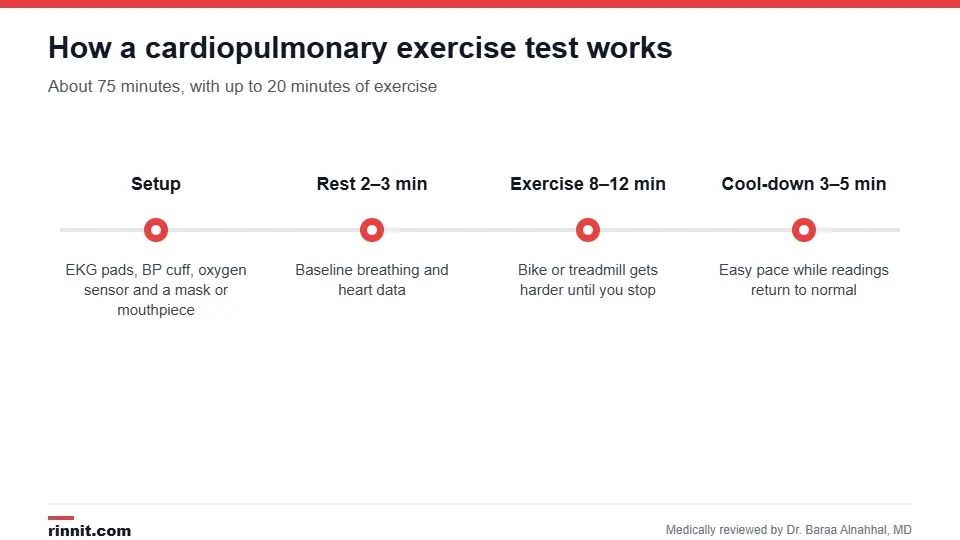
The appointment takes about 75 minutes.
Why is it done?
To find the cause of shortness of breath or unusual tiredness during activity, including exercise intolerance.
To diagnose or monitor heart failure, congenital heart disease, pulmonary hypertension and COPD.
To measure how much exercise you can safely do and build an exercise or rehabilitation plan.
To estimate prognosis and guide treatment, including decisions about heart transplant.
To assess risk before lung surgery or transplant, or fitness for demanding jobs. Sources: [1]
What it measures
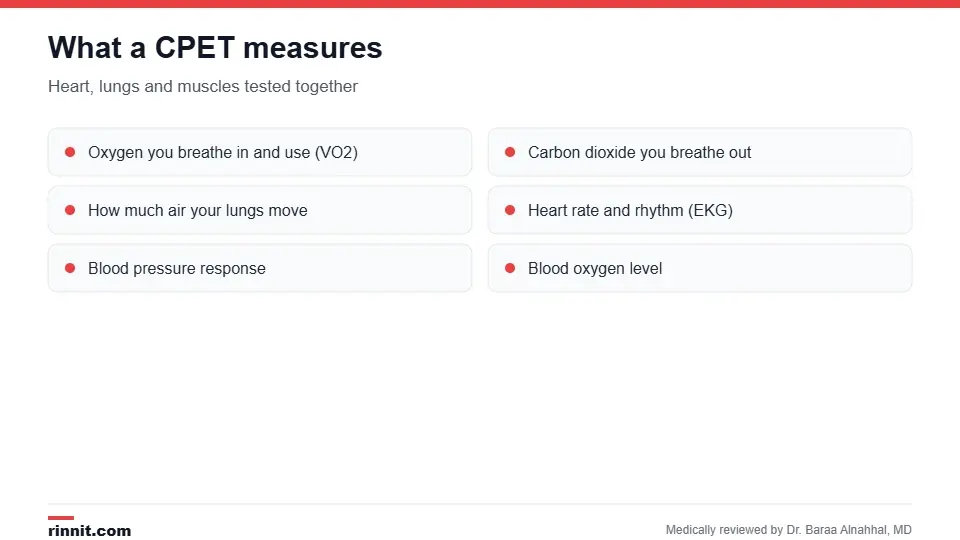
CPET measures heart, lungs and muscles together.
Oxygen uptake (VO2), including peak VO2, a key measure of fitness.
Carbon dioxide output and how efficiently you breathe.
How much air your lungs move.
Heart rate and rhythm.
Blood pressure response to exercise.
Blood oxygen level; sometimes an arterial blood gas from a wrist artery. Sources: [1]
How do I prepare?
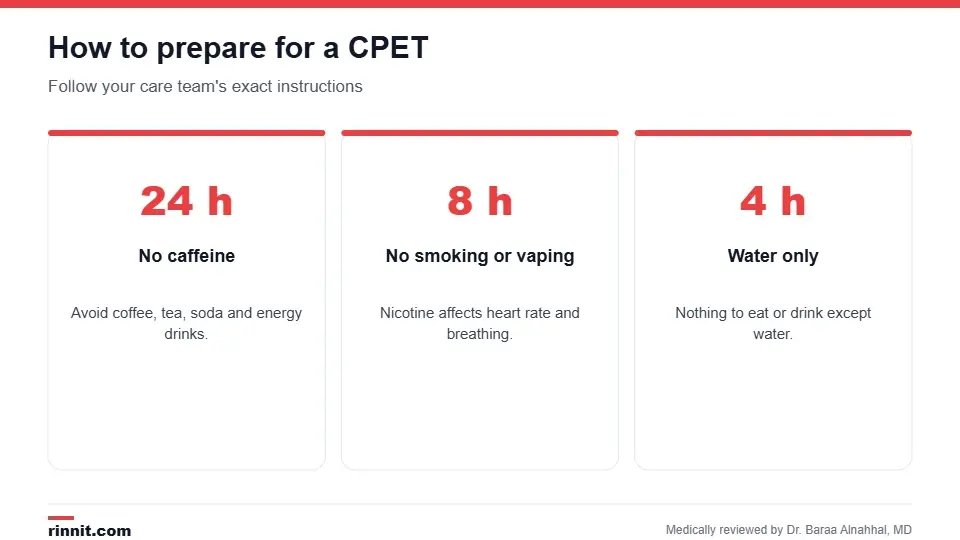
Preparation helps make results accurate.
No caffeine for 24 hours before the test.
No smoking or vaping for 8 hours before.
Nothing but water for 4 hours before.
Tell your provider about all medicines; some may need to be paused, and people using insulin should ask about the dose.
Report any recent illness or injury; the test may be rescheduled.
If you have a pacemaker or defibrillator, it must be checked first.
Wear comfortable exercise clothes and shoes. Sources: [1]
What happens during the test?
Setup: EKG electrodes, a blood pressure cuff, a finger oxygen sensor and a mask or mouthpiece are put on; sometimes a small catheter is placed in a wrist artery.
Rest: 2–3 minutes of baseline readings.
Warm-up: 2–3 minutes of easy walking or pedaling.
Exercise: usually 8–12 minutes as the resistance or pace increases; keep going as long as you can.
Cool-down: 3–5 minutes at an easy pace. Sources: [1]
Risks
Serious problems are rare, but fainting, heart attack or another emergency can happen, so trained staff monitor you throughout. The test is usually avoided with an acute infection, acute heart inflammation, a leg blood clot, a heart attack in the past 30 days, uncontrolled heart rhythm problems, severe valve narrowing, severe high blood pressure or a complicated pregnancy. Stop and tell staff right away if you have chest, jaw or arm pain, extreme shortness of breath or dizziness. Sources: [1]
Understanding your results
Results are shown on a set of technical graphs called a nine-panel plot. Your provider interprets them, explains what limits your exercise capacity and recommends next steps, which may include more testing, treatment or a tailored exercise program. A higher peak oxygen uptake generally means better fitness and a better outlook. Sources: [1, 2, 3]
Conclusion
A CPET gives a complete picture of how your heart, lungs and muscles work together, which makes it especially useful when the cause of breathlessness isn't clear. Prepare by avoiding caffeine, nicotine and food as instructed, and push yourself as far as you safely can so the results reflect your true capacity.
Keep learning: read about heart failure and pulmonary function tests.
Frequently asked questions
What is a CPET?
A test that measures heart, lung and muscle function together during exercise.
How is it different from a regular stress test?
A standard stress test looks mainly at the heart; CPET also measures breathing and oxygen use.
How long does the test take?
About 75 minutes, with up to 20 minutes of exercise.
Do I need to fast?
Have only water for 4 hours before, and no caffeine for 24 hours.
What is VO2 peak?
The highest amount of oxygen your body uses during exercise, a key fitness measure.
Do I have to exercise as hard as I can?
Yes, as long as you safely can, so results reflect your true capacity.
Is a CPET safe?
Yes, for most people. Staff monitor you and stop the test if needed.
Can I take my medicines before the test?
Ask your provider; some medicines may be paused.
Who should not have a CPET?
People with acute infections, a recent heart attack, unstable rhythm problems or severe valve disease, among others.
What do the results show?
What limits your exercise capacity and how fit your heart and lungs are.
Related Reading
Exercise Stress Test: Why It's Done, How to Prepare, What Happens and Results the standard treadmill test focused on the heart.
Heart Failure: Symptoms, Causes & Treatment Guide a condition CPET helps assess and monitor.
Exercise Intolerance: What It Is, Symptoms, and How It's Treated breathlessness and fatigue that CPET can explain.
What Is Chronic Obstructive Pulmonary Disease (COPD)? Symptoms, Causes, Stages, and Treatment a lung disease that limits exercise.
Pulmonary Function Tests (PFTs): Types, Preparation and What Your Results Mean breathing tests often done alongside CPET.
References
Cleveland Clinic. Cardiopulmonary Exercise Test (CPET). Cleveland Clinic. Last updated November 20, 2025. https://my.clevelandclinic.org/health/diagnostics/17221-metabolic-exercise-stress-test
Landsteiner I, Masri A, Saberi S, et al. Cardiopulmonary exercise testing for characterization of hypertrophic cardiomyopathy: a meta-analysis. J Am Heart Assoc. 2025;14(17):e039551. PMID 40878996. https://doi.org/10.1161/JAHA.124.039551
Kodama S, Saito K, Tanaka S, et al. Cardiorespiratory fitness as a quantitative predictor of all-cause mortality and cardiovascular events in healthy men and women: a meta-analysis. JAMA. 2009;301(19):2024-2035. PMID 19454641. https://doi.org/10.1001/jama.2009.681
Medical disclaimer
This article is for general education only and does not replace advice from a qualified healthcare professional. Talk to your doctor about your own diagnosis and treatment, and seek emergency care right away for severe or sudden symptoms.



Comments