Exercise Intolerance: What It Is, Symptoms, and How It's Treated

Updated: 3 days ago
Medically reviewed by Dr. Baraa Alnahhal, MD · Last reviewed: October 2026
Quick Answer
Exercise intolerance is a limited ability to do physical activities the way someone your age normally would, with shortness of breath and fatigue making exertion difficult. It happens when the heart, lungs or muscles struggle to take in, distribute or use oxygen. It is common in heart failure, and exercise training is often the best treatment.
What the research says
Exercise-based rehabilitation improves how far and how well people with heart failure can go. In an individual-participant meta-analysis of 19 randomized trials (3,990 patients), exercise-based cardiac rehabilitation improved the 6-minute walk distance by a mean of 21.0 m (95% CI 1.57–40.4) and quality-of-life scores by 5.94 points on the Minnesota Living with Heart Failure Questionnaire at 12 months versus no exercise. The effect on death (HR 0.83, 95% CI 0.67–1.04) and hospitalisation was not statistically significant (PubMed: Taylor et al., Health Technol Assess, 2019 [1]).
The exact type of exercise matters less than doing it. A meta-analysis of 20 randomized trials (811 patients) found no significant differences between training types on exercise-test measures, though interval training was better for improving heart pumping function (LVEF), and combined continuous plus strength training improved quality of life. The authors concluded that taking part in any kind of training program seems sufficient to benefit (PubMed: Cornelis et al., Int J Cardiol, 2016 [2]).
Combining aerobic and resistance exercise looks most helpful for daily function. In a network meta-analysis of 33 trials in chronic heart failure, every rehabilitation approach outperformed routine care; aerobic plus resistance training gave the best results for quality of life, 6-minute walk performance, and fewer rehospitalizations, while center-based aerobic training gave the greatest gain in peak oxygen uptake (RR 3.64, 95% CI 1.66–7.95) (PubMed: Hua et al., Sci Rep, 2024 [3]).
What Is Exercise Intolerance?
Exercise intolerance is the reduced ability to carry out physical activities. When you move, different parts of your body need to work together to make that happen. Problems with the various body systems involved in movement can lead to exercise intolerance. These include issues with your heart, lungs, or muscles [4].
You may not be able to reach the maximum heart rate for someone your age because of your symptoms. During exertion, your body may only be able to take in and use 60% to 70% of the oxygen of someone without the condition. This can happen if your heart isn't working well, like in people with heart failure [4].
Key point | What it means |
Definition | Reduced ability to carry out physical activities |
Main symptoms | Shortness of breath and fatigue during exertion |
Underlying problem | Trouble taking in, distributing, or using oxygen |
Oxygen use during exertion | Body may only use 60% to 70% of the oxygen of someone without the condition |
How common | About 50% of the 6+ million U.S. adults with heart failure have it |
Best treatment for many | Moderate-intensity exercise training up to an hour, three times a week |

Symptoms of Exercise Intolerance
Exercise intolerance symptoms include shortness of breath, fatigue, leg discomfort or fatigue, and hyperventilation [4].
Symptom | What you might notice |
Shortness of breath | Feeling winded or unable to catch your breath during activity |
Fatigue | Feeling unusually tired with physical effort |
Leg discomfort or fatigue | Legs feel heavy, achy, or worn out |
Hyperventilation | Breathing faster than your body needs |
What Causes Exercise Intolerance?
The heart pumps blood that carries oxygen to the body's tissues and cells. If your heart can't pump well, it has a hard time delivering oxygen throughout your body. People with lung issues may find it hard to breathe in enough oxygen to meet their muscles' need for oxygen — when you exert yourself, your muscles need more oxygen than they do at rest. After you breathe in oxygen and your heart delivers it through the blood, your cells need to use the oxygen. If your skeletal muscles aren't working well, they can't use that oxygen efficiently. A problem with any of these steps — taking in, distributing, or using oxygen — leads to exercise intolerance [4].
Exercise intolerance can keep you from doing activities you enjoy and lead to frequent hospital stays [4].
Common causes
Body system | Conditions that can cause exercise intolerance |
Heart | Heart failure; congenital (present at birth) heart disease |
Lungs | Lung disease like COPD; pulmonary embolism |
Whole body | Long COVID; anemia; concussion; aging; obesity; diabetes; kidney disease; inflammatory disorders |
Muscles | Conditions that affect skeletal muscles, like McArdle disease |
Some people may have multiple causes of intolerance to exercise. They may have heart failure, obesity, and diabetes at the same time [4], for example.

How Is Exercise Intolerance Diagnosed?
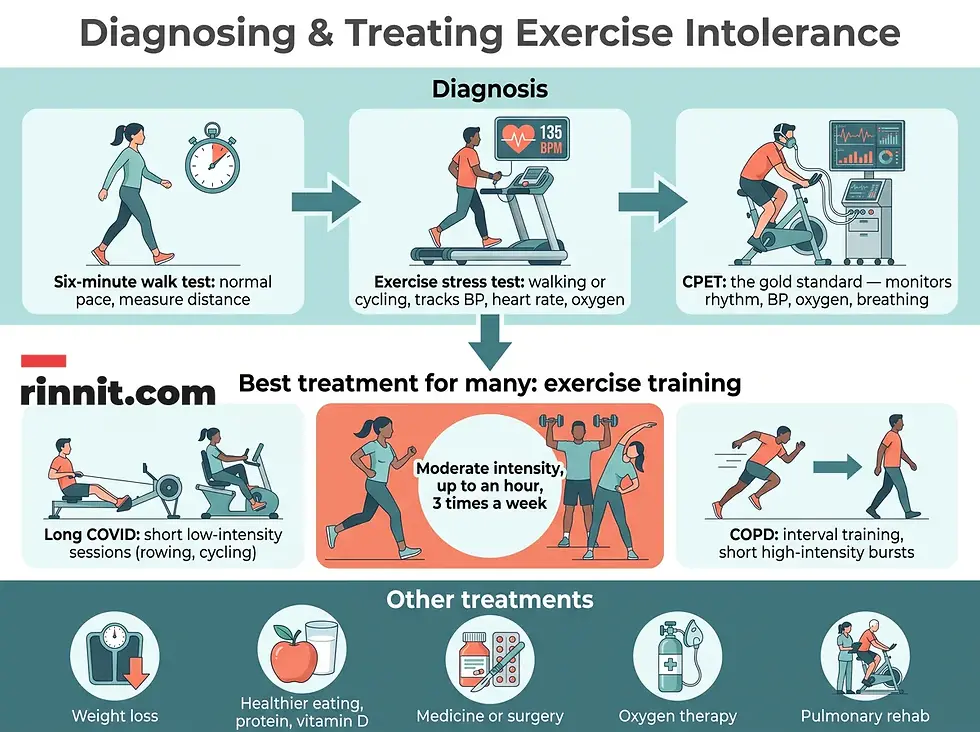
A provider can diagnose exercise intolerance by using the following tests [4]:
Test | What it involves |
Six-minute walk test | Walking at a normal pace to see how far you can go in six minutes |
Exercise stress test | A walking or cycling test that tracks blood pressure, heart rate and rhythm, and oxygen levels |
Cardiopulmonary exercise testing (CPET) | Walking or biking while a provider monitors heart rhythm, blood pressure, oxygen level, and breathing; the "gold standard" test that provides the most information |
CPET involves wearing a mask you breathe through, which monitors the depth and speed of your breaths and how much oxygen you're taking in [4].
Treatment for Exercise Intolerance
For many people, a program of physical activity (exercise training) is the best treatment for exercise intolerance. Exercise training means performing a physical activity at a moderate intensity for up to an hour three times a week [4].
A provider may make a custom exercise training plan for you. They may consider your condition and the cause of your intolerance to exercise. For example, if you have Long COVID, you may start with short sessions of low-intensity exercise like rowing or cycling. If you have COPD, you may do well with interval training [4], or short bursts of high-intensity movement.
Other treatments for exercise intolerance may include losing weight, eating healthier foods or addressing a deficiency by adding more protein or vitamin D, using medicine or surgery to treat medical conditions that cause exercise intolerance, receiving oxygen therapy, and taking part in pulmonary rehabilitation [4].
Treatment | How it helps |
Exercise training | Moderate-intensity activity up to an hour, three times a week; often the best treatment |
Custom exercise plan | Tailored to your condition — e.g., low-intensity rowing or cycling for Long COVID; interval training for COPD |
Weight loss | Reduces strain on the heart, lungs, and muscles |
Healthier eating / supplements | Adds more protein or vitamin D to address deficiencies |
Medicine or surgery | Treats the medical conditions that cause exercise intolerance |
Oxygen therapy | Helps the body take in more oxygen |
Pulmonary rehabilitation | Structured program to strengthen breathing and fitness |
Outlook: Prognosis and Prevention
What can I expect if I have exercise intolerance?
Your experience with exercise intolerance will depend on what caused it. If you're a teen who had a concussion, you'll most likely be back to normal in a month or less. If heart failure causes your intolerance to exercise, you'll be dealing with it for the rest of your life [4].
Can exercise intolerance be prevented?
Possibly. You can't control some causes of intolerance to exercise, like a heart issue that's present at birth. But you may be able to lower your risk of exercise intolerance by managing diseases that can cause it [4].
Scenario | Expected outcome |
Teen with concussion | Most likely back to normal in a month or less |
Heart failure as the cause | Dealing with it for the rest of your life |
Preventable causes | Risk can be lowered by managing diseases that cause it |
Living With Exercise Intolerance
How do I take care of myself?
Because of the various causes of exercise intolerance, what's best for you may be a bit different from what works for someone else. Follow your provider's instructions for building your tolerance to exercise. That will likely mean getting a certain amount of physical activity at a set level of effort. It could mean eating more protein or making sure you manage the condition that caused your intolerance to exercise [4].
When should I see my healthcare provider?
You can expect to have regular checkups with your provider to see how well you're doing. They'll want to see what progress you're making in the exercise training plan they made for you [4].
What questions should I ask my doctor?
Question | Why it matters |
What caused my intolerance to exercise? | Helps you understand the underlying condition |
What are the specific actions I need to take to feel better? | Gives you a clear day-to-day plan |
How often do you want to see me at a follow-up appointment? | Keeps your progress on track |
What goals should I reach for? | Provides measurable targets for your training plan |
Key Takeaways
When your body can't take in and use oxygen well, you can't do physical tasks that used to be simple for you to do. But following your provider's plan can make it easier for you to walk to the mailbox or get up the stairs. Be patient with yourself. It takes time to improve intolerance to exercise. Ask your family or friends to join you if you need some motivation to keep doing exercise training.
If everyday activities leave you short of breath or exhausted — or your stamina has dropped compared to others your age — see a healthcare provider.
Take the Next Step
Ask which test (six-minute walk, exercise stress test, or CPET) can pinpoint what's limiting your exercise. Then ask for a custom exercise training plan built around your specific cause. Support from family and friends can help you stay motivated.
Related reading: Heart Failure · Adult Congenital Heart Disease · Pulmonary Embolism · Pulmonary Rehabilitation · McArdle Disease · Obesity
Further reading: American Thoracic Society · American Heart Association — Heart Failure · American Lung Association — COPD · CDC — Long COVID
Frequently Asked Questions
1. What is exercise intolerance?
Exercise intolerance is the reduced ability to carry out physical activities. Shortness of breath and fatigue make it difficult to exert yourself. It happens when problems with the heart, lungs, or muscles disrupt the body's ability to take in, distribute, or use oxygen.
2. What are the symptoms of exercise intolerance?
Symptoms include shortness of breath, fatigue, leg discomfort or fatigue, and hyperventilation. You may also be unable to reach the maximum heart rate for someone your age during physical activity.
3. What causes exercise intolerance?
Causes include heart failure, congenital heart disease, lung disease like COPD, pulmonary embolism, Long COVID, anemia, concussion, aging, obesity, diabetes, kidney disease, skeletal muscle conditions like McArdle disease, and inflammatory disorders. Some people have multiple causes at once.
4. How common is exercise intolerance?
Exercise intolerance is common. More than 6 million people in the U.S. have heart failure, and about 50% of them have an intolerance to exercise.
5. How is exercise intolerance diagnosed?
A provider can diagnose it with a six-minute walk test, an exercise stress test, or cardiopulmonary exercise testing (CPET). CPET is the "gold standard" — it monitors heart rhythm, blood pressure, oxygen level, and breathing through a face mask during walking or biking.
6. Why does the body struggle with oxygen during exercise intolerance?
The heart pumps oxygen-carrying blood, the lungs take in oxygen, and skeletal muscles use it. If any step fails — taking in, distributing, or using oxygen — the body may only use 60% to 70% of the oxygen of someone without the condition during exertion.
7. How is exercise intolerance treated?
For many people, exercise training is the best treatment — moderate-intensity physical activity for up to an hour three times a week. Providers may tailor the plan to the cause, such as low-intensity rowing or cycling for Long COVID or interval training for COPD. Other options include weight loss, better nutrition, medicine or surgery, oxygen therapy, and pulmonary rehabilitation.
8. Can exercise intolerance go away?
It depends on the cause. A teen who had a concussion will most likely be back to normal in a month or less. Someone whose intolerance is caused by heart failure will be dealing with it for the rest of their life.
9. Can exercise intolerance be prevented?
Possibly. You can't control some causes, like a congenital heart issue. But managing diseases that can cause exercise intolerance — such as diabetes, obesity, or kidney disease — may lower your risk.
10. What should I ask my doctor about exercise intolerance?
Ask what caused your intolerance, what specific actions you need to take to feel better, how often you should have follow-up appointments, and what goals you should reach for in your exercise training plan.
Related Reading
Cardiopulmonary Exercise Test (CPET): What It Measures, How to Prepare and What to Expect explains the exercise test that measures heart, lung and muscle performance together.
References
Taylor RS, Walker S, Ciani O, et al. Exercise-based cardiac rehabilitation for chronic heart failure: the EXTRAMATCH II individual participant data meta-analysis. Health Technol Assess. 2019;23(25):1-98. doi:10.3310/hta23250. PMID: 31140973.
Cornelis J, Beckers P, Taeymans J, Vrints C, Vissers D. Comparing exercise training modalities in heart failure: a systematic review and meta-analysis. Int J Cardiol. 2016;221:867-876. doi:10.1016/j.ijcard.2016.07.105. PMID: 27434363.
Hua C, Huang W, Chen Z, et al. Effects of exercise based cardiac rehabilitation delivery modes on chronic heart failure: a systematic review and network meta-analysis. Sci Rep. 2024;14(1):31246. doi:10.1038/s41598-024-82608-z. PMID: 39732888.
Cleveland Clinic. Exercise intolerance. Cleveland Clinic Health Library. Medically reviewed; last updated April 19, 2024. https://my.clevelandclinic.org/health/diseases/exercise-intolerance
Medical Disclaimer
This article is for informational purposes only and does not constitute medical advice. Always seek the advice of your physician or other qualified health provider with any questions you may have regarding a medical condition. Never disregard professional medical advice or delay in seeking it because of something you have read here.



Comments