Post-Concussion Syndrome: Symptoms, Causes, and Treatment — What to Do When Concussion Symptoms Last

Updated: 2 days ago
Medically reviewed by Dr. Baraa Alnahhal, MD · Last reviewed: September 2026
TL;DR: Post-concussion syndrome — also called persistent post-concussive symptoms — is the name for concussion symptoms that typically last longer than three months. A concussion is a mild traumatic brain injury that can follow a fall, car accident, contact sports injury, or violent shaking of the head or body — and you do not have to lose consciousness to get one. Common symptoms include headaches (often migraine-like), dizziness, fatigue, irritability, anxiety, depression, sleep trouble, poor concentration and memory, ringing in the ears, blurry vision, noise and light sensitivity, nausea, and neck pain. In most people symptoms begin within 7 to 10 days after the injury. The risk does not appear linked to how severe the injury was, and a concussion does not always lead to lasting symptoms. There is no single cure: treatment manages each symptom — headache medicines, balance-focused physical therapy, sleep hygiene, psychotherapy, and sometimes targeted rehabilitation — and most symptoms improve over weeks to months. The goal of care is to manage symptoms and improve functioning and quality of life.
Quick Answer: What Is Post-Concussion Syndrome?
Post-concussion syndrome means concussion symptoms that typically last longer than three months.
A concussion is a mild traumatic brain injury caused by a fall, car accident, contact sports injury, or violent shaking of the head or body — no loss of consciousness is required.
Common symptoms include migraine-like headaches, dizziness, fatigue, mood changes, sleep problems, poor concentration and memory, and light or sound sensitivity.
Symptoms usually appear within the first 7 to 10 days after the injury and often resolve within weeks to months, though some people have symptoms for a year or more.
The risk of lasting symptoms does not appear linked to how severe the injury was.
There is no single cure; treatment focuses on managing each symptom with targeted therapies and, when needed, specialist care.
After a sports concussion, you should not return to the game — seek medical help so the injury does not get worse.
What Is Post-Concussion Syndrome?
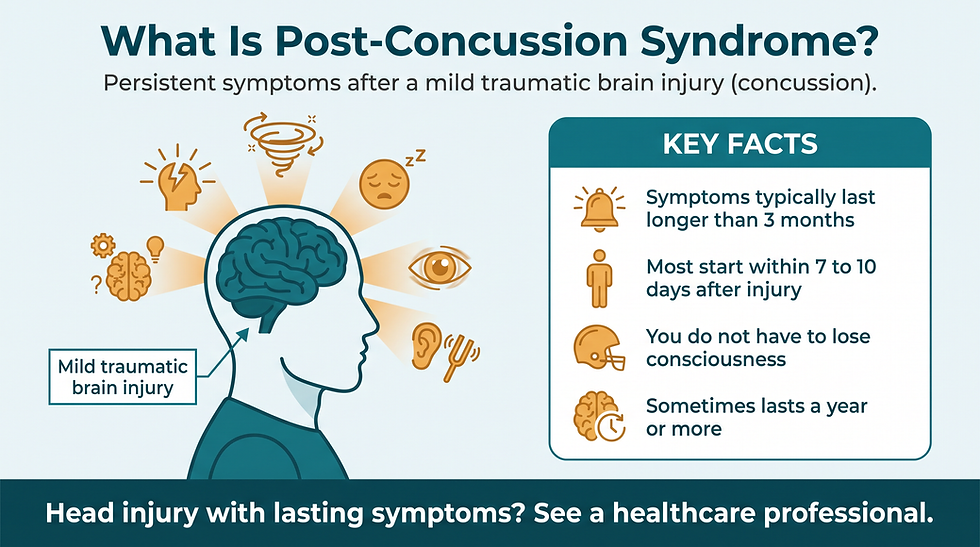
Post-concussion syndrome — also called persistent post-concussive symptoms — refers to concussion symptoms that typically last longer than three months. Symptoms can last weeks to months.
Concussion: a mild traumatic brain injury. It can be caused by a fall, a car accident, a contact sports injury, or violent shaking and movement of the head or body.
Three facts are worth knowing up front. First, you do not have to lose consciousness to get a concussion. Second, a concussion does not always cause post-concussion syndrome — many people recover fully. Third, the risk of having lasting symptoms does not appear to be linked to how severe the injury was.
The timeline matters for recognition. Persistent post-concussive symptoms in most people appear within the first 7 to 10 days after an injury. While symptoms typically last longer than three months, they sometimes can last for a year or more. The goal of treatment is to manage symptoms and to improve functioning and quality of life.
What Are the Symptoms of Post-Concussion Syndrome?
Persistent post-concussive symptoms can be different in each person. They may include:
Symptom | What It Looks Like |
Headaches | Often feel like migraines; may also feel like tension-type headaches, which can be related to a neck injury that happened at the same time as the head injury |
Dizziness | Feeling faint, woozy, or unsteady |
Fatigue | Unusual tiredness |
Irritability | Getting frustrated or angry more easily |
Anxiety | Excessive worry or nervousness |
Depression | Low mood or loss of interest |
Sleep trouble | Difficulty falling asleep or sleeping too much |
Poor concentration and memory | Trouble focusing or remembering |
Ringing in the ears | A ringing sound with no external source |
Blurry vision | Vision that is unclear; sometimes double vision |
Noise and light sensitivity | Sounds or light feel bothersome |
Nausea or vomiting | Upset stomach with or without vomiting |
Neck pain | Pain in the neck, often from the injury that caused the concussion |
What Causes Post-Concussion Syndrome?
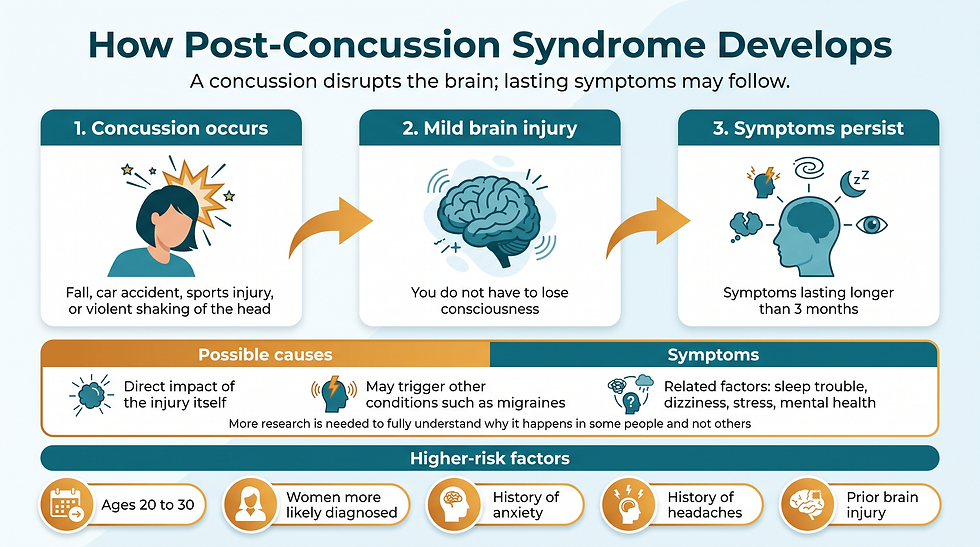
More research is needed to understand how and why persistent post-concussive symptoms happen after some injuries and in some people but not in others. The leading explanations include:
Possible Cause | Explanation |
Direct impact of the injury | Symptoms may result directly from the impact of the injury itself |
Triggered conditions | Symptoms may trigger other conditions, such as migraines |
Related factors | Symptoms also may be related to trouble with sleep, dizziness, stress, and mental health |
Your healthcare professional works with you to understand the cause of your symptoms and which treatments may help.
Who Is Most at Risk?
Risk Factor | Details |
Age | Symptoms usually are reported in people ages 20 to 30. But studies also show older adults are at risk of more serious and prolonged symptoms. |
Sex assigned at birth | Women are more likely to be diagnosed. This may be because women are generally more likely to seek medical care. |
Anxiety | A history of anxiety is a strong risk factor. |
Prior headaches | People with a history of headaches are at higher risk. |
Prior brain injury | A previous brain injury is linked to persistent symptoms — but lasting symptoms also can happen after a single concussion. |
How Is Post-Concussion Syndrome Diagnosed?
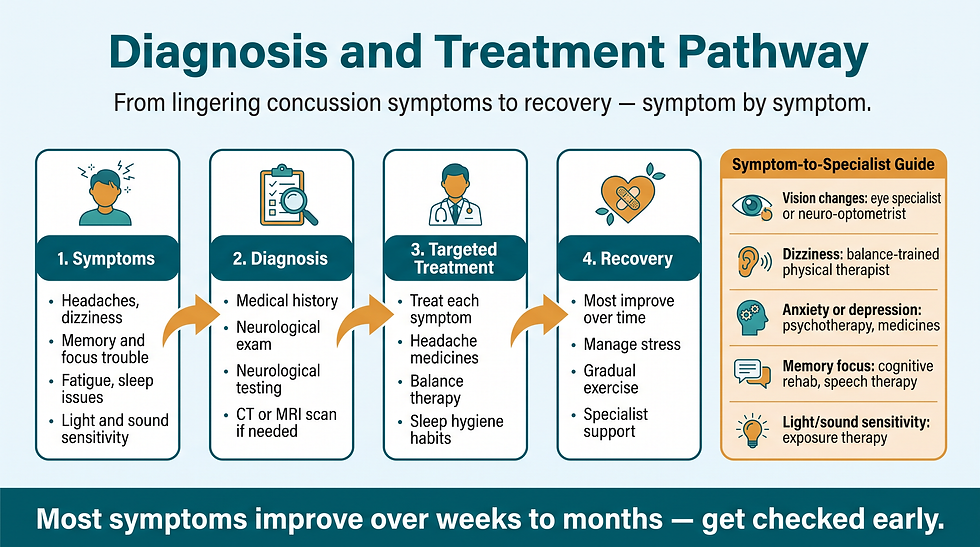
No single test can prove you have persistent post-concussive symptoms. A healthcare professional may start with your full medical history and may use these tests to help determine a diagnosis:
Test or Step | What It Involves | What It Shows |
Medical history | A full review of the injury, symptoms, and health background | The starting point for diagnosis |
Neurological exam | Tests thinking and memory, senses, strength, coordination, and reflexes | How the brain and nervous system are functioning |
Neurological testing | Further checks concentration, memory, language, thinking, and planning skills | Detailed cognitive function |
Brain imaging (CT or MRI scan) | Recommended if you have concerning symptoms, such as a very bad headache, memory loss, or vomiting | Structural brain changes, such as damage to brain tissue, and other conditions affecting the brain — but images cannot see persistent post-concussive symptoms |
Other specialists | Based on your symptoms: physical therapy, occupational therapy, speech therapy, a psychologist for anxiety or memory problems; an ear, nose, and throat specialist for dizziness; an eye specialist (ophthalmologist) for vision changes; or a visual-symptoms specialist (neuro-optometrist) | Targeted evaluation of specific symptom areas |
How Is Post-Concussion Syndrome Treated?
There is no specific treatment for persistent post-concussive symptoms. Your healthcare professional treats your symptoms, and the types and frequency of symptoms vary from person to person.
Headaches
Medicines often used for migraines or tension-type headaches may help. These may include medicines for treating depression, high blood pressure, and seizures. Medicines are usually specific to the individual, so talk with your healthcare professional about which are best for you.
One caution: overuse of pain medicine may contribute to persistent post-concussion headaches — a pattern known as medication overuse headache. This can happen with prescription pain medicine or with pain medicine you buy without a prescription.
Memory and Thinking Problems
Time may be the best therapy for memory and thinking problems after a mild traumatic brain injury. Most of these symptoms go away on their own in the weeks to months after the injury. Using a notebook or visual cues may help you manage these symptoms as your brain heals.
Approach | How It Helps |
Focused cognitive rehabilitation | Certain forms of cognitive therapy may be helpful, including focused rehabilitation in the areas you need to strengthen |
Occupational or speech therapy | Some people may need one of these therapies |
Stress management | Stress can make cognitive symptoms worse, so learning to manage stress can help |
Relaxation therapy | May also help with cognitive symptoms |
Dizziness and Vertigo
Dizziness is feeling faint, woozy, or not steady. Vertigo is a false sense that your surroundings are moving. Dizziness and vertigo symptoms can be treated by a physical therapist specifically trained to treat balance symptoms.
Sleep Problems
Trouble sleeping and other sleep symptoms are common after a concussion. Learning about good sleep habits — known as sleep hygiene — can help. This includes going to bed and waking up on a regular schedule. Sometimes medicines may be needed to improve sleep.
Vision Changes
Vision changes are common after a concussion, including blurry vision and sometimes double vision. Often, vision changes get better on their own. Some people with persistent symptoms may need to see a specialist who treats visual symptoms related to traumatic brain injuries — known as a neuro-optometrist.
Sensitivity to Light and Sound
For some people, light and sound are bothersome. These symptoms tend to get better with time. Exposure therapy with a physical or occupational therapist may help these symptoms.
Irritability, Depression, and Anxiety
Symptoms often improve once you understand the cause of your symptoms and that symptoms are likely to get better with time. Learning about the condition can help ease fears and offer some peace of mind. Treatment options for new or increasing depression or anxiety after a concussion include:
Option | What It Involves |
Psychotherapy | Talking with a psychologist, psychiatrist, or social worker who works with people who have had a brain injury may help |
Medicine | Medicines can treat depression and anxiety |
Physical activity | Early, gradual exercise that avoids reinjury may help you feel better |
How Can You Prevent a Concussion (and Post-Concussion Syndrome)?
The only known way to prevent persistent post-concussive symptoms is to avoid a head injury in the first place. You cannot always prevent a head injury, but these steps reduce the risk:
Prevention Step | How to Do It |
Wear your seat belt | Buckle up every time you ride in a car or other motor vehicle |
Use the right car safety seats | Children under 13 are safest in the back seat, especially if the car has air bags. From birth to age 4, car seats should face the rear. After outgrowing rear-facing seats and until at least age 5, children can face forward. Then they move to buckled booster seats in the back seat. Seat belts alone fit properly without boosters usually between ages 9 and 12 |
Wear a helmet | When biking, roller-skating, ice-skating, skateboarding, riding a motorcycle, skiing, or snowboarding — or any activity that could cause a head injury. Also a good idea for horseback riding and football, baseball, or softball |
Get annual eye exams | Very important for older adults, because vision problems may increase the risk of falls; get new glasses or contacts if needed |
Make your home safer | Remove small area rugs, improve lighting, install handrails, and use safety gates for children. Older adults should talk with a healthcare professional about medicines that might cause dizziness or affect balance |
When Should You See a Doctor?
Situation | What to Do |
A head injury that causes confusion, memory loss, vision changes, nausea, vomiting, or a sudden, bad headache | See a healthcare professional — even if you never lost consciousness |
Loss of feeling, inability to move part of your body, or trouble speaking or writing | See a healthcare professional right away |
A concussion during a sport | Do not go back into the game; seek medical help so the injury does not get worse |
Symptoms still present weeks after a concussion | See a healthcare professional to evaluate for persistent post-concussive symptoms |
Preparing for Your Appointment
You may first see a member of your healthcare team who makes the initial diagnosis of a concussion, or the diagnosis may be made in the emergency room. You may then be referred to a neurologist (a brain and nervous system disorder specialist) or a physiatrist (a brain rehabilitation specialist).
Conclusion
Post-concussion syndrome — persistent post-concussive symptoms — means concussion symptoms that typically last longer than three months after a mild traumatic brain injury. The injury may come from a fall, car accident, contact sports injury, or violent shaking of the head, and losing consciousness is not required. Headaches that often feel like migraines, dizziness, fatigue, mood changes, sleep trouble, memory and concentration problems, ringing in the ears, blurry vision, light and sound sensitivity, nausea, and neck pain are the most common complaints, usually beginning within 7 to 10 days of the injury.
No single test proves the condition, and no single cure exists. Diagnosis rests on a medical history, neurological exam and testing, and imaging when warning symptoms such as a very bad headache, memory loss, or vomiting are present. Treatment works symptom by symptom — headache medicines (used carefully to avoid medication overuse headache), balance-focused physical therapy for dizziness, sleep hygiene and sometimes medicines for sleep problems, vision specialists when needed, exposure therapy for light and sound sensitivity, and psychotherapy, medicines, and gradual exercise for mood symptoms. Most symptoms improve over weeks to months, and for many people time is the best therapy. The known prevention is to avoid head injuries through seat belts, proper child safety seats, helmets, annual eye exams, and safer homes.
If you have lingering headaches, dizziness, or brain fog after a head injury — or if a head injury brings confusion, vomiting, or a sudden bad headache — see a healthcare professional for an evaluation.
Frequently Asked Questions
What is post-concussion syndrome?
Post-concussion syndrome, also called persistent post-concussive symptoms, is the name for concussion symptoms that typically last longer than three months after a mild traumatic brain injury.
How long does post-concussion syndrome last?
In most people, symptoms appear within the first 7 to 10 days after the injury and typically last longer than three months. Some people have symptoms for a year or more, though most symptoms improve over weeks to months.
Can you get a concussion without losing consciousness?
Yes. You do not have to lose consciousness to get a concussion. A concussion is a mild traumatic brain injury that can follow a fall, car accident, contact sports injury, or violent shaking of the head or body.
What are the symptoms of post-concussion syndrome?
Symptoms vary by person and may include headaches (often migraine-like), dizziness, fatigue, irritability, anxiety, depression, trouble falling asleep or sleeping too much, poor concentration and memory, ringing in the ears, blurry vision, noise and light sensitivity, nausea or vomiting, and neck pain.
Is post-concussion syndrome related to how severe the injury was?
No. The risk of having persistent post-concussive symptoms does not appear to be linked to how severe the injury was. Lasting symptoms also can happen after a single concussion.
Is there a cure for post-concussion syndrome?
There is no specific treatment. Healthcare professionals treat the symptoms — headache medicines, balance therapy, sleep hygiene, psychotherapy, cognitive rehabilitation, and specialist care as needed. Most symptoms improve over time, and in many cases time is the best therapy.
Can overuse of pain medicine cause headaches after a concussion?
Yes. Overuse of pain medicine may contribute to persistent post-concussion headaches — a pattern known as medication overuse headache. This can happen with prescription pain medicine or over-the-counter pain medicine.
Who is most at risk for post-concussion syndrome?
Risk factors include being in your 20s to 30s, being a woman (more likely to be diagnosed, though this may reflect care-seeking patterns), a history of anxiety, a history of headaches, and a prior brain injury. Older adults are at risk of more serious and prolonged symptoms.
When should I not go back to play after a concussion?
If you get a concussion while playing a sport, do not go back into the game. Seek medical help so the injury does not get worse.
References
This article is for general informational purposes and is not a substitute for professional medical advice, diagnosis, or treatment. Always consult a qualified healthcare professional about any medical condition.
Comments