Exercise Stress Test: Why It's Done, How to Prepare, What Happens and Results

Updated: 2 days ago
Written and medically reviewed by Dr. Baraa Alnahhal, MD · Last reviewed: November 2026 · How we review
Quick Answer: What is an exercise stress test?
An exercise stress test shows how well the heart works when it is pumping its hardest. You walk on a treadmill or pedal a bike, at a pace that gets harder, while an electrocardiogram (EKG) records the heart's electrical activity and your blood pressure, heart rate and oxygen levels are checked. The exercise part lasts 10 to 15 minutes. [1]
What the research says
A treadmill EKG alone misses some heart disease and flags some healthy hearts. Across 147 studies with 24,074 patients who also had coronary angiography, exercise-induced ST changes had a mean sensitivity of 68% and specificity of 77%, with wide variation between studies. (Gianrossi et al., Circulation, 1989) [2]
Treadmill results help predict outlook. In 613 outpatients with suspected coronary disease, about two-thirds had low-risk treadmill scores and a 99% four-year survival, while the 4% with high-risk scores had 79% four-year survival. (Mark et al., The New England Journal of Medicine, 1991) [3]
Key takeaways
A stress test checks your heart's pumping, blood supply and electrical stability during exertion. [1]
It helps decide whether you need more testing or treatment. [1]
The exercise portion lasts about 10 to 15 minutes; imaging versions take longer. [1]
If you cannot exercise, IV medicine can simulate exercise. [1]
It is safe when there are no contraindications, and you can stop at any time. [1]
What does a stress test show?
A stress test is a very common test used to learn: [1]
How well your heart pumps blood
Whether your heart muscle gets enough blood supply
How you perform on exercise compared with others of your age and sex
Whether your symptoms, such as chest discomfort, shortness of breath, a racing heart or dizziness, appear during activity
It helps evaluate problems with heart muscle or valves, blood supply to the heart and the heart's electrical stability at rest and during exercise. The results help decide whether you need more, often more invasive, testing or treatment to lower your heart attack risk. [1]
Who needs a stress test?
A stress test may be right for you if you have symptoms of heart disease, such as angina (chest pain from poor blood flow), arrhythmia, shortness of breath, or lightheadedness or dizziness. It can help detect: [1]
Coronary artery disease
Congestive heart failure
Heart valve disease
Hypertrophic cardiomyopathy
Congenital heart disease
It is also used for people with known heart disease who want to start exercising, whose treatment needs checking, who have diabetes or other risk factors, or who need non-cardiac surgery. People in high-risk jobs, such as pilots or professional athletes, may need one too. [1]
Who should not have a stress test?
You may not need a stress test if you have stable, treated coronary artery disease without new symptoms for years, or a low risk of heart disease. An unneeded test can lead to further tests, such as a coronary angiogram, that carry more risk. [1]
Stress testing is unsafe with: [1]
Aortic dissection
Endocarditis, pericarditis or myocarditis
A recent heart attack
Severe aortic stenosis
An uncontrolled abnormal heart rhythm
Ongoing chest pain
What are the types of stress tests?
All stress tests check heart rate, blood pressure, oxygen levels and electrical activity, but some add imaging. [1]
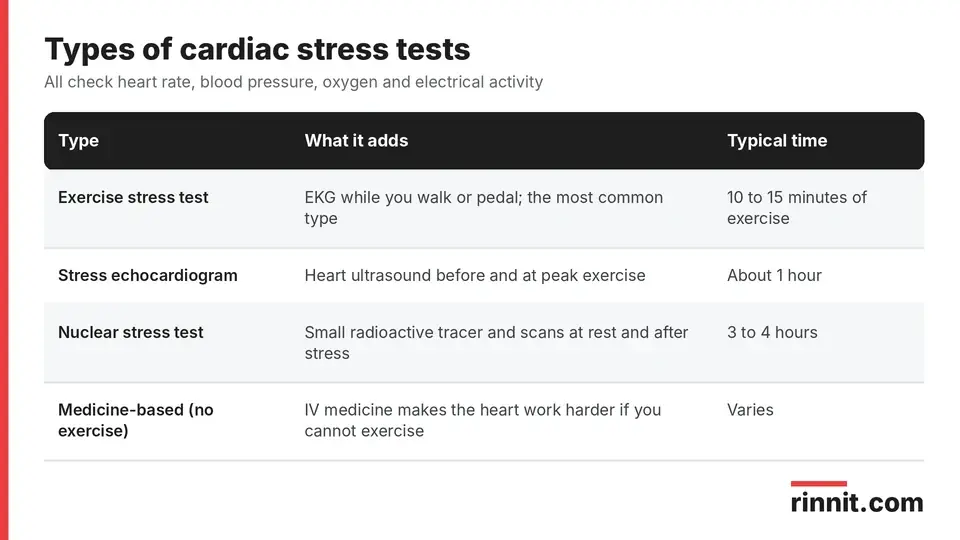
Imaging stress tests give more detail but take longer.
Type | What it adds | Typical time |
Exercise stress test | EKG while you walk or pedal; the most common type | 10 to 15 minutes of exercise |
Stress echocardiogram | Heart ultrasound before and at peak exercise | About 1 hour |
Nuclear stress test | Small radioactive tracer with SPECT or PET scans at rest and after stress | Usually 3 to 4 hours |
Cardiac rehab stress test | Entrance and exit tests to set and track an exercise program | Varies |
Sources: [1]
A stress echo may be used if a basic stress test is unclear. A nuclear test compares blood flow to the heart muscle at rest and after stress; a drop in flow usually points to a blocked artery. [1]
How do you prepare for a stress test?
Follow your provider's instructions. In general: [1]
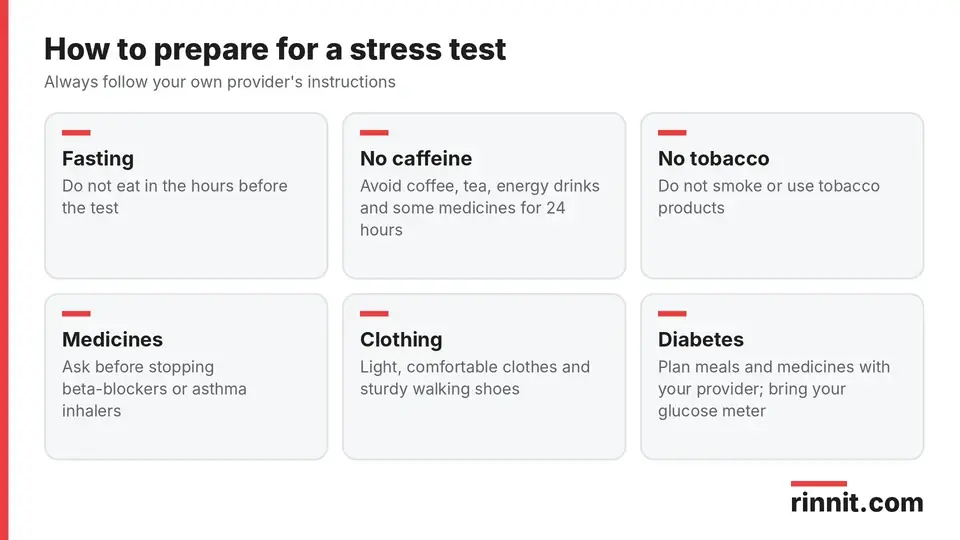
Small steps before the test help give accurate results.
Do not eat in the hours before the test; for a nuclear test, you may not eat until afterward.
Avoid caffeine for 24 hours, including coffee, tea, energy drinks and some over-the-counter medicines.
Do not smoke or use tobacco.
Ask whether to stop medicines such as beta-blockers or asthma inhalers on test day.
Try to relax, since anxiety can affect results.
Wear light, comfortable clothes and sturdy walking shoes.
If you have diabetes, do not skip meals around your medicines; plan with your diabetes care provider and bring your glucose meter. [1]
What happens during an exercise stress test?
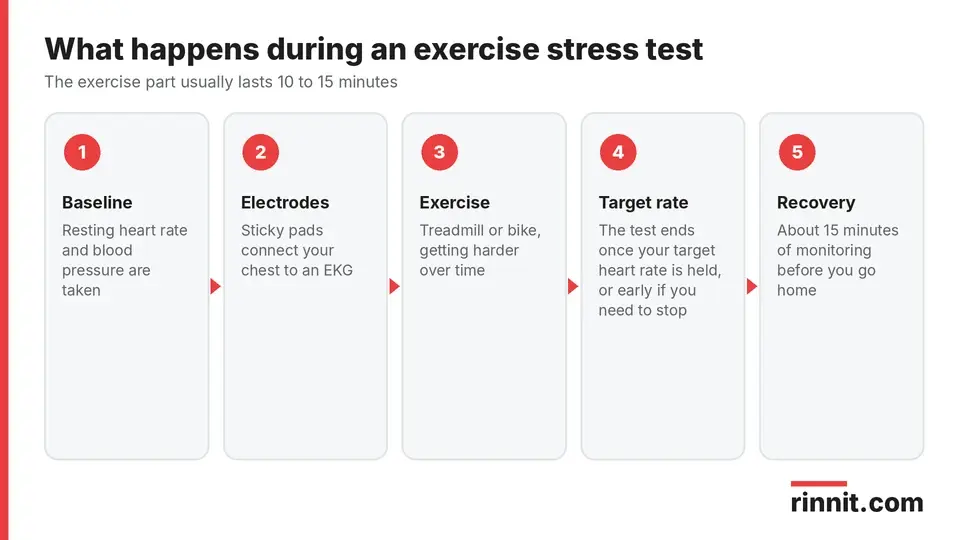
You can ask to stop the test at any time.
A technician takes your resting heart rate and blood pressure.
Small sticky electrodes are placed on your chest and arms and connected to the EKG.
You walk on a treadmill or pedal a bike at an easy pace.
The pace gradually gets more intense but stays manageable, and staff ask how you feel.
The test ends once you hold your target heart rate long enough, usually after 10 to 15 minutes, or earlier if you have severe symptoms or ask to stop.
Staff monitor you for about 15 minutes until your heart rate, blood pressure and EKG return to normal.
Sources: [1]
If you cannot exercise, you receive medicine through an IV that makes your heart pump harder and faster; it can take up to an hour to feel the effects. [1]
Is a stress test safe?
With no contraindications, exercise stress tests are safe and very few people have complications. An exercise physiologist and cardiologist are present to watch your data and symptoms and give emergency treatment if needed. You can stop at any time if you feel anxious or uncomfortable. [1]
What do stress test results mean?
Normal results
Your heart pumps as it should and gets enough blood flow. What this means depends on why you had the test: [1]
Symptom check: your symptoms are not from a heart problem, and other causes may need checking.
Exercise or surgery planning: your heart is healthy enough to start exercising or have surgery.
Monitoring: your current treatment is working.
Abnormal results
Abnormal results may mean heart disease. For mild disease, your provider may recommend lifestyle changes and medicines for diabetes, blood pressure or cholesterol. If changes appear early in the test or affect large areas of the heart, you may need cardiac catheterization, CT coronary angiography, a nuclear stress test or a stress echocardiogram. [1]
Conclusion
An exercise stress test is a common, safe way to see how your heart copes with hard work and whether your symptoms come from your heart. It takes about 10 to 15 minutes of exercise, and medicine can stand in if you cannot exercise.
Prepare by skipping food and caffeine, and ask which of your medicines to pause. Your results guide whether you need treatment, more tests or simply reassurance.
Keep learning: Read our coronary artery disease guide or our angina guide. For more background, see the MedlinePlus page on stress tests.
FAQ
What is an exercise stress test?
It is a heart test done while you walk on a treadmill or pedal a bike, with an EKG and blood pressure checks, to see how your heart handles hard work.
Why would I need a stress test?
To look for heart problems such as coronary artery disease when you have chest pain, shortness of breath, palpitations or dizziness, or before surgery or exercise.
How long does a stress test take?
The exercise part lasts about 10 to 15 minutes; tests with imaging can take up to three or four hours.
How do I prepare for a stress test?
Don't eat beforehand, avoid caffeine for 24 hours, avoid tobacco, wear comfortable clothes and ask about your medicines.
What if I can't exercise?
You receive medicine through an IV that makes your heart work harder, as exercise would.
Is a stress test safe?
Yes, when there are no contraindications; trained staff watch you throughout and you can stop at any time.
Who should not have a stress test?
People with conditions such as aortic dissection, recent heart attack, severe aortic stenosis, uncontrolled arrhythmia or ongoing chest pain.
What does a normal stress test mean?
Your heart pumps as it should and gets enough blood flow during exercise.
What happens if my stress test is abnormal?
You may need lifestyle changes, medicine or more tests such as cardiac catheterization or CT angiography.
What is the difference between an exercise and a nuclear stress test?
A nuclear test adds a small radioactive tracer and heart scans at rest and after stress.
Related Reading
Pharmacological Nuclear Stress Test: Heart Imaging Without Exercise explains the medicine-based nuclear stress test for people who can't exercise.
Cardiac MRI Adenosine Stress Test: Prep, Side Effects and Results explains the stress heart MRI that uses adenosine instead of exercise.
Coronary Artery Disease: Symptoms, Causes, Diagnosis, Treatment and Prevention — What You Need to Know explains the condition stress tests most often look for.
Angina: Symptoms, Causes, Treatment & Complete Guide covers the chest pain that often leads to a stress test.
Heart Arrhythmia: Symptoms, Types, Causes, Diagnosis & Treatment — Complete Guide describes rhythm problems a stress test can bring out.
Heart Failure: Symptoms, Causes & Treatment Guide explains another condition stress testing helps evaluate.
Exercise Stress Echocardiogram: Why It's Done, How to Prepare and What Results Mean explains the heart ultrasound done at rest and after exercise.
Cardiopulmonary Exercise Test (CPET): What It Measures, How to Prepare and What to Expect explains the exercise test that measures heart, lung and muscle performance together.
References
Cleveland Clinic. Stress Test: Purpose, Procedure, Risks and Results. Cleveland Clinic. Last updated January 17, 2022. https://my.clevelandclinic.org/health/diagnostics/16984-exercise-stress-test
Gianrossi R, Detrano R, Mulvihill D, et al. Exercise-induced ST depression in the diagnosis of coronary artery disease. A meta-analysis. Circulation. 1989;80(1):87-98. PMID 2661056. https://doi.org/10.1161/01.cir.80.1.87
Mark DB, Shaw L, Harrell FE Jr, et al. Prognostic value of a treadmill exercise score in outpatients with suspected coronary artery disease. N Engl J Med. 1991;325(12):849-853. PMID 1875969. https://doi.org/10.1056/NEJM199109193251204
Medical disclaimer
This article is for general education only and does not replace advice from a qualified healthcare professional. Talk to your doctor about your own diagnosis and treatment, and seek emergency care right away for severe or sudden symptoms.



Comments