Cardiac MRI Adenosine Stress Test: Prep, Side Effects and Results

Updated: 3 days ago
Written and medically reviewed by Dr. Baraa Alnahhal, MD · Last reviewed: November 2026 · How we review
Quick Answer
A cardiac MRI adenosine stress test checks blood flow to the heart muscle at rest and under stress without exercise. Adenosine given through an IV widens the coronary arteries the way exercise would, and a heart MRI shows areas that don't get enough blood. Avoid caffeine for 24 hours beforehand. The scan lasts about 45 minutes.
What the research says
Stress cardiac MRI is more sensitive than SPECT: in 752 people with suspected coronary heart disease, cardiac MRI with adenosine stress had 86.5% sensitivity and 83.4% specificity, compared with 66.5% and 82.6% for SPECT nuclear imaging (Greenwood JP et al., Lancet, 2012) [2]
It can guide treatment as well as invasive testing: in 918 people with stable angina, a stress MRI strategy led to fewer artery-opening procedures than invasive FFR testing (35.7% vs. 45.0%) with similar heart events at 1 year (3.6% vs. 3.7%) (Nagel E et al., New England Journal of Medicine, 2019) [3]
Key takeaways
The test shows heart blood flow at rest and under medicine-induced stress.
Adenosine mimics exercise by widening the coronary arteries.
Avoid all caffeine, including decaf, for 24 hours before.
The scan takes about 45 minutes; the visit may last up to 2 hours.
About 80% of people feel brief side effects such as flushing or chest pressure.
What is a cardiac MRI adenosine stress test?
Narrowed coronary arteries may supply enough blood at rest but not when the heart works harder. A stress test makes the heart's blood demand visible. Instead of a treadmill, adenosine dilates the arteries, so healthy arteries carry much more blood while narrowed ones can't keep up. MRI images show these differences without radiation. A similar test can be done with a radioactive tracer as a nuclear stress test. Sources: [1]
Why it's done

Medicine replaces exercise for the stress part of the test.
You can't do an exercise stress test or can't raise your heart rate enough.
You take beta-blockers, have a ventricular pacemaker or have left bundle branch block.
To check heart size and function, blood flow and heart muscle damage.
To find and assess coronary artery disease. Sources: [1]
People with severe asthma or certain uncontrolled heart rhythm problems usually shouldn't have adenosine. Sources: [1]
How to prepare
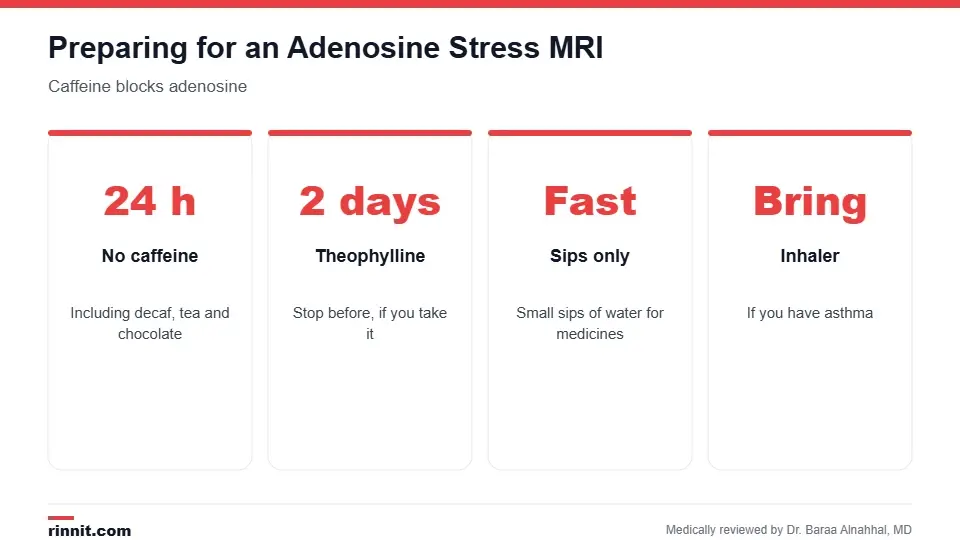
Caffeine blocks adenosine, so avoiding it is essential.
No caffeine for 24 hours: coffee, tea, soda, chocolate, decaf products and caffeine-containing medicines.
Stop theophylline 2 days before, if you take it, and bring your asthma inhaler.
Don't eat or drink except small sips of water to take medicines, and don't smoke.
Take only the heart medicines your provider approves that day.
If you have diabetes, ask how to adjust insulin; you may have a light meal 4 hours before and take diabetes pills after the test.
Tell your provider about implanted devices and all medicines and supplements. Sources: [1]
What happens during the test
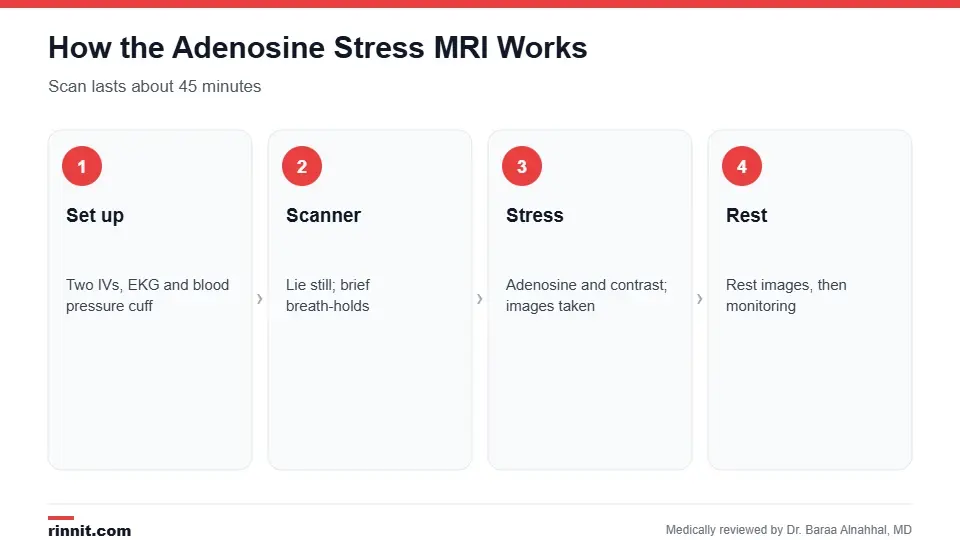
The scan lasts about 45 minutes.
Two IVs are placed, and EKG electrodes and a blood pressure cuff are attached.
You lie on the MRI table and hold your breath briefly when asked.
Adenosine is infused for a few minutes while images and contrast show blood flow under stress.
Images are also taken at rest for comparison.
You're monitored afterward, and most people go home within minutes. Sources: [1]
Side effects and risks
Medicine | Common effects | Notes |
Adenosine | Flushing, chest pain, shortness of breath in about 80% | Fades within seconds after the infusion stops |
Regadenoson (Lexiscan) | Less flushing and chest pain; more headache | Given as a 10-second injection; slightly higher seizure risk |
Rarely, adenosine causes heart block or tightening of the airways, which is treated with caffeine or aminophylline. Sources: [1]
Results
Results are usually available within a few days and are often grouped as low, intermediate or high risk. A normal test suggests good blood flow. Areas with reduced blood flow under stress suggest narrowed arteries, which may lead to a coronary angiogram, a stent or bypass surgery. Sources: [1]
Conclusion
A cardiac MRI adenosine stress test shows how well blood reaches your heart muscle without needing a treadmill or radiation. With good preparation, especially avoiding caffeine, it gives your care team clear information to guide treatment.
Keep learning: read about cardiac MRI and the nuclear stress test.
Frequently asked questions
What is an adenosine stress MRI?
A heart MRI that uses adenosine to show blood flow under stress.
Why use adenosine instead of exercise?
For people who can't exercise enough or have certain heart conditions.
Why can't I have caffeine?
Caffeine blocks adenosine and can make the test inaccurate.
How long before the test should I avoid caffeine?
24 hours, including decaf and chocolate.
Does adenosine feel uncomfortable?
Many people feel brief flushing or chest pressure that fades quickly.
How long does the test take?
The scan is about 45 minutes; the visit may take up to 2 hours.
Who shouldn't have this test?
People with severe asthma or certain uncontrolled heart rhythms.
Does it use radiation?
No. MRI uses magnets and radio waves.
Can I drive home?
Most people can go home shortly after; ask your care team.
What happens if results are abnormal?
You may need a coronary angiogram, stent or bypass surgery.
Related Reading
Pharmacological Nuclear Stress Test: Heart Imaging Without Exercise explains the medicine-based nuclear stress test for people who can't exercise.
Heart MRI (Cardiac MRI): What It Shows, How to Prepare, What Happens and Results the imaging test used in this stress test.
Nuclear Stress Test: How It Works, How to Prepare and What Results Mean a stress test that uses a radioactive tracer.
Exercise Stress Test: Why It's Done, How to Prepare, What Happens and Results the treadmill version of a stress test.
Coronary Artery Disease: Symptoms, Causes, Diagnosis, Treatment and Prevention — What You Need to Know the main condition this test looks for.
Coronary Angiogram: Why It's Done, What to Expect and Recovery the test that may follow an abnormal result.
References
Cleveland Clinic. Adenosine Stress Test. Cleveland Clinic. Last updated September 11, 2023. https://my.clevelandclinic.org/health/diagnostics/16839-cardiac-mri-adenosine-stress-test
Greenwood JP, Maredia N, Younger JF, et al. Cardiovascular magnetic resonance and single-photon emission computed tomography for diagnosis of coronary heart disease (CE-MARC): a prospective trial. Lancet. 2012;379(9814):453-460. PMID 22196944. https://doi.org/10.1016/S0140-6736(11)61335-4
Nagel E, Greenwood JP, McCann GP, et al. Magnetic resonance perfusion or fractional flow reserve in coronary disease. New England Journal of Medicine. 2019;380(25):2418-2428. PMID 31216398. https://doi.org/10.1056/NEJMoa1716734
Medical disclaimer
This article is for general education only and does not replace advice from a qualified healthcare professional. Talk to your doctor about your own diagnosis and treatment, and seek emergency care right away for severe or sudden symptoms.



Comments