Nuclear Stress Test: How It Works, How to Prepare and What Results Mean

Updated: 2 days ago
Written and medically reviewed by Dr. Baraa Alnahhal, MD · Last reviewed: November 2026 · How we review
Quick Answer: What is a nuclear stress test?
A nuclear stress test is a heart imaging test that shows how well blood flows to the heart muscle at rest and under stress. A radioactive tracer is injected, and a camera takes pictures before and after exercise. Areas with poor blood flow can point to coronary artery disease or damage from a past heart attack. [1]
What the research says
Heart imaging adds a lot to an exercise ECG alone. In a meta-analysis of 132 studies (28,664 patients), a stress ECG alone could confirm significant coronary disease only when the starting probability was at least 80%, while functional scans such as SPECT and PET could do so from about 46% to 59%. (Knuuti et al., European Heart Journal, 2018) [2]
PET is better than SPECT at ruling out blockages that limit blood flow. Pooling 37 studies (2,048 patients) checked against invasive pressure-wire testing, the negative likelihood ratio was 0.14 for PET versus 0.39 for SPECT, meaning a normal PET scan lowers the odds of disease more. (Takx et al., Circulation: Cardiovascular Imaging, 2015) [3]
Key takeaways
A nuclear stress test shows blood flow to your heart at rest and under stress using a tracer and a special camera. [1]
It helps diagnose and monitor coronary artery disease and can show heart damage from a heart attack. [1]
You'll exercise on a treadmill or bike for 6 to 12 minutes, or receive medicine if you can't exercise. [1]
Avoid caffeine for 24 hours and tobacco for 8 hours, and fast for 4 to 6 hours unless your provider says otherwise. [1]
The radiation dose is small and considered very safe, but the test isn't right for everyone. [1]
What is a nuclear stress test?
A nuclear stress test is a heart imaging tool that helps providers see blood flow in your heart muscle. A special camera picks up a radioactive tracer injected into your blood. Heart muscle that doesn't get enough blood takes up the tracer differently, so it looks different on the pictures. [1]
Cardiologists use the test to diagnose and monitor coronary artery disease (CAD), where heart arteries become clogged or blocked. It can also show whether your heart muscle is pumping well and whether a heart attack has damaged it. [1]
Other names for the test include: [1]
Myocardial perfusion imaging (MPI)
Nuclear cardiac stress test
Cardiac SPECT (single-photon emission computed tomography)
Cardiac PET (positron emission tomography)
Exercise vs medicine stress
To stress your heart, you either exercise on a treadmill or stationary bike to reach a target heart rate, which is an exercise stress test combined with imaging, or, if you can't exercise, you receive medicine that increases blood flow as if you were active. This is called a pharmacological stress test. [1]
Why would you need a nuclear stress test?
Your provider may suggest this test if: [1]
You have chest pain or angina
They want to check how fit your heart is before a procedure
They want to look for scarring or areas with too little blood flow (ischemia) in your heart
You already have CAD and they want to see whether treatment is working
How do you prepare for a nuclear stress test?
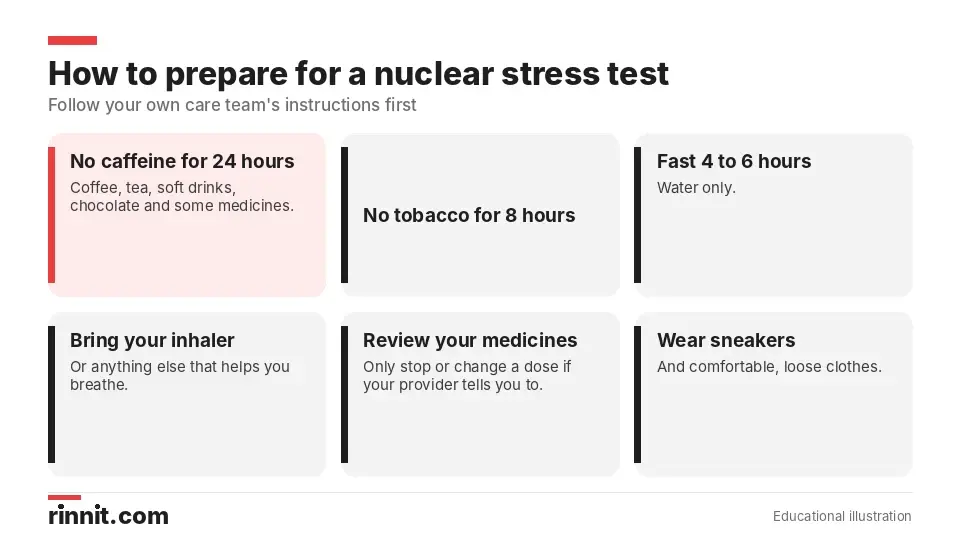
Preparation mostly means skipping caffeine and tobacco and coming in on an empty stomach.
Your provider will give you instructions. They may include: [1]
Avoid foods, drinks and medicines that contain caffeine for 24 hours before the test, such as coffee, tea, soft drinks and chocolate.
Don't use tobacco products for 8 hours before the test.
Fast for 4 to 6 hours beforehand (water only).
Bring anything that helps you breathe, like your inhaler.
Tell your provider about every medicine you take, including over-the-counter drugs, supplements and recreational drugs.
Stop or change medicines only if your provider tells you to.
Wear sneakers and comfortable, loose clothes.
What happens during a nuclear stress test?
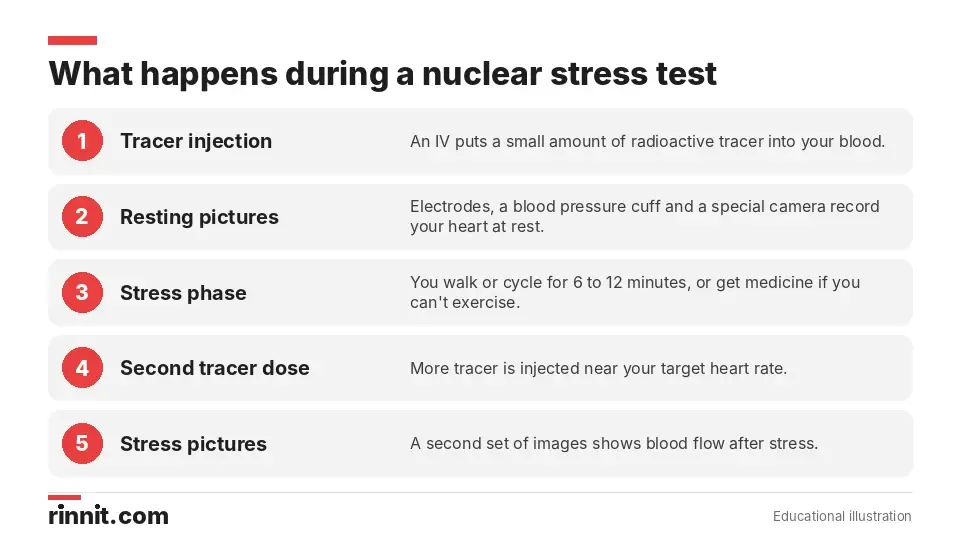
The test pairs a resting scan with a scan after your heart works harder.
A technician or other provider usually performs the test in a hospital or clinic. They will: [1]
Insert an IV into your arm and inject the tracer, which may feel cold at first.
Wait a few minutes for the tracer to reach your heart.
Place electrode patches on your chest, arms and legs and connect them to an EKG machine. They may shave some hair so the patches stick.
Put a cuff on your arm to monitor your blood pressure.
Ask you to lie still on a table while a special camera takes the first set of pictures.
Have you exercise for 6 to 12 minutes on a treadmill or bike, starting slowly and pushing harder, until you reach a target heart rate or have bothersome symptoms. You can stop if you're uncomfortable.
Inject more tracer into your bloodstream.
Take a second set of pictures after exercise.
If you can't exercise, the provider injects medicine into your arm that stimulates your heart and increases blood flow instead. [1]
What are the risks of a nuclear stress test?
The test exposes you to a small amount of radiation. These low-dose tracers are considered very safe. Some people are allergic to the tracer or have flushing, nausea or shortness of breath. [1]
Rarely, people have more serious effects, such as: [1]
An abnormal heart rhythm (arrhythmia)
Chest pain
A heart attack
Low blood pressure (hypotension)
Who shouldn't have a nuclear stress test?
The test may harm a fetus or nursing baby, so ask your provider whether you can wait until after delivery or store breast milk in advance. You also shouldn't have it if you have certain severe or unmanaged problems, such as acute coronary syndrome, aortic dissection, aortic stenosis or hypertrophic cardiomyopathy. [1]
What do nuclear stress test results mean?
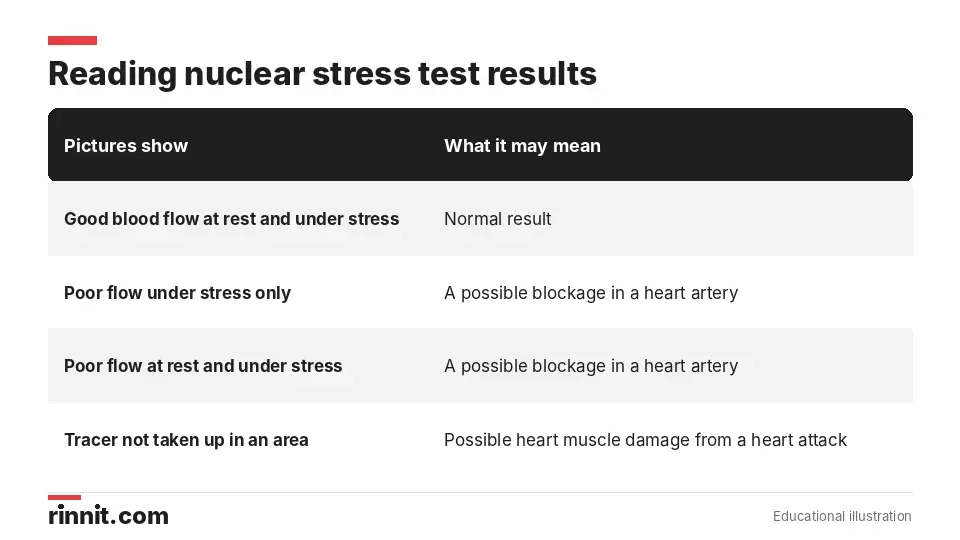
A cardiologist or radiologist compares your resting and stress pictures.
Results may take a few days, because a cardiologist or radiologist must review and interpret the images. [1]
What the pictures show | What it may mean |
Good blood flow at rest and under stress | A normal result |
Poor blood flow under stress only | A possible blockage in an artery that supplies your heart |
Poor blood flow at rest and under stress | A possible blockage in an artery that supplies your heart |
The tracer isn't picked up in an area | Possible heart muscle damage from a heart attack |
Sources: [1]
What happens if results are abnormal?
Your provider may recommend a coronary angiogram, where dye is put into your heart's arteries to see how well it flows through. If blockages are reducing blood flow, the goal is to keep CAD from getting worse and prevent a heart attack. That may mean: [1]
Stopping tobacco and lowering salt
Managing high blood pressure or cholesterol
Angioplasty and a stent to open a blocked artery
Coronary artery bypass surgery (CABG) to route blood around a blockage
You can read more about how angiograms are done in our cardiac catheterization guide.
Recovery and when to call your provider
Most people go back to normal activities right away, though you may feel tired for a while. Contact your provider if you have mild side effects such as nausea or shortness of breath. Seek medical care right away for chest pain or other heart attack symptoms, or if your heart rhythm feels off. [1]
Conclusion
A nuclear stress test shows how well blood reaches your heart muscle when it's resting and when it's working hard. It's a common, generally safe way to find blocked heart arteries and to check on heart damage or treatment progress. [1]
Follow your preparation instructions closely, especially the caffeine and fasting rules, and tell your provider about every medicine you take. The sooner you're tested, the sooner you can start treatment if you need it. [1]
Keep learning: Read our coronary artery disease guide or our angina guide. For more background, see the American Heart Association page on myocardial perfusion imaging.
FAQ
What is a nuclear stress test?
A heart imaging test that uses a small amount of radioactive tracer and a special camera to show blood flow to your heart at rest and under stress. [1]
What does a nuclear stress test show?
It shows whether blood flows well to your heart muscle, possible artery blockages, how well your heart pumps and damage from a past heart attack. [1]
How long should I avoid caffeine before a nuclear stress test?
Usually 24 hours, including coffee, tea, soft drinks, chocolate and caffeinated medicines. [1]
Can I eat before a nuclear stress test?
You'll usually fast for 4 to 6 hours before the test, drinking only water. [1]
How long do you exercise during the test?
Usually 6 to 12 minutes on a treadmill or bike, until you reach a target heart rate or have symptoms. [1]
What if I can't exercise?
You'll get medicine through an IV that stresses your heart and increases blood flow as if you were exercising. [1]
Is a nuclear stress test safe?
Yes, for most people. The radiation dose is low and considered very safe, though rare side effects include arrhythmia, chest pain or low blood pressure. [1]
Who should not have a nuclear stress test?
People who are pregnant or breastfeeding, and people with severe or unmanaged acute coronary syndrome, aortic dissection, aortic stenosis or hypertrophic cardiomyopathy. [1]
How long do results take?
Usually a few days, because a cardiologist or radiologist must review the images. [1]
What happens if my nuclear stress test is abnormal?
Your provider may order a coronary angiogram and discuss lifestyle changes, medicines, stents or bypass surgery. [1]
Related Reading
MUGA Scan: Measuring How Well Your Heart Pumps explains the nuclear scan that measures ejection fraction.
Coronary Flow Reserve (CFR): What It Measures and Normal Values explains how coronary flow reserve shows the heart's ability to boost blood flow.
Pharmacological Nuclear Stress Test: Heart Imaging Without Exercise explains the medicine-based nuclear stress test for people who can't exercise.
Cardiac MRI Adenosine Stress Test: Prep, Side Effects and Results explains the stress heart MRI that uses adenosine instead of exercise.
Nuclear Medicine Imaging: How Tracer Scans Work, Safety and Results explains how tracer-based scans show how organs work.
Cardiac Imaging: Types of Heart Scans and What Each One Shows compares the main heart imaging tests and what each one shows.
Dobutamine Stress Echocardiogram: How It Works, Preparation and Results explains the medicine-based stress test for people who can't exercise.
Coronary Artery Disease: Symptoms, Causes, Diagnosis, Treatment and Prevention — What You Need to Know explains the condition a nuclear stress test is most often used to diagnose.
Angina: Symptoms, Causes, Treatment & Complete Guide covers the chest pain that often leads to stress testing.
Heart Attack Symptoms and Treatment: A Complete Guide explains the heart damage this test can reveal.
Exercise Stress Echocardiogram: Why It's Done, How to Prepare and What Results Mean explains the heart ultrasound done at rest and after exercise.
SPECT Scan: How It Works, What It Shows and What to Expect explains the nuclear medicine scan that shows how the heart, brain and bones work.
Cardiac PET Scan: Heart Blood Flow Imaging, Prep and Results explains the nuclear scan that shows blood flow to the heart muscle.
References
Cleveland Clinic. Nuclear Stress Test. Cleveland Clinic. Last updated September 23, 2025. https://my.clevelandclinic.org/health/diagnostics/17276-nuclear-cardiac-stress-test
Knuuti J, Ballo H, Juarez-Orozco LE, et al. The performance of non-invasive tests to rule-in and rule-out significant coronary artery stenosis in patients with stable angina: a meta-analysis focused on post-test disease probability. Eur Heart J. 2018;39(35):3322-3330. PMID 29850808. https://doi.org/10.1093/eurheartj/ehy267
Takx RA, Blomberg BA, El Aidi H, et al. Diagnostic accuracy of stress myocardial perfusion imaging compared to invasive coronary angiography with fractional flow reserve meta-analysis. Circ Cardiovasc Imaging. 2015;8(1):e002666. PMID 25596143. https://doi.org/10.1161/CIRCIMAGING.114.002666
Medical disclaimer
This article is for general education only and does not replace advice from a qualified healthcare professional. Talk to your doctor about your own diagnosis and treatment, and seek emergency care right away for severe or sudden symptoms.



Comments