Cardiac Catheterization (Heart Cath): Why It's Done, Procedure, Risks and Recovery

Updated: 2 days ago
Written and medically reviewed by Dr. Baraa Alnahhal, MD · Last reviewed: November 2026 · How we review
Quick Answer: What is cardiac catheterization?
Cardiac catheterization (a heart cath) is a minimally invasive procedure in which a cardiologist threads a catheter through a blood vessel in the arm or groin to the heart. With contrast dye and X-rays, it shows blockages in the coronary arteries, checks the valves and heart muscle, and measures pressures and oxygen levels. You stay awake with a sedative. [1]
What the research says
Going through the wrist means fewer access-site problems. In a trial of 7,021 people with acute coronary syndromes, wrist (radial) access had similar rates of death, heart attack, stroke and major bleeding as groin (femoral) access, but far fewer large hematomas (42 vs 106 patients) and pseudoaneurysms needing closure (7 vs 23). (Jolly et al., The Lancet, 2011) [2]
Measuring pressure across a blockage leads to better stenting decisions. In 1,005 people with multivessel coronary disease, guiding stents with fractional flow reserve (FFR) lowered the 1-year rate of death, heart attack or repeat procedures from 18.3% to 13.2% and used fewer stents. (Tonino et al., The New England Journal of Medicine, 2009) [3]
Key takeaways
A heart cath is not surgery; it needs only a small puncture in the arm, neck or groin. [1]
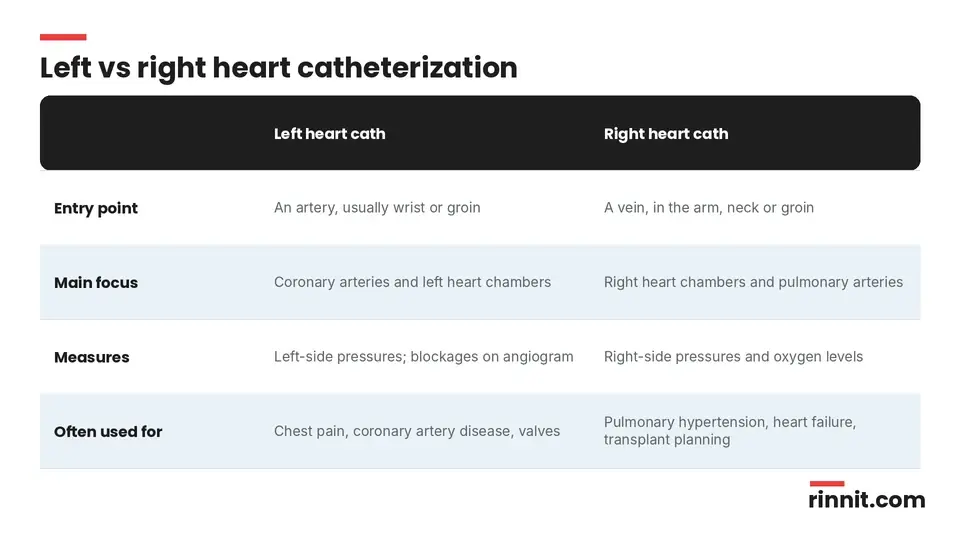
Left heart cath goes through an artery; right heart cath goes through a vein. [1]
Blockages found during the test can often be treated right away with angioplasty or a stent. [1]
Plan for 5 to 9 hours or more at the hospital, and arrange a ride home. [1]
Complications are rare; more than a million heart caths are done in the U.S. each year. [1]
Types of cardiac catheterization
Type | How it's done | What it checks |
Left heart catheterization | Through an artery | Coronary arteries, heart chambers and left-side pressures |
Right heart catheterization | Through a vein | Heart chambers and right-side pressures, including the pulmonary arteries |
Sources: [1]
Why is a cardiac catheterization done?
Your provider may recommend a heart cath to: [1]
Find the cause of chest pain or an abnormal heart rhythm
Confirm problems with the coronary arteries or heart valves
Check how well the heart muscle works and diagnose cardiomyopathy
Check the pulmonary arteries and diagnose pulmonary hypertension
Measure blood flow, oxygen levels and pressures inside the heart
Take a blood sample or a tiny piece of heart muscle (biopsy)
Get information other tests couldn't provide
Decide on treatment, such as clearing a blockage, placing a stent or referring for bypass surgery (CABG)
Help plan a heart transplant
A specially trained cardiologist does the procedure with a team of cardiology fellows, nurses and technicians. [1]
How does a heart cath work?
Contrast dye outlines your blood vessels and heart chambers while X-ray "movies" (a coronary angiogram) track it through the heart. The images can show where an artery is narrowed or blocked, the size and shape of the chambers and vessels, and any abnormal leaks or holes. [1]
For more detail, your team may also use: [1]
Intravascular ultrasound (IVUS) to see plaque, calcium and stent placement
Fractional flow reserve (FFR) to measure pressure across a blockage and judge whether it needs treatment
Optical coherence tomography (OCT) for detailed images from inside the vessels
Treatments that can be done during a cath
Treatment | What it does |
Angioplasty | Opens a narrowed artery with a small balloon |
Stent placement | Props the artery open with a small mesh tube |
Valvuloplasty | Opens a narrowed heart valve |
Rotablation | Removes calcium deposits |
Intravascular lithotripsy | Breaks up calcium with pressure waves |
Cardiac ablation | Corrects an abnormal heart rhythm |
Sources: [1]
How do you prepare for a cardiac catheterization?
Stop eating and drinking, usually 6 to 8 hours before.
Stop or adjust medicines only if your provider tells you to.
Tell your team about all allergies and medicines.
Arrange for someone to drive you home.
Sources: [1]
When you arrive, you'll change into a gown, get an IV line and lie on a table under an X-ray camera. The insertion site is cleaned, EKG stickers go on your chest, and you get a mild sedative. You stay awake the whole time, and your team explains what to tell them, such as signs of an allergic reaction, nausea or chest discomfort. [1]
What happens during a cardiac catheterization?
Numbing medicine is injected under the skin.
A plastic sheath is placed in a blood vessel in your arm, neck or groin.
The catheter is threaded through the sheath to your heart. You may feel pressure, but not pain.
You may be asked to turn your head or take and hold a deep breath to help position it.
Lights are dimmed and contrast dye is injected. You may feel warm or flushed for a few seconds.
X-ray images are taken as the dye flows; you may need to hold your breath.
The catheter and sheath are removed while you stay still, and the lights come back on.
Sources: [1]
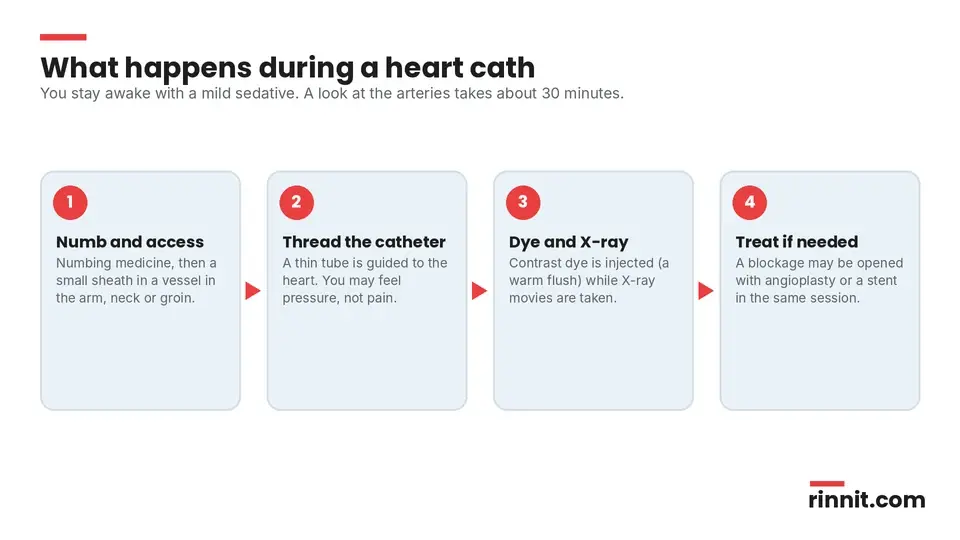
Looking only at the coronary arteries generally takes about 30 minutes. Preparation and recovery add several hours, so the whole visit may last 5 to 9 hours or longer. Treatments like angioplasty can add a couple of hours. [1]
Recovery after a heart cath
Recovery depends on where the catheter went in. [1]

Arm (wrist) access | Groin access | |
Closing the site | Bandage over the puncture | Pressure, a suture device or a plug |
Right after | Keep the arm straight at least 1 hour; walking is allowed | Lie flat with the leg straight for 2 to 6 hours, with your head no higher than two pillows |
Report right away | Bleeding (a warm, wet feeling) or finger numbness or tingling | Bleeding, or toe numbness or tingling |
Sources: [1]
You'll be watched for several hours and may go home the same day or stay overnight. [1]
Drink plenty of fluids to flush out the contrast dye.
Don't drive for about 24 hours after leaving the hospital.
If the ride home is over two hours, stay in a hotel nearby; on long rides, stop every hour to walk for 5 to 10 minutes.
Avoid strenuous activity, sports and lifting for 2 to 5 days, depending on the access site.
Shower after 24 hours, but don't soak the site in a bath or pool for one week.
Ask your provider when you can return to work and how to care for the wound.
Sources: [1]
What are the risks of cardiac catheterization?
Complications are rare, but can include: [1]
An allergic reaction or low blood pressure
An irregular heart rhythm or continued chest pain
Bleeding or infection at the insertion site
Kidney failure
A collapsed lung (pneumothorax) or fluid around the heart (cardiac tamponade)
Blood clots, heart attack, stroke or, very rarely, death
The need for emergency surgery such as CABG
What do the results mean?
Your provider may discuss results right away; a heart muscle biopsy can take a few days. A heart cath may: [1]
Find a problem, like a blockage, and fix it during the procedure
Diagnose a condition that needs surgery
Gather information to plan your treatment
Show your heart is working well after earlier treatment
If results are abnormal, another procedure or surgery may be scheduled. [1]
When should you call your doctor?
Call your provider if you have: [1]
Fever
Dizziness
Pain, swelling, bleeding or discharge at the catheter site
Chest pain or shortness of breath
An abnormal heart rhythm
Call emergency services right away if you think you're having a heart attack or stroke. [1]
Conclusion
Cardiac catheterization gives your heart team a direct look at your coronary arteries, valves and heart pressures through a small puncture, and often lets them treat a blockage in the same session. Most people go home the same day or the next morning.
If a heart cath is planned for you, ask which access site will be used, whether a stent might be placed, and how long you should avoid driving and lifting afterward.
Keep learning: Read our guide to angina or compare stenting and bypass surgery. For more background, see the NHLBI overview of cardiac catheterization.
FAQ
What is a cardiac catheterization?
It's a procedure that threads a thin tube through a blood vessel to the heart to take pictures and measurements.
Is a heart cath considered surgery?
No. It's a minimally invasive procedure through a small puncture, without a large incision.
Are you awake during a cardiac catheterization?
Yes. You get a mild sedative and numbing medicine but stay awake.
How long does a cardiac catheterization take?
About 30 minutes to look at the arteries, but the whole visit often lasts 5 to 9 hours or more.
Does a heart cath hurt?
Usually not. You may feel pressure when the catheter goes in and warmth when the dye is injected.
What is the difference between left and right heart catheterization?
Left heart cath goes through an artery to check the coronary arteries; right heart cath goes through a vein to measure right-side pressures.
Can a stent be placed during a heart cath?
Yes. Blockages can often be treated during the same procedure with angioplasty or a stent.
How long is recovery after a cardiac cath?
Most people avoid driving for 24 hours and avoid strenuous activity for 2 to 5 days.
What are the risks of cardiac catheterization?
Complications are rare and include bleeding, infection, rhythm problems, kidney injury and, very rarely, heart attack or stroke.
Do I need to fast before a cardiac catheterization?
Yes, usually for 6 to 8 hours before the procedure.
When should I call a doctor after a heart cath?
Call for fever, dizziness, chest pain, shortness of breath or bleeding, swelling or discharge at the site.
Related Reading
Angioplasty: Procedure, Types, Risks and Recovery explains how angioplasty opens narrowed arteries.
Fractional Flow Reserve (FFR): Deciding Whether You Need a Stent explains the pressure wire test that shows whether a blockage needs a stent.
Heart Biopsy (Endomyocardial Biopsy): Procedure, Risks and Results explains the catheter procedure that takes tiny samples of heart muscle.
Coronary Flow Reserve (CFR): What It Measures and Normal Values explains how coronary flow reserve shows the heart's ability to boost blood flow.
Intravascular Ultrasound (IVUS): Seeing Inside Arteries to Guide Stents explains the catheter ultrasound that images arteries from the inside.
Angina: Symptoms, Causes, Treatment & Complete Guide explains chest pain from narrowed heart arteries, a common reason for a heart cath.
NSTEMI Heart Attack: Essential Guide to Symptoms, Risks, and Recovery covers a type of heart attack often diagnosed and treated in the cath lab.
Coronary Revascularization: PCI vs. Bypass Surgery, Risks and Recovery compares stenting and bypass surgery, the treatments a heart cath helps choose between.
Pulmonary Hypertension: Complete Guide to Symptoms, Causes, Diagnosis, and Treatment explains high lung-artery pressure, which right heart catheterization confirms.
Aortic Stenosis: Narrowed Heart Valve Symptoms, Causes & Treatment covers a narrowed heart valve that a heart cath can assess.
References
Cleveland Clinic. Cardiac Catheterization: Procedure & Recovery. Cleveland Clinic. Last updated March 4, 2025. https://my.clevelandclinic.org/health/diagnostics/16832-cardiac-catheterization
Jolly SS, Yusuf S, Cairns J, et al. Radial versus femoral access for coronary angiography and intervention in patients with acute coronary syndromes (RIVAL): a randomised, parallel group, multicentre trial. Lancet. 2011;377(9775):1409-1420. PMID 21470671. https://doi.org/10.1016/S0140-6736(11)60404-2
Tonino PAL, De Bruyne B, Pijls NHJ, et al. Fractional flow reserve versus angiography for guiding percutaneous coronary intervention. N Engl J Med. 2009;360(3):213-224. PMID 19144937. https://doi.org/10.1056/NEJMoa0807611
Medical disclaimer
This article is for general education only and does not replace advice from a qualified healthcare professional. Talk to your doctor about your own diagnosis and treatment, and seek emergency care right away for severe or sudden symptoms.



Comments